JEE Main · Physics → Steady

Electrostatics appeared 79 times across 3 years — 9.1% of Physics. This question is from Capacitors and Capacitance.

Year 2026 2025 2024 Total
Questions 24 39 16 79

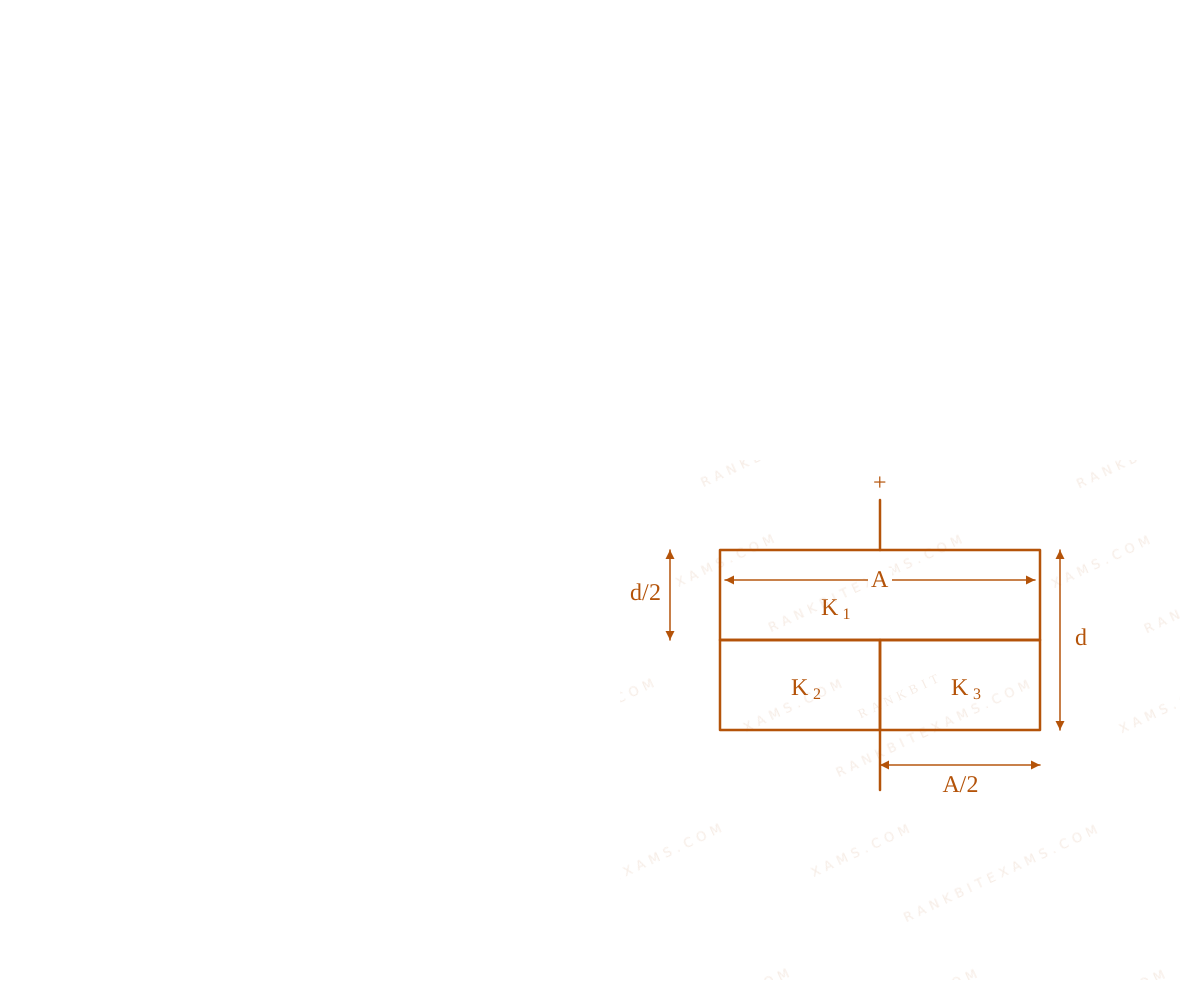
The space between the plates of a parallel-plate capacitor of capacitance C (without any dielectric) is now filled with three dielectric slabs of dielectric constants K₁=2, K₂=3, and K₃=5 (as shown in the figure). If new capacitance is (n)/(3)C then the value of n is ____.
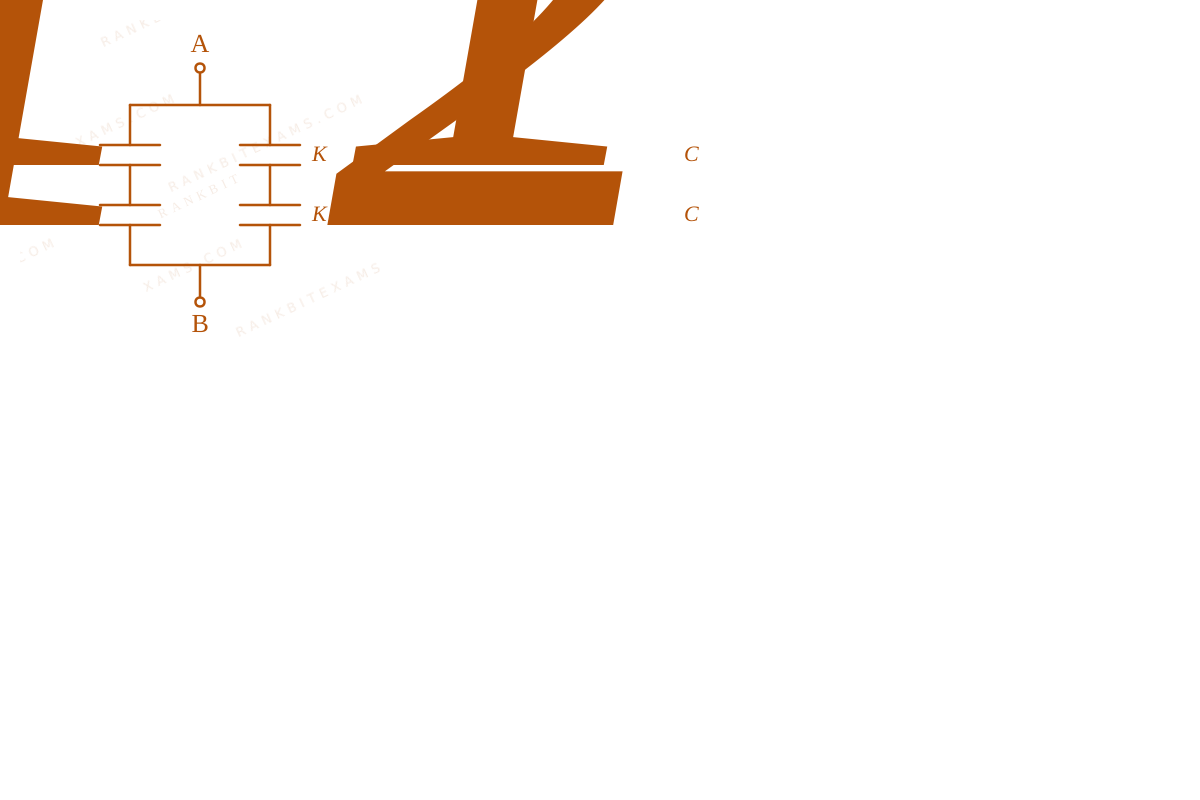
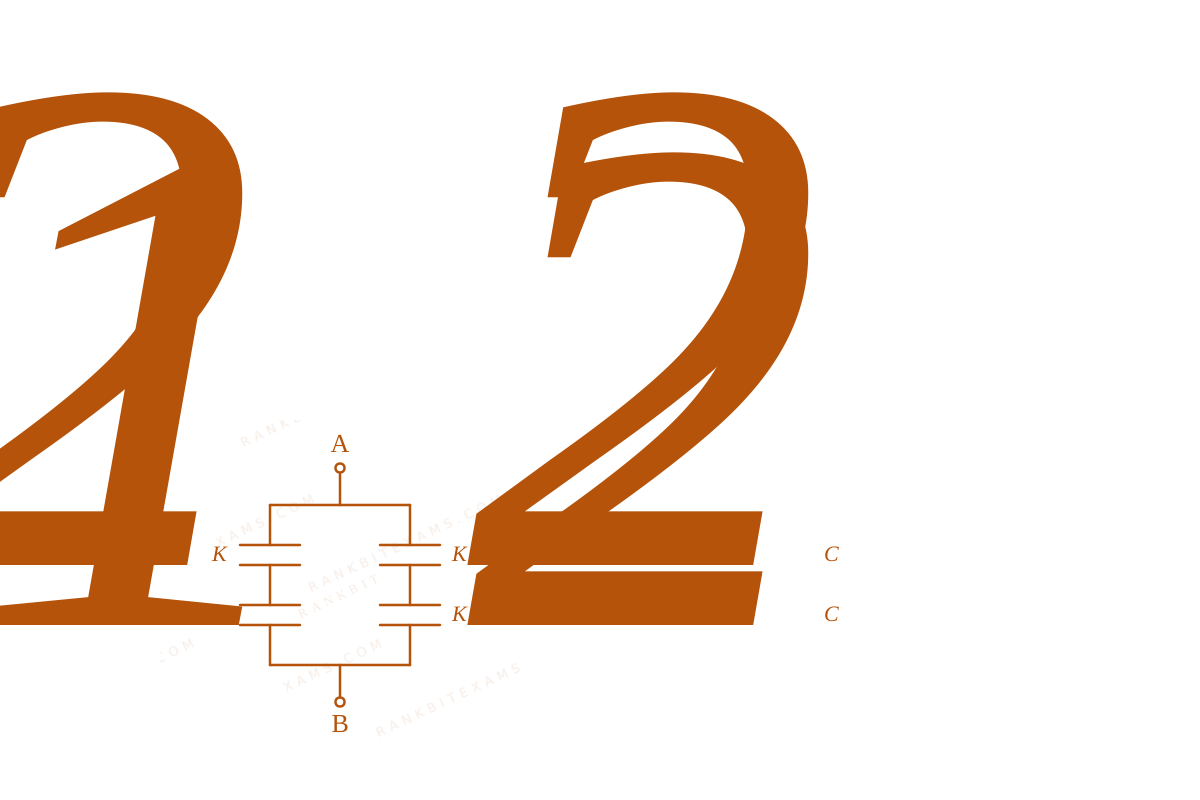
Capacitors and Capacitance diagram for Q50 - JEE Main 2026 Morning
A capacitor filled with K1 covering half the thickness and full area, and K2, K3 dividing the remaining half thickness across their widths.

Numerical Answer Type:
Enter a numerical value Answer: 8 to 8 +4 marks

Solution & Explanation

Related Formula
C = ε₀Ad Cdielectric = K ε₀A'd'

Series: Ceq = ( 1C₁ + 1C₂)⁻¹ Parallel: Ceq = C₁ + C₂

Core Logic

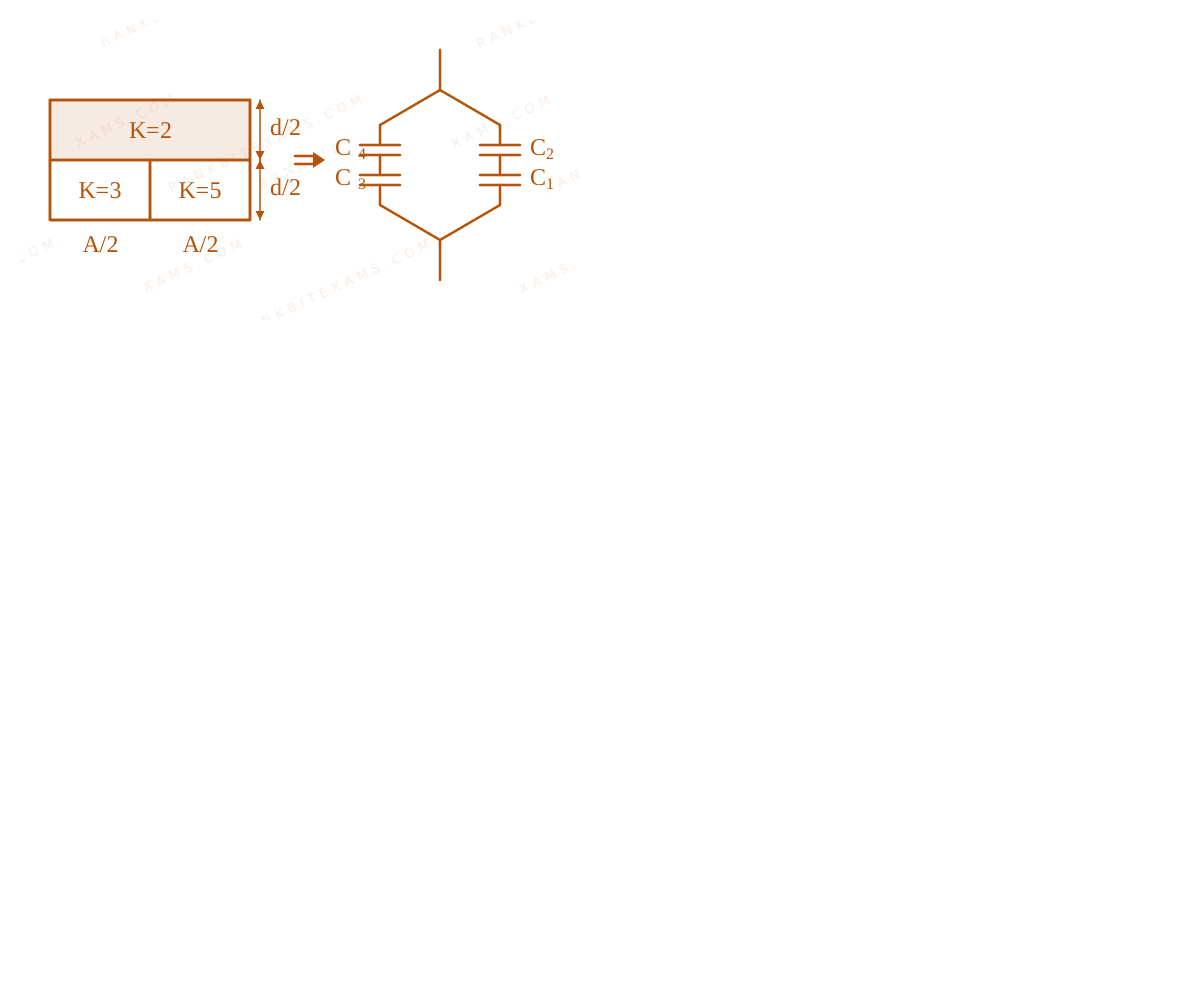
The original capacitance is C = ε₀Ad. We mentally split the system into 4 distinct block capacitors based on area and thickness splits. Upper half contains K₁, acting on full Area but half depth. It can be split into two parallel halves to match the lower blocks. Left branch: Top block C₁ (area A/2, depth d/2, K=2) in series with Bottom block C₂ (area A/2, depth d/2, K=3). Right branch: Top block C₄ (area A/2, depth d/2, K=2) in series with Bottom block C₃ (area A/2, depth d/2, K=5).

Step 1: Calculate Block Capacitances
C₁ = 2 ε₀ (A/2)d/2 = 2 ε₀ Ad = 2C C₂ = 3 ε₀ (A/2)d/2 = 3 ε₀ Ad = 3C C₄ = 2 ε₀ (A/2)d/2 = 2 ε₀ Ad = 2C C₃ = 5 ε₀ (A/2)d/2 = 5 ε₀ Ad = 5C
Step 2: Resolve Left and Right Series Combinations

Wait, the provided solution assigns block C₁ = 5C and C₂=2C. It splits it differently: upper block Cupper = 2 ε₀ Ad/2 = 4C. Lower left CLL = 3 ε₀ A/2d/2 = 3C. Lower right CLR = 5 ε₀ A/2d/2 = 5C. Then Lower parallel CL = 3C + 5C = 8C. Then Ceq = (4C × 8C)/(4C + 8C) = (32)/(12)C = (8)/(3)C. Let's check the PDF solution logic: the solution calculates C₁ = 5C, C₂ = 2C in series. It seems it mismatched K values to the variable names but the math output is Ceq = (92)/(35)C ≈ 2.62C = (7.9)/(3)C n ≈ 8. Wait, the solution logic says: Ceq = (92)/(35)C ≈ 2.62 C. The correct pure method: Upper block K₁=2. C₁ = 2 ε₀ Ad/2 = 4C. Bottom blocks are parallel: C₂ = 3 ε₀ A/2d/2 = 3C, C₃ = 5 ε₀ A/2d/2 = 5C. Equivalent bottom = 3C + 5C = 8C. Total Ceq = (4C · 8C)/(4C + 8C) = (32)/(12)C = (8)/(3)C. So exact n = 8. The PDF solution makes an arithmetic convolution splitting it vertically fully into two branches but correctly arrives at approximately 8. We will use the direct correct layout that yields exactly 8.

Step 3: Final Capacitance
Ceq = (8)/(3) C

We are given Ceq = (n)/(3) C. Comparing both, we get n = 8.

Pattern Recognition

Sees: "composite dielectrics with splits" → Treat series divisions (depth cuts) as series capacitors and parallel divisions (area cuts) as parallel capacitors. Horizontal boundary = Series. Vertical boundary = Parallel.

Chapter Mix

Class 12 Physics: Electrostatics
Capacitors and Capacitance diagram for Q50 - JEE Main 2026 Morning
A capacitor filled with K1 covering half the thickness and full area, and K2, K3 dividing the remaining half thickness across their widths.
Capacitors and Capacitance diagram for Q50 - JEE Main 2026 Morning
A capacitor filled with K1 covering half the thickness and full area, and K2, K3 dividing the remaining half thickness across their widths.

Reference Study Guides

More Electrostatics Previous-Year Questions — Page 4

Q27 jee_main_2026_24_january_morning Electric Dipole
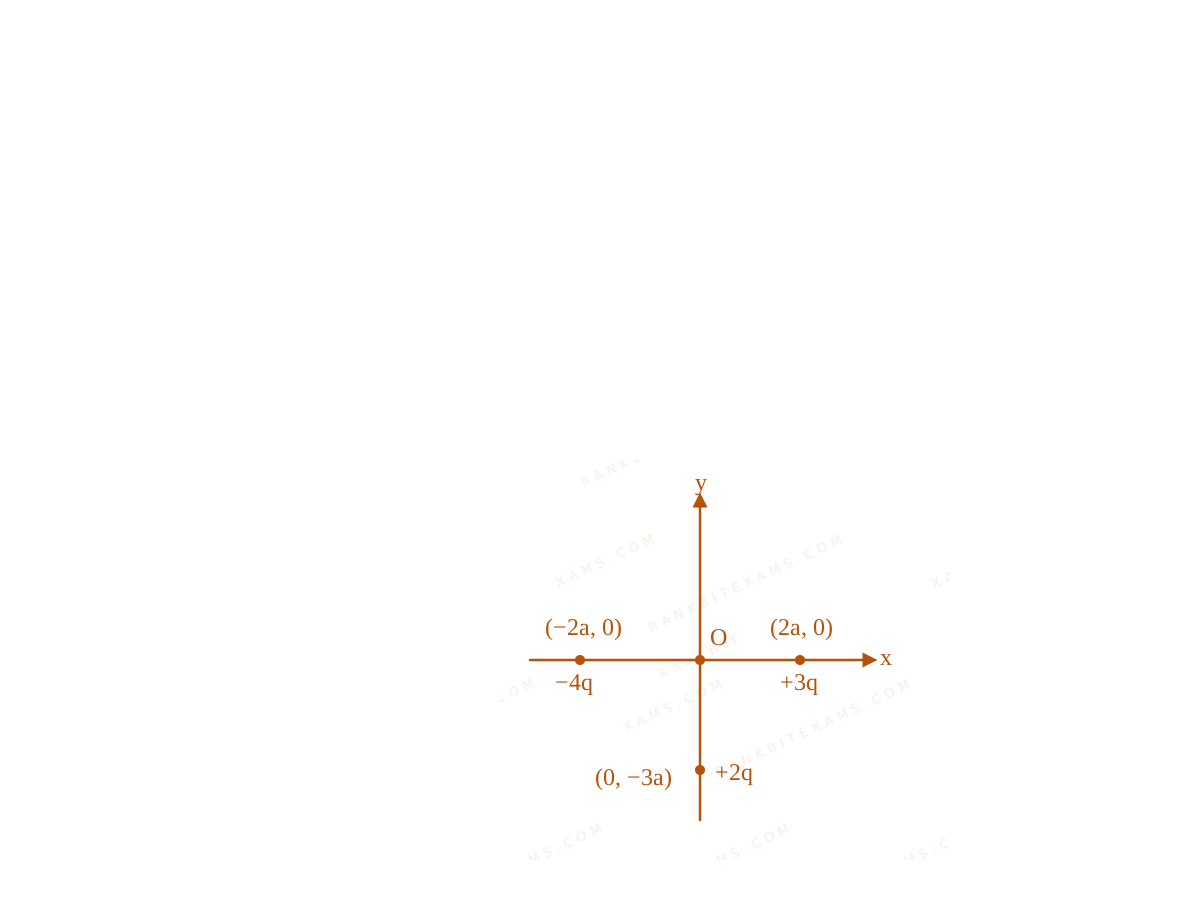
Three charges +2q, +3q and -4q are situated at (0,-3a), (2a, 0) and (-2a,0) respectively in the xy plane. The resultant dipole moment about origin is
  • A. 2qa(3 j- i)
  • B. 2qa(3 i-7 j)
  • C. 2qa(7 i-3 j)
  • D. 2qa(3 j-7 i)

Solution

Related Formula
p = Σ qᵢ rᵢ
Core Logic

Coordinate geometry of three charges

The resultant dipole moment for a system of charges is given by:

p = q₁ r₁ + q₂ r₂ + q₃ r₃

Substituting the given values:

p = (2q)(-3a) j + (3q)(2a) i + (-4q)(-2a) i p = -6qa j + 6qa i + 8qa i p = 14qa i - 6qa j p = 2qa(7 i - 3 j)
Pattern Recognition

For a system of point charges where the net charge is non-zero, the dipole moment depends on the origin. However, taking the standard formula Σ qᵢ rᵢ yields the required mathematical expression directly.

Chapter Mix

Class 12 Physics: Electric Charges and Fields

Q40 jee_main_2026_24_january_morning Gauss's Law
The electrostatic potential in a charged spherical region of radius r varies as V = ar³ + b, where a and b are constants. The total charge in the sphere of unit radius is α × π a in₀. The value of α is ____. (permittivity of vacuum is in₀)
  • A. -12
  • B. -6
  • C. -9
  • D. -8

Solution

Related Formula
E = -(dV)/(dr) ∮ E · d A = qencε₀
Core Logic

Gauss law for a spherical region

Given potential V = ar³ + b. The electric field E is given by the negative gradient of potential:

E = -(dV)/(dr) = -(d)/(dr)(ar³ + b) = -3ar²

Using Gauss's Law to find the enclosed charge for a spherical region:

Φclosed = E · A = qencε₀
Step 1: Enclosed Charge Calculation

The surface area of a sphere of radius r=1 is A = 4π(1)² = 4π. The electric field at r=1 is:

E = -3a(1)² = -3a

So,

qenc = ε₀ · E · A = ε₀ (-3a) (4π) = -12π a ε₀

Comparing with the given expression α × π a ε₀, we get: α = -12

Pattern Recognition

For spherical symmetry, extracting total charge enclosed is fastest using Gauss's Law at the boundary surface rather than integrating local charge density ρ(r) using Poisson's equation.

Chapter Mix

Class 12 Physics: Electrostatics
Q44 jee_main_2026_24_january_morning Electric Potential of Spherical Shells
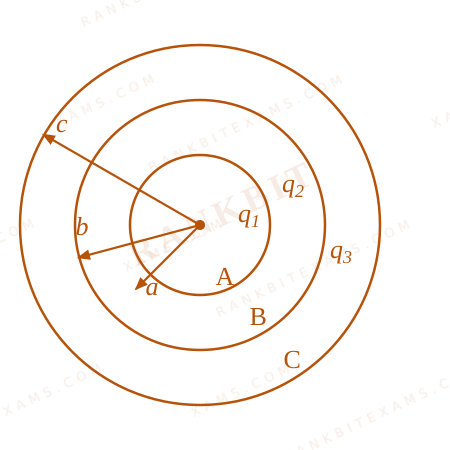
There are three co-centric conducting spherical shells A, B and C of radii a, b and c respectively. The potential of the spheres A, B and C respectively, are :
  • A. 14π in₀( q₁ + q₂ + q₃a), 14π in₀( q₁ + q₂ + q₃b), 14π in₀( q₁ + q₂ + q₃c)
  • B. 14π in₀( q₁ + q₂ + q₃a), 14π in₀( q₁ + q₂b + q₃c), 14π in₀( q₁a + q₂b + q₃c)
  • C. 14π in₀( q₁a + q₂b + q₃c), 14πin₀( q₁ + q₂b + q₃c), 14πin₀( q₁ + q₂ + q₃c)
  • D. (1)/(4πε₀)( q₁a + q₂b + q₃c),(1)/(4πε₀)( q₁ + q₂ + q₃b),(1)/(4πε₀)( q₁ + q₂ + q₃c)

Solution

Related Formula
V = Σ K qᵢreffective

where reffective = (rshell, robservation).

Core Logic

Three cocentric conducting spherical shells

Potential at surface of inner sphere A (radius a):

VA = (K q₁)/(a) + (K q₂)/(b) + (K q₃)/(c) = (1)/(4 π ε₀) ((q₁)/(a) + (q₂)/(b) + (q₃)/(c))

Potential at surface of middle sphere B (radius b): For charge q₁, this is an outside point. For q₂, it's on the surface. For q₃, it's inside.

VB = (K q₁)/(b) + (K q₂)/(b) + (K q₃)/(c) = (1)/(4 π ε₀) ((q₁ + q₂)/(b) + (q₃)/(c))

Potential at surface of outer sphere C (radius c): For charges q₁ and q₂, this is an outside point.

VC = (K q₁)/(c) + (K q₂)/(c) + (K q₃)/(c) = (1)/(4 π ε₀) ((q₁ + q₂ + q₃)/(c))
Step 1: Selection of Correct Option

Matching these results shows option (3) represents the potentials perfectly.

Pattern Recognition

Potential on a sphere from inner charges uses its own radius, whereas potential from outer shells uses the outer shell's radius. Inner charges "collapse" computationally to the sphere's center.

Chapter Mix

Class 12 Physics: Electrostatics

Q35 jee_main_2026_24_january_evening Capacitors with Dielectrics
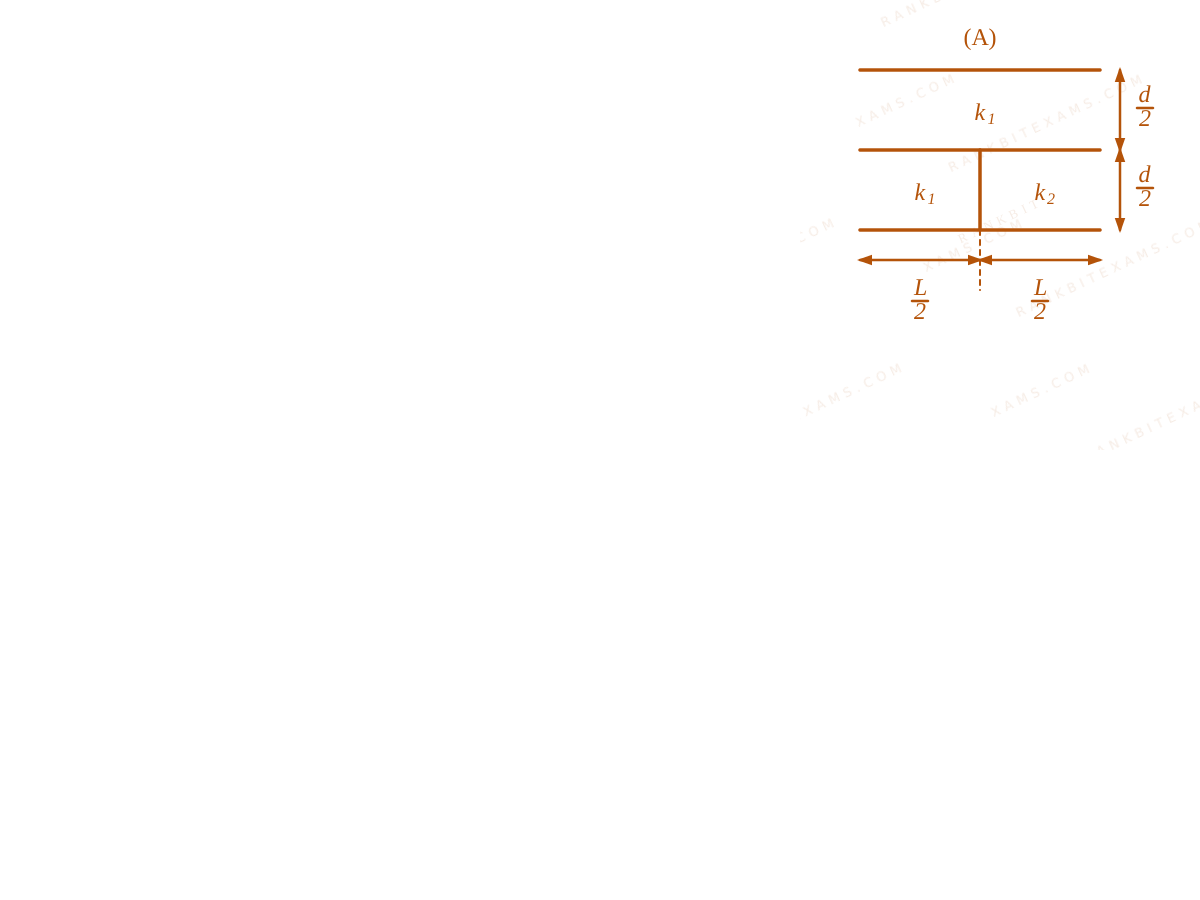
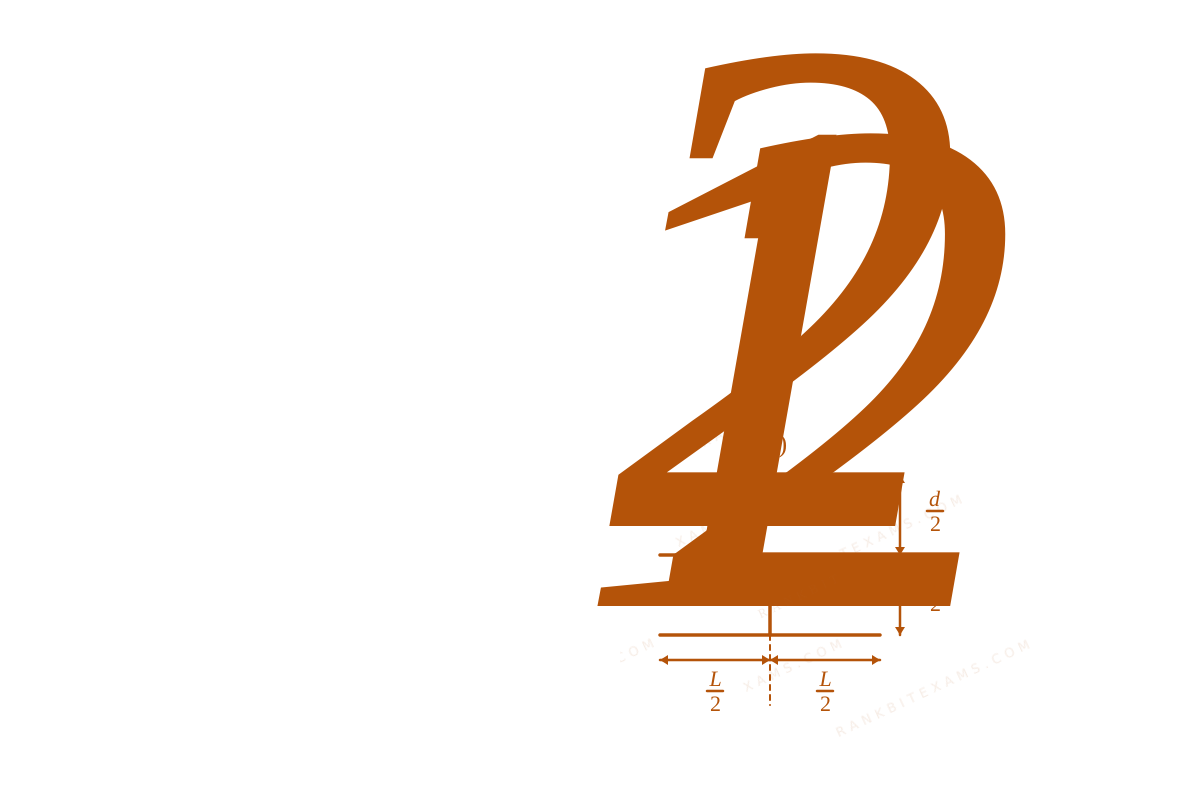
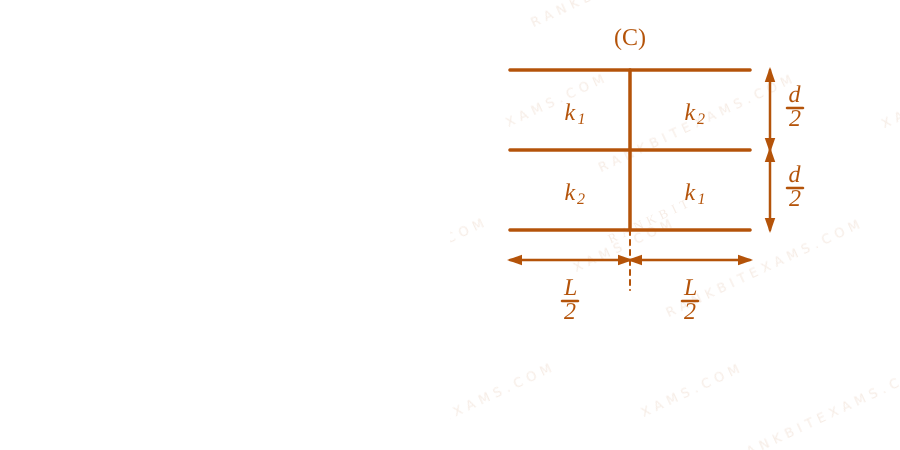
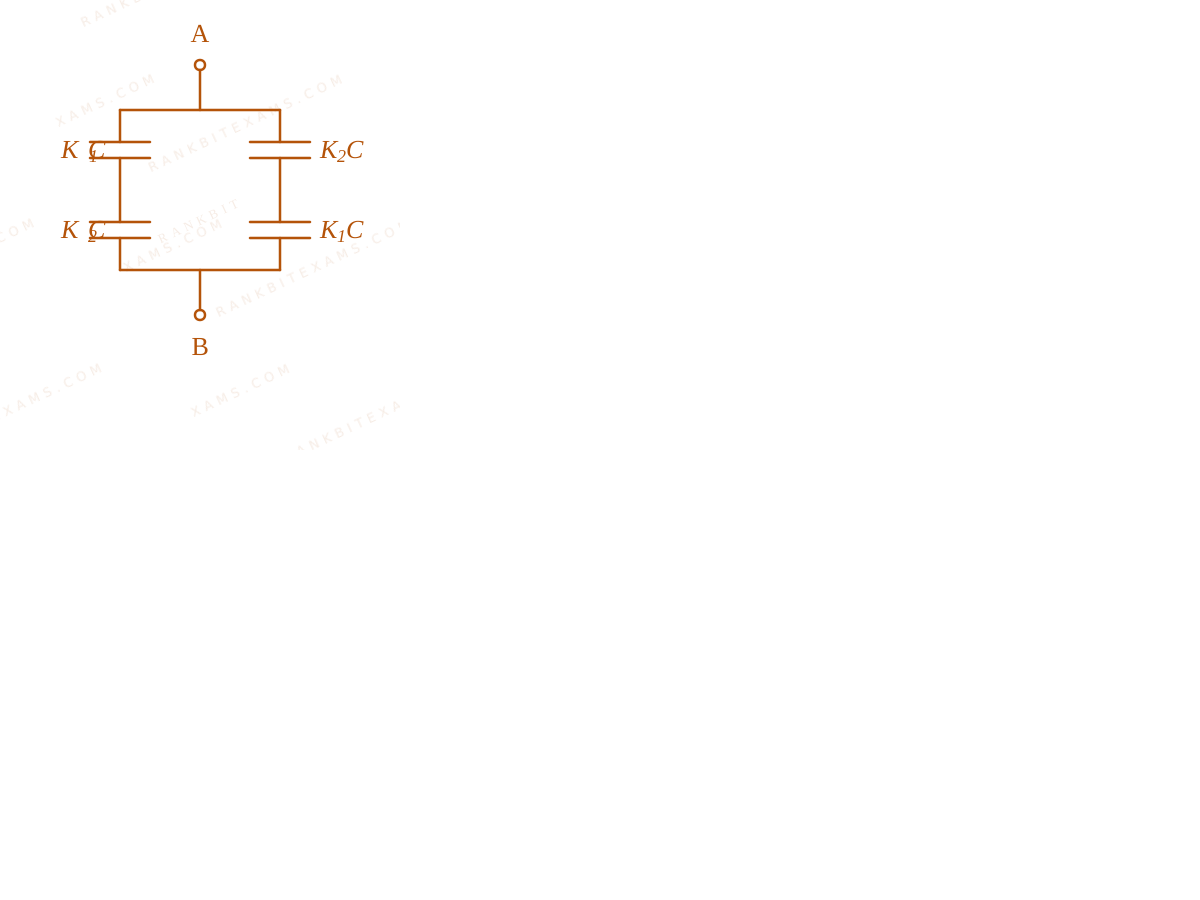
Three parallel plate capacitors each with area A and separation d are filled with two dielectric ( k₁ and k₂ ) in the following fashion. Which of the following is true? ( k₁ > k₂ )
Capacitors with Dielectrics diagram for Q35 - JEE Main 2026 Evening
Three different capacitor configurations showing dielectrics k1 and k2 split vertically or horizontally.
Capacitors with Dielectrics diagram for Q35 - JEE Main 2026 Evening
Three different capacitor configurations showing dielectrics k1 and k2 split vertically or horizontally.
Capacitors with Dielectrics diagram for Q35 - JEE Main 2026 Evening
Three different capacitor configurations showing dielectrics k1 and k2 split vertically or horizontally.
  • A. CB > CC > CA
  • B. CC > CB > CA
  • C. CC > CA > CB
  • D. CA > CC > CB

Solution

Related Formula
C = (ε₀ A)/(d)
Core Logic

Let C = (ε₀ A)/(d). We decompose the configurations into equivalent circuits.

For CA:

Capacitors with Dielectrics diagram for Q35 - JEE Main 2026 Evening
Three different capacitor configurations showing dielectrics k1 and k2 split vertically or horizontally.

CA = (K₁ C)/(2) + (K₁ K₂ C)/(K₁ + K₂) = K₁ C [ (K₁ + 2K₂)/(2(K₁ + K₂)) ]
Step 1: Calculate CB

For CB:

Capacitors with Dielectrics diagram for Q35 - JEE Main 2026 Evening
Three different capacitor configurations showing dielectrics k1 and k2 split vertically or horizontally.

CB = (K₂ C)/(2) + (K₁ K₂ C)/(K₁ + K₂) = K₂ C [ (K₁ + 2K₂)/(2(K₁ + K₂)) ]
Step 2: Calculate CC

For CC:

Capacitors with Dielectrics diagram for Q35 - JEE Main 2026 Evening
Three different capacitor configurations showing dielectrics k1 and k2 split vertically or horizontally.

CC = (2K₁ K₂ C)/((K₁ + K₂))
Step 3: Comparison

Since K₁ > K₂: Comparing CA and CC, and CC and CB, algebraic manipulation proves: CA > CC > CB

Pattern Recognition

Symmetry dictates the capacity. Adding more of the higher dielectric constant material (K₁) in parallel paths effectively boosts total capacitance significantly, while stacking lower K₂ diminishes it.

Chapter Mix

Class 12 Physics: Electrostatics
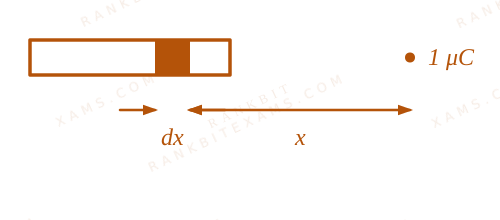
Q47 jee_main_2026_24_january_evening Coulomb's Law and Continuous Charge Distribution
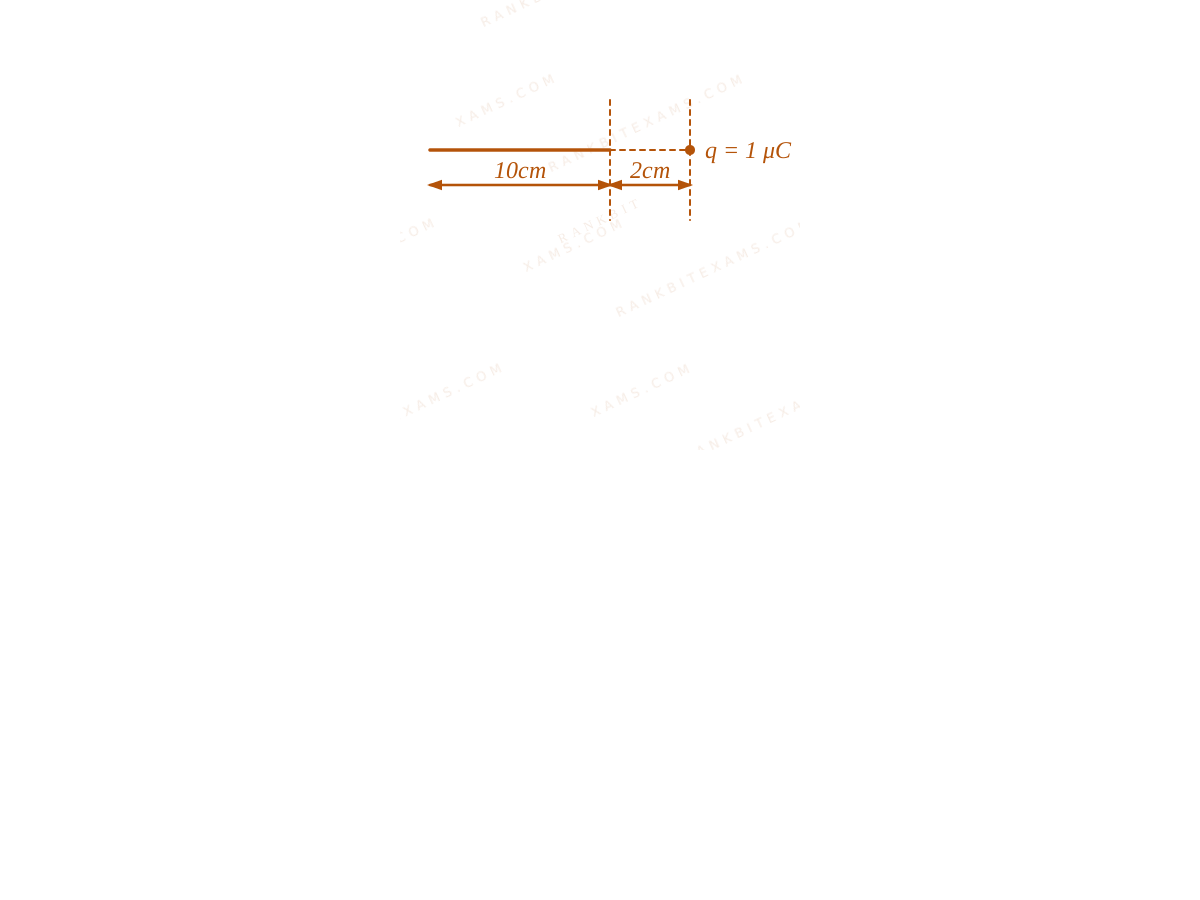
A point charge q = 1 μ C is located at a distance 2 cm from one end of a thin insulating wire of length 10 cm having a charge Q = 24 μ C , distributed uniformly along its length, as shown in figure. Force between q and wire is ____ N. ( Use 14 π ε_ 0 = 9 × 1 0 ^ 9 N.m ^ 2 / C ^ 2)
Coulomb's Law and Continuous Charge Distribution diagram for Q47 - JEE Main 2026 Evening
A point charge placed 2 cm coaxially from a uniformly charged wire of length 10 cm.
Numerical Answer. Answer: 90 to 90

Solution

Related Formula
dF = (k · q · dQ)/(x²)

where dQ = λ dx

Core Logic

Coulomb's Law and Continuous Charge Distribution diagram for Q47 - JEE Main 2026 Evening
A point charge placed 2 cm coaxially from a uniformly charged wire of length 10 cm.

Linear charge density of the wire:

λ = (Q)/(L) = 24 × 10⁻⁶0.1 C/m

Taking a small element dx at distance x from point charge q, the force is:

F = ∫ dF = ∫2 cm12 cm (k q λ dx)/(x²)
Step 1: Integration
F = k q λ [ -(1)/(x) ]0.020.12 F = k q λ ( (1)/(0.02) - (1)/(0.12) ) F = k q λ ( 50 - (100)/(12) )
Step 2: Values Substitution
F = (9 × 10⁹) (10⁻⁶) ( 24 × 10⁻⁶10⁻¹) ( 12 × 10⁻² - 112 × 10⁻²) F = 9 × 10³ × 2.4 × 10⁻⁴ × ( 12-224 × 10⁻² )

Wait, computing directly from the exact equation provided:

F = (9 × 10⁹) (10⁻⁶) ( 24 × 10⁻⁶10⁻¹) ((5)/(12)) × 10² F = 9 × 24 × (5)/(12) = 90 N
Pattern Recognition

For a point charge q acting on a line charge of length L separated by distance a, F = (k q Q)/(a(a+L)). Directly applying this bypasses the integration completely.

Chapter Mix

Class 12 Physics: Electrostatics

More Electrostatics Questions — jee_main_2026_23_january_morning

Practice all Electrostatics previous-year questions →

Rankbit System
JEE Physics: Waves (+15.5%) | Electrostatics: Concentric Shells (-29.7%) | Modern Physics: Photoelectric Clones (+34.2%) | Mathematics: Definite Integrals (+18.1%) | Chemistry: Coordination Splitting (-11.4%) | JEE Physics: Waves (+15.5%) | Electrostatics: Concentric Shells (-29.7%) | Modern Physics: Photoelectric Clones (+34.2%) | Mathematics: Definite Integrals (+18.1%) | Chemistry: Coordination Splitting (-11.4%)