Q
jee_main_2026_21_jan_morning
Capacitance with Dielectric
A parallel plate capacitor has capacitance C, when there is vacuum within the parallel plates.
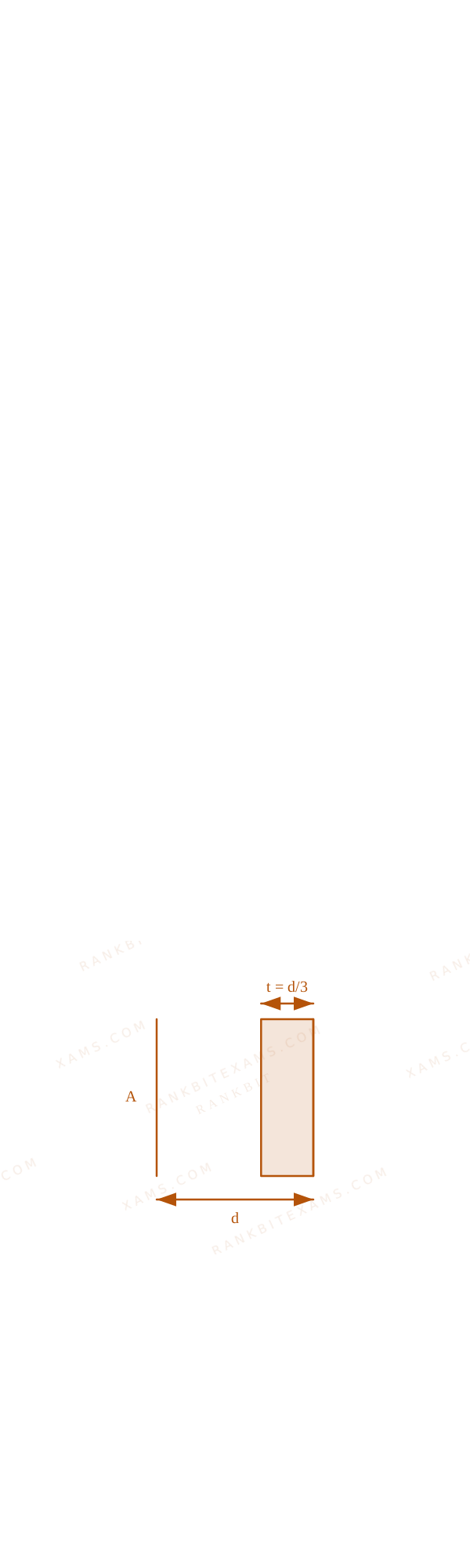
A sheet having thickness ((1)/(3))rd of the separation between the plates and relative permittivity K is introduced between the plates. The new capacitance of the system is :
Solution
Related Formula
C = (ε₀ A)/(d - t + (t)/(K))Alternatively, treat as two capacitors in series: Ceq = (C₁ C₂)/(C₁ + C₂)
Core Logic
Initial capacitance (vacuum): C = A ε₀d.

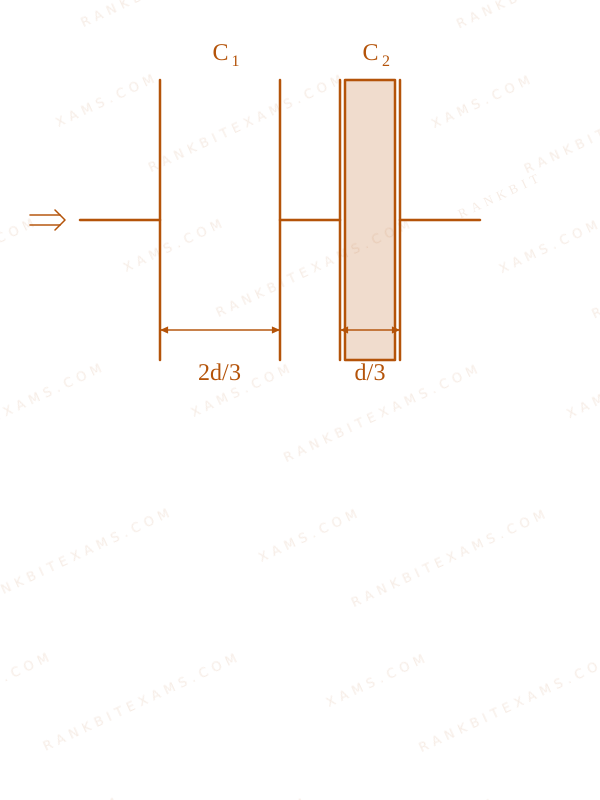
The system can be modelled as two capacitors in series:
- A vacuum capacitor of thickness d - (d)/(3) = (2d)/(3)
- A dielectric capacitor of thickness (d)/(3) and dielectric constant K.
Step 1: Capacitors in Series
The capacitances are:
C₁ = (ε₀ A)/(((2d)/(3))) = (3)/(2) ((ε₀ A)/(d)) = (3)/(2) C C₂ = (K ε₀ A)/(((d)/(3))) = 3K ((ε₀ A)/(d)) = 3KCNow, equivalent capacitance in series:
Ceq = (C₁ C₂)/(C₁ + C₂) = (((3)/(2) C) × (3KC))/((3)/(2) C + 3KC) Ceq = ((9)/(2)KC²)/((3)/(2)C(1 + 2K)) Ceq = (3KC)/(2K + 1)Pattern Recognition
Partial dielectric filling of thickness t: Use formula Cnew = (ε₀ A)/(d - t + t/K). Plugging t = d/3 directly gives (ε₀ A)/(d - d/3 + d/3K) = (ε₀ A)/((2d)/(3) + (d)/(3K)) = (3K ε₀ A)/(2Kd + d) = (3KC)/(2K+1).
Chapter Mix
Class 12 Physics: Electrostatics