A point charge of 10^-8 C is placed at origin. The work done in moving a point charge 2 muC from point A(4, 4, 2) m to B(2, 2, 1) m is ____ J. left(frac14piepsilon_0=9times10^9text in SI unitsright)

Solution & Explanation

### Related Formula W_textext = Delta U = U_f - U_i U = frac14piepsilon_0 fracq_1 q_2r ### Core Logic Work done by external agent: W_textext = Delta U, where Delta U is the change in potential energy. W_textext = frac14pi epsilon_0 fracq_1 q_2r_f - frac14pi epsilon_0 fracq_1 q_2r_i Calculate the distances of points A and B from the origin: r_i = |A| = sqrt4^2 + 4^2 + 2^2 = sqrt16+16+4 = sqrt36 = 6text m r_f = |B| = sqrt2^2 + 2^2 + 1^2 = sqrt4+4+1 = sqrt9 = 3text m ### Step 1: Calculate Work Done W_textext = (9 times 10^9) times (10^-8 times 2 times 10^-6) left[ frac13 - frac16 right] W_textext = 18 times 10^-5 times left(frac2-16right) W_textext = 18 times 10^-5 times frac16 = 3 times 10^-5text J = 30 times 10^-6text J ### Pattern Recognition Electric field is conservative. Work done simply equals change in kqq/r from initial to final radial coordinate. No path dependence. ### Evaluation Rubric / Model Answer null ### Chapter Mix Class 12 Physics: Electrostatics
Reference Study Guides

More Electrostatics Previous-Year Questions

Q jee_main_2026_21_jan_morning Capacitance with Dielectric
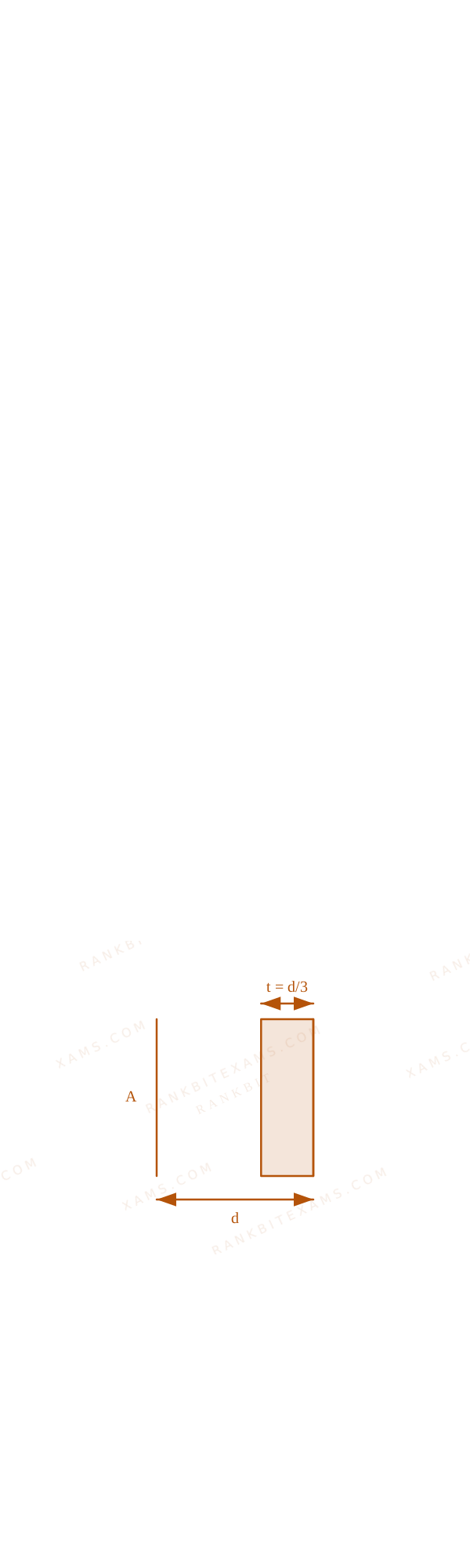
A parallel plate capacitor has capacitance C, when there is vacuum within the parallel plates. A sheet having thickness left(frac13right)^mathrmrd of the separation between the plates and relative permittivity K is introduced between the plates. The new capacitance of the system is :
  • A. frac3mathrmKC2mathrmK + 1
  • B. fracmathrmCK2 + mathrmK
  • C. frac3mathrmCK^2(2mathrmK + 1)^2
  • D. frac4mathrmKC3mathrmK - 1

Solution

### Related Formula C = fracepsilon_0 Ad - t + fractK Alternatively, treat as two capacitors in series: C_eq = fracC_1 C_2C_1 + C_2 ### Core Logic Initial capacitance (vacuum): C = fracA epsilon_0d.
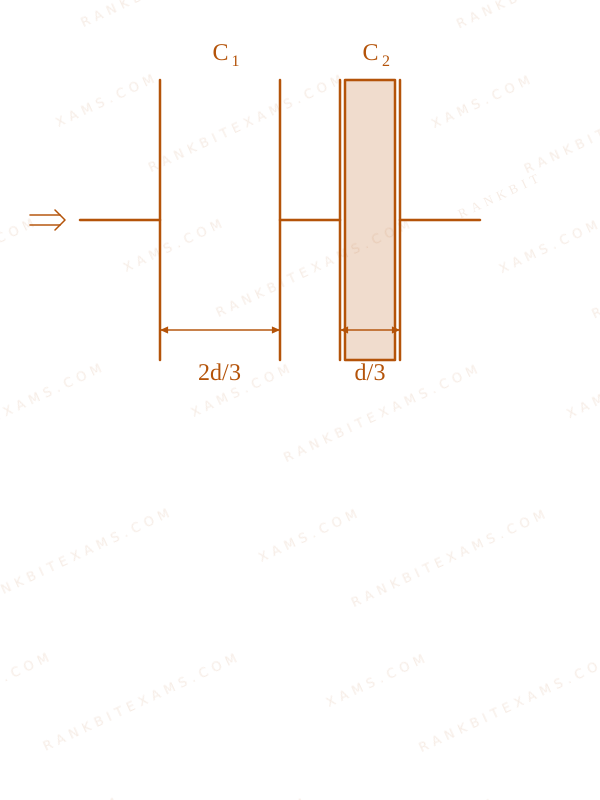
Capacitance with Dielectric diagram for Q34 - JEE Main 2026 Morning
The system can be modelled as two capacitors in series: 1. A vacuum capacitor of thickness d - fracd3 = frac2d3 2. A dielectric capacitor of thickness fracd3 and dielectric constant K.
Capacitance with Dielectric diagram for Q34 - JEE Main 2026 Morning
### Step 1: Capacitors in Series The capacitances are: C_1 = fracepsilon_0 Aleft(frac2d3right) = frac32 left(fracepsilon_0 Adright) = frac32 C C_2 = fracK epsilon_0 Aleft(fracd3right) = 3K left(fracepsilon_0 Adright) = 3KC Now, equivalent capacitance in series: C_texteq = fracC_1 C_2C_1 + C_2 = fracleft(frac32 Cright) times (3KC)frac32 C + 3KC C_texteq = fracfrac92KC^2frac32C(1 + 2K) C_texteq = frac3KC2K + 1 ### Pattern Recognition Partial dielectric filling of thickness t: Use formula C_textnew = fracepsilon_0 Ad - t + t/K. Plugging t = d/3 directly gives fracepsilon_0 Ad - d/3 + d/3K = fracepsilon_0 Afrac2d3 + fracd3K = frac3K epsilon_0 A2Kd + d = frac3KC2K+1. ### Evaluation Rubric / Model Answer null ### Chapter Mix Class 12 Physics: Electrostatics
Q1 jee_main_2025_02_april_evening Dielectrics and Polarization
Given below are two statements: one is labelled as Assertion (A) and the other is labelled as Reason (R). Assertion (A): Net dipole moment of a polar linear isotropic dielectric substance is not zero even in the absence of an external electric field. Reason (R): In absence of an external electric field, the different permanent dipoles of a polar dielectric substance are oriented in random directions. In the light of the above statements, choose the most appropriate answer from the options given below:
  • A. (A)text is correct but (R)text is not correct
  • B. textBoth (A)text and (R)text are correct but (R)text is not the correct explanation of (A)
  • C. textBoth (A)text and (R)text are correct and (R)text is the correct explanation of (A)
  • D. (A)text is not correct but (R)text is correct

Solution

### Related Formula vecP_textnet = sum vecp_i where: vecP_textnet = net dipole moment of the dielectric vecp_i = dipole moment of the individual i-th molecule ### Core Logic No external electric field is present (E_textext = 0). Due to thermal agitation, all molecular permanent dipoles are randomly oriented in space: vecP_textnet = 0 quad textwhen vecE_textext = 0 Thus: 1. Assertion (A) is false because it claims the net dipole moment is non-zero even without an external field. 2. Reason (R) is true because it correctly describes that different permanent dipoles are randomly oriented. ### Step 1: Final Conclusion Therefore, (A) is not correct but (R) is correct. ### Pattern Recognition Sees: "polar dielectric" + "no external field" → net bulk dipole moment is always zero. Trap: Confusing the molecular level with the macroscopic level. Each molecule in a polar dielectric has a permanent dipole moment, but the macro substance has zero net moment due to random thermal orientations. Shortcut: No external field means vectors cancel globally, which implies zero net moment. Thus (A) is false immediately. ### Evaluation Rubric / Model Answer null ### Chapter Mix Class 12 Physics: Electrostatics
Q5 jee_main_2025_02_april_morning Electric Field and Gauss's Law
Consider two infinitely large plane parallel conducting plates as shown below. The plates are uniformly charged with a surface charge density +sigma and -2sigma. The force experienced by a point charge +q placed at the mid point between two plates will be:
Parallel conducting plates for Q5
Two parallel plates with charges +sigma and -2sigma and a point charge +q at the midpoint.
  • A. fracsigma q4 epsilon_0
  • B. frac3sigma q2 epsilon_0
  • C. frac3sigma q4 epsilon_0
  • D. fracsigma q2 epsilon_0

Solution

### Related Formula E = fracsigma_textinnerepsilon_0 ### Core Logic For parallel conducting plates of large area, charges redistribute on the outer and inner faces to maintain electrostatic equilibrium. Total charge per unit area on Plate 1: q_1 = sigma Total charge per unit area on Plate 2: q_2 = -2sigma The outer surface charge density on the far sides of both plates must be equal: sigma_textouter = fracq_1 + q_22 = fracsigma - 2sigma2 = -fracsigma2 Now, compute the charges on the inner facing surfaces: - Inner face of Plate 1: sigma_textinner1 = q_1 - sigma_textouter = sigma - left(-fracsigma2right) = frac3sigma2 - Inner face of Plate 2: sigma_textinner2 = q_2 - sigma_textouter = -2sigma - left(-fracsigma2right) = -frac3sigma2 In the region between the plates, both inner surfaces create an electric field in the same direction (away from the positive plate 1 and towards negative plate 2): E = fracsigma_textinner12epsilon_0 + frac|sigma_textinner2|2epsilon_0 = frac3sigma/22epsilon_0 + frac3sigma/22epsilon_0 = frac3sigma2epsilon_0 Thus, the electrostatic force on +q is: F = q E = frac3sigma q2epsilon_0 ### Step 1: Final Conclusion The force experienced by the point charge +q is frac3sigma q2epsilon_0. ### Pattern Recognition For conducting plates with total charges Q_1 and Q_2, always calculate the outer charge first: Q_textouter = fracQ_1+Q_22. The field inside the gap is exclusively due to the inner surfaces: E = fracsigma_textinnerepsilon_0. ### Evaluation Rubric / Model Answer null ### Chapter Mix Class 12 Physics: Electrostatics
Q7 jee_main_2025_02_april_morning Electric Field and Gauss's Law
A point charge +q is placed at the origin. A second point charge +9q is placed at (d, 0, 0) in Cartesian coordinate system. The point in between them where the electric field vanishes is:
  • A. (4d / 3, 0, 0)
  • B. (d / 4, 0, 0)
  • C. (3d / 4, 0, 0)
  • D. (d / 3, 0, 0)

Solution

### Related Formula E = frack Qr^2 x = fracd1 + sqrtfracq_2q_1 ### Core Logic Let the null point where the electric field is zero be at (x, 0, 0) where 0 < x < d. At this point, the fields due to both charges are equal in magnitude and opposite in direction: frack qx^2 = frack (9q)(d - x)^2 Taking the square root on both sides: frac1x = frac3d - x implies d - x = 3x 4x = d implies x = fracd4 Thus, the coordinates of the null point are left(fracd4, 0, 0right). ### Step 1: Final Conclusion The point where the electric field vanishes is left(fracd4, 0, 0right). ### Pattern Recognition For two like charges, the zero-field null point always lies along the line joining them and is closer to the smaller charge. Use the standard shortcut: x = fracd1 + sqrtq_2/q_1 measured from charge q_1. ### Evaluation Rubric / Model Answer null ### Chapter Mix Class 12 Physics: Electrostatics

More Electrostatics Questions — jee_main_2026_21_jan_morning

Practice all Electrostatics previous-year questions →

Rankbit System
JEE Physics: Waves (+15.5%) | Electrostatics: Concentric Shells (-29.7%) | Modern Physics: Photoelectric Clones (+34.2%) | Mathematics: Definite Integrals (+18.1%) | Chemistry: Coordination Splitting (-11.4%) | JEE Physics: Waves (+15.5%) | Electrostatics: Concentric Shells (-29.7%) | Modern Physics: Photoelectric Clones (+34.2%) | Mathematics: Definite Integrals (+18.1%) | Chemistry: Coordination Splitting (-11.4%)
YOUR FIRST PREP STEP STARTS HERE

We Map Every Repeating Question in Competitive Exams.

Say goodbye to generic mock test fatigue. RankBit uses smart analysis to group past exam questions into their foundational Repeating Question Types. Find chapter weightage, track repeating questions, and score higher with targeted practice.

Select Your Target Exam

Choose an exam track below to find formulas per chapter and patterns.

Syncing Exam Intelligence

Mapping formulas and patterns across all tracks…

PATH A — FULL LENGTH PRACTICE

Full Mock Test Hub

Simulate real NTA exam conditions with fully tracked mocks. Time yourself against past papers.

Now Live Open
PATH B — TARGETED PRACTICE

Topic-wise Practice Hub

Practice past-year questions one chapter at a time. Pick an exam → subject → chapter and get every PYQ for that topic — pulled together from all past papers — with the chapter's key formulas alongside.

Loading Questions... Browse Topics
Latest from the Blog
View all →

Loading articles...