JEE Main · Chemistry ↓ Falling

Chemical Bonding and Molecular Structure appeared 42 times across 3 years — 4.9% of Chemistry. This question is from Lewis Structures and Lone Pairs.

Year 2026 2025 2024 Total
Questions 12 14 16 42

Identify the molecule(X) with maximum number of lone pairs of electrons (obtained using Lewis dot structure) among HNO₃, H₂SO₄, NF₃ and O₃. Choose the correct bond angle made by the central atom of the molecule (X).

Solution & Explanation

Core Logic

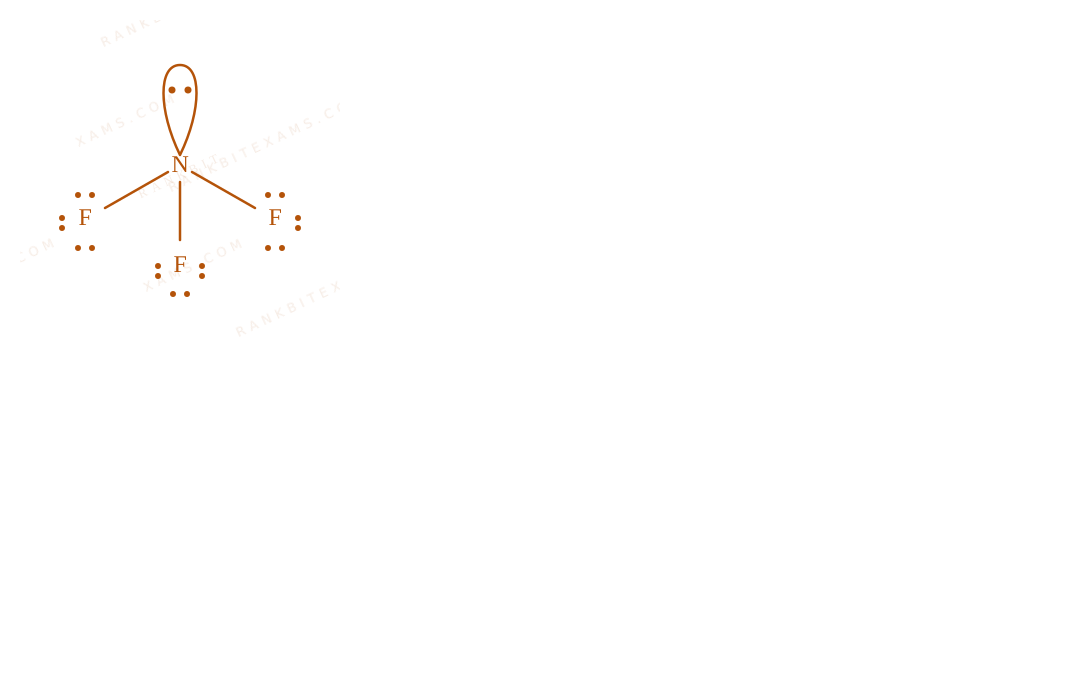
Draw Lewis structures for all given molecules and sum the total lone pairs on all atoms. HNO₃: 7 lone pairs total. H₂SO₄: 8 lone pairs total. O₃: 6 lone pairs total. NF₃: Nitrogen has 1 lone pair, and each of the three fluorine atoms has 3 lone pairs. Total = 1 + (3 × 3) = 10 lone pairs.

Step 1: Identifying Molecule X

Molecule X is NF₃ due to possessing the maximum number of lone pairs (10).

Lewis Structures and Lone Pairs diagram for Q65 - JEE Main 2026 Morning

Step 2: Bond Angle Analysis

In NF₃, Nitrogen is sp³ hybridized. Due to the high electronegativity of Fluorine, the bond pair electron density shifts towards fluorine. This reduces bond pair-bond pair repulsion around the central nitrogen compared to ammonia (NH₃). As a result, the lone pair compresses the F-N-F bond angle more severely than in NH₃ (107^°). The resulting F-N-F bond angle is approximately 102^°.

Pattern Recognition

Electronegativity rules: If the surrounding atoms are more electronegative than the central atom, bond angles decrease because bonding electrons are pulled away from the central atom, allowing the lone pair to expand further and crush the angle.

Chapter Mix

Class 11 Chemistry: Chemical Bonding and Molecular Structure Class 12 Chemistry: The p-Block Elements

Lewis Structures and Lone Pairs diagram for Q65 - JEE Main 2026 Morning

Reference Study Guides

More Chemical Bonding and Molecular Structure Previous-Year Questions — Page 9

Q77 jee_main_2024_31_jan_morning Molecular Orbital Theory
The linear combination of atomic orbitals to form molecular orbitals takes place only when the combining atomic orbitals A. have the same energy B. have the minimum overlap C. have same symmetry about the molecular axis D. have different symmetry about the molecular axis Choose the most appropriate from the options given below:
  • A. A, B, C only
  • B. A and C only
  • C. B, C, D only
  • D. B and D only

Solution

Core Logic

Conditions for the linear combination of atomic orbitals (LCAO) to form molecular orbitals:

  • The combining atomic orbitals must have the same or nearly the same energy.
  • The combining atomic orbitals must have the same symmetry about the molecular axis.
  • The combining atomic orbitals must overlap to the maximum extent (not minimum).
Chapter Mix

Class 11 Chemistry: Chemical Bonding and Molecular Structure

Q85 jee_main_2024_31_jan_morning Hybridization
The number of species from the following in which the central atom uses sp³ hybrid orbitals in its bonding is NH₃, SO₂, SiO₂, BeCl₂, CO₂, H₂O, CH₄, BF₃
Numerical Answer. Answer: 4 to 4

Solution

Core Logic

Analyzing the hybridization of the central atom in each species:

  • NH₃: 3 bp + 1 lp = 4 electron domains arrow sp³
  • SO₂: 2 bp + 1 lp = 3 electron domains arrow sp²
  • SiO₂: A giant covalent network where each Si is bonded to 4 oxygens tetrahedrally arrow sp³
  • BeCl₂: 2 bp + 0 lp = 2 electron domains arrow sp
  • CO₂: 2 bp + 0 lp = 2 electron domains arrow sp
  • H₂O: 2 bp + 2 lp = 4 electron domains arrow sp³
  • CH₄: 4 bp + 0 lp = 4 electron domains arrow sp³
  • BF₃: 3 bp + 0 lp = 3 electron domains arrow sp²
  • Total species with sp³ hybridization: NH₃, SiO₂, H₂O, CH₄. Total count = 4.

Chapter Mix

Class 11 Chemistry: Chemical Bonding and Molecular Structure

More Chemical Bonding and Molecular Structure Questions — jee_main_2026_23_january_morning

Practice all Chemical Bonding and Molecular Structure previous-year questions →

Rankbit System
JEE Physics: Waves (+15.5%) | Electrostatics: Concentric Shells (-29.7%) | Modern Physics: Photoelectric Clones (+34.2%) | Mathematics: Definite Integrals (+18.1%) | Chemistry: Coordination Splitting (-11.4%) | JEE Physics: Waves (+15.5%) | Electrostatics: Concentric Shells (-29.7%) | Modern Physics: Photoelectric Clones (+34.2%) | Mathematics: Definite Integrals (+18.1%) | Chemistry: Coordination Splitting (-11.4%)