JEE Main · Physics ↓ Falling

Work, Energy and Power appeared 31 times across 3 years — 3.6% of Physics. This question is from Motion on Curved Path.

Year 2026 2025 2024 Total
Questions 8 15 8 31

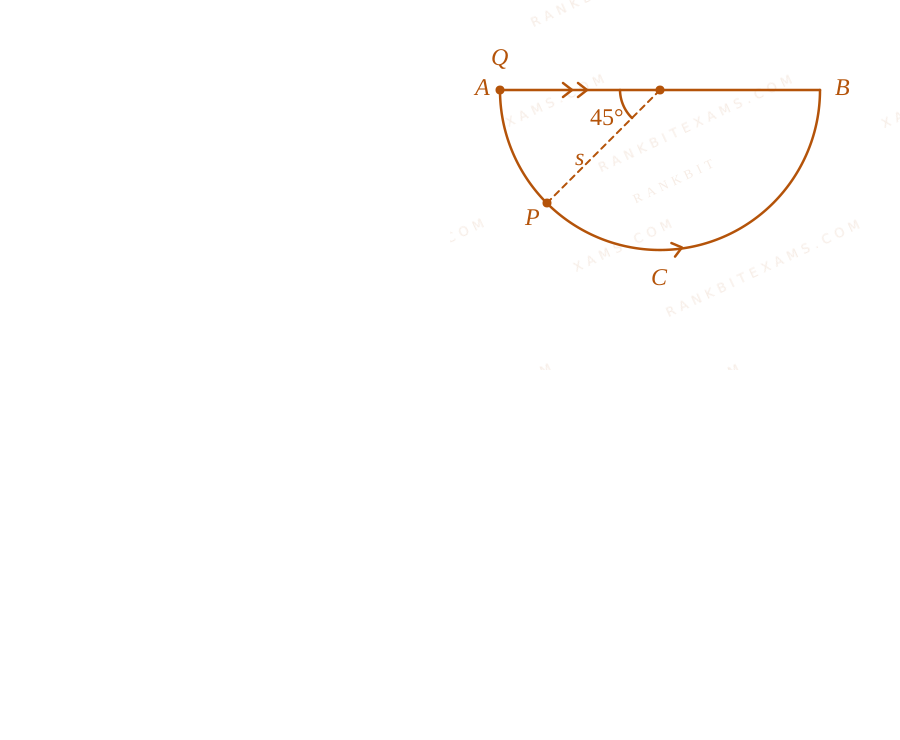
A bead P sliding on a frictionless semi-circular string (ACB) and it is at point S at t = 0 and at this instant the horizontal component of its velocity is v. Another bead Q of the same mass as P is ejected from point A at t = 0 along the horizontal string AB, with the speed v, friction between the beads and the respective strings may be neglected in both cases. Let tₚ and tQ be the respective times taken by beads P and Q to reach the point B, then the relation between tₚ and tQ is
Motion on Curved Path diagram for Q33 - JEE Main 2026 Evening
Diagram showing bead P on a curved path and bead Q on a straight horizontal path.

Solution & Explanation

Related Formula
t = SVhorizontal
Core Logic

Motion on Curved Path diagram for Q33 - JEE Main 2026 Evening
Diagram showing bead P on a curved path and bead Q on a straight horizontal path.

For bead Q on the straight horizontal wire, its horizontal velocity remains constant at v. Total distance is XQ. For bead P on the semi-circular wire, as it moves down the curve, gravity increases its total speed, thus increasing its horizontal velocity component significantly compared to its initial value. Over the path, horizontal displacement of Q is greater than the direct horizontal projection of P's remaining path.

Step 1: Compare Horizontal Displacement and Time

Horizontal displacement required to reach B from their respective starting states: XQ > XP.

Time taken by bead Q:

tQ = (XQ)/(v)

Time taken by bead P:

tP = XPvhorizontal, avg

Since XQ > XP and vhorizontal, P > v for a major part of the journey, tP < tQ.

Pattern Recognition

A particle on a frictionless downward curve gains kinetic energy, resulting in a higher average horizontal velocity than a particle moving strictly horizontally at the initial horizontal velocity. It covers less or equal horizontal distance but at a higher average speed.

Chapter Mix

Class 11 Physics: Work, Energy and Power Class 11 Physics: Kinematics

Reference Study Guides

More Work, Energy and Power Previous-Year Questions — Page 7

Q49 jee_main_2024_31_jan_morning Conservation Of Momentum
An artillery piece of mass M₁ fires a shell of mass M₂ horizontally. Instantaneously after the firing, the ratio of kinetic energy of the artillery and that of the shell is :
  • A. M₁ / (M₁ + M₂)
  • B. (M₂)/(M₁)
  • C. M₂ / (M₁ + M₂)
  • D. (M₁)/(M₂)

Solution

Related Formula
KE = (p²)/(2m)
Core Logic

By conservation of linear momentum (since no external horizontal force acts on the system):

0 = M₁ v₁ + M₂ v₂ | p₁| = | p₂| = p

Both the artillery and the shell acquire the exact same magnitude of momentum during firing.

Step 2: Kinetic Energy Ratio

The kinetic energy is related to momentum by KE = (p²)/(2m). Since p is identical for both bodies:

KE ∝ (1)/(m)

Therefore, the ratio of kinetic energy of the artillery (M₁) to the shell (M₂) is:

KE₁KE₂ = ((p²)/(2M₁))/((p²)/(2M₂)) = (M₂)/(M₁)
Chapter Mix

Class 11 Physics: Work, Energy And Power

More Work, Energy and Power Questions — jee_main_2026_23_january_evening

Practice all Work, Energy and Power previous-year questions →

Rankbit System
JEE Physics: Waves (+15.5%) | Electrostatics: Concentric Shells (-29.7%) | Modern Physics: Photoelectric Clones (+34.2%) | Mathematics: Definite Integrals (+18.1%) | Chemistry: Coordination Splitting (-11.4%) | JEE Physics: Waves (+15.5%) | Electrostatics: Concentric Shells (-29.7%) | Modern Physics: Photoelectric Clones (+34.2%) | Mathematics: Definite Integrals (+18.1%) | Chemistry: Coordination Splitting (-11.4%)