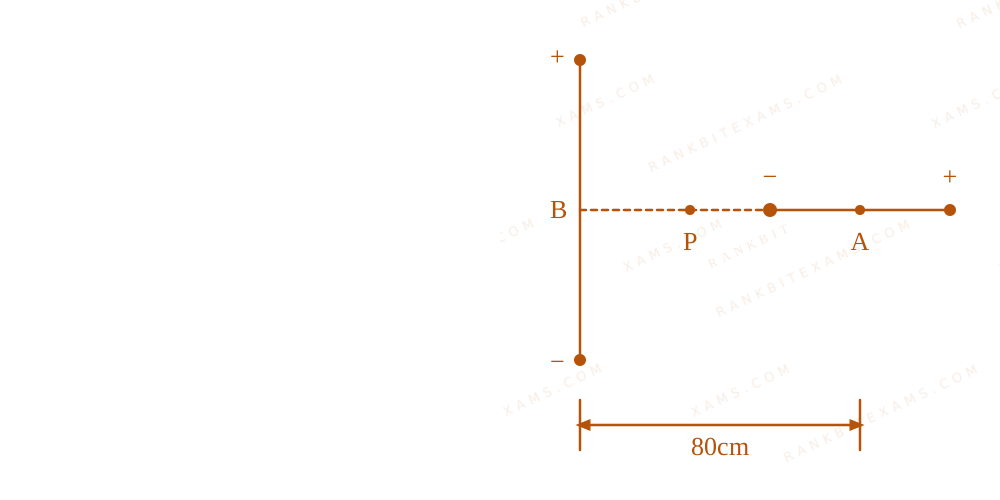
Two shorts dipoles(A, B)$(A, B)$ , A having charges ± 2μ C$\pm 2\mu C$ and length 1 cm and B having charges ± 4μ C$\pm 4\mu C$ and length 1 cm are placed with their centres 80 cm apart as shown in the figure. The electric field at a point P, equi-distant from the centres of both dipoles is ____ N/C.
Configuration of two short electric dipoles and an equidistant point P.
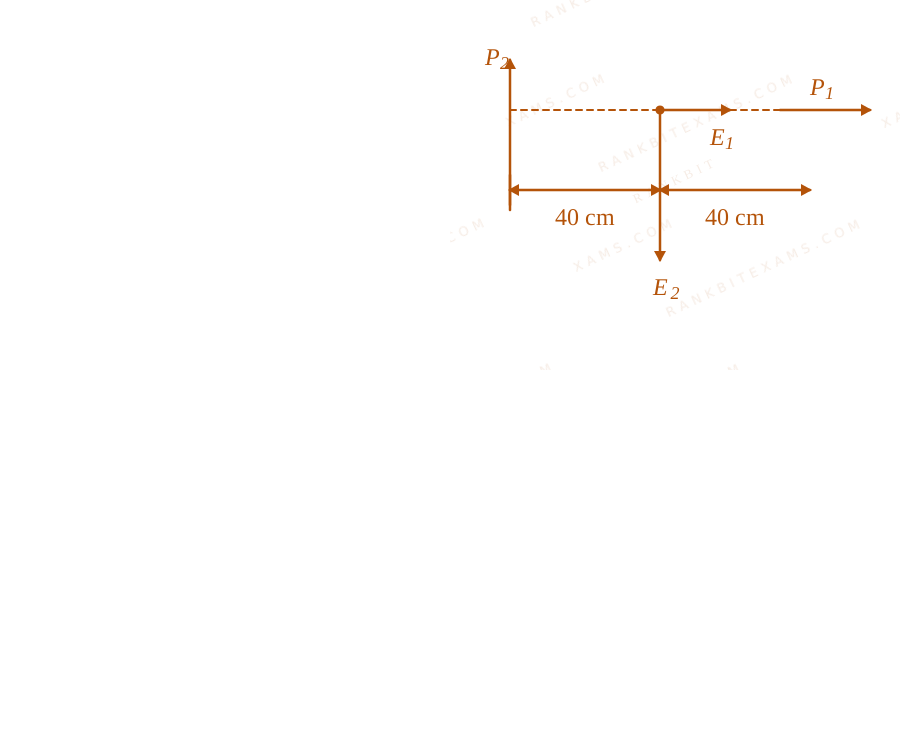
Configuration of two short electric dipoles and an equidistant point P.
Point P is at a distance of r = 40 cm = 0.4 m$r = 40 \, \mathrm{cm} = 0.4 \, \mathrm{m}$ from the centre of both dipoles.
For dipole A, point P lies on the axial line.
For dipole B, point P lies on the equatorial line.
Wait, the orientation in the figure sets the directions. From the diagram, A is oriented left-to-right (minus to plus) so E₁$\vec{E}_1$ on its axis is along + i$+\hat{i}$ or - i$-\hat{i}$ depending on precise placement. Based on standard convention:
Identify the relationship of the observation point to each dipole (axial vs equatorial). The axial field has a factor of 2, while the equatorial does not. Vector addition is mandatory since the fields are perpendicular.
Keywords:#two shorts dipoles#JEE Main 2026 Evening Q31#Electrostatics JEE Main 2026#Electric Dipole JEE Main 2026#two short dipoles#electric field P#equidistant point
More Electrostatics Previous-Year Questions — Page 6
Two large plane parallel conducting plates are kept 10cm$10\mathrm{cm}$ apart as shown in figure. The potential difference between them is V. The potential difference between the points A and B (shown in the figure) is :
The diagram shows two parallel plates separated by 10 cm, with points A and B defining a right triangle of legs 3 cm and 4 cm.
A.(1)/(4) ~V$\frac{1}{4} \mathrm{~V}$
B.(2)/(5) ~V$\frac{2}{5} \mathrm{~V}$
C.(3)/(4) ~V$\frac{3}{4} \mathrm{~V}$
D.1 ~V$1 \mathrm{~V}$
Solution
Related Formula
Uniform Electric Field between parallel plates:
E = (V)/(d)$$E = \frac{V}{d}$$
Potential difference between two points along the direction of the field:
Δ V = E · Δ x$$\Delta V = E \cdot \Delta x$$
Core Logic
The separation between the plates is d = 10 cm$d = 10 \ \mathrm{cm}$. The electric field E$\vec{E}$ between them is uniform and runs perpendicularly between the plates (along the horizontal direction, +x$+x$):
E = (V)/(10) V/cm$$E = \frac{V}{10} \ \mathrm{V/cm}$$
From the geometry shown in the figure:
AC = 3 cm$AC = 3 \ \mathrm{cm}$ is perpendicular to E$\vec{E}$ (vertical direction).
CB = 4 cm$CB = 4 \ \mathrm{cm}$ is parallel to E$\vec{E}$ (horizontal direction).
Step 1: Calculate potential difference between A and B
Since line AC$AC$ is perpendicular to E$\vec{E}$:
VA - VC = 0 VA = VC$$V_A - V_C = 0 \implies V_A = V_C$$
Thus, the potential difference between A$A$ and B$B$ is completely due to the horizontal displacement CB$CB$:
VAB = VA - VB = E · (CB)$$V_{AB} = V_A - V_B = E \cdot (CB)$$
Thus, the potential difference between A$A$ and B$B$ is (2)/(5)V$\frac{2}{5}V$.
Pattern Recognition
Sees: Uniform electric field, potential difference over diagonal paths.
Trap: Projecting along the hypotenuse length (5 cm$5\text{ cm}$) directly without considering the electric field's physical direction.
Shortcut: Electric field is purely horizontal. Hence, only horizontal displacement matters. The horizontal displacement is 4 cm$4\text{ cm}$ out of 10 cm$10\text{ cm}$ total plate gap, so the potential difference is (4)/(10)V = (2)/(5)V$\frac{4}{10}V = \frac{2}{5}V$.
Chapter Mix
Class 12 Physics: Electrostatic Potential and Capacitance
Q20jee_main_2025_02_april_eveningElectric Field of a Ring
Consider a circular loop that is uniformly charged and has a radius a√(2)$a\sqrt{2}$ . Find the position along the positive z$z$ -axis of the cartesian coordinate system where the electric field is maximum if the ring was assumed to be placed in xy-plane at the origin:
A.a√(2)$\frac{a}{\sqrt{2}}$
B.(a)/(2)$\frac{a}{2}$
C.a$a$
D.0$0$
Solution
Related Formula
Electric field intensity on the axis of a ring of radius R$R$ at axial distance z$z$:
E = k Q z(z² + R²)3/2$$E = \frac{k Q z}{\left(z^2 + R^2\right)^{3/2}}$$
Condition for maximum electric field on the axis of a ring:
z = R√(2)$$z = \frac{R}{\sqrt{2}}$$
Core Logic
To find where the axial field is maximized, take the first derivative of E$E$ with respect to z$z$ and set it to zero:
Substitute the radius R = a√(2)$R = a\sqrt{2}$ into the maximized coordinate condition:
z = a√(2)√(2) = a$$z = \frac{a\sqrt{2}}{\sqrt{2}} = a$$
Thus, the electric field reaches its peak intensity at z = a$z = a$.
Pattern Recognition
Sees: Maximum axial field location of circular charged ring.
Trap: Simply picking radius R$R$ directly as the distance value, or omitting the 1/√(2)$1/\sqrt{2}$ scaling factor.
Shortcut: The peak of the axial field distribution of any ring always lies at z = R√(2)$z = \frac{R}{\sqrt{2}}$. With R = a√(2)$R = a\sqrt{2}$, z$z$ resolves simply to a√(2)√(2) = a$\frac{a\sqrt{2}}{\sqrt{2}} = a$.
Chapter Mix
Class 12 Physics: Electric Charges and Fields
Qjee_main_2025_02_april_morningElectric Field and Gauss's Law
A small bob of mass 100~mg$100\mathrm{~mg}$ and charge +10~μ C$+10\mathrm{~\mu C}$ is connected to an insulating string of length 1~m$1\mathrm{~m}$. It is brought near to an infinitely long non-conducting sheet of charge density 'σ$\sigma$' as shown in figure. If string subtends an angle of 45circ$45^{circ}$ with the sheet at equilibrium the charge density of sheet will be:
(Given, ε₀ = 8.85× 10⁻¹² Fm$\epsilon_0 = 8.85\times 10^{-12}\frac{\mathrm{F}}{\mathrm{m}}$ and acceleration due to gravity, g = 10~m/s²$g = 10\mathrm{~m/s^2}$)
A small charged bob hanging by a string of length 1 m subtending an angle of 45 degrees near a charged sheet.
A. 0.885 nC / m²$\mathrm{nC} / \mathrm{m}^{2}$
B. 17.7 nC / m²$\mathrm{nC} / \mathrm{m}^{2}$
C. 885 nC / m²$\mathrm{nC} / \mathrm{m}^{2}$
D. 1.77 nC / m²$\mathrm{nC} / \mathrm{m}^{2}$
Solution
Related Formula
E = (σ)/(2ε₀) (field of infinite non-conducting charged sheet)$$E = \frac{\sigma}{2\epsilon_0} \quad \text{(field of infinite non-conducting charged sheet)}$$θ = (Fₑ)/(mg)$$\tan\theta = \frac{F_e}{mg}$$
Core Logic
In equilibrium, three forces act on the suspended charged bob:
Tension T$T$ directed along the string at θ = 45°$\theta = 45^{\circ}$ with the vertical sheet.
Weight mg$mg$ directed vertically downwards.
Electrostatic repulsion force Fₑ = qE$F_e = qE$ acting horizontally away from the sheet.
From the balance of forces in vertical and horizontal directions:
The charge density of the sheet is 1.77~nC/m²$1.77\mathrm{~nC/m}^2$.
Pattern Recognition
For a charge hanging near a vertical charged sheet, the equilibrium angle is governed by θ = (Fₑ)/(mg)$\tan\theta = \frac{F_e}{mg}$. For θ = 45°$\theta = 45^{\circ}$, the horizontal force equals the vertical force (Fₑ = mg$F_e = mg$). Be careful to use the field of a non-conducting sheet: E = (σ)/(2ε₀)$E = \frac{\sigma}{2\epsilon_0}$.
Chapter Mix
Class 12 Physics: Electrostatics
Q5jee_main_2025_02_april_morningElectric Field and Gauss's Law
Consider two infinitely large plane parallel conducting plates as shown below. The plates are uniformly charged with a surface charge density +σ$+\sigma$ and -2σ$-2\sigma$. The force experienced by a point charge +q$+q$ placed at the mid point between two plates will be:
Two parallel plates with charges +sigma and -2sigma and a point charge +q at the midpoint.
A.(σ q)/(4 ε₀)$\frac{\sigma q}{4 \epsilon_0}$
B.(3σ q)/(2 ε₀)$\frac{3\sigma q}{2 \epsilon_0}$
C.(3σ q)/(4 ε₀)$\frac{3\sigma q}{4 \epsilon_0}$
D.(σ q)/(2 ε₀)$\frac{\sigma q}{2 \epsilon_0}$
Solution
Related Formula
E = σᵢₙₙₑᵣε₀$$E = \frac{\sigma_{\text{inner}}}{\epsilon_0}$$
Core Logic
For parallel conducting plates of large area, charges redistribute on the outer and inner faces to maintain electrostatic equilibrium.
Total charge per unit area on Plate 1: q₁ = σ$q_1 = \sigma$
Total charge per unit area on Plate 2: q₂ = -2σ$q_2 = -2\sigma$
The outer surface charge density on the far sides of both plates must be equal:
In the region between the plates, both inner surfaces create an electric field in the same direction (away from the positive plate 1 and towards negative plate 2):
F = q E = (3σ q)/(2ε₀)$$F = q E = \frac{3\sigma q}{2\epsilon_0}$$
Step 1: Final Conclusion
The force experienced by the point charge +q$+q$ is (3σ q)/(2ε₀)$\frac{3\sigma q}{2\epsilon_0}$.
Pattern Recognition
For conducting plates with total charges Q₁$Q_1$ and Q₂$Q_2$, always calculate the outer charge first: Qouter = (Q₁+Q₂)/(2)$Q_{\text{outer}} = \frac{Q_1+Q_2}{2}$. The field inside the gap is exclusively due to the inner surfaces: E = σᵢₙₙₑᵣε₀$E = \frac{\sigma_{\text{inner}}}{\epsilon_0}$.
Chapter Mix
Class 12 Physics: Electrostatics
Q7jee_main_2025_02_april_morningElectric Field and Gauss's Law
A point charge +q$+q$ is placed at the origin. A second point charge +9q$+9q$ is placed at (d, 0, 0)$(d, 0, 0)$ in Cartesian coordinate system. The point in between them where the electric field vanishes is:
(1)/(x) = (3)/(d - x) d - x = 3x$$\frac{1}{x} = \frac{3}{d - x} \implies d - x = 3x$$4x = d x = (d)/(4)$$4x = d \implies x = \frac{d}{4}$$
Thus, the coordinates of the null point are ((d)/(4), 0, 0)$\left(\frac{d}{4}, 0, 0\right)$.
Step 1: Final Conclusion
The point where the electric field vanishes is ((d)/(4), 0, 0)$\left(\frac{d}{4}, 0, 0\right)$.
Pattern Recognition
For two like charges, the zero-field null point always lies along the line joining them and is closer to the smaller charge. Use the standard shortcut: x = d1 + √(q₂/q₁)$x = \frac{d}{1 + \sqrt{q_2/q_1}}$ measured from charge q₁$q_1$.
Chapter Mix
Class 12 Physics: Electrostatics
More Electrostatics Questions — jee_main_2026_23_january_evening
Practice past-year questions one chapter at a time. Pick an exam → subject → chapter and get every PYQ for that topic — pulled together from all past papers — with the chapter's key formulas alongside.