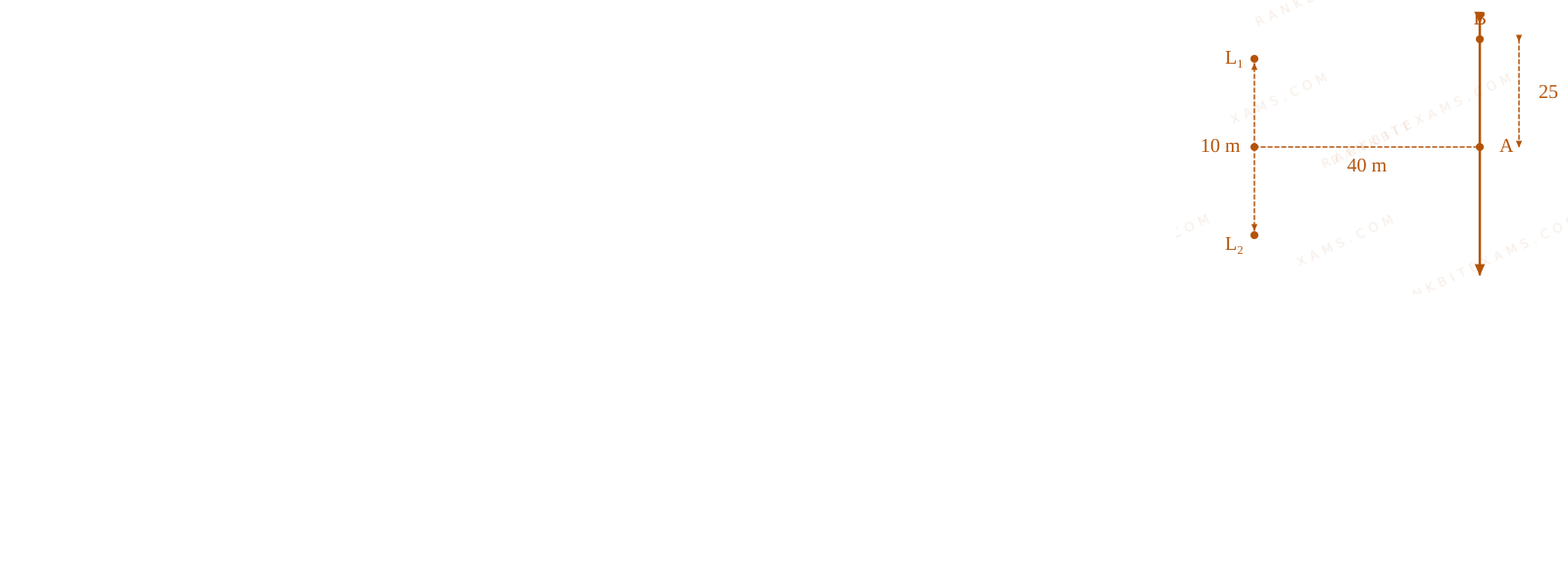
Two loudspeakers L₁ and L₂ are placed with a separation of 10 m, as shown in figure. Both speakers are fed with an audio input signal of same frequency with constant volume. A voice recorder, initially at point A, at equidistance to both loud speakers, is moved by 25 m along the line AB while monitoring the audio signal. The measured signal was found to undergo 10 cycles of minima and maxima during the movement. The frequency of the input signal is \_\_\_\_ Hz (Speed of sound in air is 324~m/s and √(5)=2.23)
Waves and Sound diagram for Q46 - JEE Main 2026 January Morning
Two loudspeakers setup with path difference for sound interference.

Numerical Answer Type:
Enter a numerical value Answer: 600 to 600 +4 marks

Solution & Explanation

Related Formula
Δ x = nλ, v = fλ
Core Logic

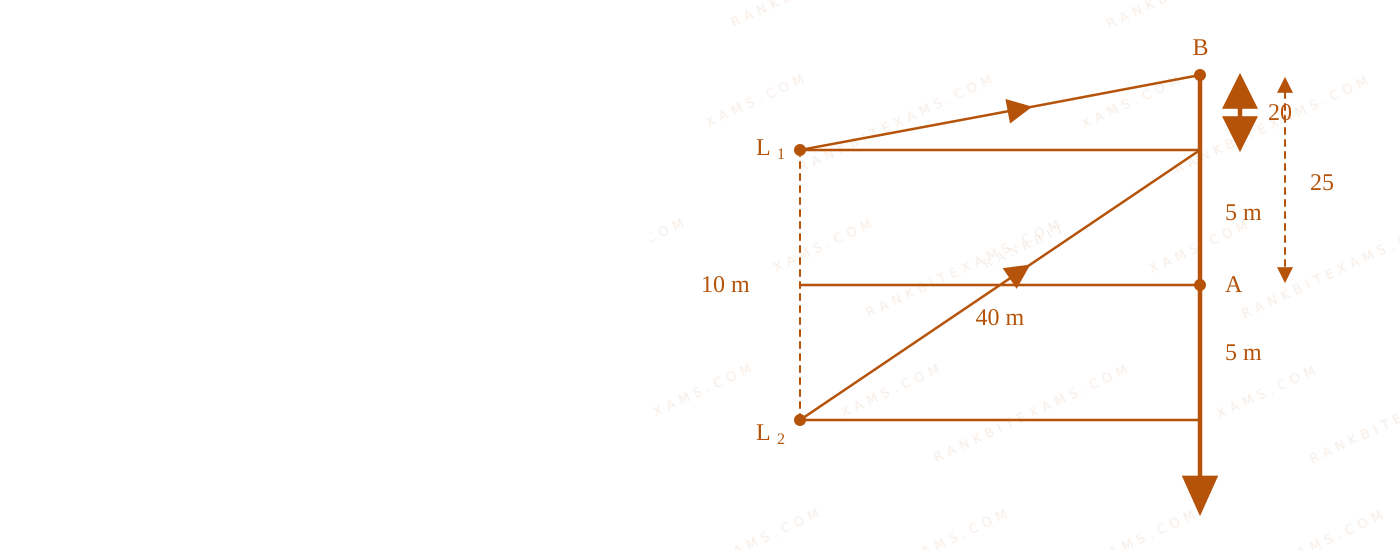
Solution geometry diagram for Q46 - JEE Main 2026 Morning
Two loudspeakers setup with path difference for sound interference.

Path difference at point B:

L₁ B = √(20² + 40²) = 20√(5) m = 44.6 m L₂ B = √(40² + 30²) = 50 m Δ x = 50 - 44.6 = 5.4 m Δ x = nλ 5.4 = 10 × λ λ = 0.54 m f = (v)/(λ) = (324)/(0.54) = 600 Hz
Pattern Recognition

Sees: Loudspeaker interference cycles along displacement line. Shortcut: Compute path difference at endpoint B, relate to total interference cycles to find wavelength, then frequency. Check: Numerical answer is 600 Hz. ✓

Chapter Mix

Class 11 Physics: Waves and Sound

Reference Study Guides

More Waves and Sound Previous-Year Questions — Page 5

Q37 jee_main_2024_31_jan_evening Speed of Sound in Gases
The speed of sound in oxygen at S.T.P. will be approximately: (Given, R = 8.3 J K⁻¹ , γ = 1.4)
  • A. 310 m/s
  • B. 333 m/s
  • C. 341 m/s
  • D. 325 m/s

Solution

Related Formula
v = √((γ RT)/(M))
Core Logic

For Oxygen (O₂) at standard temperature and pressure (S.T.P.): T = 273 K M = 32 g/mol = 32 × 10⁻³ kg/mol γ = 1.4 R = 8.3 J K⁻¹ mol⁻¹

Step 1: Calculate Velocity
v = 1.4 × 8.3 × 27332 × 10⁻³ v = 3172.2632 × 10⁻³ v = √(99.133 × 10³) v = √(99133) ≈ 314.85 m/s

Approximating to the closest given option yields 310 m/s.

Pattern Recognition

For diatomic gases around room temp or STP, velocities range roughly from 250 to 350 m/s depending on molar mass (N₂ ≈ 334, O₂ ≈ 315). Recognize 315 is closest to option (1) due to standard approximations taken in exams.

Chapter Mix

Class 11 Physics: Waves Class 11 Physics: Kinetic Theory of Gases
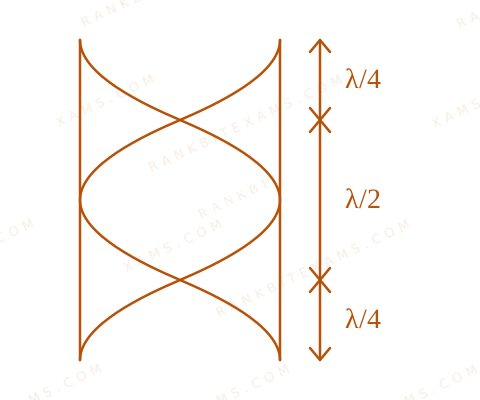
Q jee_main_2024_31_jan_morning Organ Pipes
The fundamental frequency of a closed organ pipe is equal to the first overtone frequency of an open organ pipe. If length of the open pipe is 60~cm, the length of the closed pipe will be:
  • A. 60~cm
  • B. 45~cm
  • C. 30~cm
  • D. 15~cm

Solution

Related Formula
fclosed, fundamental = (v)/(4Lc) fopen, 1st overtone = (2v)/(2Lₒ)
Core Logic

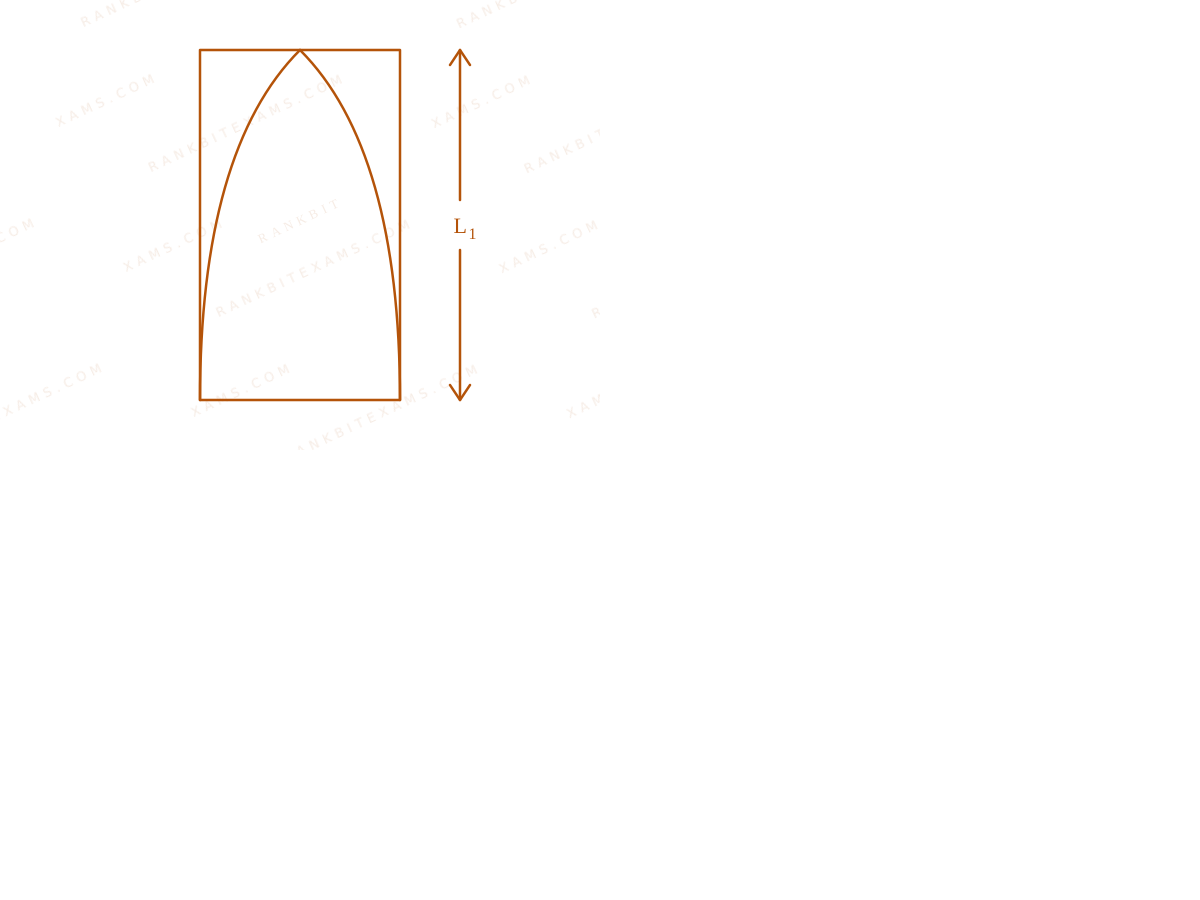
Organ Pipes diagram for Q45 - JEE Main 2024 Morning

Organ Pipes diagram for Q45 - JEE Main 2024 Morning

For a closed organ pipe, the fundamental frequency (1st harmonic) is:

f₁ = (v)/(λ) = (v)/(4L₁)

where L₁ is the length of the closed pipe.

For an open organ pipe, the first overtone (2nd harmonic) is:

f₂ = (2v)/(2L₂) = (v)/(L₂)

where L₂ is the length of the open pipe (L₂ = 60 cm).

Step 2: Equating Frequencies

Given f₁ = f₂:

(v)/(4L₁) = (v)/(L₂)

L₂ = 4L₁

60 = 4 × L₁ L₁ = 15 cm
Chapter Mix

Class 11 Physics: Waves

Rankbit System
JEE Physics: Waves (+15.5%) | Electrostatics: Concentric Shells (-29.7%) | Modern Physics: Photoelectric Clones (+34.2%) | Mathematics: Definite Integrals (+18.1%) | Chemistry: Coordination Splitting (-11.4%) | JEE Physics: Waves (+15.5%) | Electrostatics: Concentric Shells (-29.7%) | Modern Physics: Photoelectric Clones (+34.2%) | Mathematics: Definite Integrals (+18.1%) | Chemistry: Coordination Splitting (-11.4%)