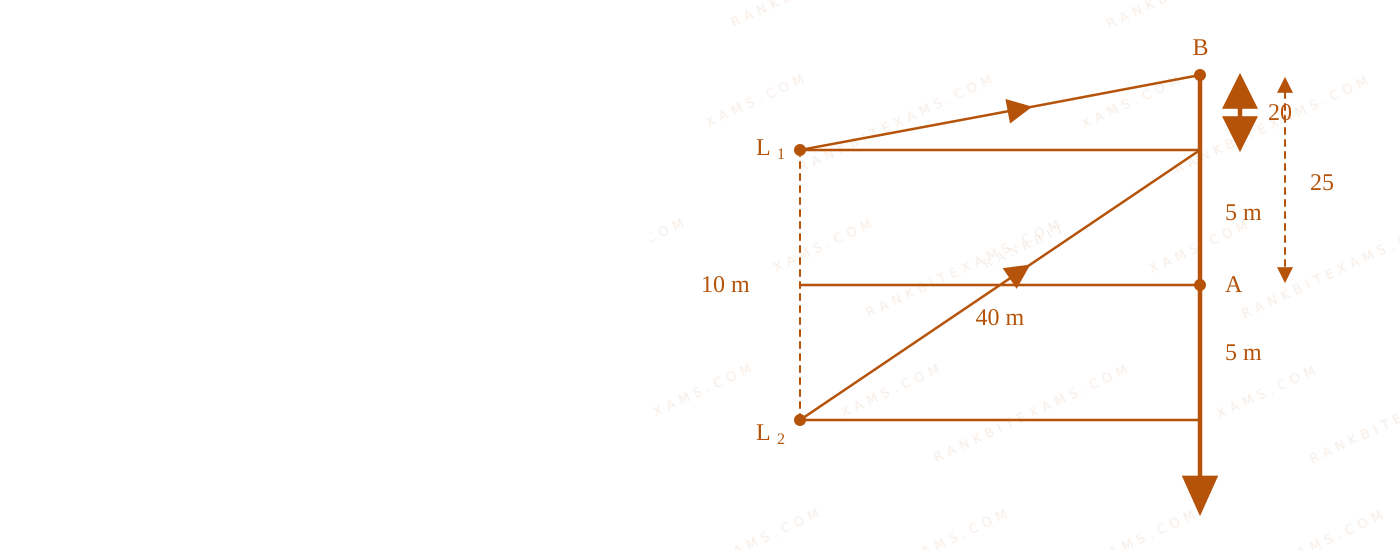
Two loudspeakers L₁ and L₂ are placed with a separation of 10 m, as shown in figure. Both speakers are fed with an audio input signal of same frequency with constant volume. A voice recorder, initially at point A, at equidistance to both loud speakers, is moved by 25 m along the line AB while monitoring the audio signal. The measured signal was found to undergo 10 cycles of minima and maxima during the movement. The frequency of the input signal is \_\_\_\_ Hz (Speed of sound in air is 324~m/s and √(5)=2.23)
Waves and Sound diagram for Q46 - JEE Main 2026 January Morning
Two loudspeakers setup with path difference for sound interference.

Numerical Answer Type:
Enter a numerical value Answer: 600 to 600 +4 marks

Solution & Explanation

Related Formula
Δ x = nλ, v = fλ
Core Logic

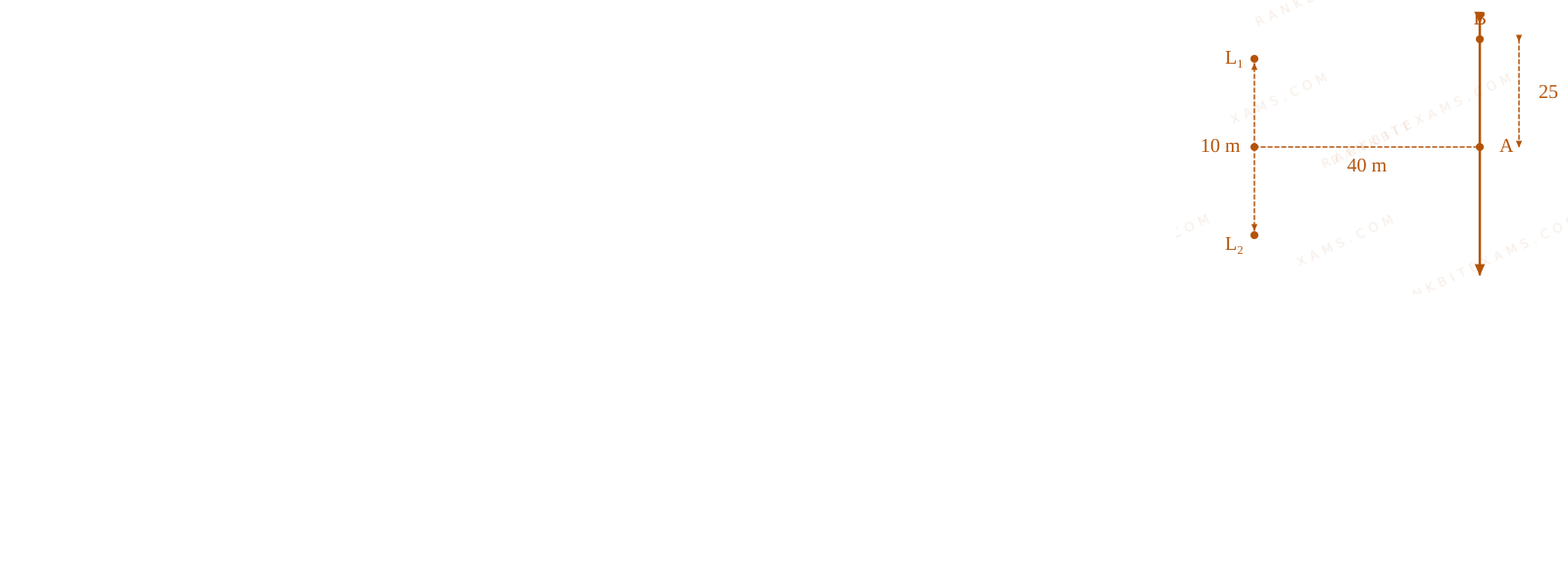
Solution geometry diagram for Q46 - JEE Main 2026 Morning
Two loudspeakers setup with path difference for sound interference.

Path difference at point B:

L₁ B = √(20² + 40²) = 20√(5) m = 44.6 m L₂ B = √(40² + 30²) = 50 m Δ x = 50 - 44.6 = 5.4 m Δ x = nλ 5.4 = 10 × λ λ = 0.54 m f = (v)/(λ) = (324)/(0.54) = 600 Hz
Pattern Recognition

Sees: Loudspeaker interference cycles along displacement line. Shortcut: Compute path difference at endpoint B, relate to total interference cycles to find wavelength, then frequency. Check: Numerical answer is 600 Hz. ✓

Chapter Mix

Class 11 Physics: Waves and Sound

Reference Study Guides

More Waves and Sound Previous-Year Questions — Page 4

Q jee_main_2025_04_april_morning Organ Pipes and Standing Waves
In an experiment with a closed organ pipe, it is filled with water by ((1)/(5))^th of its volume. The frequency of the fundamental note will change by:
  • A. 25%
  • B. 20%
  • C. -20%
  • D. -25%

Solution

Related Formula

Fundamental frequency of a closed organ pipe:

f₁ = (v)/(4l)

where l is the length of the resonating air column.

Core Logic

Initially, the full air column length is l. Filling (1)/(5) of its space with fluid reduces the available vibrating air column length to:

l₂ = l - (1)/(5)l = (4)/(5)l

Resonating length air column profile initial state for Q16 - JEE Main 2025 Morning

Step 1: Calculate New Frequency

The modified acoustic frequency response is:

f₂ = (v)/(4l₂) = (v)/(4((4)/(5)l)) = (5v)/(16l) = (5)/(4)f₁

Resonating length air column profile initial state for Q16 - JEE Main 2025 Morning

Step 2: Determine Percentage Shift
Δ f% = (f₂ - f₁)/(f₁) × 100 = ((5)/(4) - 1) × 100 = 25%
Pattern Recognition

Shortening the resonance tube length raises pitch frequency inversely (f ∝ (1)/(l)). Reducing the air column length to 80% of its original value drives the frequency up to 125%, yielding a positive 25% increase.

Evaluation Rubric / Model Answer

Option A: 25%

Chapter Mix

Class 11 Physics: Waves

Q13 jee_main_2025_07_april_evening Wave Equation
The equation of a wave travelling on a string is y= [20π x+10π t] where x and t are distance and time in SI units. The minimum distance between two points having the same oscillating speed is : [cite: 120, 121]
  • A. 5.0 cm [cite: 122]
  • B. 20 cm [cite: 123]
  • C. 10 cm [cite: 124]
  • D. 2.5 cm [cite: 125]

Solution

Related Formula
k = (2π)/(λ)

Δ xmin = (λ)/(2) [cite: 715]

Core Logic

From the given wave equation, the wave number k is the coefficient of x [cite: 120]:

k = 20π rad/m

Now find the wavelength λ: [cite: 717]

λ = (2π)/(k) = (2π)/(20π) = (1)/(10) m = 10 cm [cite: 717]

The minimum distance between any two points moving with identical speeds in a continuous wave cycle corresponds to a phase difference of π, which translates spatially to a half-wavelength separation ((λ)/(2)) [cite: 715]:

Distance = (λ)/(2) = (10)/(2) = 5 cm [cite: 717]

Pattern Recognition

Oscillating speed configuration reaches identical value fields twice per spatial wavelength cycle[cite: 715]. Thus, minimum distance separation scales exactly to (λ)/(2)[cite: 715].

Chapter Mix

Class 11 Physics: Waves

Q57 jee_main_2024_01_february_morning Beats
A tuning fork resonates with a sonometer wire of length 1~m stretched with a tension of 6~N. When the tension in the wire is changed to 54~N, the same tuning fork produces 12 beats per second with it. The frequency of the tuning fork is _______ Hz.
Numerical Answer. Answer: 6 to 6

Solution

Related Formula

Fundamental frequency of a sonometer wire:

f = (1)/(2L)√((T)/(mu)) f ∝ √(T)

Beat frequency equation:

fbeat = |ffork - fwire|
Core Logic

Let the tuning fork frequency be f. Initially, it resonates with the wire at 6~N:

f = f₁ = (1)/(2L)√((6)/(mu))

When the tension shifts to 54~N, the wire's new frequency becomes:

f₂ = (1)/(2L)√((54)/(mu))

Taking the ratio of frequencies:

(f₁)/(f₂) = √((6)/(54)) = √((1)/(9)) = (1)/(3) f₂ = 3f₁ = 3f
Step 1: Apply Beat Conditions

The new frequency f₂ creates 12 beats per second with the fork:

f₂ - f = 12 3f - f = 12 2f = 12 f = 6~Hz
Pattern Recognition

Resonance establishes a direct anchor equality (ffork = finitial). Since tension changes by a factor of 9 (54/6), the frequency scales up by a factor of 3 (√(9)).

Chapter Mix

Class 11 Physics: Waves Class 11 Physics: Oscillations

Q jee_main_2024_30_january_evening Sound Intensity and Distance
A point source is emitting sound waves of intensity 16 × 10⁻⁸ ~W m⁻² at the origin. The difference in intensity (magnitude only) at two points located at a distance of 2 ~m and 4 ~m from the origin respectively will be ________ × 10⁻⁸ ~W m⁻².
Numerical Answer. Answer: 3 to 3

Solution

Related Formula
I = (P)/(4π r²) I ∝ (1)/(r²)
Core Logic

For a point source, the intensity I is inversely proportional to the square of the distance from the source. If the given intensity is at r₀ = 1m (usually implied if "at origin" is stated alongside a base value, though the phrasing "at the origin" is ambiguous), we can assume I₀ = 16 × 10⁻⁸. The official NTA answer assumes the initial given intensity was at r=2m. Wait, if I = 16 × 10⁻⁸ was the source power factor or the intensity at r=2, let's reverse-engineer the answer `3`. If I ∝ 1/r², and I₁ at r=2 and I₂ at r=4: I₂ = I₁ (r₁/r₂)² = I₁ (2/4)² = I₁ / 4. Difference Δ I = I₁ - I₂ = I₁ - I₁/4 = 3 I₁ / 4. If this difference equals 3, then I₁ must be 4. But 16 × 10⁻⁸ is given. Wait, if I at 1m is 16 × 10⁻⁸: I(2m) = (16)/(2²) = 4 × 10⁻⁸. I(4m) = (16)/(4²) = 1 × 10⁻⁸. Δ I = 4 - 1 = 3 × 10⁻⁸. This perfectly matches.

Step 1: Calculate Intensity at r = 2m and r = 4m

Assume the intensity I₀ = 16 × 10⁻⁸ ~W m⁻² represents the reference intensity at r=1m. Intensity at r=2 ~m:

I₁ = (I₀)/(2²) = 16 × 10⁻⁸4 = 4 × 10⁻⁸ ~W m⁻²

Intensity at r=4 ~m:

I₂ = (I₀)/(4²) = 16 × 10⁻⁸16 = 1 × 10⁻⁸ ~W m⁻²
Step 2: Calculate the Difference

Magnitude of intensity difference:

Δ I = |I₁ - I₂| = (4 - 1) × 10⁻⁸ = 3 × 10⁻⁸ ~W m⁻²
Pattern Recognition

Although the question text ("at the origin") was poorly drafted (intensity at r=0 would be infinite), the numerical setup expects you to treat 16 × 10⁻⁸ as the P/4π constant multiplier for the 1/r² dropoff BY NTA 3 BY RANKBIT (BONUS) Question is wrong as data is incomplete.

Chapter Mix

Class 11 Physics: Waves
Q59 jee_main_2024_30_jan_morning Resonance in Closed Organ Pipes
In a closed organ pipe, the frequency of fundamental note is 30 ~Hz. A certain amount of water is now poured in the organ pipe so that the fundamental frequency is increased to 110 ~Hz. If the organ pipe has a cross-sectional area of 2 ~cm², the amount of water poured in the organ tube is ______ g. (Take speed of sound in air is 330 ~m/s)
Numerical Answer. Answer: 400 to 400

Solution

Related Formula
f = (v)/(4L) (closed organ pipe)
Core Logic

Adding water to a closed organ pipe reduces its effective air column length, thereby increasing the fundamental frequency. The change in length corresponds directly to the volume of water poured.

Step 1: Calculate Initial Length
(v)/(4 ₁) = 30 (330)/(4 ₁) = 30 ₁ = (330)/(120) = (11)/(4) ~m
Step 2: Calculate Final Length
(v)/(4 ₂) = 110 (330)/(4 ₂) = 110 ₂ = (330)/(440) = (3)/(4) ~m
Step 3: Calculate Water Mass

The change in length (water depth) is:

Δ = ₁ - ₂ = (11)/(4) - (3)/(4) = (8)/(4) = 2 ~m = 200 ~cm

Change in volume (volume of water) = Area × Δ:

Vwater = 2 ~cm² × 200 ~cm = 400 ~cm³

Mass of water (M):

M = Volume × Density = 400 ~cm³ × 1 ~g/cm³ = 400 ~g
Pattern Recognition

Always map frequency changes to length changes using f ∝ 1/L. Poured water height is exactly the length change Δ L. Watch out for CGS unit conversion (cm, grams).

Chapter Mix

Class 11 Physics: Waves

Rankbit System
JEE Physics: Waves (+15.5%) | Electrostatics: Concentric Shells (-29.7%) | Modern Physics: Photoelectric Clones (+34.2%) | Mathematics: Definite Integrals (+18.1%) | Chemistry: Coordination Splitting (-11.4%) | JEE Physics: Waves (+15.5%) | Electrostatics: Concentric Shells (-29.7%) | Modern Physics: Photoelectric Clones (+34.2%) | Mathematics: Definite Integrals (+18.1%) | Chemistry: Coordination Splitting (-11.4%)