Decomposition of A is a first order reaction at T(K) and is given by textA(textg) rightarrow textB(textg) + textC(textg). In a closed 1 L vessel, 1 bar textA(textg) is allowed to decompose at T(K). After 100 minutes, the total pressure was 1.5 bar. What is the rate constant (in textmin^-1) of the reaction? (log 2 = 0.3)

Solution & Explanation

### Related Formula k = frac2.303t logleft(fracP_02P_0 - P_texttotalright) or equivalent first-order expression. ### Core Logic For textA(textg) rightarrow textB(textg) + textC(textg): - Initial pressure: P_0 = 1 text bar - At time t = 100 text min, pressure of A remaining = 1 - P, pressures of B and C = P. - Total pressure P_texttotal = 1 - P + P + P = 1 + P = 1.5 text bar implies P = 0.5 text bar. Remaining pressure of A = 1 - 0.5 = 0.5 text bar. ### Step 1: Calculating Rate Constant k = frac1100 lnleft(frac10.5right) = frac0.693100 = 6.9 times 10^-3 text min^-1 ### Pattern Recognition Sees: gaseous phase first-order kinetics with total pressure data. Trap: Confusing partial pressure of reactant with total pressure in rate expressions. ### Chapter Mix Class 12 Chemistry: Chemical Kinetics

Reference Study Guides

More Chemical Kinetics Previous-Year Questions

Q71 jee_main_2026_21_jan_morning Arrhenius Equation
Pre-exponential factors of two different reactions of same order are identical. Let activation energy of first reaction exceeds the activation energy of second reaction by 20text kJ mol^-1. If k_1 and k_2 are the rate constants of first and second reaction respectively at 300 K, then ln frack_2k_1 will be ..... (nearest integer) [R=8.3text J K^-1text mol^-1]
Numerical Answer. Answer: 8 to 8

Solution

### Related Formula ln k = ln A - fracE_aRT ### Core Logic For Reaction 1: ln k_1 = ln A - fracE_1RT For Reaction 2: ln k_2 = ln A - fracE_2RT (Pre-exponential factor A is the same). Subtracting the first from the second: ln k_2 - ln k_1 = -fracE_2RT - left(-fracE_1RTright) ln left(frack_2k_1right) = fracE_1 - E_2RT Given that E_1 exceeds E_2 by 20text kJ mol^-1, E_1 - E_2 = 20000text J mol^-1. T = 300text K, R = 8.3text J K^-1text mol^-1. ln left(frack_2k_1right) = frac200008.3 times 300 = frac2008.3 times 3 = frac20024.9 ln left(frack_2k_1right) = 8.032 Rounding off to nearest integer gives 8. ### Evaluation Rubric / Model Answer null ### Chapter Mix Class 12 Chemistry: Chemical Kinetics
Q58 jee_main_2026_21_jan_evening First Order Reactions and Rate Constant
Decomposition of A is a first order reaction at T(K) and is given by textA(textg) rightarrow textB(textg) + textC(textg). In a closed 1 L vessel, 1 bar textA(textg) is allowed to decompose at T(K). After 100 minutes, the total pressure was 1.5 bar. What is the rate constant (in textmin^-1) of the reaction? (log 2 = 0.3)
  • A. (1) \ 6.9 times 10^-1
  • B. (2) \ 6.9 times 10^-3
  • C. (3) \ 6.9 times 10^-2
  • D. (4) \ 6.9 times 10^-4

Solution

### Related Formula k = frac2.303t logleft(fracP_02P_0 - P_texttotalright) or equivalent first-order expression. ### Core Logic For textA(textg) rightarrow textB(textg) + textC(textg): - Initial pressure: P_0 = 1 text bar - At time t = 100 text min, pressure of A remaining = 1 - P, pressures of B and C = P. - Total pressure P_texttotal = 1 - P + P + P = 1 + P = 1.5 text bar implies P = 0.5 text bar. Remaining pressure of A = 1 - 0.5 = 0.5 text bar. ### Step 1: Calculating Rate Constant k = frac1100 lnleft(frac10.5right) = frac0.693100 = 6.9 times 10^-3 text min^-1 ### Pattern Recognition Sees: gaseous phase first-order kinetics with total pressure data. Trap: Confusing partial pressure of reactant with total pressure in rate expressions. ### Chapter Mix Class 12 Chemistry: Chemical Kinetics
Q39 jee_main_2025_02_april_evening Reaction Mechanism and Energy Profiles
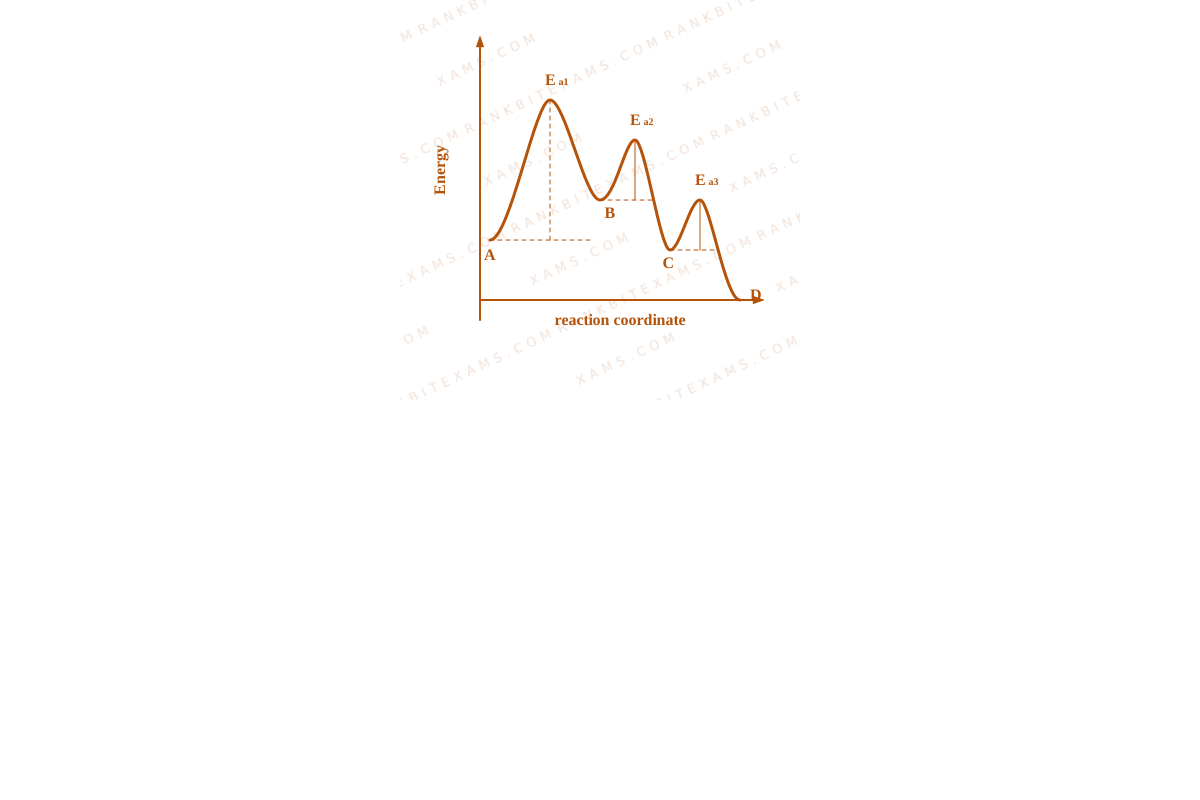
Reactant A converts to product D through the given mechanism (with the net evolution of heat): mathrmA rightarrow mathrmB slow; Delta mathrmH = +mathrmve mathrmB rightarrow mathrmC fast; Delta mathrmH = -mathrmve mathrmC rightarrow mathrmD fast; Delta mathrmH = -mathrmve Which of the following represents the above reaction mechanism?
  • A. textGraph (1)
  • B. textGraph (2)
  • C. textGraph (3)
  • D. textGraph (4)

Solution

### Related Formula k = A e^-E_mathrma/RT textRate propto frac1E_mathrma ### Core Logic Let us break down each step of the mechanism: 1. **Step 1**: mathrmA rightarrow mathrmB is **slow**. - Being the rate-determining step, it must have the **highest activation energy barrier** (E_mathrma1). - Since Delta H = +mathrmve (endothermic), the energy level of intermediate state B must be **higher** than the reactant state A. 2. **Step 2**: mathrmB rightarrow mathrmC is **fast**. - It has a much **lower activation energy barrier** (E_mathrma2). - Since Delta H = -mathrmve (exothermic), the energy level of intermediate C is **lower** than state B. 3. **Step 3**: mathrmC rightarrow mathrmD is **fast**. - It has a **low activation energy barrier** (E_mathrma3). - Since Delta H = -mathrmve (exothermic), the energy level of final state D is **lower** than state C. 4. **Net Reaction**: Exothermic with "net evolution of heat". - The potential energy of the final product D is **lower** than the initial potential energy of reactant A. ### Step 1: Check Potential Energy Profile Evaluating the transition states and relative energy levels in **Graph (1)**: - The first peak (transition state 1) is clearly the highest (E_mathrma1 > E_mathrma2, E_mathrma3) implies Step 1 is the slowest. - The intermediate B is higher in energy than A. - Intermediates C and product D are progressively lower in energy. - Product D has lower energy than reactant A (net exothermic).
Annotated reaction mechanism coordinate graph showing relative activation energies
This perfectly corresponds to **Graph (1)**. ### Pattern Recognition Kinetics shortcut: Slow step = tallest peak. Exothermic step = drop in energy levels of products/intermediates. Endothermic step = climb in energy levels. Use these rules to visually scan energy profiles in under 5 seconds. ### Evaluation Rubric / Model Answer null ### Chapter Mix Class 12 Chemistry: Chemical Kinetics

Q46 jee_main_2025_02_april_evening First-Order Reactions and Half-Life
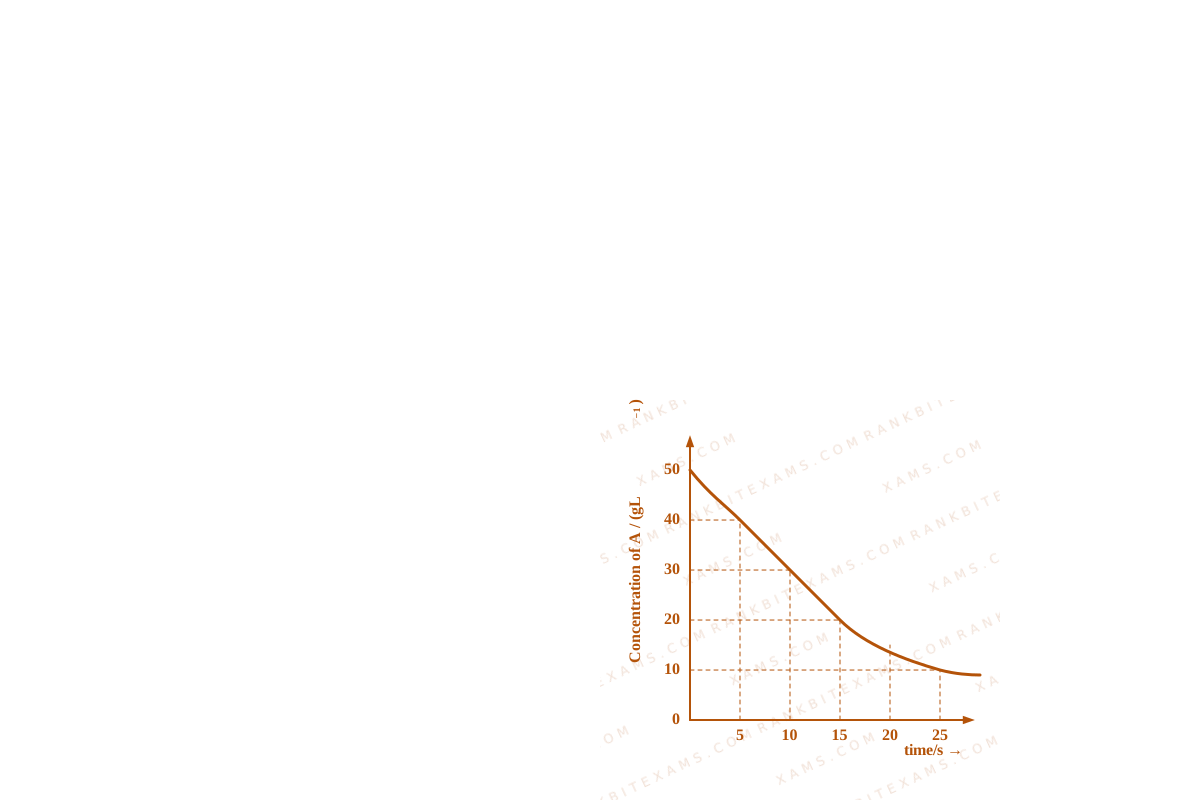
For the reaction mathrmA rightarrow mathrmB the following graph was obtained. The time required (in seconds) for the concentration of A to reduce to 2.5~mathrmg~L^-1 (if the initial concentration of A was 50~mathrmg~L^-1) is _______. (Nearest integer) Given: log 2 = 0.3010
Concentration of A versus time graph for Q46 - JEE Main 2025 Evening
The graph plots the concentration of A in g/L against time in seconds, indicating marked coordinates at t=5s, t=10s, t=15s, t=20s, and t=25s.
Numerical Answer. Answer: 43 to 43

Solution

### Related Formula t_1/2 = fracln 2k t = frac1k lnleft(fracA_0A_tright) ### Core Logic Let's first analyze the order of the reaction using the concentration-time coordinates from the graph: - At t=5~mathrms, concentration [A] = 40~mathrmg~L^-1 - At t=15~mathrms, concentration [A] = 20~mathrmg~L^-1 Notice that the concentration drops to exactly half of its value (40 rightarrow 20) over a time interval of Delta t = 15 - 5 = 10~mathrms. - At t=25~mathrms, concentration [A] = 10~mathrmg~L^-1 Again, the concentration drops to half (20 rightarrow 10) in another interval of Delta t = 25 - 15 = 10~mathrms. Since the half-life (t_1/2) is constant and independent of the initial concentration, this reaction follows **first-order kinetics**. ### Step 1: Calculate the Rate Constant (k) The half-life of the reaction is t_1/2 = 10~mathrms. k = fracln 210 = frac2.303 log 210 = frac2.303 times 0.301010 approx 0.0693~mathrms^-1 ### Step 2: Calculate the Time for Decay to 2.5 g/L Given initial concentration A_0 = 50~mathrmg~L^-1 and target concentration A_t = 2.5~mathrmg~L^-1: t = frac2.303k logleft(fracA_0A_tright) t = frac2.303frac2.303 log 210 logleft(frac502.5right) t = frac10log 2 log(20) t = 10 times fraclog(10) + log(2)log(2) t = 10 times left( frac1 + 0.30100.3010 right) t = 10 times left( frac1.30100.3010 right) approx 43.22~mathrms Rounding to the nearest integer gives **43** seconds. ### Pattern Recognition Shortcut trick: If t_1/2 = 10~mathrms, any concentration drop of 2^n times takes n times t_1/2 seconds. Here, frac502.5 = 20. Since 2^4 = 16 (takes 40 s) and 2^5 = 32 (takes 50 s), a drop of 20 times must take slightly over 40 seconds. This confirms our calculation of 43 seconds. ### Evaluation Rubric / Model Answer null ### Chapter Mix Class 12 Chemistry: Chemical Kinetics

More Chemical Kinetics Questions — jee_main_2026_22_january_morning

Practice all Chemical Kinetics previous-year questions →

Rankbit System
JEE Physics: Waves (+15.5%) | Electrostatics: Concentric Shells (-29.7%) | Modern Physics: Photoelectric Clones (+34.2%) | Mathematics: Definite Integrals (+18.1%) | Chemistry: Coordination Splitting (-11.4%) | JEE Physics: Waves (+15.5%) | Electrostatics: Concentric Shells (-29.7%) | Modern Physics: Photoelectric Clones (+34.2%) | Mathematics: Definite Integrals (+18.1%) | Chemistry: Coordination Splitting (-11.4%)