10 mole of oxygen is heated at constant volume from 30°C$30^{\circ}\text{C}$ to 40°C$40^{\circ}\text{C}$. The change in the internal energy of the gas is ____ cal. (The molecular specific heat of oxygen at constant pressure, Cₚ = 7 cal./mol °C$C_{p} = 7\text{ cal./mol }^{\circ}\text{C}$ and R = 2 cal./mol °C$R = 2\text{ cal./mol }^{\circ}\text{C}$.)
Numerical Answer Type:
Enter a numerical valueAnswer: 500 to 500+4 marks
Solution & Explanation
Related Formula
Δ U = n Cv Δ T$$\Delta U = n C_v \Delta T$$
Cv = Cₚ - R$C_v = C_p - R$
Core Logic
Given values:
n = 10 moles$n = 10\text{ moles}$Δ T = 40°C - 30°C = 10°C$\Delta T = 40^{\circ}\text{C} - 30^{\circ}\text{C} = 10^{\circ}\text{C}$Cₚ = 7 cal/mol·°C$C_p = 7\text{ cal/mol}\cdot^{\circ}\text{C}$R = 2 cal/mol·°C$R = 2\text{ cal/mol}\cdot^{\circ}\text{C}$
Δ U = n Cv Δ T$$\Delta U = n C_v \Delta T$$Δ U = 10 × (7 - 2) × (40 - 30)$$\Delta U = 10 \times (7 - 2) \times (40 - 30)$$Δ U = 10 × 5 × 10 = 500 cal$$\Delta U = 10 \times 5 \times 10 = 500\text{ cal}$$
Pattern Recognition
Change in internal energy of an ideal gas is ALWAYS Δ U = n Cv Δ T$\Delta U = n C_v \Delta T$, regardless of the process (constant volume or not). Use Cv = Cₚ - R$C_v = C_p - R$ when Cₚ$C_p$ is given.
Chapter Mix
Class 11 Physics: Thermodynamics
Class 11 Physics: Kinetic Theory of Gases
Keywords:#10 mole of oxygen is heated at constant volume#JEE Main 2026 Morning Q49#Thermodynamics JEE Main 2026#Internal Energy JEE Main 2026
More Thermodynamics Previous-Year Questions — Page 3
Q47jee_main_2026_28_january_eveningWork Done in Cyclic Process
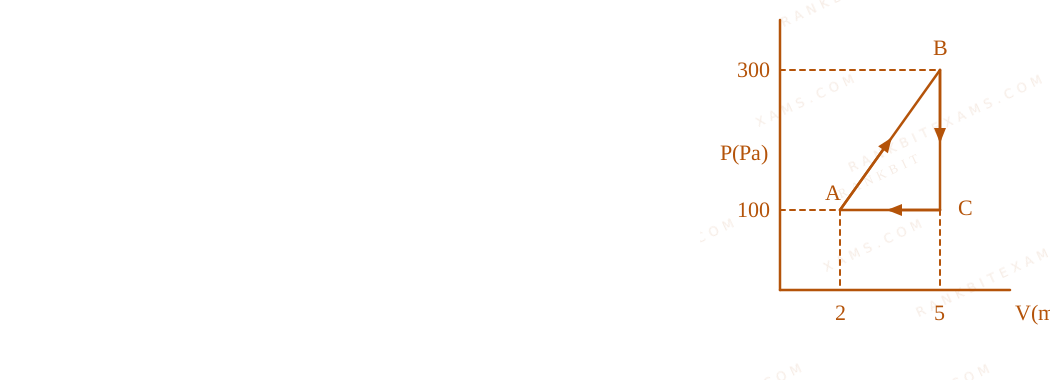
A thermodynamic system is taken through the cyclic process ABC as shown in the figure. The total work done by the system during the cycle ABC is ____ J.
A Pressure-Volume indicator diagram showing a clockwise triangular cycle ABC.
Numerical Answer.Answer: 300 to 300
Solution
Related Formula
Wcycle = Area enclosed by the P-V cycle$$W_{\text{cycle}} = \text{Area enclosed by the P-V cycle}$$
Core Logic
In a P-V diagram, the work done in a cyclic process is equal to the area of the enclosed loop. Since the cycle ABC is clockwise (A arrow$\rightarrow$ B arrow$\rightarrow$ C arrow$\rightarrow$ A), the net work done by the system is positive.
Step 1: Calculate the Area
The shape ABC is a right-angled triangle.
Base of the triangle = Δ V = VC - VA = 5 - 2 = 3 m³$= \Delta V = V_C - V_A = 5 - 2 = 3 \text{ m}^3$
Height of the triangle = Δ P = PB - PC = 300 - 100 = 200 Pa$= \Delta P = P_B - P_C = 300 - 100 = 200 \text{ Pa}$
Always verify axis units (kPa, atm, Liters, cc) before blindly multiplying area. Here units are cleanly in standard SI (Pa and m³$m^3$), so 1 Pa · 1 m³ = 1 Joule$1 \text{ Pa} \cdot 1 \text{ m}^3 = 1 \text{ Joule}$.
Chapter Mix
Class 11 Physics: Thermodynamics
Q10jee_main_2025_02_april_eveningAdiabatic Process
Identify the characteristics of an adiabatic process in a monoatomic gas.
(A) Internal energy is constant.
(B) Work done in the process is equal to the change in internal energy.
(C) The product of temperature and volume is a constant.
(D) The product of pressure and volume is a constant.
(E) The work done to change the temperature from T₁$T_1$ to T₂$T_2$ is proportional to (T₂ - T₁)$(T_2 - T_1)$
Choose the correct answer from the options given below:
A.(A), (C), (D) only$\text{(A), (C), (D) only}$
B.(A), (C), (E) only$\text{(A), (C), (E) only}$
C.(B), (E) only$\text{(B), (E) only}$
D.(B), (D) only$\text{(B), (D) only}$
Solution
Related Formula
First Law of Thermodynamics:
dQ = dU + dW$dQ = dU + dW$
In an adiabatic process:
dQ = 0 dW = -dU$$dQ = 0 \implies dW = -dU$$
Change in Internal Energy:
dU = n Cv dT = n Cv (T₂ - T₁)$$dU = n C_v dT = n C_v (T_2 - T_1)$$
Core Logic
Let's analyze each statement:
(A) Internal energy is constant: Incorrect. Since temperature changes during an adiabatic expansion/compression, internal energy (U ∝ T$U \propto T$) must change.
(B) Work done is equal to the change in internal energy: Correct in magnitude (|dW| = |dU|$|dW| = |dU|$). By definition, dW = -dU$dW = -dU$, which correlates the magnitude of work to the change in internal energy.
(C) Product of temperature and volume is constant: Incorrect. The adiabatic equation of state is T Vγ-1 = constant$T V^{\gamma-1} = \text{constant}$.
(D) Product of pressure and volume is constant: Incorrect. The relation is P V^γ = constant$P V^\gamma = \text{constant}$.
(E) Work done is proportional to (T₂ - T₁)$(T_2 - T_1)$: Correct. Since dW = -dU = -n Cv (T₂ - T₁)$dW = -dU = -n C_v (T_2 - T_1)$, work done is directly proportional to the temperature change (T₂ - T₁)$(T_2 - T_1)$.
Step 1: Determine the correct option
Since only statements (B) and (E) are correct, the correct option is (3).
Pattern Recognition
Sees: Characteristics of adiabatic thermodynamic process.
Trap: Confusing adiabatic state relations (PV^γ = C$PV^\gamma = C$, TVγ-1 = C$TV^{\gamma-1} = C$) with isothermal state relations (PV = C$PV = C$, T = C$T = C$).
Shortcut: First law of thermodynamics under dQ=0$dQ=0$ strictly enforces |dW| = |dU|$|dW| = |dU|$, which validates statement B and E immediately.
Option (2): From the First Law (dQ = dU + dW dW = -dU$dQ = dU + dW \implies dW = -dU$), the work done equals the decrease in internal energy.
Option (4): The internal energy of an ideal gas (dU = n Cv dT$dU = n C_{\mathrm{v}} dT$) increases directly as temperature increases.
Step 2: Final Conclusion
The statement 'The molar heat capacity is zero' is true.
Pattern Recognition
Adiabatic = no heat flow (dQ=0$dQ=0$). Since molar heat capacity tracks the ratio of heat input to temperature change, C$C$ must be 0. Conversely, isothermal has infinite capacity because heat is absorbed without any temperature change (dT=0$dT=0$).
Chapter Mix
Class 11 Physics: Thermodynamics
Qjee_main_2025_03_april_eveningThermodynamic Processes and First Law
An ideal gas exists in a state with pressure P₀$P_{0}$, volume V₀$V_{0}$. It is isothermally expanded to 4 times of its initial volume (V₀)$(V_{0})$, then isobarically compressed to its original volume. Finally the system is heated isochorically to bring it to its initial state. The amount of heat exchanged in this process is :
A.P₀V₀(2ln 2-0.75)$P_{0}V_{0}(2\ln 2-0.75)$
B.P₀V₀(ln 2-0.75)$P_{0}V_{0}(\ln 2-0.75)$
C.P₀V₀(ln 2-0.25)$P_{0}V_{0}(\ln 2-0.25)$
D.P₀V₀(2ln 2-0.25)$P_{0}V_{0}(2\ln 2-0.25)$
Solution
Related Formula
For a cyclic thermodynamic process, the net change in internal energy is zero:
Δ Ucyclic = 0$$\Delta U_{\text{cyclic}} = 0$$
By the First Law of Thermodynamics, the total heat exchanged QT$Q_T$ equals the net work done Wₙₑₜ$W_{\text{net}}$:
In any cyclic system returning to its initial state, finding total heat is mathematically equivalent to calculating the enclosed area on a P-V diagram. Here, the isobaric step occurs at the lowest expanded pressure, resulting in a simple negative rectangular area correction subtracted from the logarithmic isothermal expansion curve.
Chapter Mix
Class 11 Physics: Thermodynamics
Qjee_main_2025_07_april_morningWork Done in Thermodynamic Processes
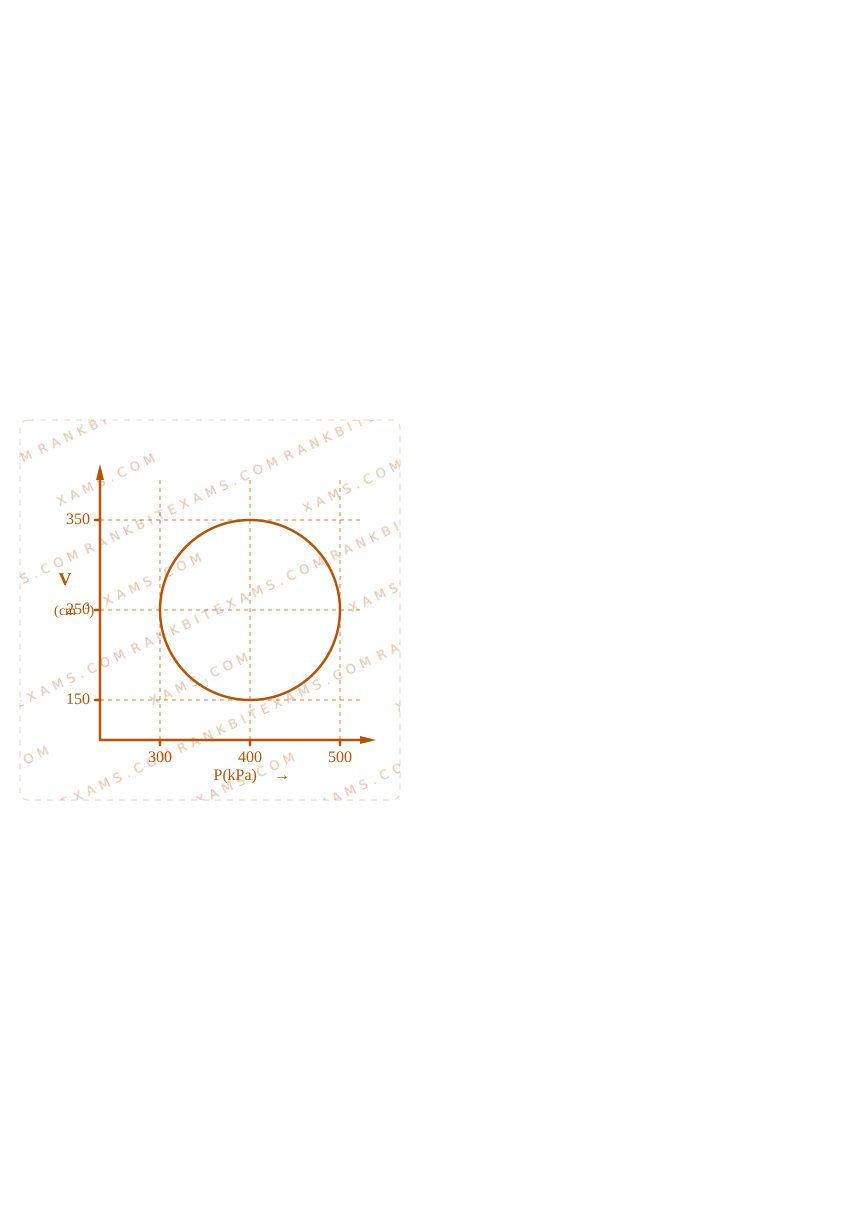
An ideal gas has undergone through the cyclic process as shown in the figure. Work done by the gas in the entire cycle is × 10⁻¹$\times 10^{-1}$ J. (Take π = 3.14$\pi = 3.14$ )
A cycle plot in which the volume lies in cm^3 (150 to 350) and pressure is in kPa (300 to 500), forming an ellipse.
Numerical Answer.Answer: 314 to 314
Solution
Related Formula
The work done W$W$ in a cyclic thermodynamic process is equal to the area enclosed by the loop on a Pressure-Volume (P-V$P-V$) diagram:
W = Area of Closed Loop$$W = \text{Area of Closed Loop}$$
For an ellipse with semi-major axis a$a$ and semi-minor axis b$b$:
Area = π a b$$\text{Area} = \pi a b$$
Core Logic
Determine the semi-axes of the elliptical cycle on the P-V$P-V$ plane:
Sees: Circular/elliptical thermodynamic cycle.
Shortcut: Work done is always π Δ P Δ V / 4$\pi \Delta P \Delta V / 4$. Simply compute the semi-axes difference 100 ~kPa$100 \mathrm{~kPa}$ and 100 ~cm³$100 \mathrm{~cm^3}$ and multiply by π$\pi$ directly, keeping tracking of metric prefixes (10³ × 10⁻⁶ = 10⁻³$10^3 \times 10^{-6} = 10^{-3}$).
Chapter Mix
Class 11 Physics: Thermodynamics
More Thermodynamics Questions — jee_main_2026_21_jan_morning
Practice past-year questions one chapter at a time. Pick an exam → subject → chapter and get every PYQ for that topic — pulled together from all past papers — with the chapter's key formulas alongside.
.svg)