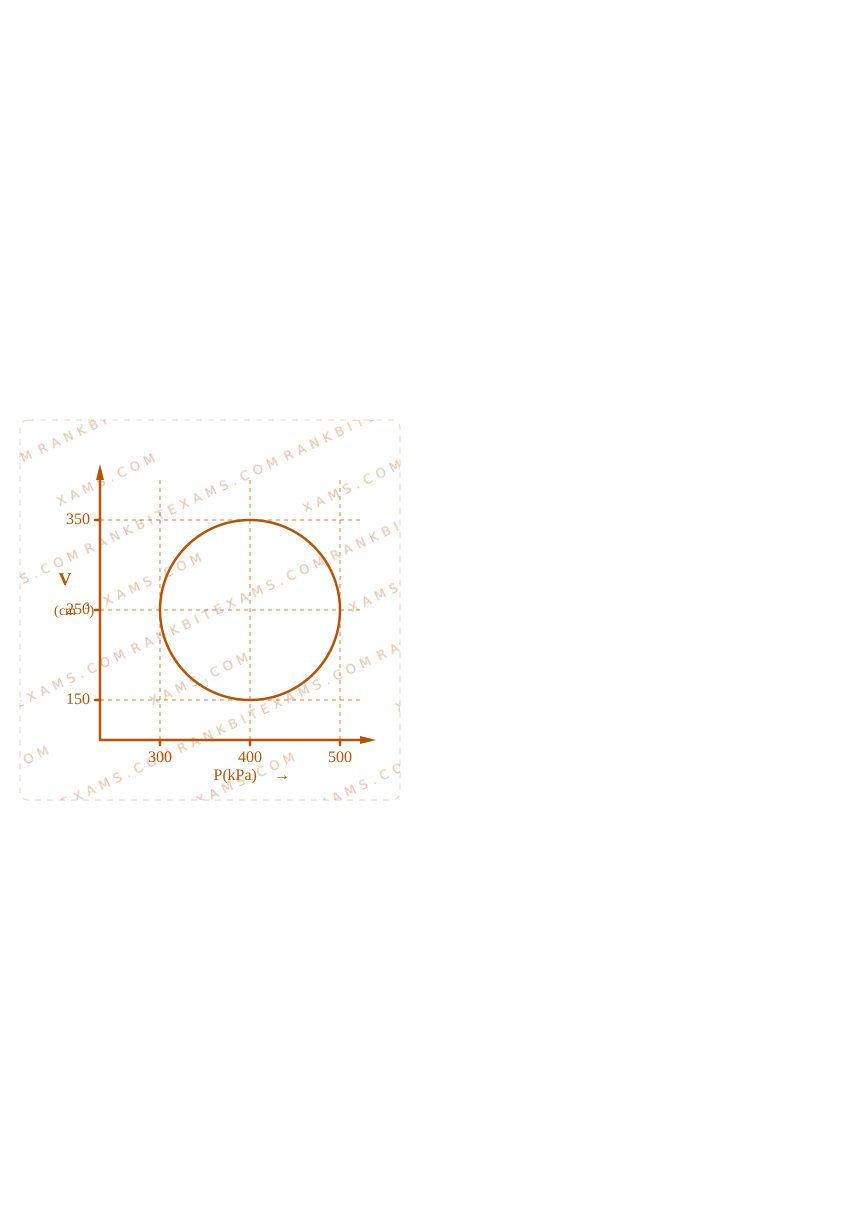
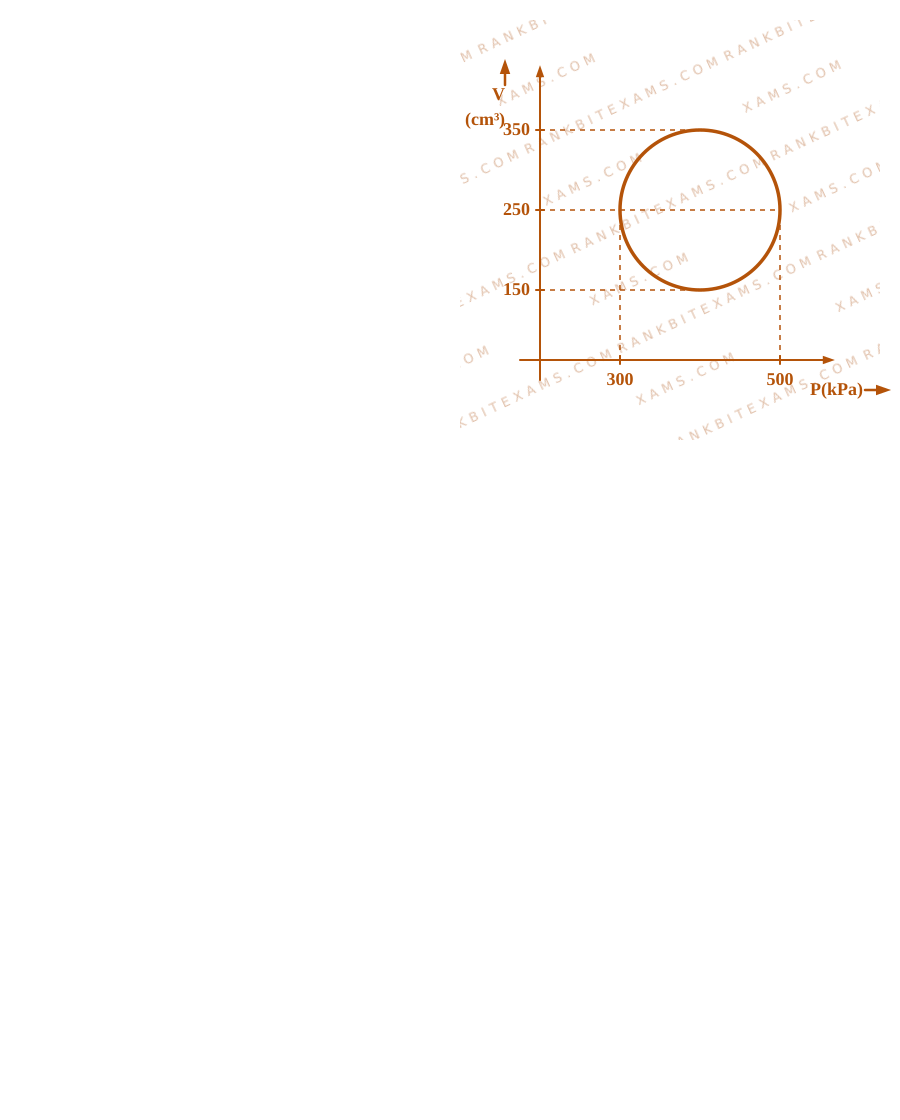
An ideal gas has undergone through the cyclic process as shown in the figure. Work done by the gas in the entire cycle is times 10^-1 J. (Take pi = 3.14 )
Elliptical thermodynamic cycle on PV plane for Q25 - JEE Main 2025 Morning
A cycle plot in which the volume lies in cm^3 (150 to 350) and pressure is in kPa (300 to 500), forming an ellipse.

Numerical Answer Type:
Enter a numerical value Answer: 314 to 314 +4 marks

Solution & Explanation

### Related Formula The work done W in a cyclic thermodynamic process is equal to the area enclosed by the loop on a Pressure-Volume (P-V) diagram: W = textArea of Closed Loop For an ellipse with semi-major axis a and semi-minor axis b: textArea = pi a b ### Core Logic Determine the semi-axes of the elliptical cycle on the P-V plane: - On the Pressure axis (x-axis): a = fracP_textmax - P_textmin2 = frac500 - 3002 mathrm~kPa = 100 mathrm~kPa = 10^5 mathrm~Pa - On the Volume axis (y-axis): b = fracV_textmax - V_textmin2 = frac350 - 1502 mathrm~cm^3 = 100 mathrm~cm^3 = 100 times 10^-6 mathrm~m^3 = 10^-4 mathrm~m^3 ### Step 1: Calculate Area Substitute a and b in standard SI units into the area equation: W = pi a b = 3.14 times (10^5 mathrm~Pa) times (10^-4 mathrm~m^3) W = 3.14 times 10 = 31.4 mathrm~J Express in terms of times 10^-1 mathrm~J: W = 314 times 10^-1 mathrm~J Thus, the multiplier is 314. ### Pattern Recognition Sees: Circular/elliptical thermodynamic cycle. Shortcut: Work done is always pi Delta P Delta V / 4. Simply compute the semi-axes difference 100 mathrm~kPa and 100 mathrm~cm^3 and multiply by pi directly, keeping tracking of metric prefixes (10^3 times 10^-6 = 10^-3). ### Evaluation Rubric / Model Answer null ### Chapter Mix Class 11 Physics: Thermodynamics
PV integration and area calculation details
A cycle plot in which the volume lies in cm^3 (150 to 350) and pressure is in kPa (300 to 500), forming an ellipse.

Reference Study Guides

More Thermodynamics Previous-Year Questions

Q49 jee_main_2026_21_jan_morning Internal Energy
10 mole of oxygen is heated at constant volume from 30^circtextC to 40^circtextC. The change in the internal energy of the gas is ____ cal. (The molecular specific heat of oxygen at constant pressure, C_p = 7text cal./mol ^circtextC and R = 2text cal./mol ^circtextC.)
Numerical Answer. Answer: 500 to 500

Solution

### Related Formula Delta U = n C_v Delta T C_v = C_p - R ### Core Logic Given values: n = 10text moles Delta T = 40^circtextC - 30^circtextC = 10^circtextC C_p = 7text cal/molcdot^circtextC R = 2text cal/molcdot^circtextC First, find C_v using Mayer's relation: C_v = C_p - R = 7 - 2 = 5text cal/molcdot^circtextC ### Step 1: Calculate Internal Energy Change Delta U = n C_v Delta T Delta U = 10 times (7 - 2) times (40 - 30) Delta U = 10 times 5 times 10 = 500text cal ### Pattern Recognition Change in internal energy of an ideal gas is ALWAYS Delta U = n C_v Delta T, regardless of the process (constant volume or not). Use C_v = C_p - R when C_p is given. ### Evaluation Rubric / Model Answer null ### Chapter Mix Class 11 Physics: Thermodynamics Class 11 Physics: Kinetic Theory of Gases
Q10 jee_main_2025_02_april_evening Adiabatic Process
Identify the characteristics of an adiabatic process in a monoatomic gas. (A) Internal energy is constant. (B) Work done in the process is equal to the change in internal energy. (C) The product of temperature and volume is a constant. (D) The product of pressure and volume is a constant. (E) The work done to change the temperature from T_1 to T_2 is proportional to (T_2 - T_1) Choose the correct answer from the options given below:
  • A. text(A), (C), (D) only
  • B. text(A), (C), (E) only
  • C. text(B), (E) only
  • D. text(B), (D) only

Solution

### Related Formula 1. First Law of Thermodynamics: dQ = dU + dW In an adiabatic process: dQ = 0 implies dW = -dU 2. Change in Internal Energy: dU = n C_v dT = n C_v (T_2 - T_1) ### Core Logic Let's analyze each statement: - **(A) Internal energy is constant:** Incorrect. Since temperature changes during an adiabatic expansion/compression, internal energy (U propto T) must change. - **(B) Work done is equal to the change in internal energy:** Correct in magnitude (|dW| = |dU|). By definition, dW = -dU, which correlates the magnitude of work to the change in internal energy. - **(C) Product of temperature and volume is constant:** Incorrect. The adiabatic equation of state is T V^gamma-1 = textconstant. - **(D) Product of pressure and volume is constant:** Incorrect. The relation is P V^gamma = textconstant. - **(E) Work done is proportional to (T_2 - T_1):** Correct. Since dW = -dU = -n C_v (T_2 - T_1), work done is directly proportional to the temperature change (T_2 - T_1). ### Step 1: Determine the correct option Since only statements (B) and (E) are correct, the correct option is (3). ### Pattern Recognition Sees: Characteristics of adiabatic thermodynamic process. Trap: Confusing adiabatic state relations (PV^gamma = C, TV^gamma-1 = C) with isothermal state relations (PV = C, T = C). Shortcut: First law of thermodynamics under dQ=0 strictly enforces |dW| = |dU|, which validates statement B and E immediately. ### Evaluation Rubric / Model Answer null ### Chapter Mix Class 11 Physics: Thermodynamics
Q12 jee_main_2025_02_april_morning Thermodynamic Processes
In an adiabatic process, which of the following statements is true?
  • A. The molar heat capacity is infinite
  • B. Work done by the gas equals the increase in internal energy
  • C. The molar heat capacity is zero
  • D. The internal energy of the gas decreases as the temperature increases

Solution

### Related Formula dQ = n C dT dQ = 0 quad text(for adiabatic process) ### Core Logic An adiabatic process involves no heat exchange between the system and its surroundings (dQ = 0). The molar heat capacity C is defined as: C = frac1nfracdQdT Since dQ = 0 while the temperature changes (dT neq 0): C = 0 Thus, the molar heat capacity for any adiabatic process is always zero. ### Step 1: Check other options - Option (1): Isothermal processes have infinite molar heat capacity (dT = 0). - Option (2): From the First Law (dQ = dU + dW implies dW = -dU), the work done equals the *decrease* in internal energy. - Option (4): The internal energy of an ideal gas (dU = n C_mathrmv dT) increases directly as temperature increases. ### Step 2: Final Conclusion The statement 'The molar heat capacity is zero' is true. ### Pattern Recognition Adiabatic = no heat flow (dQ=0). Since molar heat capacity tracks the ratio of heat input to temperature change, C must be 0. Conversely, isothermal has infinite capacity because heat is absorbed without any temperature change (dT=0). ### Evaluation Rubric / Model Answer null ### Chapter Mix Class 11 Physics: Thermodynamics
Q jee_main_2025_03_april_evening Thermodynamic Processes and First Law
An ideal gas exists in a state with pressure P_0, volume V_0. It is isothermally expanded to 4 times of its initial volume (V_0), then isobarically compressed to its original volume. Finally the system is heated isochorically to bring it to its initial state. The amount of heat exchanged in this process is :
  • A. P_0V_0(2ln 2-0.75)
  • B. P_0V_0(ln 2-0.75)
  • C. P_0V_0(ln 2-0.25)
  • D. P_0V_0(2ln 2-0.25)

Solution

### Related Formula For a cyclic thermodynamic process, the net change in internal energy is zero: Delta U_textcyclic = 0 By the First Law of Thermodynamics, the total heat exchanged Q_T equals the net work done W_textnet: Q_T = W_textnet = W_1 + W_2 + W_3 ### Core Logic The cycle consists of three steps: 1. Isothermal expansion from (P_0, V_0) to volume 4V_0. 2. Isobaric compression to the original volume V_0. 3. Isochoric heating back to the initial state.
Thermodynamic Processes and First Law
### Step 1: Work in Isothermal Expansion (W_1) Initial state: (P_0, V_0). Final state volume: 4V_0. W_1 = P_0 V_0 lnleft(frac4V_0V_0right) = P_0 V_0 ln(4) = 2 P_0 V_0 ln(2) Also, the pressure at the end of this process is: P_1 = fracP_0 V_04V_0 = fracP_04 ### Step 2: Work in Isobaric Compression (W_2) The process occurs at constant pressure P = P_1 = P_0/4. The volume goes from 4V_0 back to V_0: W_2 = P Delta V = fracP_04 (V_0 - 4V_0) = fracP_04 (-3V_0) = -0.75 P_0 V_0 ### Step 3: Work in Isochoric Heating (W_3) Since the volume is held constant at V_0, no boundary work is done: W_3 = 0 ### Step 4: Total Heat Exchanged (Q_T) Q_T = W_textnet = W_1 + W_2 + W_3 Q_T = 2 P_0 V_0 ln(2) - 0.75 P_0 V_0 = P_0 V_0 (2ln(2) - 0.75) ### Pattern Recognition In any cyclic system returning to its initial state, finding total heat is mathematically equivalent to calculating the enclosed area on a P-V diagram. Here, the isobaric step occurs at the lowest expanded pressure, resulting in a simple negative rectangular area correction subtracted from the logarithmic isothermal expansion curve. ### Evaluation Rubric / Model Answer null ### Chapter Mix Class 11 Physics: Thermodynamics

More Thermodynamics Questions — jee_main_2025_07_april_morning

Practice all Thermodynamics previous-year questions →

Rankbit System
JEE Physics: Waves (+15.5%) | Electrostatics: Concentric Shells (-29.7%) | Modern Physics: Photoelectric Clones (+34.2%) | Mathematics: Definite Integrals (+18.1%) | Chemistry: Coordination Splitting (-11.4%) | JEE Physics: Waves (+15.5%) | Electrostatics: Concentric Shells (-29.7%) | Modern Physics: Photoelectric Clones (+34.2%) | Mathematics: Definite Integrals (+18.1%) | Chemistry: Coordination Splitting (-11.4%)
