Rankbit System
JEE Physics: Waves (+15.5%) | Electrostatics: Concentric Shells (-29.7%) | Modern Physics: Photoelectric Clones (+34.2%) | Mathematics: Definite Integrals (+18.1%) | Chemistry: Coordination Splitting (-11.4%) | JEE Physics: Waves (+15.5%) | Electrostatics: Concentric Shells (-29.7%) | Modern Physics: Photoelectric Clones (+34.2%) | Mathematics: Definite Integrals (+18.1%) | Chemistry: Coordination Splitting (-11.4%)

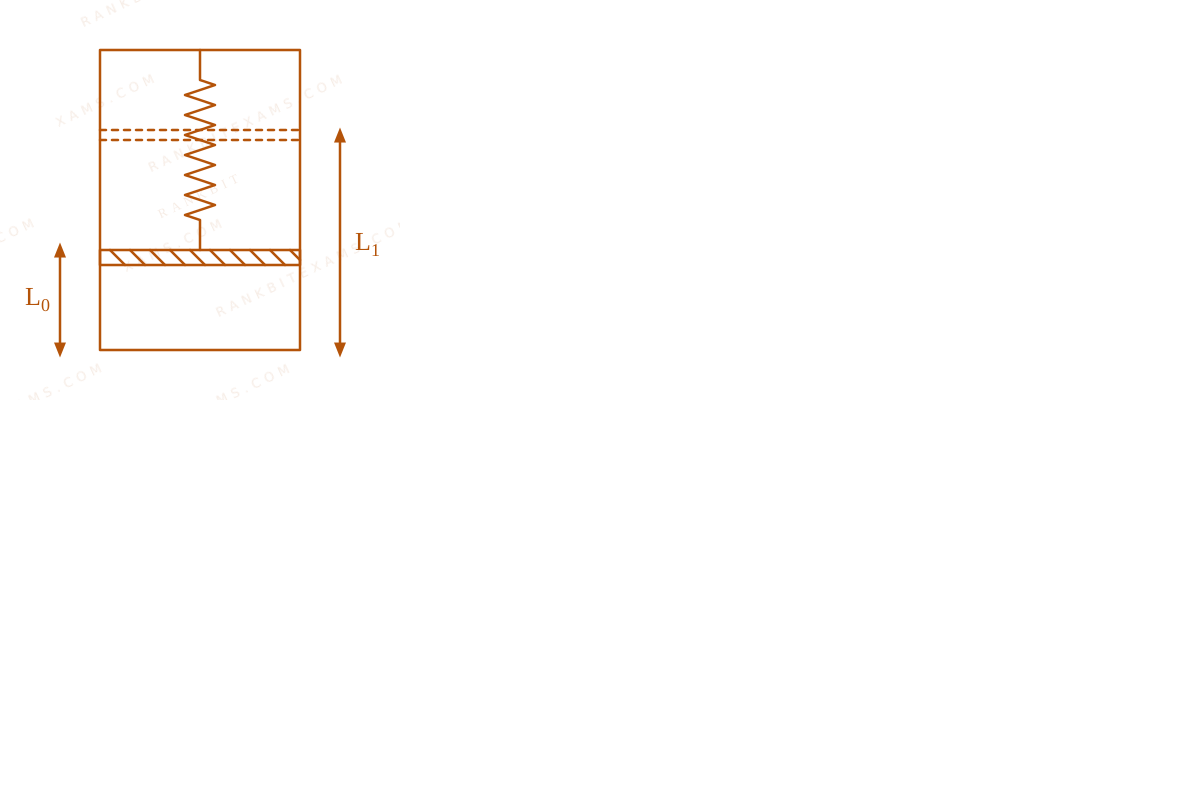
A piston of mass M is hung from a massless spring whose restoring force law goes as F = -kx^3, where k is the spring constant of appropriate dimension. The piston separates the vertical chamber into two parts, where the bottom part is filled with 'n' moles of an ideal gas. An external work is done on the gas isothermally (at a constant temperature T) with the help of a heating filament (with negligible volume) mounted in lower part of the chamber, so that the piston goes up from a height L_0 to L_1, the total energy delivered by the filament is (Assume spring to be in its natural length before heating)
Piston connected to spring with gas underneath for Q11
A schematic of a piston of mass M connected to a spring inside a vertical chamber, separating gas at the bottom from vacuum/atmosphere at the top.

Solution & Explanation

### Related Formula First Law of Thermodynamics: Delta Q = Delta U + W_textby gas Work done by an ideal gas during isothermal expansion: W_textgas = nRTlnleft(fracV_1V_0right) = nRTlnleft(fracL_1L_0 ight) Conservation of Energy (Work-Energy Theorem): Total energy delivered by the heating filament (W_textfilament) must equal the total work needed to lift the piston against gravity and compress the non-linear spring. ### Core Logic Since the process is isothermal, the change in internal energy of the ideal gas is zero (Delta U = 0). Hence: Q = W_textgas By the Work-Energy Theorem for the piston: W_textgas + W_textfilament = Delta U_textgravity + Delta U_textspring Let's evaluate each term: - Increase in gravitational potential energy: Delta U_textgravity = Mg(L_1 - L_0) - Increase in spring potential energy: U_textspring = -int_L_0^L_1 F_textrestoring dx = int_L_0^L_1 kx^3 dx = frack4(L_1^4 - L_0^4) ### Step 1: Finding Total Energy Delivered Isolating W_textfilament (the net external energy delivered to the gas system): W_textfilament = W_textgas + Mg(L_1 - L_0) + frack4(L_1^4 - L_0^4) Since W_textgas = nRTlnleft(fracL_1L_0 ight): W_textfilament = nRTlnleft(fracL_1L_0 ight) + Mg(L_1 - L_0) + frack4(L_1^4 - L_0^4) ### Pattern Recognition Notice how energy conservation instantly frames this complex thermodynamics question. The heating filament's energy simply goes into three distinct stores: the isothermal work of gas expansion, raising the mass against gravity (Mgh), and the potential energy of the spring (integrated from kx^3). Keeping this total energy ledger in mind prevents tedious mathematical tangents. ### Evaluation Rubric / Model Answer null ### Chapter Mix Class 11 Physics: Thermodynamics: First Law Class 11 Physics: Work, Energy and Power: Variable Force Integration
Reference Study Guides

More Thermodynamics Previous-Year Questions

Q10 2025 Adiabatic Process
Identify the characteristics of an adiabatic process in a monoatomic gas. (A) Internal energy is constant. (B) Work done in the process is equal to the change in internal energy. (C) The product of temperature and volume is a constant. (D) The product of pressure and volume is a constant. (E) The work done to change the temperature from T_1 to T_2 is proportional to (T_2 - T_1) Choose the correct answer from the options given below:
  • A. text(A), (C), (D) only
  • B. text(A), (C), (E) only
  • C. text(B), (E) only
  • D. text(B), (D) only

Solution

### Related Formula 1. First Law of Thermodynamics: dQ = dU + dW In an adiabatic process: dQ = 0 implies dW = -dU 2. Change in Internal Energy: dU = n C_v dT = n C_v (T_2 - T_1) ### Core Logic Let's analyze each statement: - **(A) Internal energy is constant:** Incorrect. Since temperature changes during an adiabatic expansion/compression, internal energy (U propto T) must change. - **(B) Work done is equal to the change in internal energy:** Correct in magnitude (|dW| = |dU|). By definition, dW = -dU, which correlates the magnitude of work to the change in internal energy. - **(C) Product of temperature and volume is constant:** Incorrect. The adiabatic equation of state is T V^gamma-1 = textconstant. - **(D) Product of pressure and volume is constant:** Incorrect. The relation is P V^gamma = textconstant. - **(E) Work done is proportional to (T_2 - T_1):** Correct. Since dW = -dU = -n C_v (T_2 - T_1), work done is directly proportional to the temperature change (T_2 - T_1). ### Step 1: Determine the correct option Since only statements (B) and (E) are correct, the correct option is (3). ### Pattern Recognition Sees: Characteristics of adiabatic thermodynamic process. Trap: Confusing adiabatic state relations (PV^gamma = C, TV^gamma-1 = C) with isothermal state relations (PV = C, T = C). Shortcut: First law of thermodynamics under dQ=0 strictly enforces |dW| = |dU|, which validates statement B and E immediately. ### Evaluation Rubric / Model Answer null ### Chapter Mix Class 11 Physics: Thermodynamics
Q12 2025 Thermodynamic Processes
In an adiabatic process, which of the following statements is true?
  • A. The molar heat capacity is infinite
  • B. Work done by the gas equals the increase in internal energy
  • C. The molar heat capacity is zero
  • D. The internal energy of the gas decreases as the temperature increases

Solution

### Related Formula dQ = n C dT dQ = 0 quad text(for adiabatic process) ### Core Logic An adiabatic process involves no heat exchange between the system and its surroundings (dQ = 0). The molar heat capacity C is defined as: C = frac1nfracdQdT Since dQ = 0 while the temperature changes (dT neq 0): C = 0 Thus, the molar heat capacity for any adiabatic process is always zero. ### Step 1: Check other options - Option (1): Isothermal processes have infinite molar heat capacity (dT = 0). - Option (2): From the First Law (dQ = dU + dW implies dW = -dU), the work done equals the *decrease* in internal energy. - Option (4): The internal energy of an ideal gas (dU = n C_mathrmv dT) increases directly as temperature increases. ### Step 2: Final Conclusion The statement 'The molar heat capacity is zero' is true. ### Pattern Recognition Adiabatic = no heat flow (dQ=0). Since molar heat capacity tracks the ratio of heat input to temperature change, C must be 0. Conversely, isothermal has infinite capacity because heat is absorbed without any temperature change (dT=0). ### Evaluation Rubric / Model Answer null ### Chapter Mix Class 11 Physics: Thermodynamics
Q 2025 Thermodynamic Processes and First Law
An ideal gas exists in a state with pressure P_0, volume V_0. It is isothermally expanded to 4 times of its initial volume (V_0), then isobarically compressed to its original volume. Finally the system is heated isochorically to bring it to its initial state. The amount of heat exchanged in this process is :
  • A. P_0V_0(2ln 2-0.75)
  • B. P_0V_0(ln 2-0.75)
  • C. P_0V_0(ln 2-0.25)
  • D. P_0V_0(2ln 2-0.25)

Solution

### Related Formula For a cyclic thermodynamic process, the net change in internal energy is zero: Delta U_textcyclic = 0 By the First Law of Thermodynamics, the total heat exchanged Q_T equals the net work done W_textnet: Q_T = W_textnet = W_1 + W_2 + W_3 ### Core Logic The cycle consists of three steps: 1. Isothermal expansion from (P_0, V_0) to volume 4V_0. 2. Isobaric compression to the original volume V_0. 3. Isochoric heating back to the initial state.
Thermodynamic Processes and First Law
### Step 1: Work in Isothermal Expansion (W_1) Initial state: (P_0, V_0). Final state volume: 4V_0. W_1 = P_0 V_0 lnleft(frac4V_0V_0right) = P_0 V_0 ln(4) = 2 P_0 V_0 ln(2) Also, the pressure at the end of this process is: P_1 = fracP_0 V_04V_0 = fracP_04 ### Step 2: Work in Isobaric Compression (W_2) The process occurs at constant pressure P = P_1 = P_0/4. The volume goes from 4V_0 back to V_0: W_2 = P Delta V = fracP_04 (V_0 - 4V_0) = fracP_04 (-3V_0) = -0.75 P_0 V_0 ### Step 3: Work in Isochoric Heating (W_3) Since the volume is held constant at V_0, no boundary work is done: W_3 = 0 ### Step 4: Total Heat Exchanged (Q_T) Q_T = W_textnet = W_1 + W_2 + W_3 Q_T = 2 P_0 V_0 ln(2) - 0.75 P_0 V_0 = P_0 V_0 (2ln(2) - 0.75) ### Pattern Recognition In any cyclic system returning to its initial state, finding total heat is mathematically equivalent to calculating the enclosed area on a P-V diagram. Here, the isobaric step occurs at the lowest expanded pressure, resulting in a simple negative rectangular area correction subtracted from the logarithmic isothermal expansion curve. ### Evaluation Rubric / Model Answer null ### Chapter Mix Class 11 Physics: Thermodynamics
Q41 2025 Latent Heat and Phase Equilibrium
Given below are two statements: Statement I: When a system containing ice in equilibrium with water (liquid) is heated, heat is absorbed by the system and there is no change in the temperature of the system until whole ice gets melted. Statement II: At melting point of ice, there is absorption of heat in order to overcome intermolecular forces of attraction within the molecules of water in ice and kinetic energy of molecules is not increased at melting point. In the light of the above statements, choose the correct answer from the options given below:
  • A. Statement I is true but Statement II is false
  • B. Both Statement I and Statement II are false
  • C. Both Statement I and Statement II are true
  • D. Statement I is false but Statement II is true

Solution

### Related Formula During phase transition, latent heat of fusion (L_f) is absorbed: Q = m L_f Temperature remains constant because the average kinetic energy of the molecules does not change; instead, potential energy changes during phase transition: textTemperature T propto textAverage Kinetic Energy of molecules ### Core Logic Statement I Analysis: - During a phase transition (such as ice melting at 0^circmathrmC), any added heat is utilized as latent heat of fusion. The system remains at a constant temperature of 0^circmathrmC as long as both solid and liquid phases coexist in equilibrium. Thus, Statement I is True. ### Step 1: Analyze Statement II - Statement II explains *why* this happens: The thermal energy is spent entirely to break down the highly ordered crystalline hydrogen-bonded lattice of ice into liquid water. It does not increase the translational kinetic energy of the molecules. Since kinetic energy is constant, temperature remains constant. Thus, Statement II is True. ### Step 2: Conclusion Therefore, both Statement I and Statement II are True, matching Option (3). ### Pattern Recognition For any phase transition (melting, boiling, sublimation): Temperature stays flat. The added energy goes entirely into latent heat (potential energy change to overcome intermolecular forces), meaning average kinetic energy is constant. ### Evaluation Rubric / Model Answer null ### Chapter Mix Class 11 Chemistry: Thermodynamics Class 11 Physics: Thermal Properties of Matter
Q47 2025 Work Done in Reversible Cyclic Processes
A perfect gas (0.1mathrm~mol) having barC_v=1.50mathrm~R (independent of temperature) undergoes the transformation from point 1 to point 4 as shown in the pressure-volume diagram below. If each step is reversible, the total work done (w) while going from point 1 to point 4 is (-) ________ J. (nearest integer)
P-V path diagram for Q47 - JEE Main 2025 Evening
P-V graph showing a thermodynamic process from point 1 to point 4 containing an isobaric step and isochoric steps.
[Given: R=0.082mathrm~L~atm~K^-1~mol^-1 = 8.314mathrm~J~K^-1~mol^-1]
Numerical Answer. Answer: 304 to 304

Solution

### Related Formula Thermodynamic work done (w) for each step: - Isochoric step (V = textconstant): w = 0 - Isobaric step (P = textconstant): w = -P Delta V ### Core Logic The process from point 1 to point 4 consists of three distinct segments: 1. Step 1 rightarrow 2: Isochoric cooling at constant volume V_1 = 1000mathrm~cm^3. Work done w_1rightarrow 2 = 0. 2. Step 2 rightarrow 3: Isobaric compression at constant pressure P = 3.00mathrm~atm from volume 2000mathrm~cm^3 to 1000mathrm~cm^3. 3. Step 3 rightarrow 4: Isochoric step at constant volume. Work done w_3rightarrow 4 = 0. ### Step 1: Calculate work done in the isobaric step (2 rightarrow 3) The volume changes from V_i = 2000mathrm~cm^3 = 2.0mathrm~L to V_f = 1000mathrm~cm^3 = 1.0mathrm~L: w_2rightarrow 3 = -P Delta V = -3.00mathrm~atm times (1.0mathrm~L - 2.0mathrm~L) = +3.00mathrm~Lcdot atm ### Step 2: Convert work to Joules and analyze direction Convert \mathrm{L\cdot atm} to Joules: w_2rightarrow 3 = 3.00 times 101.325mathrm~J = 303.975mathrm~J approx 304mathrm~J The question asks for the total work done as (-) ________ J, meaning work done *by* the system (expansion) is negative and work done *on* the system (compression) is positive. Since this is compression, work done on the gas is +304\mathrm{~J}, which is represented as -(-304)\mathrm{~J} in typical IUPAC convention where work of expansion is examined. The absolute magnitude of the work is 304\mathrm{~J}. ### Pattern Recognition During any cyclic or multi-step path on a P-V graph, work is done *only* when there is a change in volume (W = -\int P dV$). Any vertical line (constant volume) represents an isochoric step where work is exactly zero. The horizontal segment directly represents rectangular area under the path. ### Evaluation Rubric / Model Answer null ### Chapter Mix Class 11 Chemistry: Thermodynamics Class 11 Physics: Thermodynamics

More Thermodynamics Questions — jee_main_2025_03_april_morning

Practice all Thermodynamics previous-year questions →

YOUR FIRST PREP STEP STARTS HERE

We Map Every Repeating Question in Competitive Exams.

Say goodbye to generic mock test fatigue. RankBit uses smart analysis to group past exam questions into their foundational Repeating Question Types. Find chapter weightage, track repeating questions, and score higher with targeted practice.

Select Your Target Exam

Choose an exam track below to find formulas per chapter and patterns.

Syncing Exam Intelligence

Mapping formulas and patterns across all tracks…

PATH A — FULL LENGTH PRACTICE

Full Mock Test Hub

Simulate real NTA exam conditions with fully tracked mocks. Time yourself against past papers.

Under Development
PATH B — TARGETED PRACTICE

Topic-wise Practice Hub

Practice past-year questions one chapter at a time. Pick an exam → subject → chapter and get every PYQ for that topic — pulled together from all past papers — with the chapter's key formulas alongside.

Loading Questions... Browse Topics
Latest from the Blog
View all →

Loading articles...
