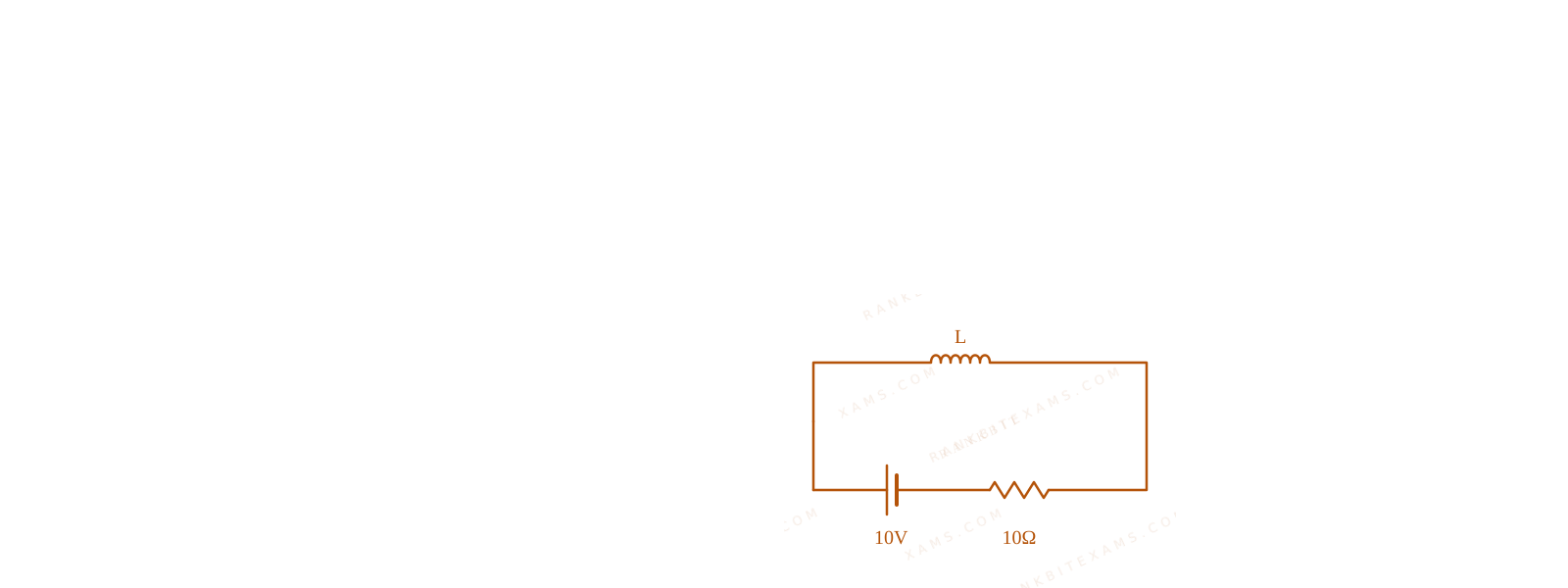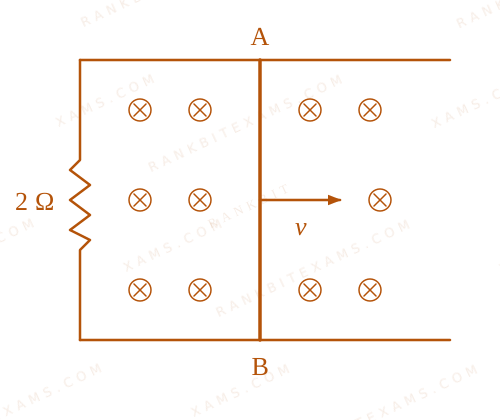
A 1 m long metal rod AB completes the circuit as shown in figure. The area of circuit is perpendicular to the magnetic field of 0.10 T. If the resistance of the total circuit is 2Omega then the force needed to move the rod towards right with constant speed (v) of 1.5 m/s is ____ N.
Motional EMF diagram for Q41 - JEE Main 2026 Morning
A conducting rod AB moves on a U-shaped rail in a perpendicular magnetic field.

Solution & Explanation

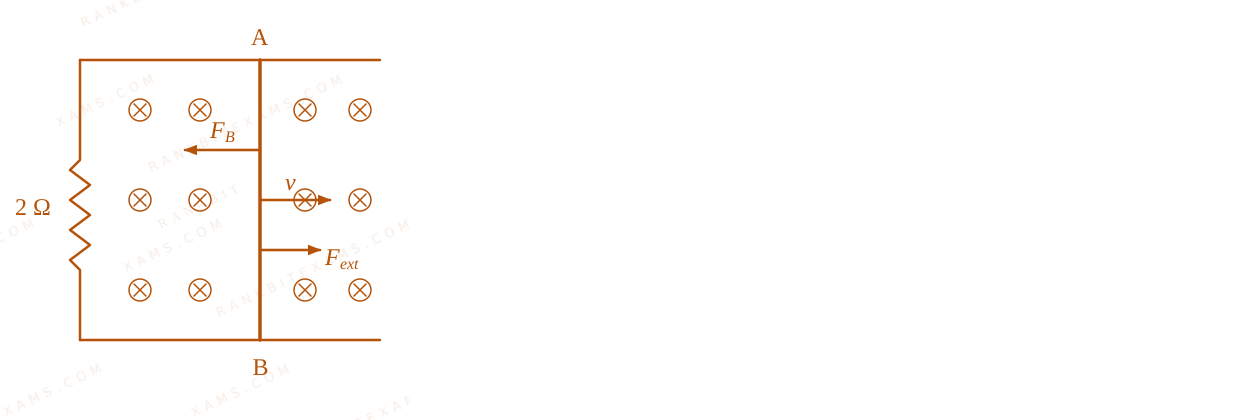
### Related Formula E = B l v i = fracER F_B = i l B = fracB^2 l^2 vR ### Core Logic To maintain a constant speed, the external force applied must balance the opposing magnetic force generated by the induced current. F_textext = F_B ### Step 1: Calculate External Force Given values: B = 0.10text T l = 1text m v = 1.5text m/s R = 2\, Omega F_textext = fracB^2 l^2 vR F_textext = frac(0.10)^2 times (1)^2 times 1.52 F_textext = frac0.01 times 1.52 = frac0.0152 = 0.0075 F_textext = 7.5 times 10^-3text N
Motional EMF solution diagram for Q41 - JEE Main 2026 Morning
A conducting rod AB moves on a U-shaped rail in a perpendicular magnetic field.
### Pattern Recognition Standard "sliding rod on rails" problem. The required mechanical force to maintain terminal velocity is always F = fracB^2 L^2 vR. ### Evaluation Rubric / Model Answer null ### Chapter Mix Class 12 Physics: Electromagnetic Induction
More Electromagnetic Induction Previous-Year Questions — Page 2

Q21 jee_main_2025_28_jan_evening Motional EMF
A conducting \bar moves on two conducting rails as shown in the figure. A constant magnetic field B \exists into the page. The \bar starts to move from the vertex at time t = 0 with a constant velocity. If the induced EMF is E propto t^n , then value of n is
Motional EMF diagram for Q21 - JEE Main 2025 Evening
A linear conductor \bar moving laterally across V-shaped intersecting conducting guide rails.
Numerical Answer. Answer: 1

Solution

### Related Formula The motional EMF induced across a moving conductor of instantaneous length ell inside a perpendicular uniform magnetic field is given by: E = B cdot ell cdot v ### Core Logic Let the V-shaped guide rails form an \angle, so that the instantaneous length ell of the conducting \bar grows linearly with its horizontal position distance x from the vertex [cite: 782, 791]: ell propto x Since the \bar moves with a constant velocity v, its displacement position at any time t is : x = v cdot t implies ell propto v cdot t Substituting this time-dependent length into the induced EMF expression : E = B cdot ell cdot v implies E propto B cdot (v cdot t) cdot v implies E propto t^1 Comparing this to the given relation E propto t^n gives the exponent[cite: 188, 791]: n = 1 ### Step 1: Geometric Analysis The expanding circuit loop configuration across time is shown below:
Motional EMF geometric analysis diagram for Q21
A linear conductor \bar moving laterally across V-shaped intersecting conducting guide rails.
### Pattern Recognition For \parallel rails, the length ell remains constant, meaning induced EMF is independent of time (E propto t^0). For V-shaped divergent rails, the effective length increases linearly with distance, making the induced EMF directly proportional to time (E propto t^1). ### Evaluation Rubric / Model Answer null ### Chapter Mix Class 12 Physics: Electromagnetic Induction
Q jee_main_2025_29_jan_morning Mutual Inductance
Consider mathrmI_1 and mathrmI_2 are the currents flowing simultaneously in two nearby coils 1 & 2, respectively. If mathrmL_1 = self inductance of coil 1, mathrmM_12 = mutual inductance of coil 1 with respect to coil 2, then the value of induced emf in coil 1 will be
  • A. varepsilon_1 = -mathrmL_1fracmathrmdI_1mathrmdt +mathrmM_12fracmathrmdI_2mathrmdt
  • B. varepsilon_1 = -mathrmL_1fracmathrmdI_1mathrmdt -mathrmM_12fracmathrmdI_1mathrmdt
  • C. varepsilon_1 = -mathrmL_1fracmathrmdI_1mathrmdt -mathrmM_12fracmathrmdI_2mathrmdt
  • D. varepsilon_1 = -mathrmL_1fracmathrmdI_2mathrmdt -mathrmM_12fracmathrmdI_1mathrmdt

Solution

### Related Formula phi_1 = L_1 I_1 + M_12 I_2 varepsilon_1 = -fracmathrmdphi_1mathrmdt ### Core Logic The total flux linked with coil 1 is due to its own current I_1 and the mutual influence of current I_2 in the neighboring coil : phi_1 = L_1 I_1 + M_12 I_2 Differentiating with respect to time according to Faraday\'s Law yields : varepsilon_1 = -L_1 fracmathrmdI_1mathrmdt - M_12 fracmathrmdI_2mathrmdt ### Pattern Recognition Total induced emf sums both self-induction and mutual induction effects additively with standard Lenz law negative signs. ### Chapter Mix Class 12 Physics: Electromagnetic Induction

Q jee_main_2025_29_jan_morning AC Generator
A coil of area A and N turns is rotating with angular velocity omega in a uniform magnetic field vecB about an axis perpendicular to vecB . Magnetic flux varphi and induced emf varepsilon across it, at an instant when vecB is parallel to the plane of coil, are:
  • A. varphi = mathrmAB,varepsilon = 0
  • B. varphi = 0, varepsilon = mathrmNABomega
  • C. varphi = 0, varepsilon = 0
  • D. varphi = mathrmAB,varepsilon = mathrmNABomega

Solution

### Related Formula phi = BAN cos(omega t) varepsilon = BANomega sin(omega t) ### Core Logic
AC Generator explanation diagram for Q12
When the magnetic field vector vecB lines up parallel to the plane of the coil, the norm area vector stands perpendicular to vecB, yielding omega t = fracpi2. Thus : phi = BAN cosleft(fracpi2right) = 0 varepsilon = BANomega sinleft(fracpi2right) = NABomega ### Pattern Recognition Flux is zero when the field lines are parallel to the coil surface, but the rate of change of flux (and thus emf) peaks to its absolute maximum. ### Chapter Mix Class 12 Physics: Electromagnetic Induction
Q52 jee_main_2024_01_february_morning Induced EMF
A rectangular loop of sides 12mathrm~cm and 5mathrm~cm, with its sides parallel to the x-axis and y-axis respectively moves with a velocity of 5mathrm~cm/s in the positive x-axis direction, in a space containing a variable magnetic field in the positive z-direction. The field has a gradient of 10^-3mathrm~T/cm along the negative x-direction and it is decreasing with time at the rate of 10^-3mathrm~T/s. If the resistance of the loop is 6mathrm~mOmega, the power dissipated by the loop as heat is x times 10^-9mathrm~W. The value of x is:
Numerical Answer. Answer: 216 to 216

Solution

### Related Formula Total induced EMF in a moving loop within a time-varying spatial field: varepsilon_textnet = varepsilon_textmotional + varepsilon_texttime varepsilon_textmotional = l cdot v cdot Delta B = l cdot v cdot left(fracdBdx cdot Delta xright) varepsilon_texttime = A cdot fracdBdt ### Core Logic Loop dimensions: l = 5mathrm~cm = 0.05mathrm~m, Delta x = 12mathrm~cm = 0.12mathrm~m. Velocity v = 5mathrm~cm/s = 0.05mathrm~m/s. Spatial gradient fracdBdx = 10^-3mathrm~T/cm = 0.1mathrm~T/m. Time decay rate fracdBdt = 10^-3mathrm~T/s. Calculate the motional component across the leading edges: varepsilon_textmotional = 300 times 10^-7mathrm~V Calculate the time-varying field induction across the loop area: A = 12 times 5 = 60mathrm~cm^2 = 60 times 10^-4mathrm~m^2 varepsilon_texttime = A cdot fracdBdt = 60 times 10^-4 times 10^-3 = 60 times 10^-7mathrm~V Both changes induce current in the same direction according to Lenz's law: varepsilon_textnet = 300 times 10^-7 + 60 times 10^-7 = 360 times 10^-7mathrm~V ### Step 1: Calculate Dissipated Power Given loop resistance R = 6mathrm~mOmega = 6 times 10^-3mathrm~Omega: P = fracvarepsilon_textnet^2R = frac(360 times 10^-7)^26 times 10^-3 = frac129600 times 10^-146 times 10^-3 P = 21600 times 10^-11 = 216 times 10^-9mathrm~W Therefore, x = 216. ### Pattern Recognition When a loop moves through a field that changes in both space and time, the total induced EMF is the sum of the motional EMF (vfracpartial Bpartial x) and the transformer EMF (Afracpartial Bpartial t). ### Evaluation Rubric / Model Answer null ### Chapter Mix Class 12 Physics: Electromagnetic Induction
Q52 jee_main_2024_29_january_evening Motional Electromotive Force
A horizontal straight wire 5text m long extending from east to west falling freely at right angle to horizontal component of earth's magnetic field 0.60 times 10^-4text Wb m^-2. The instantaneous value of emf induced in the wire when its velocity is 10text ms^-1 is x times 10^-3text V. The value of x is:
Numerical Answer. Answer: 3 to 3

Solution

### Related Formula The motional electromotive force (emf) induced in a conductor of length L moving with velocity v perpendicular to a magnetic field B is: e = B v L ### Core Logic Given parameters: * Length of wire, L = 5text m * Horizontal magnetic field component, B_H = 0.60 times 10^-4text Wb m^-2 * Velocity of fall, v = 10text ms^-1 ### Step 1: Calculate the Induced EMF Substitute the parameters directly into the motional emf formula: e = B_H v L e = (0.60 times 10^-4text Wb m^-2) times (10text ms^-1) times (5text m) e = 3 times 10^-3text V Comparing this to x times 10^-3text V, we find: x = 3 ### Pattern Recognition Motional EMF is directly the product of field, velocity, and length (e = B v L) when they are mutually perpendicular. A simple multiplication is all that is required here. ### Evaluation Rubric / Model Answer null ### Chapter Mix Class 12 Physics: Electromagnetic Induction

More Electromagnetic Induction Questions — jee_main_2026_21_jan_morning

Practice all Electromagnetic Induction previous-year questions →

Rankbit System
JEE Physics: Waves (+15.5%) | Electrostatics: Concentric Shells (-29.7%) | Modern Physics: Photoelectric Clones (+34.2%) | Mathematics: Definite Integrals (+18.1%) | Chemistry: Coordination Splitting (-11.4%) | JEE Physics: Waves (+15.5%) | Electrostatics: Concentric Shells (-29.7%) | Modern Physics: Photoelectric Clones (+34.2%) | Mathematics: Definite Integrals (+18.1%) | Chemistry: Coordination Splitting (-11.4%)
YOUR FIRST PREP STEP STARTS HERE

We Map Every Repeating Question in Competitive Exams.

Say goodbye to generic mock test fatigue. RankBit uses smart analysis to group past exam questions into their foundational Repeating Question Types. Find chapter weightage, track repeating questions, and score higher with targeted practice.

Select Your Target Exam

Choose an exam track below to find formulas per chapter and patterns.

Syncing Exam Intelligence

Mapping formulas and patterns across all tracks…

PATH A — FULL LENGTH PRACTICE

Full Mock Test Hub

Simulate real NTA exam conditions with fully tracked mocks. Time yourself against past papers.

Now Live Open
PATH B — TARGETED PRACTICE

Topic-wise Practice Hub

Practice past-year questions one chapter at a time. Pick an exam → subject → chapter and get every PYQ for that topic — pulled together from all past papers — with the chapter's key formulas alongside.

Loading Questions... Browse Topics
Latest from the Blog
View all →

Loading articles...