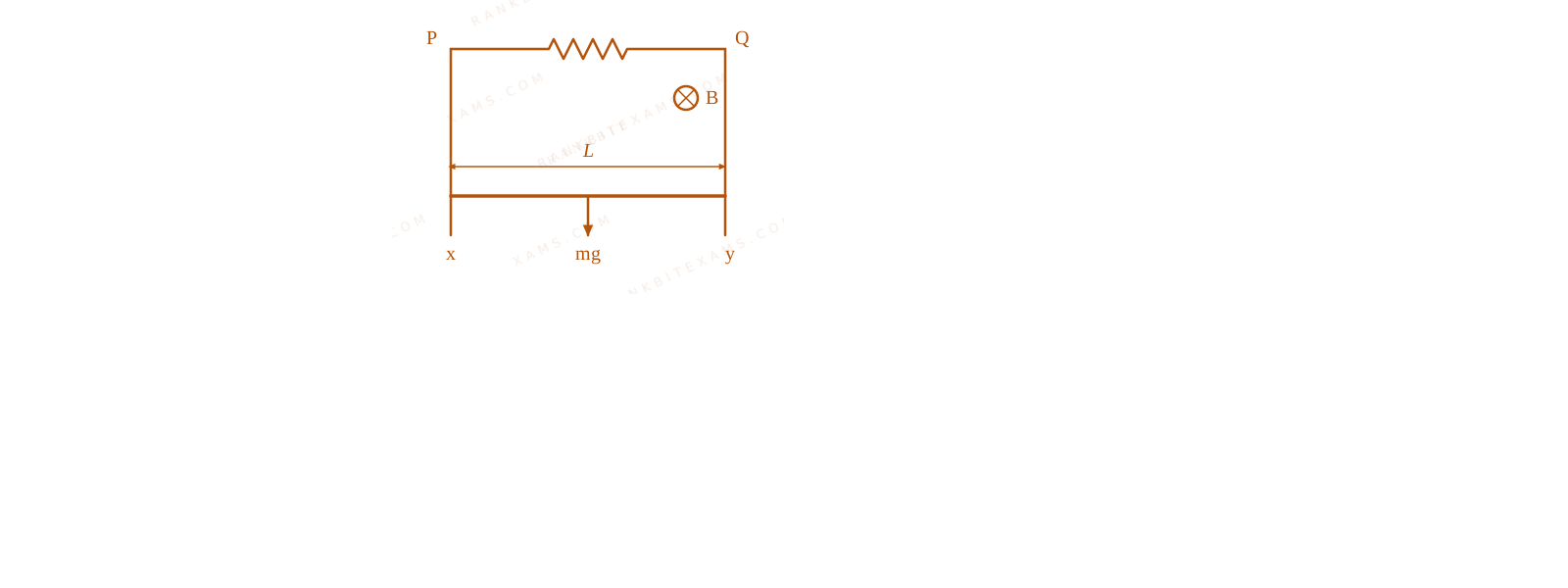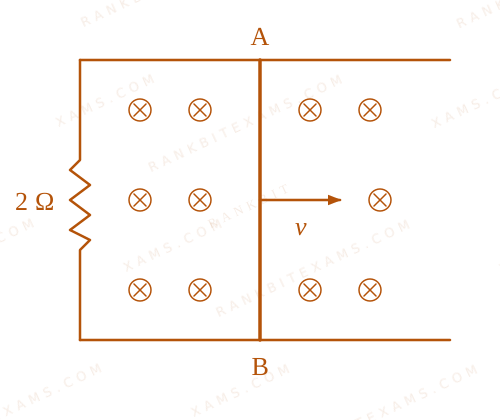
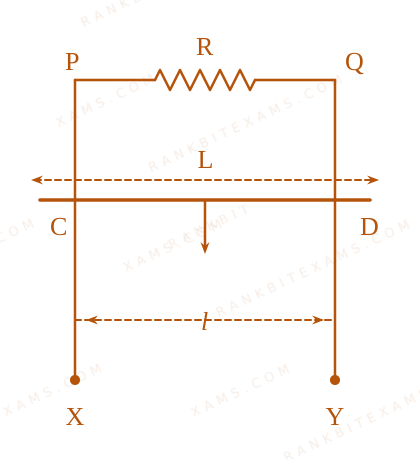
A 1 m long metal rod AB completes the circuit as shown in figure. The area of circuit is perpendicular to the magnetic field of 0.10 T. If the resistance of the total circuit is 2Omega then the force needed to move the rod towards right with constant speed (v) of 1.5 m/s is ____ N.
Motional EMF diagram for Q41 - JEE Main 2026 Morning
A conducting rod AB moves on a U-shaped rail in a perpendicular magnetic field.

Solution & Explanation

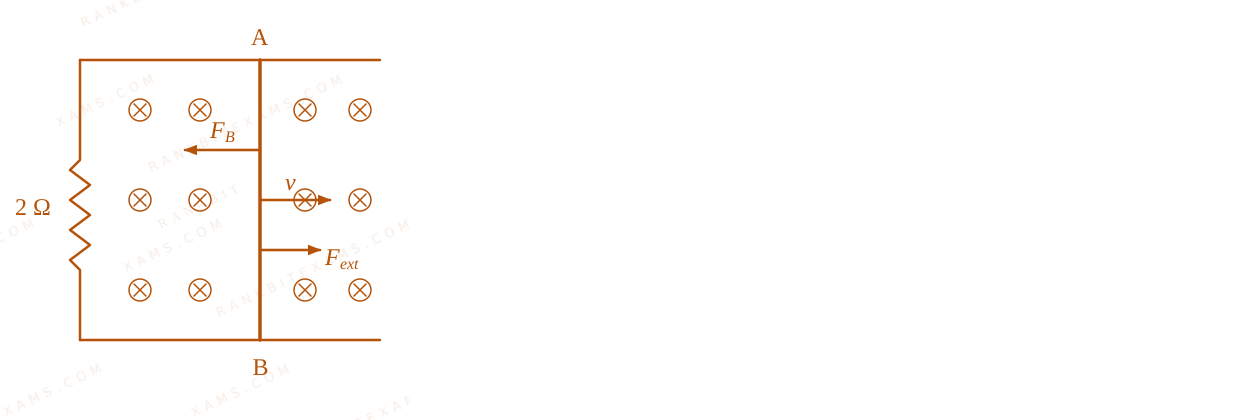
### Related Formula E = B l v i = fracER F_B = i l B = fracB^2 l^2 vR ### Core Logic To maintain a constant speed, the external force applied must balance the opposing magnetic force generated by the induced current. F_textext = F_B ### Step 1: Calculate External Force Given values: B = 0.10text T l = 1text m v = 1.5text m/s R = 2\, Omega F_textext = fracB^2 l^2 vR F_textext = frac(0.10)^2 times (1)^2 times 1.52 F_textext = frac0.01 times 1.52 = frac0.0152 = 0.0075 F_textext = 7.5 times 10^-3text N
Motional EMF solution diagram for Q41 - JEE Main 2026 Morning
A conducting rod AB moves on a U-shaped rail in a perpendicular magnetic field.
### Pattern Recognition Standard "sliding rod on rails" problem. The required mechanical force to maintain terminal velocity is always F = fracB^2 L^2 vR. ### Evaluation Rubric / Model Answer null ### Chapter Mix Class 12 Physics: Electromagnetic Induction

More Electromagnetic Induction Previous-Year Questions

Q28 jee_main_2026_21_jan_morning Faraday's Law
A conducting circular loop of area 1.0 \, mathrmm^2 is placed perpendicular to a magnetic field which varies as B = sin(100 \, t)text Tesla. If the resistance of the loop is 100 \, Omega, then the average thermal energy dissipated in the loop in one period is ____ J.
  • A. fracpi2
  • B. 2pi
  • C. pi
  • D. pi^2

Solution

### Related Formula phi = B cdot A E = -fracdphidt P = fracE^2R ### Core Logic Given area of the loop, A = 1text m^2 and magnetic field B = sin(100t). The magnetic flux passing through the loop is: phi = B cdot A = sin(100t) times 1 = sin(100t) Induced EMF E = left| fracdphidt right| = 100cos(100t) ### Step 1: Calculating Power and Energy Instantaneous power P = fracE^2R = frac100^2 cos^2(100t)100 = 100cos^2(100t). Thermal energy dissipated in one time period T: Q = int_0^T P \, dt = int_0^T 100cos^2(100t) \, dt The angular frequency omega = 100text rad/s, so time period T = frac2piomega = frac2pi100 = fracpi50text sec. Q = 100 int_0^pi/50 cos^2(100t) \, dt = 100 int_0^pi/50 frac1 + cos(200t)2 \, dt Q = 50 left[ t + fracsin(200t)200 right]_0^pi/50 Q = 50 left( fracpi50 - 0 right) = pitext Joules ### Pattern Recognition For a sinusoidal signal, the integral of cos^2(omega t) over one full period T is always T/2. Thus, int P \, dt = P_textmax times fracT2. ### Evaluation Rubric / Model Answer null ### Chapter Mix Class 12 Physics: Electromagnetic Induction Class 12 Physics: Alternating Current
Q8 jee_main_2025_02_april_evening Self Induction and Energy Stored
A solenoid having area A and length l is filled with a material having relative permeability 2. The magnetic energy stored in the solenoid is :
  • A. fracB^2 A lmu_0
  • B. fracB^2 A l2 mu_0
  • C. B^2 A l
  • D. fracB^2 A l4 mu_0

Solution

### Related Formula 1. Magnetic Energy Density (energy per unit volume): u_m = fracB^22 mu = fracB^22 mu_r mu_0 2. Total Energy stored: U = u_m times V = u_m times (A l) ### Core Logic We are given: - Relative permeability mu_r = 2 - Permeability of the filled core medium mu = mu_r mu_0 = 2 mu_0 Substitute mu_r = 2 into the energy density expression: u_m = fracB^22 (2 mu_0) = fracB^24 mu_0 Multiply by the total volume of the solenoid (V = A l): U = u_m cdot V = fracB^24 mu_0 A l ### Pattern Recognition Sees: Magnetic energy stored in a solenoid with medium relative permeability. Trap: Placing the relative permeability mu_r in the numerator of the formula instead of the denominator. Shortcut: Magnetic energy density is always inversely proportional to permeability. With medium mu = 2mu_0, energy density is halved compared to free space, giving fracB^24mu_0. Multiply by volume Al to get fracB^2 Al4mu_0. ### Evaluation Rubric / Model Answer null ### Chapter Mix Class 12 Physics: Electromagnetic Induction Class 12 Physics: Magnetism and Matter
Q25 jee_main_2025_04_april_morning Motional Electromotive Force
Conductor wire ABCDE with each arm 10mathrm~cm in length is placed in magnetic field of frac1sqrt2mathrm~Tesla, perpendicular to its plane. When conductor is pulled towards right with constant velocity of 10mathrm~cm/s, induced emf between points A and E is ________ mV.
Conductor wire path geometry layout for Q25 - JEE Main 2025 Morning
The figure outlines a segmented conductive wire trail pulled laterally through an orthogonal inward magnetic field matrix region.
Numerical Answer. Answer: 10 to 10

Solution

### Related Formula Motional electromotive force formula: epsilon = B cdot v cdot l_texteff where l_texteff is the net straight-line displacement distance joining start point A to target endpoint E (l_AE). ### Core Logic Since the external magnetic induction field map remains completely uniform across space, any arbitrary zig-zag wire loop profile can be simplified into a straight line connector vector bridging its raw boundary tips.
Effective vector length translation resolution mapping for Q25 - JEE Main 2025 Morning
The figure outlines a segmented conductive wire trail pulled laterally through an orthogonal inward magnetic field matrix region.
### Step 1: Compute Effective Length From the geometric angle configurations: l_texteff = 2 cdot (10 cdot sin 45^circ) = 2 cdot 10 cdot frac1sqrt2 = 10sqrt2mathrm~cm = 0.1sqrt2mathrm~m (Alternatively tracking structural vector projections: l_AB = 2 cdot 10sin(45^circ)mathrm~cm). ### Step 2: Calculate Induced EMF Substitute the parameters into the induction formula: epsilon = left( frac1sqrt2 ight) times left( 10 times 10^-2mathrm~m/s ight) times left( 10sqrt2 times 10^-2mathrm~m ight) epsilon = frac1sqrt2 cdot (0.1) cdot (0.1sqrt2) = 0.01mathrm~V = 10mathrm~mV ### Pattern Recognition In uniform magnetic fields, intermediate paths do not affect motional EMF values. The output voltage depends strictly on the straight line distance joining the end tips perpendicular to the velocity direction. ### Evaluation Rubric / Model Answer null ### Chapter Mix Class 12 Physics: Electromagnetic Induction
Q1 jee_main_2025_28_jan_evening Motional EMF
A uniform magnetic field of 0.4 mathrmT acts perpendicular to a circular copper disc 20 mathrm~cm in radius. The disc is having a uniform angular velocity of 10 pi rad mathrms^-1 about an axis through its centre and perpendicular to the disc. What is the potential difference developed between the axis of the disc and the rim? ( pi = 3.14 )
  • A. text0.0628 V
  • B. text0.5024 V
  • C. text0.2512 V
  • D. text0.1256 V

Solution

### Related Formula The induced electromotive force (EMF) developed between the center and the rim of a rotating disc in a perpendicular magnetic field is given by: E = frac12 B omega R^2 ### Core Logic Given parameters from the problem statement [cite: 655, 657, 658]: * Magnetic field, B = 0.4 text T * Radius of the disc, R = 20 text cm = 0.2 text m * Angular velocity, \omega = 10\pi \text{ rad s}^{-1} Substituting the values into the governing formula: E = frac12 times 0.4 times (10 times 3.14) times (0.2)^2 E = 0.2 times 31.4 times 0.04 E = 0.2512 text V ### Step 1: Evaluation The potential difference developed between the axis of the disc and the rim is precisely 0.2512 text V. ### Pattern Recognition For any rotating conductor of length R or a continuous disc rotating about its center in a perpendicular magnetic field, the induced EMF is mathematically equivalent to a single radial rod sweeping the area, leading directly to the formula frac12Bomega R^2. ### Evaluation Rubric / Model Answer null ### Chapter Mix Class 12 Physics: Electromagnetic Induction

More Electromagnetic Induction Questions — jee_main_2026_21_jan_morning

Practice all Electromagnetic Induction previous-year questions →

Rankbit System
JEE Physics: Waves (+15.5%) | Electrostatics: Concentric Shells (-29.7%) | Modern Physics: Photoelectric Clones (+34.2%) | Mathematics: Definite Integrals (+18.1%) | Chemistry: Coordination Splitting (-11.4%) | JEE Physics: Waves (+15.5%) | Electrostatics: Concentric Shells (-29.7%) | Modern Physics: Photoelectric Clones (+34.2%) | Mathematics: Definite Integrals (+18.1%) | Chemistry: Coordination Splitting (-11.4%)
YOUR FIRST PREP STEP STARTS HERE

We Map Every Repeating Question in Competitive Exams.

Say goodbye to generic mock test fatigue. RankBit uses smart analysis to group past exam questions into their foundational Repeating Question Types. Find chapter weightage, track repeating questions, and score higher with targeted practice.

Select Your Target Exam

Choose an exam track below to find formulas per chapter and patterns.

Syncing Exam Intelligence

Mapping formulas and patterns across all tracks…

PATH A — FULL LENGTH PRACTICE

Full Mock Test Hub

Simulate real NTA exam conditions with fully tracked mocks. Time yourself against past papers.

Now Live Open
PATH B — TARGETED PRACTICE

Topic-wise Practice Hub

Practice past-year questions one chapter at a time. Pick an exam → subject → chapter and get every PYQ for that topic — pulled together from all past papers — with the chapter's key formulas alongside.

Loading Questions... Browse Topics
Latest from the Blog
View all →

Loading articles...