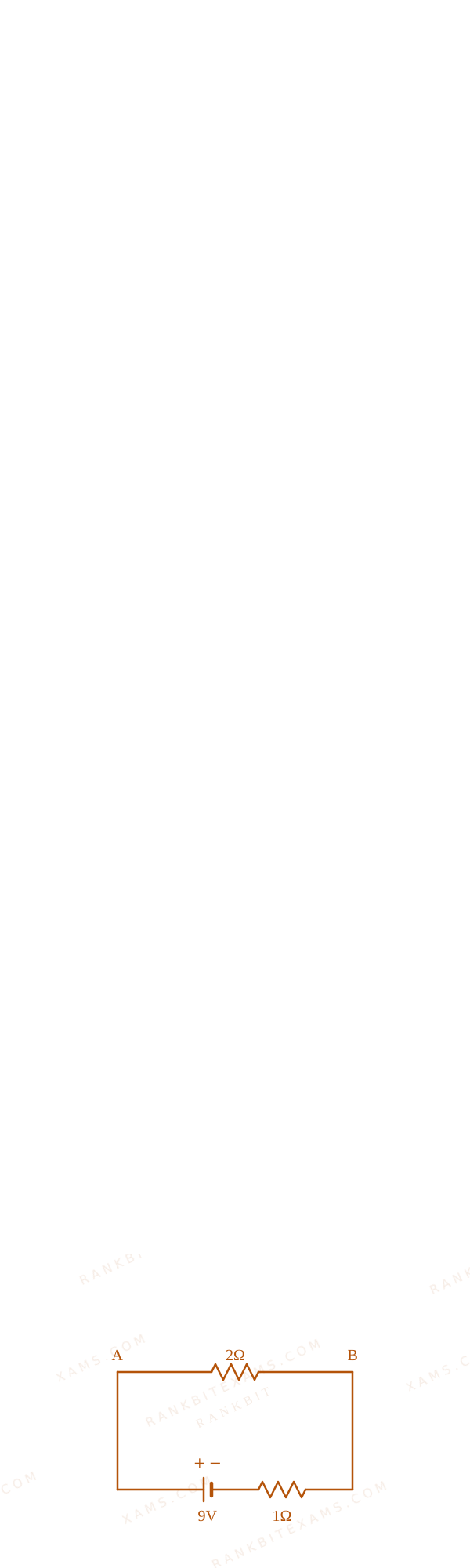
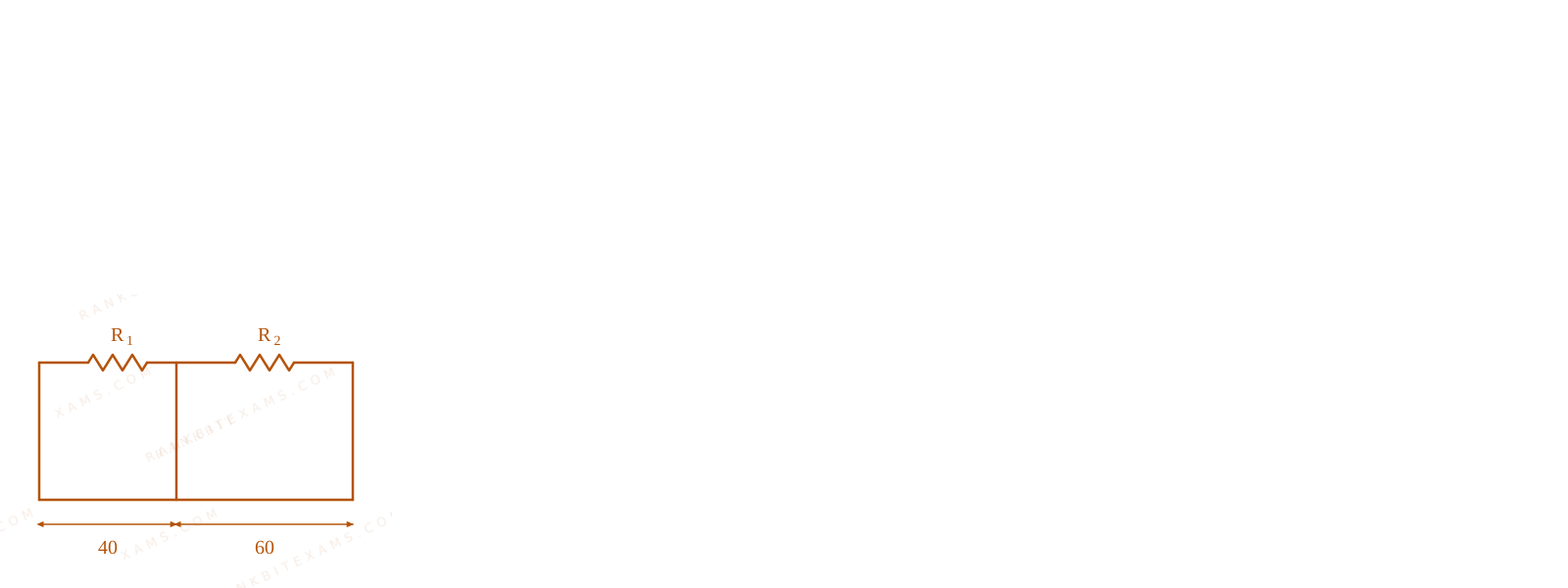
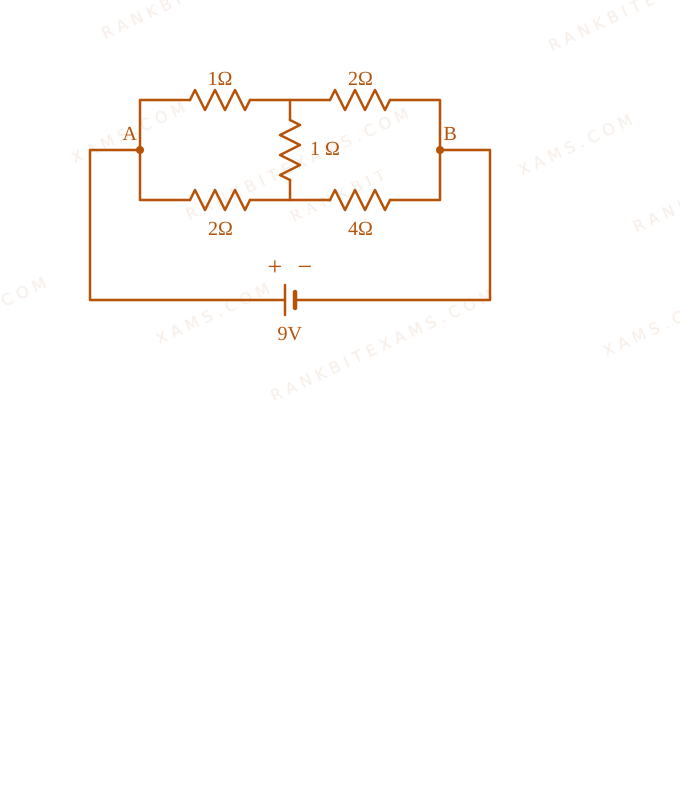
The heat generated in 1 minute between points A and B in the given circuit, when a battery of 9V with internal resistance of 1 Omega is connected across these points is ____ J.
Heating Effect of Current diagram for Q47 - JEE Main 2026 Morning
A bridge network with resistors 1 ohm, 2 ohms, 2 ohms, and 4 ohms forming the arms.

Numerical Answer Type:
Enter a numerical value Answer: 1080 to 1080 +4 marks

Solution & Explanation

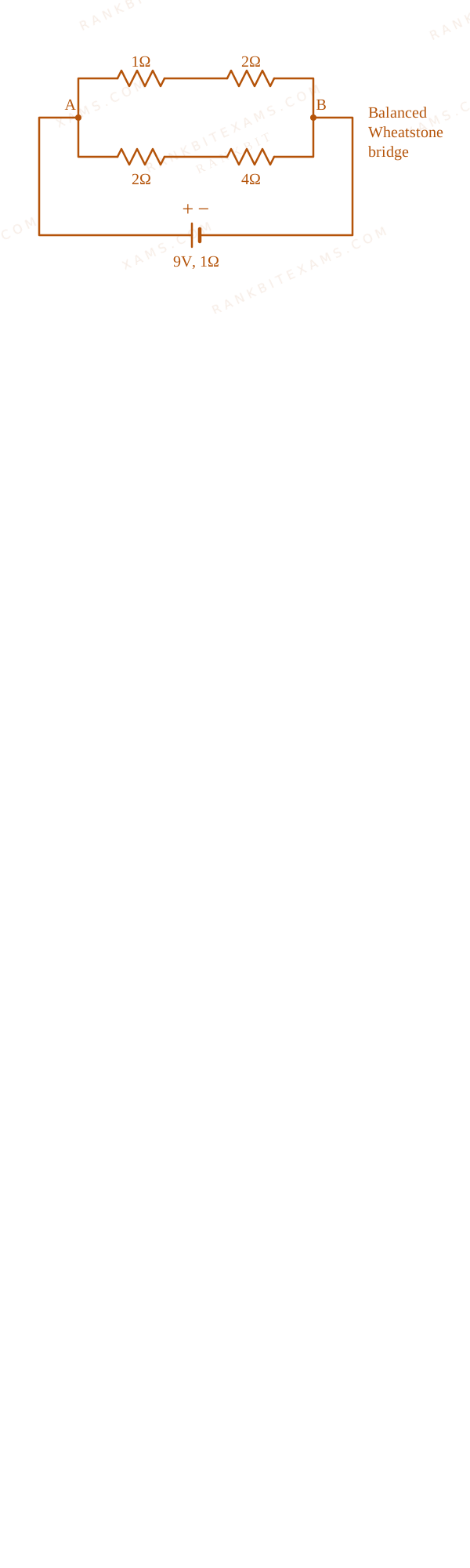
### Related Formula R_texteq = fracR_1 R_2R_1 + R_2 text (parallel) H = I^2 R t I = fracVR_texteq + r ### Core Logic The circuit is a balanced Wheatstone bridge between A and B, because the ratio of adjacent arms is frac12 = frac24. Thus, the middle 1\,Omega resistor (if there is one connecting the middle nodes) is ineffective.
Heating Effect of Current solution diagram for Q47 - JEE Main 2026 Morning
A bridge network with resistors 1 ohm, 2 ohms, 2 ohms, and 4 ohms forming the arms.
The equivalent resistance across AB (R_AB) involves the upper branch (1+2 = 3\,Omega) and the lower branch (2+4 = 6\,Omega) in parallel.
Heating Effect of Current solution diagram for Q47 - JEE Main 2026 Morning
A bridge network with resistors 1 ohm, 2 ohms, 2 ohms, and 4 ohms forming the arms.
R_AB = frac3 times 63 + 6 = frac189 = 2\,Omega ### Step 1: Calculate Current and Heat Total resistance in the circuit = R_AB + r_textinternal = 2 + 1 = 3\,Omega. Total current from the battery i = frac9textV3\,Omega = 3textA. The heat generated specifically between points A and B in 1 minute (60 seconds) is: H_AB = i^2 R_AB t = (3)^2 times 2 times 60 H_AB = 9 times 120 = 1080text J ### Pattern Recognition Check for balanced Wheatstone bridge first. Then use H = i^2 R t strictly with the equivalent resistance of just the section AB to find heat specifically generated across AB. ### Evaluation Rubric / Model Answer null ### Chapter Mix Class 12 Physics: Current Electricity

More Current Electricity Previous-Year Questions

Q8 jee_main_2025_02_april_morning Electrical Energy and Power
The battery of a mobile phone is rated as 4.2mathrm~V, 5800mathrm~mAh. How much energy is stored in it when fully charged?
  • A. 43.8mathrm~kJ
  • B. 48.7mathrm~kJ
  • C. 87.7mathrm~kJ
  • D. 24.4mathrm~kJ

Solution

### Related Formula E = V cdot Q Q = I cdot t ### Core Logic The capacity rating 5800mathrm~mAh represents total electric charge Q stored: Q = 5800mathrm~mA times 1mathrm~hour = (5800 times 10^-3mathrm~A) times 3600mathrm~s = 20880mathrm~C Given the voltage is V = 4.2mathrm~V, the energy stored in Joules is: E = V cdot Q = 4.2 times 20880 = 87696mathrm~J = 87.696mathrm~kJ approx 87.7mathrm~kJ ### Step 1: Final Conclusion The electrical energy stored in the fully charged battery is 87.7mathrm~kJ. ### Pattern Recognition Always remember: textEnergy (in Joules) = textVoltage (V) times textCapacity (Ah) times 3600. This directly transforms electrical rating units to standard SI energy units. ### Evaluation Rubric / Model Answer null ### Chapter Mix Class 12 Physics: Current Electricity
Q jee_main_2025_03_april_evening Grouping of Cells
Two cells of emf 1V and 2V and internal resistance 2Omega and 1Omega, respectively, are connected in series with an external resistance of 6Omega. The total current in the circuit is I_1 Now the same two cells in parallel configuration are connected to same external resistance. In this case, the total current drawn is I_2. The value of (fracI_1I_2) is fracx3. The value of x is ________.
Numerical Answer. Answer: 4 to 4

Solution

### Related Formula - Series cell configuration: varepsilon_texteq = varepsilon_1 + varepsilon_2, quad r_texteq = r_1 + r_2 - Parallel cell configuration (for unequal cells in parallel): varepsilon_texteq = fracfracvarepsilon_1r_1 + fracvarepsilon_2r_2frac1r_1 + frac1r_2, quad frac1r_texteq = frac1r_1 + frac1r_2 - Circuit current: I = fracvarepsilon_texteqr_texteq + R ### Core Logic Given parameters: - Cell 1: \varepsilon_1 = 1\mathrm{~V}, r_1 = 2\Omega - Cell 2: \varepsilon_2 = 2\mathrm{~V}, r_2 = 1\Omega - External resistance R = 6\Omega ### Step 1: Calculate I_1 (Series Configuration)
Grouping of Cells
Grouping of Cells
varepsilon_texteq = 1 + 2 = 3mathrm~V r_texteq = 2 + 1 = 3Omega I_1 = frac33 + 6 = frac39 = frac13mathrm~A ### Step 2: Calculate $I_2$ (Parallel Configuration)
Grouping of Cells
Grouping of Cells
\varepsilon_{\text{eq}} = \frac{\frac{1}{2} + \frac{2}{1}}{\frac{1}{2} + \frac{1}{1}} = \frac{0.5 + 2}{1.5} = \frac{2.5}{1.5} = \frac{5}{3}\mathrm{~V} r_{\text{eq}} = \frac{r_1 r_2}{r_1 + r_2} = \frac{2 \times 1}{2 + 1} = \frac{2}{3}\Omega I_2 = \frac{\varepsilon_{\text{eq}}}{r_{\text{eq}} + R} = \frac{\frac{5}{3}}{\frac{2}{3} + 6} = \frac{\frac{5}{3}}{\frac{20}{3}} = \frac{5}{20} = \frac{1}{4}\mathrm{~A}$ ### Step 3: Find ratio and evaluate $x$ \frac{I_1}{I_2} = \frac{\frac{1}{3}}{\frac{1}{4}} = \frac{4}{3}$ Comparing with \frac{x}{3}: x = 4 ### Pattern Recognition For cells connected in parallel, the formula for equivalent EMF \varepsilon_{\text{eq}}$ can be viewed as a weighted average. Connecting cells in series maximizes EMF but increases internal resistance, while parallel configuration limits EMF to an intermediate value while reducing equivalent internal resistance. ### Evaluation Rubric / Model Answer null ### Chapter Mix Class 12 Physics: Current Electricity
Q3 jee_main_2025_07_april_morning Combination of Resistors
A wire of resistance R is bent into a triangular pyramid as shown in figure with each segment having same length. The resistance between points A and B is R/n. The value of n is :
Triangular pyramid resistor network for Q3 - JEE Main 2025 Morning
A triangular pyramid resistor network with terminals A and B marked, showing symmetry in the layout.
  • A. 16
  • B. 14
  • C. 10
  • D. 12

Solution

### Related Formula For a wire of total resistance R divided into N equal segments, the resistance of each segment r is: r = fracRN For a balanced Wheatstone bridge with resistors of resistance r, the central arm can be neglected because no current flows through it. ### Core Logic The triangular pyramid has 6 segments of equal length. Since the total resistance of the wire is R: r = fracR6 Let the four vertices of the pyramid be A, B, C, and D. Terminals are at A and B. The segments are: - AB (direct path between terminals, resistance r) - AC, BC, AD, BD (forming a closed quadrilateral network between A and B with bridge arm CD) - CD (bridge arm connecting the midpoints, resistance r) ### Step 1: Simplify the Network By symmetry, the potentials at C and D are equal when a voltage is applied across A and B. Thus, the bridge is balanced, and no current flows through the segment CD. We can remove segment CD from the calculations: - The path A to C to B consists of two resistors in series: r + r = 2r. - The path A to D to B also consists of two resistors in series: r + r = 2r. - The direct path A to B has a single resistor r. These three parallel branches are connected between A and B. ### Step 2: Calculate Equivalent Resistance The equivalent resistance R_AB is: frac1R_AB = frac12r + frac12r + frac1r = frac1r + frac1r = frac2r R_AB = fracr2 Substitute r = fracR6: R_AB = fracR/62 = fracR12 Comparing with R_AB = fracRn, we find n = 12. ### Pattern Recognition Sees: Resistor network formed by a 3D pyramid (6 identical edges, 4 nodes). Shortcut: A 6-resistor regular tetrahedron has an equivalent resistance of r/2 across any two vertices. Since the total wire resistance is R and it's cut into 6 pieces, r = R/6 implies R_texteq = R/12. ### Evaluation Rubric / Model Answer null ### Chapter Mix Class 12 Physics: Current Electricity
Q1 jee_main_2025_29_jan_evening Seebeck Effect and Thermoelectricity
The difference of temperature in a material can convert heat energy into electrical energy. To harvest the heat energy, the material should have:
  • A. textlow thermal conductivity and low electrical conductivity
  • B. texthigh thermal conductivity and high electrical conductivity
  • C. textlow thermal conductivity and high electrical conductivity
  • D. texthigh thermal conductivity and low electrical conductivity

Solution

### Related Formula V = S cdot Delta T where, V = Thermoelectric voltage (Seebeck voltage) S = Seebeck coefficient Delta T = Temperature difference ### Core Logic To maximize the efficiency of a thermoelectric device harvesting heat energy, two conditions must be fulfilled: 1. **Low thermal conductivity**: This ensures that the temperature gradient (Delta T) across the material is maintained and heat does not rapidly flow from the hot side to the cold side. 2. **High electrical conductivity**: This minimizes internal Joule heating losses (I^2R) when electrical current is drawn from the material. Therefore, the material should possess low thermal conductivity and high electrical conductivity. ### Pattern Recognition thermoelectric figure of merit is given by Z = fracS^2 sigmakappa, where sigma is electrical conductivity and kappa is thermal conductivity. To maximize Z, we inherently need high sigma and low kappa. ### Evaluation Rubric / Model Answer null ### Chapter Mix Class 12 Physics: Current Electricity Class 11 Physics: Thermal Properties of Matter

More Current Electricity Questions — jee_main_2026_21_jan_morning

Practice all Current Electricity previous-year questions →

Rankbit System
JEE Physics: Waves (+15.5%) | Electrostatics: Concentric Shells (-29.7%) | Modern Physics: Photoelectric Clones (+34.2%) | Mathematics: Definite Integrals (+18.1%) | Chemistry: Coordination Splitting (-11.4%) | JEE Physics: Waves (+15.5%) | Electrostatics: Concentric Shells (-29.7%) | Modern Physics: Photoelectric Clones (+34.2%) | Mathematics: Definite Integrals (+18.1%) | Chemistry: Coordination Splitting (-11.4%)
YOUR FIRST PREP STEP STARTS HERE

We Map Every Repeating Question in Competitive Exams.

Say goodbye to generic mock test fatigue. RankBit uses smart analysis to group past exam questions into their foundational Repeating Question Types. Find chapter weightage, track repeating questions, and score higher with targeted practice.

Select Your Target Exam

Choose an exam track below to find formulas per chapter and patterns.

Syncing Exam Intelligence

Mapping formulas and patterns across all tracks…

PATH A — FULL LENGTH PRACTICE

Full Mock Test Hub

Simulate real NTA exam conditions with fully tracked mocks. Time yourself against past papers.

Now Live Open
PATH B — TARGETED PRACTICE

Topic-wise Practice Hub

Practice past-year questions one chapter at a time. Pick an exam → subject → chapter and get every PYQ for that topic — pulled together from all past papers — with the chapter's key formulas alongside.
Loading Questions... Browse Topics
Latest from the Blog
View all →

Loading articles...