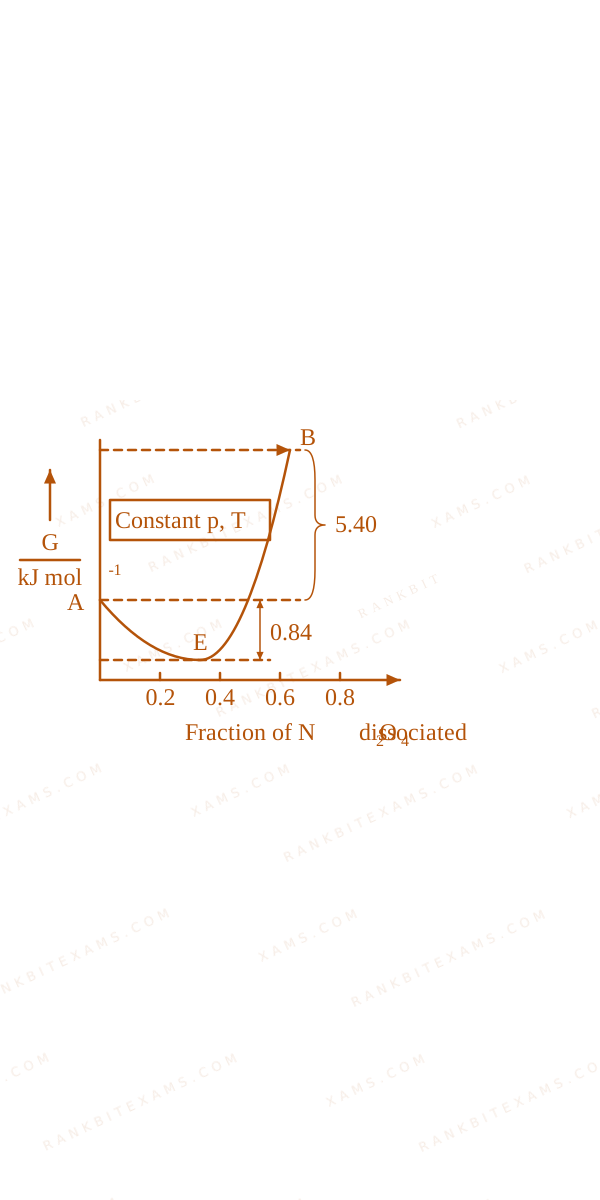
For the reaction, N₂O₄ leftharpoons 2NO₂$N_{2}O_{4} \rightleftharpoons 2NO_{2}$, graph is plotted as shown below. Identify correct statements.
A. Standard free energy change for the reaction is -5.40 kJ mol⁻¹$-5.40\text{ kJ mol}^{-1}$.
B. As Δ G$\Delta G^{\ominus}$ in graph is positive, N₂O₄$N_{2}O_{4}$ will not dissociate into NO₂$NO_{2}$ at all.
C. Reverse reaction will go to completion.
D. When 1 mole of N₂O₄$N_{2}O_{4}$ changes into equilibrium mixture, value of Δ G = -0.84 kJ mol⁻¹$\Delta G = -0.84\text{ kJ mol}^{-1}$.
E. When 2 mole of NO₂$NO_{2}$ changes into equilibrium mixture, Δ G$\Delta G$ for equilibrium mixture is -6.24 kJ mol⁻¹$-6.24\text{ kJ mol}^{-1}$.
A plot of Gibbs free energy against the fraction of N2O4 dissociated.
Choose the correct answer from the options given below :
A.D and E only$\text{D and E only}$
B.C and E only$\text{C and E only}$
C.A and D only$\text{A and D only}$
D.B and C only$\text{B and C only}$
Solution & Explanation
Core Logic
Let's analyze the statements based on the given Gibbs free energy (G) vs. extent of reaction plot.
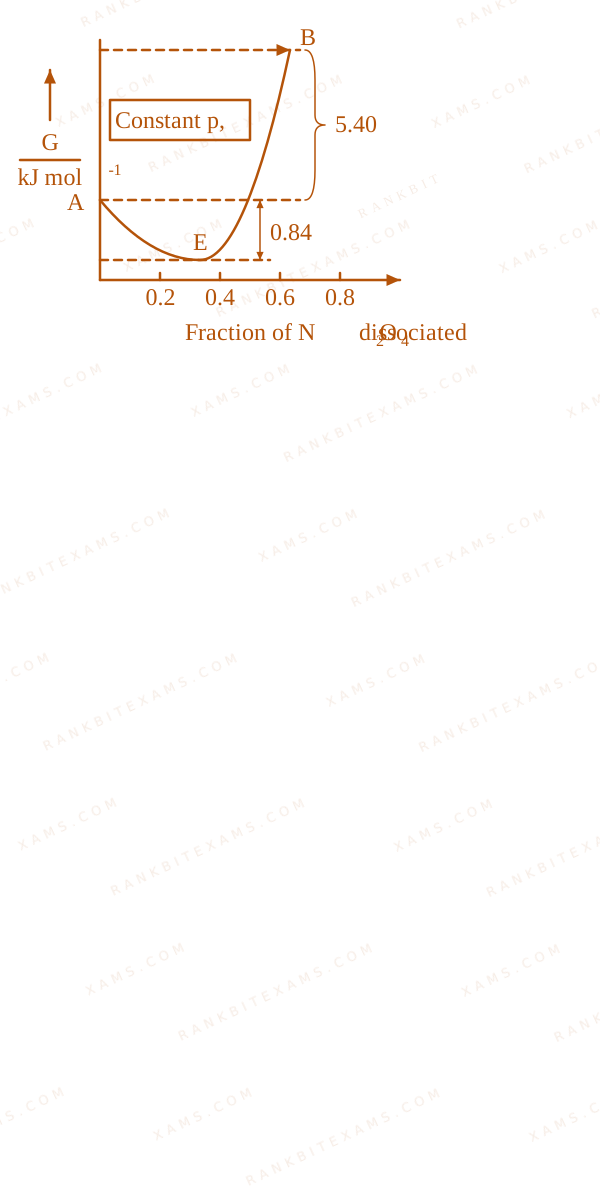
A plot of Gibbs free energy against the fraction of N2O4 dissociated.
A. Standard free energy change (Δᵣ G°$\Delta_r G^{\circ}$) is the difference between standard free energies of pure products (point B) and pure reactants (point A): Δᵣ G° = GB° - GA°$\Delta_r G^{\circ} = G_B^{\circ} - G_A^{\circ}$. Since B is higher than A, Δᵣ G°$\Delta_r G^{\circ}$ is positive, not -5.40 kJ mol⁻¹$-5.40\text{ kJ mol}^{-1}$. Statement A is false.
B. Even if Δᵣ G°$\Delta_r G^{\circ}$ is positive, the minimum of the curve (equilibrium state E) lies between the pure reactant and product states. Therefore, partial dissociation occurs to reach equilibrium. It is false to say it will not dissociate at all. Statement B is false.
C. The minimum E is not at fraction = 0 or 1, meaning an equilibrium mixture exists. Reverse reaction does not go to completion. Statement C is false.
D. From 1 mole of pure reactant (point A) to the equilibrium mixture (point E), the drop in Gibbs energy is 0.84 kJ mol⁻¹$0.84\text{ kJ mol}^{-1}$. Thus Δ G = -0.84 kJ mol⁻¹$\Delta G = -0.84\text{ kJ mol}^{-1}$ is correct. Statement D is true.
E. The difference from pure products (point B, equivalent to 2 moles NO₂$NO_2$) to equilibrium (E) is the entire vertical distance. The drop from B to A is 5.40$5.40$, and A to E is 0.84$0.84$. So drop from B to E is - (5.40 + 0.84) = -6.24 kJ mol⁻¹$- (5.40 + 0.84) = -6.24\text{ kJ mol}^{-1}$. Statement E is true.
Step 1: Final Conclusion
Only statements D and E are correct.
Pattern Recognition
The free energy of mixing creates a minimum 'dip' (Equilibrium) below both pure reactants and pure products, preventing either forward or reverse reactions from going absolutely to 100% completion.
Chapter Mix
Class 11 Chemistry: Thermodynamics
Class 11 Chemistry: Equilibrium
Keywords:#Gibbs free energy change#N2O4 dissociation#JEE Main 2026 Morning Q69#Thermodynamics JEE Main 2026#Gibbs free energy graph#Equilibrium
More Thermodynamics Previous-Year Questions — Page 4
Q47jee_main_2025_03_april_eveningWork Done in Reversible Cyclic Processes
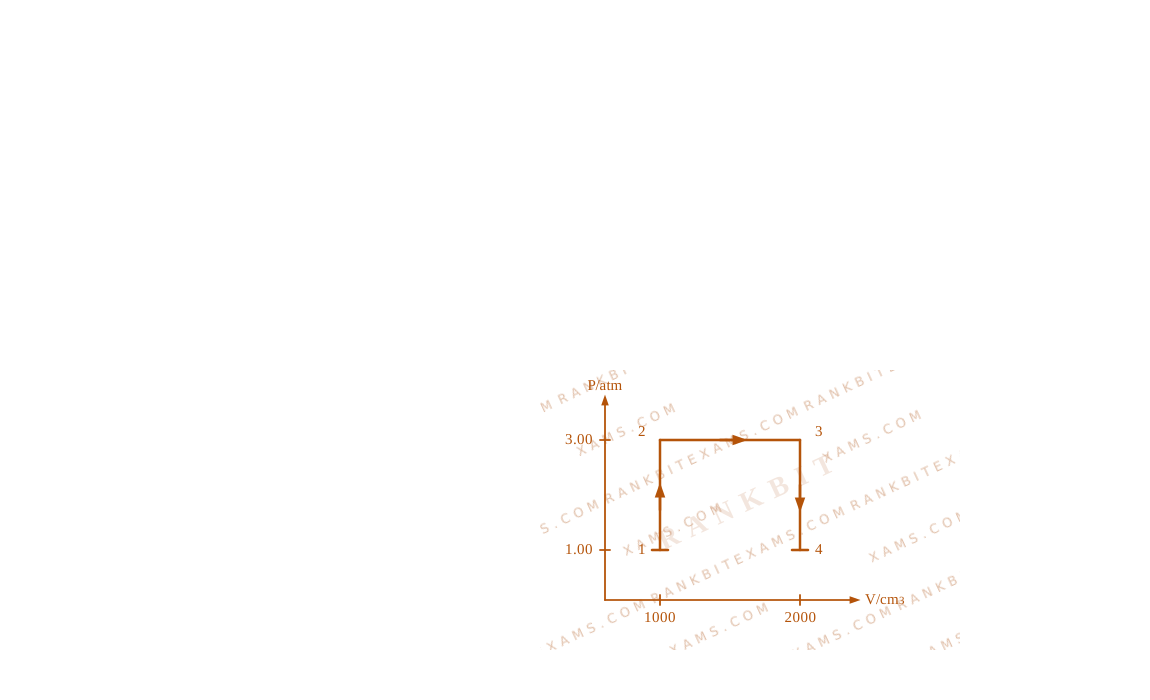
A perfect gas (0.1~mol$0.1\mathrm{~mol}$) having Cv=1.50~R$\bar{C}_{v}=1.50\mathrm{~R}$ (independent of temperature) undergoes the transformation from point 1 to point 4 as shown in the pressure-volume diagram below. If each step is reversible, the total work done (w) while going from point 1 to point 4 is (-$-$) ________ J. (nearest integer) P-V graph showing a thermodynamic process from point 1 to point 4 containing an isobaric step and isochoric steps.
[Given: R=0.082 ~L~atm~K⁻¹~mol⁻¹ = 8.314 ~J~K⁻¹~mol⁻¹$R=0.082\mathrm{~L~atm~K^{-1}~mol^{-1}} = 8.314\mathrm{~J~K^{-1}~mol^{-1}}$]
Numerical Answer.Answer: 304 to 304
Solution
Related Formula
Thermodynamic work done (w$w$) for each step:
Isochoric step (V = constant$V = \text{constant}$):
-) ________ J, meaning work done by the system (expansion) is negative and work done on the system (compression) is positive. Since this is compression, work done on the gas is$) ________ J, meaning work done by the system (expansion) is negative and work done on the system (compression) is positive. Since this is compression, work done on the gas is $+304\mathrm{~J}, which is represented as$, which is represented as $-(-304)\mathrm{~J}in typical IUPAC convention where work of expansion is examined. The absolute magnitude of the work is$ in typical IUPAC convention where work of expansion is examined. The absolute magnitude of the work is $304\mathrm{~J}.
Pattern Recognition
During any cyclic or multi-step path on a P-V graph, work is done only when there is a change in volume (
$.
Pattern Recognition
During any cyclic or multi-step path on a P-V graph, work is done only when there is a change in volume ($
W = -\int P dV$). Any vertical line (constant volume) represents an isochoric step where work is exactly zero. The horizontal segment directly represents rectangular area under the path.
Chapter Mix
Class 11 Chemistry: Thermodynamics
Class 11 Physics: Thermodynamics
Q48jee_main_2025_03_april_eveningBomb Calorimetry and Heat of Combustion
A sample of n-octane (1.14~g$1.14\mathrm{~g}$) was completely burnt in excess of oxygen in a bomb calorimeter, whose heat capacity is 5 ~kJ~K⁻¹$5\mathrm{~kJ~K^{-1}}$. As a result of combustion reaction, the temperature of the calorimeter is increased by 5 K. The magnitude of the heat of combustion of octane at constant volume is ________ kJ~mol⁻¹$\mathrm{kJ~mol^{-1}}$. (nearest integer)
Numerical Answer.Answer: 2500 to 2500
Solution
Related Formula
Heat released at constant volume (qv$q_v$) in a bomb calorimeter is:
A bomb calorimeter operates at rigid constant volume, meaning boundary work
$.
Pattern Recognition
A bomb calorimeter operates at rigid constant volume, meaning boundary work $
w = 0. Thus, by the first law of thermodynamics, the measured heat flow represents the internal energy change ($. Thus, by the first law of thermodynamics, the measured heat flow represents the internal energy change ($\Delta U), not the enthalpy change ($), not the enthalpy change ($\Delta H$, which occurs at constant pressure).
Chapter Mix
Class 11 Chemistry: Thermodynamics
Q29jee_main_2025_07_april_morningEnthalpy Changes
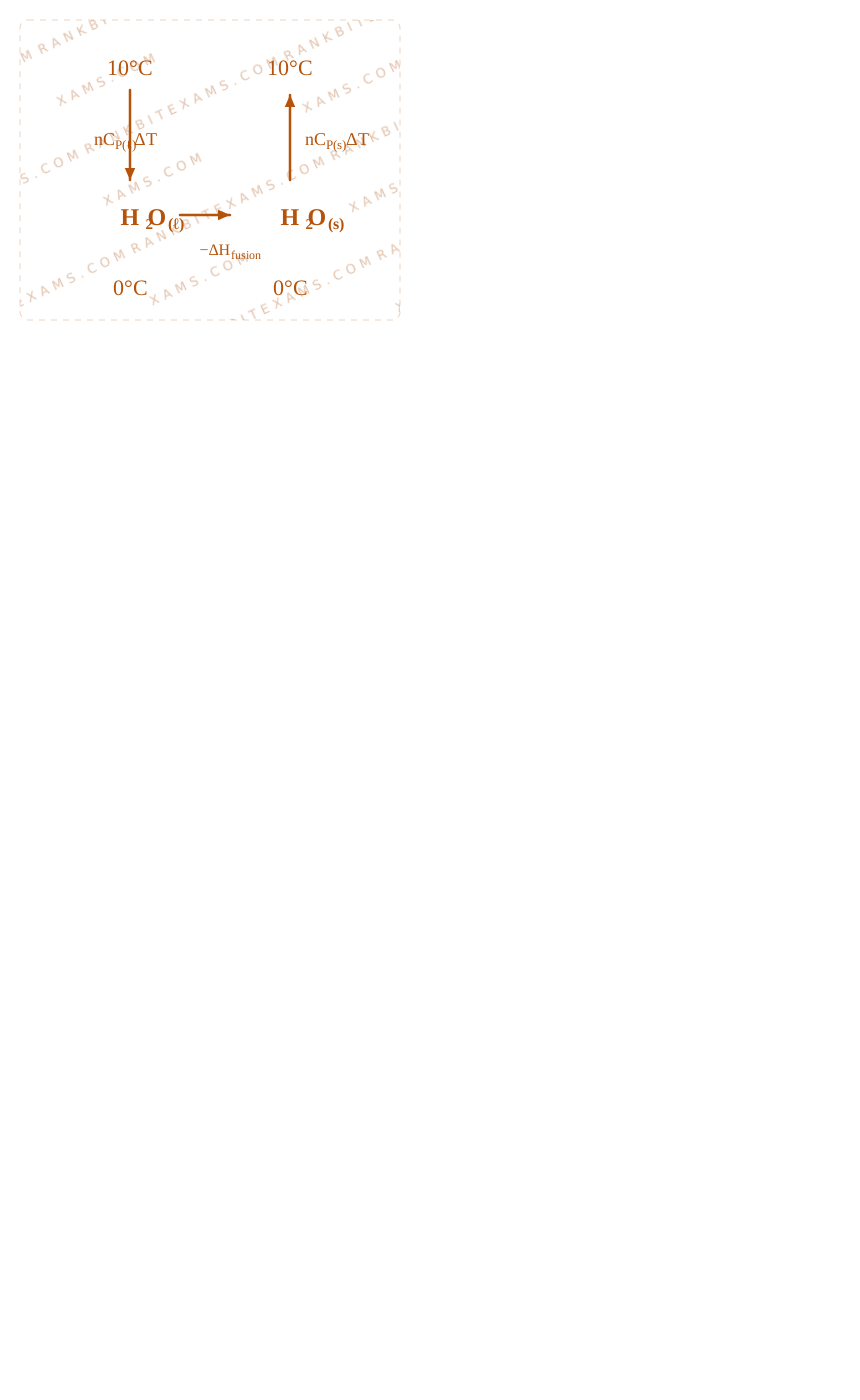
Total enthalpy change for freezing of 1 ~mol$1 \mathrm{~mol}$ of water at 10° C$10^{\circ} \mathrm{C}$ to ice at -10° C$-10^{\circ} \mathrm{C}$ is
(Given: ΔfusH = x$\Delta_{\mathrm{fus}}\mathrm{H} = \mathrm{x}$ kJ/mol, Cₚ[H₂O( )] = y J mol⁻¹ K⁻¹$\mathrm{C}_{\mathrm{p}}[\mathrm{H}_2\mathrm{O}(\ell)] = \mathrm{y}\text{ J mol}^{-1}\text{ K}^{-1}$, Cₚ[H₂O(s)] = z J mol⁻¹ K⁻¹$\mathrm{C}_{\mathrm{p}}[\mathrm{H}_2\mathrm{O}(\text{s})] = \mathrm{z}\text{ J mol}^{-1}\text{ K}^{-1}$)
Freezing is an exothermic process, so all three steps (cooling water, freezing, and cooling ice) must carry a negative sign. Factoring out -10$-10$ cleanly yields the expression -10(100x+y+z)$-10(100x+y+z)$.
Chapter Mix
Class 11 Chemistry: Chemical Thermodynamics
Qjee_main_2025_08_april_eveningResonance Energy
Resonance in an X₂Y$\text{X}_2\text{Y}$ molecule is represented as follows:
X = X = Y X ≡ X^+ - Y^-$$\text{X} = \text{X} = \text{Y} \longleftrightarrow \text{X} \equiv \text{X}^+ - \text{Y}^-$$
The experimental enthalpy of formation for gaseous X₂Y$\text{X}_2\text{Y}$ is given by the reaction:
X ≡ X(g) + (1)/(2)Y = Y(g) X₂Y(g) Δ Hf(exp) = 80 kJ mol⁻¹$$\text{X} \equiv \text{X}(g) + \frac{1}{2}\text{Y} = \text{Y}(g) \longrightarrow \text{X}_2\text{Y}(g) \quad \Delta H_{f(\text{exp})} = 80 \text{ kJ mol}^{-1}$$
Calculate the magnitude of the resonance energy of X₂Y$\text{X}_2\text{Y}$ in kJ mol⁻¹$\text{kJ mol}^{-1}$ (as the nearest integer value).
**Given bond energies:**
* X ≡ X = 940 kJ mol⁻¹$\text{X} \equiv \text{X} = 940 \text{ kJ mol}^{-1}$
* X = X = 410 kJ mol⁻¹$\text{X} = \text{X} = 410 \text{ kJ mol}^{-1}$
* Y = Y = 500 kJ mol⁻¹$\text{Y} = \text{Y} = 500 \text{ kJ mol}^{-1}$
* X = Y = 602 kJ mol⁻¹$\text{X} = \text{Y} = 602 \text{ kJ mol}^{-1}$
Valence settings: X : 3, Y : 2$\text{X} : 3, \text{Y} : 2$
Numerical Answer.Answer: 98 to 98
Solution
Related Formula
Resonance energy equation related to experimental and theoretical formation enthalpies:
Taking the magnitude as requested: |Δ HR.E.| = 98$|\Delta H_{\text{R.E.}}| = 98$.
Pattern Recognition
Resonance energy is always a stabilizing factor, meaning Δ Hf(exp)$\Delta H_{f(\text{exp})}$ is more exothermic (or less endothermic) than the theoretical localized state. The magnitude is simply the absolute value of this difference (|80 - 178| = 98$|80 - 178| = 98$).
Chapter Mix
Class 11 Chemistry: Chemical Thermodynamics
Class 11 Chemistry: Chemical Bonding and Molecular Structure
Q39jee_main_2025_29_jan_eveningHess's Law of Constant Heat Summation
If C(diamond) arrow C(graphite) + X kJ mol⁻¹$C(\text{diamond}) \rightarrow C(\text{graphite}) + X\text{ kJ mol}^{-1}$C(diamond) + O₂(g) arrow CO₂(g) + Y kJ mol⁻¹$$C(\text{diamond}) + O_{2}(g) \rightarrow CO_{2}(g) + Y\text{ kJ mol}^{-1}$$C(graphite) + O₂(g) arrow CO₂(g) + Z kJ mol⁻¹$$C(\text{graphite}) + O_{2}(g) \rightarrow CO_{2}(g) + Z\text{ kJ mol}^{-1}$$
At constant temperature, then the correct relationship is:
A. X = Y + Z
B. -X = Y + Z
C. X = -Y + Z
D. X = Y - Z
Solution
Core Logic
Let's treat the given parameters as terms for exothermic heats evolved on the product side:
1) C(diamond) arrow C(graphite)$C(\text{diamond}) \rightarrow C(\text{graphite})$, Delta H = -X$Delta H = -X$
2) C(diamond) + O₂(g) arrow CO₂(g)$C(\text{diamond}) + O_{2}(g) \rightarrow CO_{2}(g)$, Delta H = -Y$Delta H = -Y$
3) C(graphite) + O₂(g) arrow CO₂(g)$C(\text{graphite}) + O_{2}(g) \rightarrow CO_{2}(g)$, Delta H = -Z$Delta H = -Z$
By subtracting Equation (3) from Equation (2):
C(diamond) - C(graphite) arrow 0 implies C(diamond) arrow C(graphite)$$C(\text{diamond}) - C(\text{graphite}) \rightarrow 0 implies C(\text{diamond}) \rightarrow C(\text{graphite})$$Delta H = (-Y) - (-Z) = Z - Y$$Delta H = (-Y) - (-Z) = Z - Y$$
Matching this to Equation (1):
-X = Z - Y implies X = Y - Z$$-X = Z - Y implies X = Y - Z$$
Pattern Recognition
Hess's Law states that the enthalpy change of an overall reaction is equal to the sum of the enthalpy changes of its individual steps.
Chapter Mix
Class 11 Chemistry: Thermodynamics
More Thermodynamics Questions — jee_main_2026_21_jan_morning
Practice past-year questions one chapter at a time. Pick an exam → subject → chapter and get every PYQ for that topic — pulled together from all past papers — with the chapter's key formulas alongside.