Given below are two statements: Statement I: When an electric discharge is passed through gaseous hydrogen, the hydrogen molecules dissociate and the energetically excited hydrogen atoms produce electromagnetic radiation of discrete frequencies. Statement II: The frequency of second line of Balmer series obtained from He^+ is equal to that of first line of Lyman series obtained from hydrogen atom. In the light of the above statements, choose the correct answer from the options given below:

Solution & Explanation

### Related Formula frac1lambda = RZ^2left(frac1n_1^2 - frac1n_2^2right) ### Core Logic Statement I is a factual description of how the hydrogen emission spectrum is obtained. Dissociation yields excited atoms that emit light at discrete frequencies. So Statement I is true. For Statement II: First line of Lyman series for H atom (Z=1, n_1=1, n_2=2): frac1lambda_1 = R(1)^2left(frac11^2 - frac12^2right) = Rleft(1 - frac14right) = frac3R4 Second line of Balmer series for He^+ (Z=2, n_1=2, n_2=4): frac1lambda_2 = R(2)^2left(frac12^2 - frac14^2right) = 4Rleft(frac14 - frac116right) = 4Rleft(frac316right) = frac3R4 Since frac1lambda_1 = frac1lambda_2, their wavelengths (and therefore frequencies) are exactly the same. Statement II is true. ### Step 1: Final Conclusion Both statements are correct. ### Evaluation Rubric / Model Answer null ### Chapter Mix Class 11 Chemistry: Structure of Atom
Reference Study Guides

More Structure of Atom Previous-Year Questions — Page 3

Q26 jee_main_2025_03_april_morning Bohr's Model vs Quantum Mechanical Model
Which of the following postulate of Bohr's model of hydrogen atom in not in agreement with quantum mechanical model of an atom?
  • A. An atom in a stationary state does not emit electromagnetic radiation as long as it stays in the same state
  • B. An atom can take only certain distinct energies E_1, E_2, E_3, etc. These allowed states of constant energy are called the stationary states of atom
  • C. When an electron makes a transition from a higher energy stationary state to a lower energy stationary state, then it emits a photon of light
  • D. The electron in a H atom's stationary state moves in a circle around the nucleus

Solution

### Related Formula According to the quantum mechanical model, the position and momentum of an electron cannot be determined simultaneously with absolute certainty as per Heisenberg's Uncertainty Principle: Delta x cdot Delta p ge frach4pi ### Core Logic Bohr's model defines fixed circular orbits for electrons around the nucleus, implying precise knowledge of both trajectory and position. However, the quantum mechanical model replaces these deterministic circular paths with three-dimensional probability distributions known as orbitals, where the path is spherical for the ground state of hydrogen. ### Step 1: Evaluation of Options Postulates (1), (2), and (3) regarding discrete energy levels, stationary states, and photon emissions are preserved in the quantum mechanical framework. Postulate (4) incorrectly confines the electron to a defined circular two-dimensional path, which directly contradicts quantum mechanical principles. ### Pattern Recognition Sees: "Bohr's model not in agreement with Quantum Mechanics" ightarrow Look for deterministic trajectories like "moves in a circle" or "fixed path". Quantum mechanics is probabilistic, not deterministic. ### Evaluation Rubric / Model Answer null ### Chapter Mix Class 11 Chemistry: Structure of Atom
Q38 jee_main_2025_04_april_evening Quantum Numbers and Electronic Configuration
Consider the ground state of chromium atom (Z = 24). How many electrons are with Azimuthal quantum number l = 1 and l = 2 respectively?
  • A. 12 and 4
  • B. 16 and 4
  • C. 12 and 5
  • D. 16 and 5

Solution

### Related Formula textAzimuthal Quantum Number: l=1 implies textp-orbital, quad l=2 implies textd-orbital ### Core Logic The ground-state electronic configuration of Chromium (Z=24) is anomalous due to half-filled stability: Cr: 1s^2 \, 2s^2 \, 2p^6 \, 3s^2 \, 3p^6 \, 3d^5 \, 4s^1 Now count the electrons in specific subshells: - For l = 1 (p-electrons): present in 2p^6 and 3p^6 implies 6 + 6 = 12 electrons. - For l = 2 (d-electrons): present in 3d^5 implies 5 electrons. Thus, the counts are **12 and 5** respectively. ### Pattern Recognition Always remember the 3d^5 4s^1 exception for Chromium (Z=24) and 3d^10 4s^1 for Copper (Z=29). Forgetting the half-filled d-subshell exception will lead to the wrong answer (12 and 4). ### Evaluation Rubric / Model Answer null ### Chapter Mix Class 11 Chemistry: Structure of Atom
Q45 jee_main_2025_04_april_morning Quantum Mechanical Model of Atom
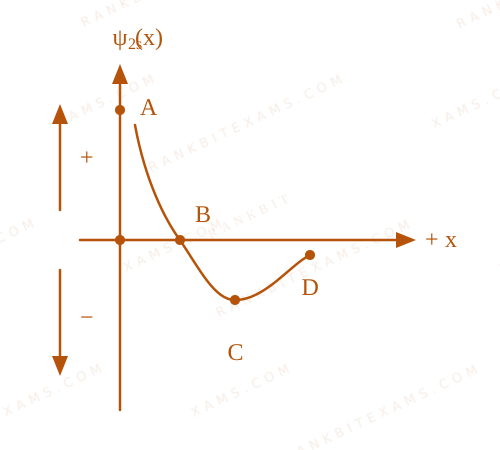
Which one of the following about an electron occupying the 1s orbital in a hydrogen atom is incorrect? (Bohr's radius is represented by a_0)
  • A. textThe probability density of finding the electron is maximum at the nucleus
  • B. textThe electron can be found at a distance 2a_0 text from the nucleus
  • C. textThe 1s orbital is spherically symmetrical
  • D. textThe total energy of the electron is maximum when it is at a distance a_0 text from the nucleus

Solution

### Core Logic Let's evaluate each statement using quantum mechanics: * **Statement (1) is correct:** The wave function squared Psi^2 (probability density) for a 1s orbital peaks directly at the nucleus (r = 0). * **Statement (2) is correct:** The boundary distribution curves drop off exponentially but approach zero only at infinity, meaning the electron has a non-zero probability of being found at any distance, including 2a_0. * **Statement (3) is correct:** All s-orbitals have an angular wave function component of unity, making them perfectly spherical. * **Statement (4) is incorrect:** The total energy of a bound electron in a hydrogen atom is constant for a given principal quantum number quantum state (E = -13.6mathrm~eV when n=1), independent of its spatial distance from the nucleus. ### Pattern Recognition Total energy is a fixed state property defined strictly by the principal quantum number n. It never varies as a function of the electron's position coordinates within that orbital state. ### Evaluation Rubric / Model Answer null ### Chapter Mix Class 11 Chemistry: Structure of Atom
Q43 jee_main_2025_07_april_evening Electronic Configuration and Stability
The extra stability of half-filled subshell is due to: (A) Symmetrical distribution of electrons (B) Smaller coulombic repulsion energy (C) The presence of electrons with the same spin in non-degenerate orbitals (D) Larger exchange energy (E) Relatively smaller shielding of electrons by one another Identify the correct statements
  • A. text(B), (D) and (E) only
  • B. text(A), (B), (D) and (E) only
  • C. text(B), (C) and (D) only
  • D. text(A), (B) and (D) only

Solution

### Related Formula textExchange Energy (E) propto K cdot fracn(n-1)2 where n represents the total count of parallel spin electrons within degenerate electronic levels. ### Core Logic The enhanced quantum and physical stability belonging to half-filled and completely filled subshells is driven by explicit mechanisms: 1. **Symmetrical distribution**: Electrons in a half-filled subshell are distributed uniformly across all degenerate spatial orientations, minimizing structural polarization. 2. **Large Exchange Energy**: Parallel spins maximize the permissible quantum exchanges, dropping potential energy configurations significantly. 3. **Smaller Coulombic Repulsion**: Placing single electrons inside separate degenerate orbitals reduces electron-electron proximity repulsions compared to forced pairing. 4. **Smaller Shielding Effects**: Uniform spatial shells provide less mutual shielding, allowing closer nuclear interactions. ### Step 1: Assessing Validity Options Evaluating statement metrics: - Statements (A), (B), (D), and (E) outline accurate chemical factors. [cite: 1008, 1009, 1010, 1011] - Statement (C) incorrectly claims non-degenerate orbitals; half-filled configurations strictly populate *degenerate* subshell levels (like p_x, p_y, p_z). ### Pattern Recognition Stability markers checklist: Symmetry, exchange energy maximization, and decreased coulombic repulsion are the dominant triad explaining half-filled orbital stability (e.g., textCr: 3d^5 4s^1 or textCu: 3d^10 4s^1 anomalies). ### Evaluation Rubric / Model Answer null ### Chapter Mix Class 11 Chemistry: Structure of Atom
Q29 jee_main_2025_24_jan_evening Bohr Model and Hydrogen Spectrum
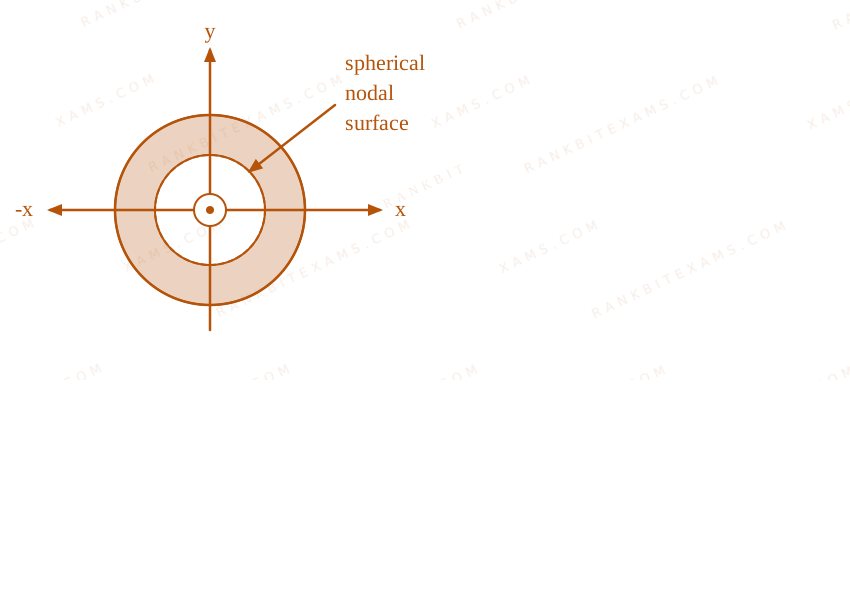
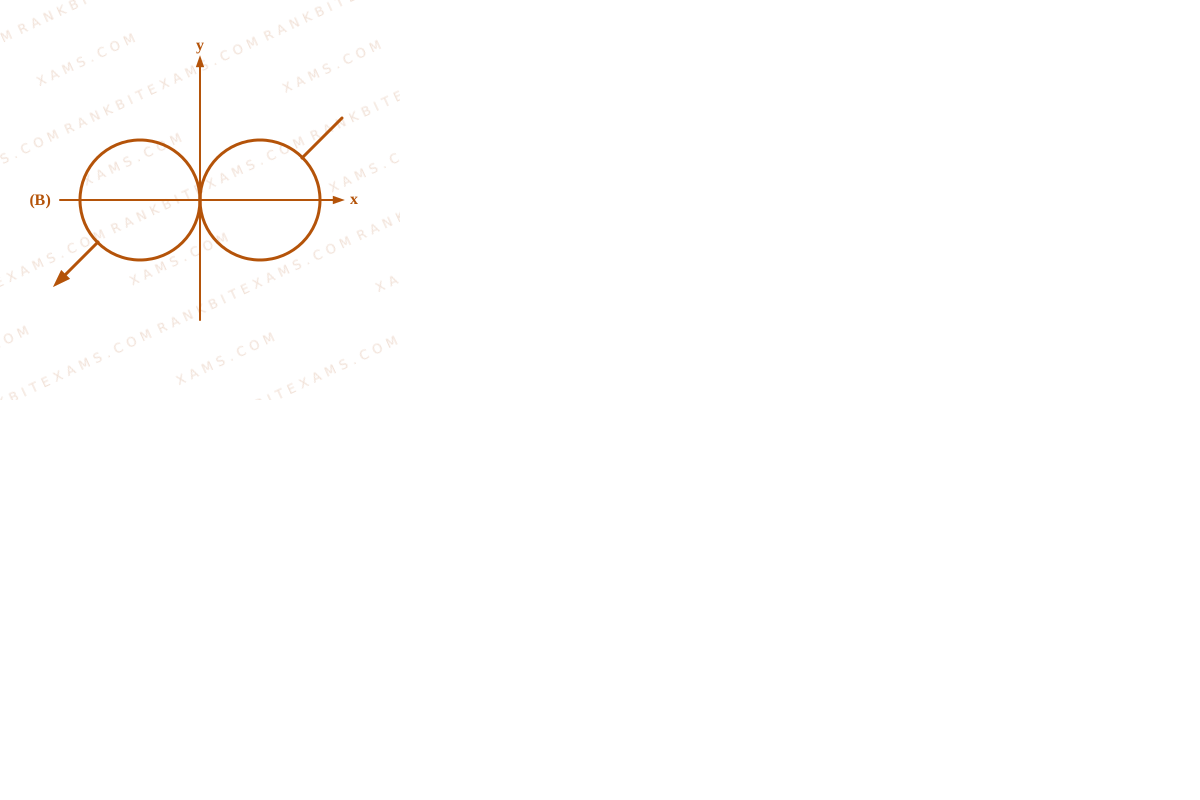
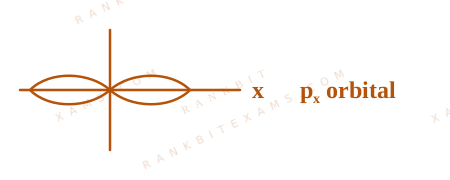
For hydrogen atom, the orbital/s with lowest energy is/are: (A) 4s (B) 3p_x (C) 3d_x^2-y^2 (D) 3d_z^2 (E) 4p_z Choose the correct answer from the options given below :
  • A. \text{(A) and (E) only}
  • B. \text{(B) only}
  • C. \text{(A) only}
  • D. \text{(B), (C) and (D) only}

Solution

### Related Formula For single-electron systems like the hydrogen atom: E_n = -frac13.6 cdot Z^2n^2 text eV where energy depends strictly and solely on the principal quantum number (n). ### Core Logic In multi-electron atoms, orbital energy is governed by the (n+l) rule due to inter-electronic repulsions. However, in single-electron species like Hydrogen, subshells within the same main shell are degenerate (possess identical energy levels). Let's map the principal quantum numbers: * For (A) 4s ightarrow n = 4 * For (B) 3p_x ightarrow n = 3 * For (C) 3d_x^2-y^2 ightarrow n = 3 * For (D) 3d_z^2 ightarrow n = 3 * For (E) 4p_z ightarrow n = 4 Orbitals with n = 3 have lower energy than those with n = 4. Since (B), (C), and (D) all share n = 3, they are degenerate and together represent the lowest energy states among the options provided. ### Pattern Recognition Classic Trap: Do not apply the (n+l) rule for Hydrogen or hydrogen-like single-electron ions (He^+, Li^2+). For these systems, energy is determined purely by the shell index n. ### Evaluation Rubric / Model Answer null ### Chapter Mix Class 11 Chemistry: Structure of Atom
More Structure of Atom Questions — jee_main_2026_21_jan_morning

Practice all Structure of Atom previous-year questions →

Rankbit System
JEE Physics: Waves (+15.5%) | Electrostatics: Concentric Shells (-29.7%) | Modern Physics: Photoelectric Clones (+34.2%) | Mathematics: Definite Integrals (+18.1%) | Chemistry: Coordination Splitting (-11.4%) | JEE Physics: Waves (+15.5%) | Electrostatics: Concentric Shells (-29.7%) | Modern Physics: Photoelectric Clones (+34.2%) | Mathematics: Definite Integrals (+18.1%) | Chemistry: Coordination Splitting (-11.4%)
YOUR FIRST PREP STEP STARTS HERE

We Map Every Repeating Question in Competitive Exams.

Say goodbye to generic mock test fatigue. RankBit uses smart analysis to group past exam questions into their foundational Repeating Question Types. Find chapter weightage, track repeating questions, and score higher with targeted practice.

Select Your Target Exam

Choose an exam track below to find formulas per chapter and patterns.

Syncing Exam Intelligence

Mapping formulas and patterns across all tracks…

PATH A — FULL LENGTH PRACTICE

Full Mock Test Hub

Simulate real NTA exam conditions with fully tracked mocks. Time yourself against past papers.

Now Live Open
PATH B — TARGETED PRACTICE

Topic-wise Practice Hub

Practice past-year questions one chapter at a time. Pick an exam → subject → chapter and get every PYQ for that topic — pulled together from all past papers — with the chapter's key formulas alongside.

Loading Questions... Browse Topics
Latest from the Blog
View all →

Loading articles...
