JEE Main · Chemistry → Steady

Structure of Atom appeared 39 times across 3 years — 4.5% of Chemistry. This question is from Photoelectric Effect.

Year 2026 2025 2024 Total
Questions 14 16 9 39

Which of the following statements are correct, if the threshold frequency of caesium is 5.16 × 10¹⁴ ~Hz ?
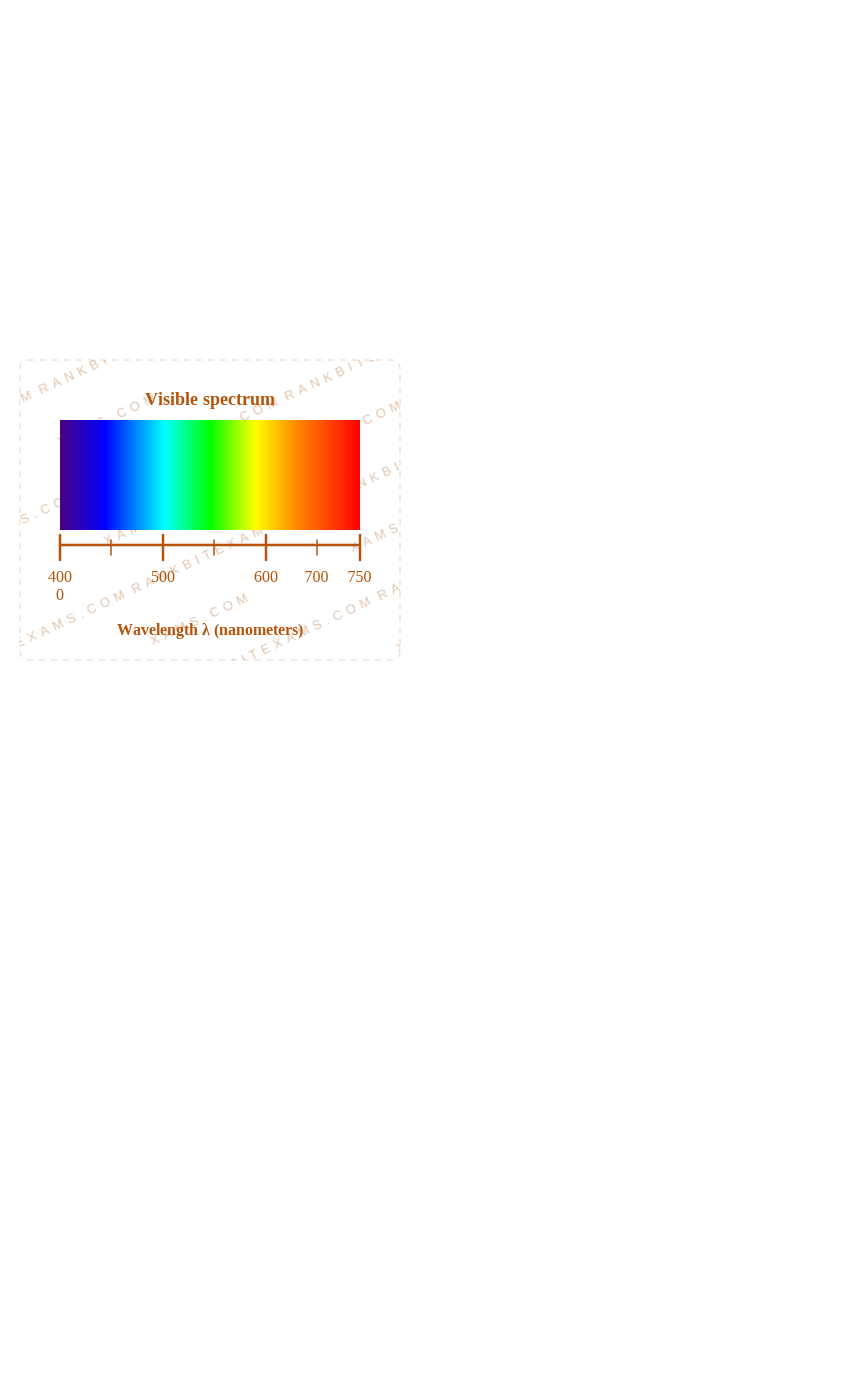
Visible spectrum wavelength diagram for Q32 - JEE Main 2025
The visible spectrum wavelength scale shows the relationship between red, yellow, and blue light frequency thresholds.
A. When Cs is placed inside a vacuum chamber with an ammeter connected to it and yellow light is focused on Cs the ammeter shows the presence of current. B. When the brightness of the yellow light is dimmed, the value of the current in the ammeter is reduced. C. When a red light is used instead of the yellow light, the current produced is higher with respect to the yellow light. D. When a blue light is used, the ammeter shows the formation of current. E. When a white light is used, the ammeter shows formation of current. Choose the correct answer from the options given below:

Solution & Explanation

Related Formula
λ = (c)/(ν)

where, c = 3.0 × 10⁸ m s⁻¹ ν₀ = 5.16 × 10¹⁴ Hz

Core Logic

Let's first calculate the threshold wavelength (λ₀) for Caesium:

λ₀ = 3.0 × 10⁸5.16 × 10¹⁴ ≈ 5.81 × 10⁻⁷ m = 581.4 nm

Comparing this with the visible spectrum:

  • Yellow light (580 nm) corresponds closely to the threshold wavelength. Hence, photoelectric emission occurs (Statement A is correct).
  • The photocurrent is directly proportional to the light intensity (brightness). Reducing brightness decreases the current (Statement B is correct).
  • Red light (620--750 nm) has a lower frequency than the threshold frequency, meaning no current is produced (Statement C is incorrect).
  • Blue light (450--490 nm) has a higher frequency than the threshold. Thus, current is produced (Statement D is correct).
  • White light contains all wavelengths (including blue, violet, etc.), which will produce a photoelectric current (Statement E is correct).
  • Therefore, statements A, B, D, and E are correct.

Pattern Recognition

The wavelength threshold is 581 nm (yellow-green region). Any light with shorter wavelength (higher frequency), like blue or white, will cause emission. Dimming simply decreases photon flux and hence current.

Chapter Mix

Class 11 Chemistry: Structure of Atom Class 12 Physics: Dual Nature of Radiation and Matter

More Structure of Atom Previous-Year Questions

Q70 jee_main_2026_21_jan_morning Hydrogen Spectrum
Given below are two statements: Statement I: When an electric discharge is passed through gaseous hydrogen, the hydrogen molecules dissociate and the energetically excited hydrogen atoms produce electromagnetic radiation of discrete frequencies. Statement II: The frequency of second line of Balmer series obtained from He⁺ is equal to that of first line of Lyman series obtained from hydrogen atom. In the light of the above statements, choose the correct answer from the options given below:
  • A. Both Statement I and Statement II are true
  • B. Both Statement I and Statement II are false
  • C. Statement I is false but Statement II is true
  • D. Statement I is true but Statement II is false

Solution

Related Formula
(1)/(λ) = RZ²((1)/(n₁²) - (1)/(n₂²))
Core Logic

Statement I is a factual description of how the hydrogen emission spectrum is obtained. Dissociation yields excited atoms that emit light at discrete frequencies. So Statement I is true.

For Statement II: First line of Lyman series for H atom (Z=1, n₁=1, n₂=2):

(1)/(λ₁) = R(1)²((1)/(1²) - (1)/(2²)) = R(1 - (1)/(4)) = (3R)/(4)

Second line of Balmer series for He^+ (Z=2, n₁=2, n₂=4):

(1)/(λ₂) = R(2)²((1)/(2²) - (1)/(4²)) = 4R((1)/(4) - (1)/(16)) = 4R((3)/(16)) = (3R)/(4)

Since (1)/(λ₁) = (1)/(λ₂), their wavelengths (and therefore frequencies) are exactly the same. Statement II is true.

Step 1: Final Conclusion

Both statements are correct.

Chapter Mix

Class 11 Chemistry: Structure of Atom

Q51 jee_main_2026_21_jan_evening Hydrogen Spectrum and Energy Levels
Consider the following spectral lines for atomic hydrogen: A. First line of Paschen series B. Second line of Balmer series C. Third line of Paschen series D. Fourth line of Bracket series The correct arrangement of the above lines in ascending order of energy is:
  • A. (1) D < C < A < B
  • B. (2) A < B < C < D
  • C. (3) C < D < B < A
  • D. (4) D < A < C < B

Solution

Related Formula
Δ E = 13.6 Z² ((1)/(n₁²) - (1)/(n₂²)) eV
Core Logic

Let's find the values of n₁ and n₂ for each transition:

  • (A) Paschen (1st line): n₁ = 3, n₂ = 4
  • (B) Balmer (2nd line): n₁ = 2, n₂ = 4
  • (C) Paschen (3rd line): n₁ = 3, n₂ = 6
  • (D) Bracket (4th line): n₁ = 4, n₂ = 8
  • Calculating or comparing the energy values corresponding to these transitions yields the ascending order of energy.

Step 1: Final Conclusion

The correct ascending order of energy of the given lines is D < A < C < B, corresponding to option (4).

Pattern Recognition

Sees: hydrogen spectral lines energy comparison. Trap: Confusing series limits with specific line numbers. Shortcut: Evaluate transition frequencies or wavelength gaps using Rydberg formula equivalents.

Chapter Mix

Class 11 Chemistry: Structure of Atom

Q54 jee_main_2026_22_january_morning Bohr Model Energy Calculations
The energy required by electrons, present in the first Bohr orbit of hydrogen atom to be excited to second Bohr orbit is ____ J mol⁻¹. Given: RH = 2.18 × 10⁻¹¹ ergs.
  • A. 1.635 × 10⁻¹⁸
  • B. 9.835 × 10⁵
  • C. 9.835 × 10¹²
  • D. 1.635 × 10⁻¹¹

Solution

Related Formula
Eₙ = -RH × Z²n² Δ E = RH Z² ( (1)/(n₁²) - (1)/(n₂²) )
Core Logic

Given RH = 2.18 × 10⁻¹¹ ergs. Convert this to Joules: 1 Joule = 10⁷ ergs RH = 2.18 × 10⁻¹⁸ J.

Calculate energy difference per atom:

Δ E = 2.18 × 10⁻¹⁸ × 1² [ 11² - 12² ] Δ E = 2.18 × 10⁻¹⁸ × ( 1 - (1)/(4) ) = 2.18 × 10⁻¹⁸ × (3)/(4) Δ E = 1.635 × 10⁻¹⁸ Joule/atom
Step 1: Conversion to per mole

To find the energy per mole, multiply by Avogadro's number (NA = 6.02 × 10²³):

Δ Emole = 1.635 × 10⁻¹⁸ × 6.02 × 10²³ Joule/mole Δ Emole = 9.84 × 10⁵ Joule/mole ≈ 9.835 × 10⁵ J mol⁻¹
Pattern Recognition

Energy gaps in Hydrogen: 1 arrow 2 transition is exactly (3)/(4) of the ionization energy. Watch out for per atom vs per mole unit traps.

Chapter Mix

Class 11 Chemistry: Structure of Atom

Q64 jee_main_2026_22_january_evening Balmer Series Energy Transitions
The energy of first (lowest) Balmer line of H atom is x J. The energy (in J) of second Balmer line of H atom is:
  • A. x²
  • B. (x)/(1.35)
  • C. 2x
  • D. 1.35x

Solution

Related Formula
Δ E = 13.6 Z² ((1)/(n₁²) - (1)/(n₂²)) eV
Core Logic

Step 1: First Balmer line (n₁ = 2, n₂ = 3):

Δ E₁ = x = 13.6 ((1)/(2²) - (1)/(3²)) = 13.6 ((1)/(4) - (1)/(9)) = 13.6 ((5)/(36))

Step 2: Second Balmer line (n₁ = 2, n₂ = 4):

Δ E₂ = 13.6 ((1)/(2²) - (1)/(4²)) = 13.6 ((1)/(4) - (1)/(16)) = 13.6 ((3)/(16))

Step 3: Ratio of energies:

(Δ E₂)/(x) = ((3)/(16))/((5)/(36)) = (3 × 36)/(16 × 5) = (27)/(20) = 1.35 Δ E₂ = 1.35 x
Pattern Recognition

Sees: Ratio of hydrogen spectrum spectral line energies. Shortcut: (3/16) / (5/36) = 27/20 = 1.35.

Chapter Mix

Class 11 Chemistry: Structure of Atom Class 12 Physics: Atoms

Q51 jee_main_2026_23_january_morning Bohr Model for Hydrogen Like Species
Which of the following statements regarding the energy of the stationary state is true in the following one-electron system?
  • A. -1.09 × 10⁻¹⁸ J for second orbit of H atom.
  • B. +2.18 × 10⁻¹⁸ J for second orbit of He⁺ ion
  • C. +8.72 × 10⁻¹⁸ J for first orbit of He⁺ ion
  • D. -2.18 × 10⁻¹⁸ J for third orbit of Li²⁺ ion

Solution

Related Formula
Eₙ = -2.18 × 10⁻¹⁸ (Z²)/(n²) J/atom
Core Logic

Evaluate the energy of the stationary state for the given species by substituting the atomic number Z and the orbit number n into the energy formula for hydrogen-like species.

Step 1: Calculation for Li2+ Ion

For the 3rd orbit of the Li²⁺ ion, we have Z = 3 (since lithium has 3 protons) and n = 3.

E₃ = -2.18 × 10⁻¹⁸ × (3²)/(3²) E₃ = -2.18 × 10⁻¹⁸ J
Pattern Recognition

When Z = n, the Z²/n² ratio becomes 1, immediately resulting in the ground state energy of a hydrogen atom (-2.18 × 10⁻¹⁸ J). This is a common shortcut for identifying correct energy states.

Chapter Mix

Class 11 Chemistry: Structure of Atom

Rankbit System
JEE Physics: Waves (+15.5%) | Electrostatics: Concentric Shells (-29.7%) | Modern Physics: Photoelectric Clones (+34.2%) | Mathematics: Definite Integrals (+18.1%) | Chemistry: Coordination Splitting (-11.4%) | JEE Physics: Waves (+15.5%) | Electrostatics: Concentric Shells (-29.7%) | Modern Physics: Photoelectric Clones (+34.2%) | Mathematics: Definite Integrals (+18.1%) | Chemistry: Coordination Splitting (-11.4%)