Consider the following reactions: NaCl + K_2Cr_2O_7 + H_2SO_4 rightarrow A + KHSO_4 + NaHSO_4 + H_2O A + NaOH rightarrow B + NaCl + H_2O B + H_2SO_4 + H_2O_2 rightarrow C + Na_2SO_4 + H_2O In the product 'C', 'X' is the number of O_2^2- units, 'Y' is the total number oxygen atoms present and 'Z' is the oxidation state of Cr. The value of X + Y + Z is ____.

Numerical Answer Type:
Enter a numerical value Answer: 13 to 13 +4 marks

Solution & Explanation

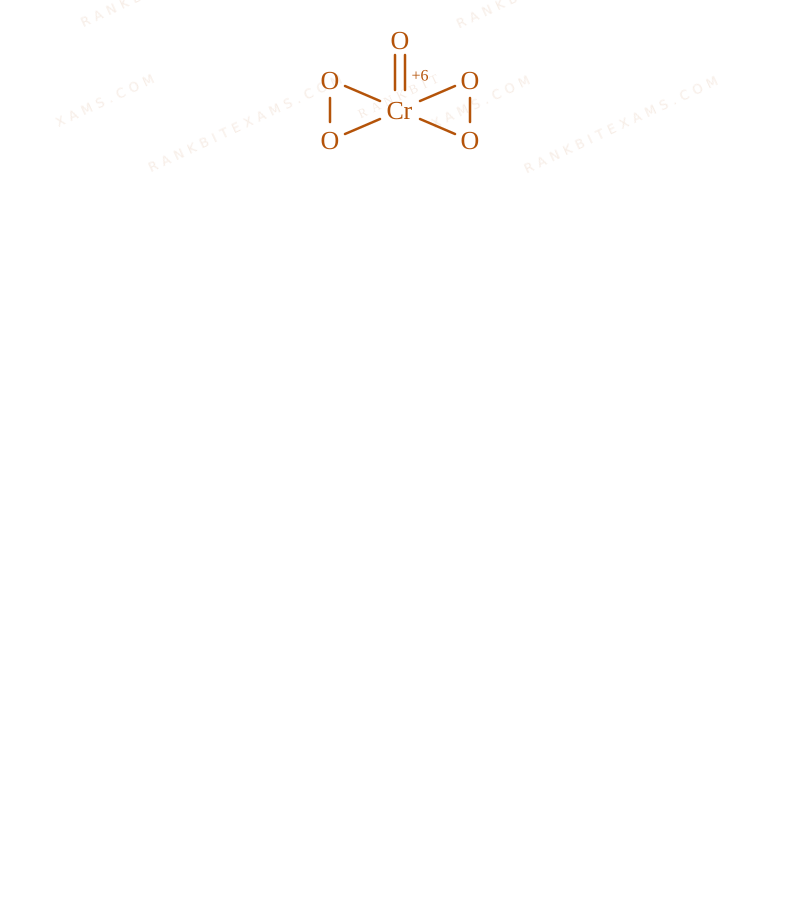
### Core Logic The first reaction is the classical **Chromyl Chloride Test**: 4mathrmNaCl + mathrmK_2Cr_2O_7 + 6mathrmH_2SO_4 rightarrow 2mathrmCrO_2Cl_2 (textA) + 2mathrmKHSO_4 + 4mathrmNaHSO_4 + 3mathrmH_2O Product A is Chromyl chloride (mathrmCrO_2Cl_2), a red-orange gas. When Chromyl chloride gas is passed into NaOH solution, it forms a yellow solution of sodium chromate (B): mathrmCrO_2Cl_2 (textA) + 4mathrmNaOH rightarrow mathrmNa_2CrO_4 (textB) + 2mathrmNaCl + 2mathrmH_2O Acidifying the sodium chromate solution with H_2SO_4 and adding H_2O_2 yields a deep blue solution of Chromium(VI) peroxide, CrO_5 (C): mathrmNa_2CrO_4 (textB) + mathrmH_2SO_4 + 2mathrmH_2O_2 rightarrow mathrmCrO_5 (textC) + mathrmNa_2SO_4 + 3mathrmH_2O Structure of CrO_5:
Chromyl Chloride Test diagram for Q75 - JEE Main 2026 Morning
- It has a butterfly structure. - Number of peroxy units (O_2^2-), X = 2. - Total number of oxygen atoms, Y = 5. - Oxidation state of Cr, Z = +6. Sum: X + Y + Z = 2 + 5 + 6 = 13. ### Step 1: Final Calculation X + Y + Z = 13 ### Pattern Recognition Chromyl chloride test rightarrow CrO_2Cl_2 (red gas). Absorbed in NaOH rightarrow Na_2CrO_4 (yellow). Tested with H_2O_2/H^+ rightarrow CrO_5 (butterfly structure, blue, two peroxy links, Cr in +6). ### Evaluation Rubric / Model Answer null ### Chapter Mix Class 12 Chemistry: d and f Block Elements Class 11 Chemistry: Redox Reactions

Reference Study Guides

More d and f Block Elements Previous-Year Questions — Page 5

Q63 jee_main_2024_01_february_morning Oxidising Properties
In acidic medium, K_2Cr_2O_7 shows oxidising action as represented in the half reaction Cr_2O_7^2- + XH^+ + Ye^- rightarrow 2A + ZH_2O X, Y, Z and A are respectively are:
  • A. 8, 6, 4 text and Cr_2O_3
  • B. 14, 7, 6 text and Cr^3+
  • C. 8, 4, 6 text and Cr_2O_3
  • D. 14, 6, 7 text and Cr^3+

Solution

### Core Logic The balanced half-reaction for the dichromate ion acting as an oxidising agent in an acidic medium is: Cr_2O_7^2- + 14H^+ + 6e^- rightarrow 2Cr^3+ + 7H_2O ### Step 1: Compare with Given Equation Comparing this with the given equation Cr_2O_7^2- + XH^+ + Ye^- rightarrow 2A + ZH_2O: X = 14 Y = 6 Z = 7 A = Cr^3+ ### Pattern Recognition In acidic medium, dichromate (Cr_2O_7^2-) always requires 14H^+ to balance 7O atoms, forming 7H_2O. Chromium reduces from +6 to +3 state, taking 6e^- overall. ### Evaluation Rubric / Model Answer null ### Chapter Mix Class 12 Chemistry: The d-and f-Block Elements Class 11 Chemistry: Redox Reactions
Q73 jee_main_2024_29_january_evening Lanthanoid Oxidation States
Which of the following acts as a strong reducing agent? (Atomic number : Ce = 58, Eu = 63, Gd = 64, Lu = 71)
  • A. mathrmLu^3+
  • B. mathrmGd^3+
  • C. mathrmEu^2+
  • D. mathrmCe^4+

Solution

### Related Formula textElectronic configuration of mathrmEu = [mathrmXe] 4f^7 6s^2 ### Core Logic The most common and stable oxidation state for lanthanoids is +3. In the case of Europium: mathrmEu^2+ = [mathrmXe] 4f^7 This configuration possesses a highly stable half-filled f-subshell. However, because the +3 state is universally favored by thermodynamics in solution, textEu^2+ readily undergoes oxidation to lose one more electron: mathrmEu^2+ rightarrow mathrmEu^3+ + 1e^- By releasing an electron to stabilize into the +3 state, it behaves as a potent reducing agent. ### Step 1: Evaluation Conversely, textCe^4+ acts as a powerful oxidizing agent to return to +3, while textLu^3+ and textGd^3+ are already perfectly configured at their native stable limits. ### Pattern Recognition Europium(II) has a stable half-filled f^7 configuration, yet easily loses an electron to attain the highly stable +3 state typical of lanthanoids, making it a strong reducing agent. ### Evaluation Rubric / Model Answer null ### Chapter Mix Class 12 Chemistry: d and f Block Elements
Q75 jee_main_2024_29_january_evening Properties of Zinc, Cadmium and Mercury
Which of the following statements are correct about Zn, Cd and mathrmHg ? A. They exhibit high enthalpy of atomization as the d-subshell is full. B. Zn and Cd do not show variable oxidation state while Hg shows +mathrmI and +mathrmII. C. Compounds of Zn, Cd and Hg are paramagnetic in nature. D. Zn, Cd and Hg are called soft metals. Choose the most appropriate from the options given below:
  • A. B, D only
  • B. B, C only
  • C. A, D only
  • D. C, D only

Solution

### Related Formula textGeneral configuration of Group 12: (n-1)d^10 ns^2 ### Core Logic Analyzing each statement based on inorganic chemistry principles: * **Statement A is false**: Because their d-subshell is completely full (d^10), these elements do not form strong metallic bonds. As a result, they exhibit the *lowest* enthalpy of atomization in their respective periods. * **Statement B is true**: textZn and textCd show only a stable +2 oxidation state, whereas textHg exhibits variable states forming both +1 (as textHg_2^2+) and +2. * **Statement C is false**: With a fully paired d^10 subshell, their compounds lack unpaired electrons and are explicitly diamagnetic. * **Statement D is true**: Due to weak metallic bonds, these elements have low melting points and are classified as soft metals. ### Step 1: Selection Verification Statements B and D are true, matching choice (1). ### Pattern Recognition Group 12 metals have a full d^10 subshell, leading to exceptionally weak metallic bonding, low enthalpies of atomization, and diamagnetic characteristics. ### Evaluation Rubric / Model Answer null ### Chapter Mix Class 12 Chemistry: d and f Block Elements
Q75 jee_main_2024_27_jan_morning Qualitative Analysis of Lead
Yellow compound of lead chromate gets dissolved on treatment with hot textNaOH solution. The product of lead formed is a :
  • A. Tetraanionic complex with coordination number six
  • B. Neutral complex with coordination number four
  • C. Dianionic complex with coordination number six
  • D. Dianionic complex with coordination number four

Solution

### Related Formula Dissolution reaction pathway: textPbCrO_4 + 4textNaOH (hot excess) rightarrow textNa_2[textPb(OH)_4] + textNa_2textCrO_4 ### Core Logic The reaction yields sodium tetrahydroxoplumbate(II), [textPb(OH)_4]^2-. The charge of the complex species is -2 (dianionic), and it binds 4 hydroxo coordination ligands, matching a coordination number of four. ### Chapter Mix Class 12 Chemistry: d-and f-Block Elements Class 12 Chemistry: Coordination Compounds
Q78 jee_main_2024_27_jan_morning Chromyl Chloride Test
textNaCl reacts with conc. H_2SO_4 and K_2Cr_2O_7 to give reddish fumes (B), which react with textNaOH to give yellow solution (C). (B) and (C) respectively are;
  • A. CrO_2Cl_2, Na_2CrO_4
  • B. Na_2CrO_4, CrO_2Cl_2
  • C. CrO_2Cl_2, KHSO_4
  • D. CrO_2Cl_2, Na_2Cr_2O_7

Solution

### Step 1: Production of Reddish Fumes 4textNaCl + textK_2textCr_2textO_7 + 6textH_2textSO_4 rightarrow 2textCrO_2textCl_2uparrow + 2textKHSO_4 + 4textNaHSO_4 + 3textH_2textO Reddish brown vapors (B) are chromyl chloride (CrO_2Cl_2). ### Step 2: Conversion to Yellow Solution textCrO_2textCl_2 + 4textNaOH rightarrow textNa_2textCrO_4 + 2textNaCl + 2textH_2textO Yellow solution (C) corresponds to sodium chromate (Na_2CrO_4). ### Pattern Recognition Chloride detection signature: textCl^- rightarrow textCrO_2textCl_2text (red-brown) rightarrow textNa_2textCrO_4text (yellow chromate). ### Chapter Mix Class 12 Chemistry: d-and f-Block Elements

More d and f Block Elements Questions — jee_main_2026_21_jan_morning

Practice all d and f Block Elements previous-year questions →

Rankbit System
JEE Physics: Waves (+15.5%) | Electrostatics: Concentric Shells (-29.7%) | Modern Physics: Photoelectric Clones (+34.2%) | Mathematics: Definite Integrals (+18.1%) | Chemistry: Coordination Splitting (-11.4%) | JEE Physics: Waves (+15.5%) | Electrostatics: Concentric Shells (-29.7%) | Modern Physics: Photoelectric Clones (+34.2%) | Mathematics: Definite Integrals (+18.1%) | Chemistry: Coordination Splitting (-11.4%)
YOUR FIRST PREP STEP STARTS HERE

We Map Every Repeating Question in Competitive Exams.

Say goodbye to generic mock test fatigue. RankBit uses smart analysis to group past exam questions into their foundational Repeating Question Types. Find chapter weightage, track repeating questions, and score higher with targeted practice.

Select Your Target Exam

Choose an exam track below to find formulas per chapter and patterns.

Syncing Exam Intelligence

Mapping formulas and patterns across all tracks…

PATH A — FULL LENGTH PRACTICE

Full Mock Test Hub

Simulate real NTA exam conditions with fully tracked mocks. Time yourself against past papers.

Now Live Open
PATH B — TARGETED PRACTICE

Topic-wise Practice Hub

Practice past-year questions one chapter at a time. Pick an exam → subject → chapter and get every PYQ for that topic — pulled together from all past papers — with the chapter's key formulas alongside.

Loading Questions... Browse Topics
Latest from the Blog
View all →

Loading articles...
