Consider the following reactions: NaCl + K_2Cr_2O_7 + H_2SO_4 rightarrow A + KHSO_4 + NaHSO_4 + H_2O A + NaOH rightarrow B + NaCl + H_2O B + H_2SO_4 + H_2O_2 rightarrow C + Na_2SO_4 + H_2O In the product 'C', 'X' is the number of O_2^2- units, 'Y' is the total number oxygen atoms present and 'Z' is the oxidation state of Cr. The value of X + Y + Z is ____.

Numerical Answer Type:
Enter a numerical value Answer: 13 to 13 +4 marks

Solution & Explanation

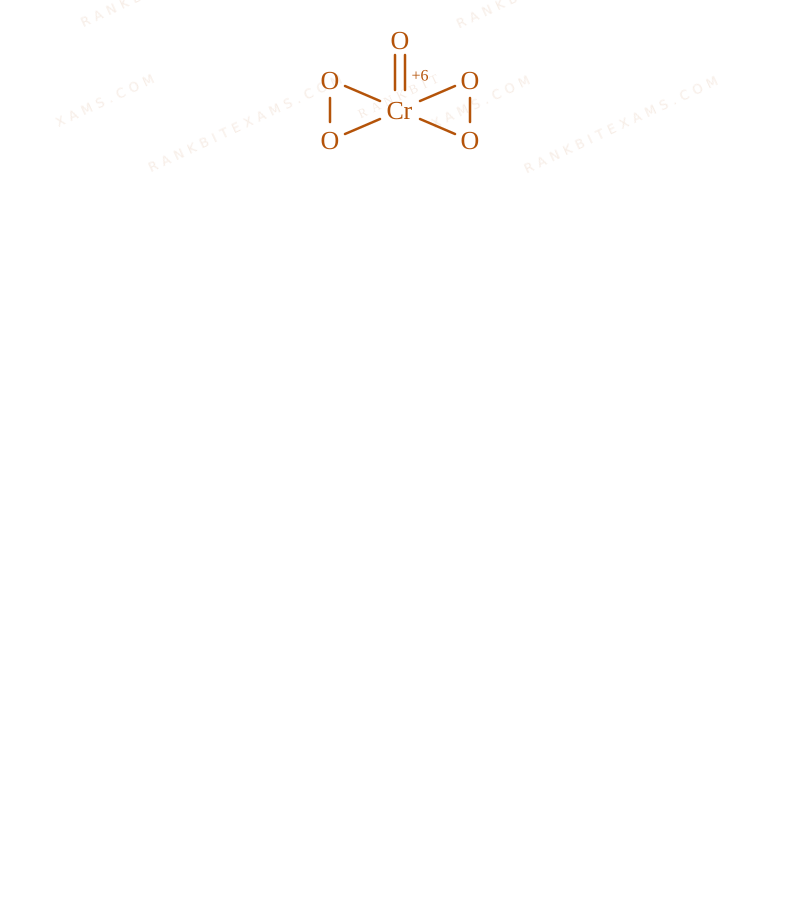
### Core Logic The first reaction is the classical **Chromyl Chloride Test**: 4mathrmNaCl + mathrmK_2Cr_2O_7 + 6mathrmH_2SO_4 rightarrow 2mathrmCrO_2Cl_2 (textA) + 2mathrmKHSO_4 + 4mathrmNaHSO_4 + 3mathrmH_2O Product A is Chromyl chloride (mathrmCrO_2Cl_2), a red-orange gas. When Chromyl chloride gas is passed into NaOH solution, it forms a yellow solution of sodium chromate (B): mathrmCrO_2Cl_2 (textA) + 4mathrmNaOH rightarrow mathrmNa_2CrO_4 (textB) + 2mathrmNaCl + 2mathrmH_2O Acidifying the sodium chromate solution with H_2SO_4 and adding H_2O_2 yields a deep blue solution of Chromium(VI) peroxide, CrO_5 (C): mathrmNa_2CrO_4 (textB) + mathrmH_2SO_4 + 2mathrmH_2O_2 rightarrow mathrmCrO_5 (textC) + mathrmNa_2SO_4 + 3mathrmH_2O Structure of CrO_5:
Chromyl Chloride Test diagram for Q75 - JEE Main 2026 Morning
- It has a butterfly structure. - Number of peroxy units (O_2^2-), X = 2. - Total number of oxygen atoms, Y = 5. - Oxidation state of Cr, Z = +6. Sum: X + Y + Z = 2 + 5 + 6 = 13. ### Step 1: Final Calculation X + Y + Z = 13 ### Pattern Recognition Chromyl chloride test rightarrow CrO_2Cl_2 (red gas). Absorbed in NaOH rightarrow Na_2CrO_4 (yellow). Tested with H_2O_2/H^+ rightarrow CrO_5 (butterfly structure, blue, two peroxy links, Cr in +6). ### Evaluation Rubric / Model Answer null ### Chapter Mix Class 12 Chemistry: d and f Block Elements Class 11 Chemistry: Redox Reactions

Reference Study Guides

More d and f Block Elements Previous-Year Questions — Page 4

Q37 jee_main_2025_24_jan_morning Preparation and Properties of Potassium Permanganate
Preparation of potassium permanganate from mathrmMnO_2 involves two step process in which the 1^textst step is a reaction with KOH and mathrmKNO_3 to produce
  • A. mathrmK_4[mathrmMn(mathrmOH)_6]
  • B. mathrmK_3mathrmMnO_4
  • C. mathrmKMnO_4
  • D. mathrmK_2mathrmMnO_4

Solution

### Related Formula 2MnO_2 + 4KOH + O_2 xrightarrowKNO_3 2K_2MnO_4 + 2H_2O ### Core Logic The standard preparation of potassium permanganate begins with the oxidative fusion of pyrolusite ore (MnO_2). Fusing the solid reactant directly along an alkaline base payload (KOH) combined explicitly with an oxidizing carrier (KNO_3) yields the intermediate green product, **potassium manganate** (K_2MnO_4). ### Pattern Recognition Step 1 yields the +6 green compound (K_2MnO_4); the subsequent Step 2 steps oxidize this intermediate to synthesize the target deep purple +7 agent (KMnO_4). ### Evaluation Rubric / Model Answer null ### Chapter Mix Class 12 Chemistry: The d-and f-Block Elements

Q27 jee_main_2025_28_jan_evening Oxides and Oxoanions of Transition Metals
The amphoteric oxide among V_2O_3, V_2O_4 and V_2O_5 upon reaction with alkali leads to formation of an oxide anion. The oxidation state of V in the oxide anion is :
  • A. +3
  • B. +7
  • C. +5
  • D. +4

Solution

### Related Formula Oxidation state equation for an oxoanion VO_4^3-: x + 4(-2) = -3 ### Core Logic Among the given oxides of Vanadium: - V_2O_3 is basic. - V_2O_4 is less basic / amphoteric. - V_2O_5 is predominantly amphoteric (reacts with both acids and alkalies). When V_2O_5 reacts with an alkali, it forms the orthovanadate ion (VO_4^3-). ### Step 1: Finding the Oxidation State In VO_4^3- ion: x - 8 = -3 implies x = +5 Thus, the oxidation state of Vanadium in the resulting oxide anion is +5. ### Pattern Recognition As the oxidation state of a transition metal increases, its oxide shifts from basic to amphoteric to acidic. V_2O_5 has the highest oxidation state (+5) here and dissolves in alkali to retain its +5 oxidation state in VO_4^3-. ### Evaluation Rubric / Model Answer null ### Chapter Mix Class 12 Chemistry: d- and f-Block Elements
Q46 jee_main_2025_28_jan_evening Magnetic Properties and Oxidation States
The spin only magnetic moment (mu) value (B.M.) of the compound with strongest oxidising power among Mn_2O_3, TiO and VO is ______ B.M. (Nearest integer).
Numerical Answer. Answer: 5 to 5

Solution

### Related Formula Spin-only magnetic moment expression: mu = sqrtn(n+2)mathrm\ B.M. ### Core Logic Evaluating the oxidation states and stability profiles: - In TiO: Ti^2+ - In VO: V^2+ - In Mn_2O_3: Mn^3+ Mn^3+ possesses a very high reduction potential (E^circ_Mn^3+/Mn^2+ = +1.57mathrm\ V), making it an exceptionally strong oxidizing agent because it easily gains an electron to form stable Mn^2+ (d^5 configuration). ### Step 1: Calculate the Magnetic Moment of Mn(III) Electronic configuration of Mn^3+: Mn^3+ = [Ar]3d^4 implies n = 4text unpaired electrons Calculating the spin-only magnetic moment: mu = sqrt4(4+2) = sqrt24 approx 4.89mathrm\ B.M. ### Step 2: Rounding to Nearest Integer Rounding 4.89mathrm\ B.M. to the nearest integer gives 5. ### Pattern Recognition High reduction potentials are strongly tied to manganese in its +3 oxidation state. To quickly estimate magnetic moments, remember that a system with n unpaired electrons always results in a value of 'n.textsomething' B.M. Thus, 4 unpaired electrons rightarrow 4.89mathrm\ B.M., which rounds up to 5. ### Evaluation Rubric / Model Answer null ### Chapter Mix Class 12 Chemistry: d- and f-Block Elements
Q jee_main_2025_29_jan_morning Melting Points of Transition Elements
The correct option with order of melting points of the pairs (Mn, Fe), (Tc, Ru) and (Re, Os) is :
  • A. mathrmFe < mathrmMn , mathrmRu < mathrmTc and mathrmRe < mathrmOs
  • B. mathrmMn < mathrmFe, mathrmTc < mathrmRu and mathrmRe < mathrmOs
  • C. mathrmMn < mathrmFe, mathrmTc < mathrmRu and mathrmOs < mathrmRe
  • D. mathrmFe < mathrmMn , mathrmRu < mathrmTc and mathrmOs < mathrmRe

Solution

### Formulas Used Melting point trends in 3d, 4d, and 5d series transition metals depend on the extent of metallic bonding and d-electron participation. ### Core Logic According to NCERT transition element periodic trends: * **3d Series (mathrmMn vs mathrmFe)**: Manganese (mathrmMn, 3d^5 4s^2) has an abnormally low melting point compared to Iron (mathrmFe, 3d^6 4s^2) because its stable, half-filled d^5 configuration holds d-electrons more tightly, reducing their participation in metallic bonding rightarrow mathbfmathrmMn < mathrmFe. * **4d Series (mathrmTc vs mathrmRu)**: Technetium (mathrmTc, 4d^5 5s^2) similarly shows a dip in melting point compared to Ruthenium (mathrmRu, 4d^7 5s^1) due to the stable 4d^5 configuration rightarrow mathbfmathrmTc < mathrmRu. * **5d Series (mathrmRe vs mathrmOs)**: Rhenium (mathrmRe, 5d^5 6s^2) has optimal interatomic interaction and a higher melting point than Osmium (mathrmOs, 5d^6 6s^2) rightarrow mathbfmathrmOs < mathrmRe. Combining these trends yields: **mathrmMn < mathrmFe, mathrmTc < mathrmRu, and mathrmOs < mathrmRe** ### Pattern Recognition Stable half-filled d^5 configurations in 3d (mathrmMn) and 4d (mathrmTc) restrict d-electron delocalization, creating characteristic dips in melting point curves compared to adjacent metals. **Correct Option:** **(C)**
Q jee_main_2025_29_jan_morning Preparation and Properties of Potassium Dichromate
The molar mass of the water insoluble product formed from the fusion of chromite ore mathrm(FeCr_2O_4) with mathrmNa_2mathrmCO_3 in presence of mathrmO_2 is ________ mathrmg \, mol^-1.
Numerical Answer. Answer: 160 to 160

Solution

### Related Formula textBalanced fusion reaction process description ### Core Logic Write the balanced chemical equation for the industrial preparation stage of chromate salts: 4mathrmFeCr_2O_4 + 8mathrmNa_2CO_3 + 7mathrmO_2 rightarrow 8mathrmNa_2CrO_4 + 2mathrmFe_2O_3 + 8mathrmCO_2 Evaluating the solubilities of the products: * mathrmNa_2CrO_4 is highly soluble in water. * mathrmFe_2O_3 (Iron(III) oxide) is water-insoluble. Molar Mass of mathrmFe_2O_3: M = (2 cdot 55.85) + (3 cdot 16.0) simeq (2 cdot 56) + (3 cdot 16) = 112 + 48 = 160 mathrm~g/mol ### Pattern Recognition Transition metal oxides in high oxidation states with minimal ionic breakdown parameters reliably act as insoluble precipitates in water. ### Chapter Mix Class 12 Chemistry: The d-and f-Block Elements

More d and f Block Elements Questions — jee_main_2026_21_jan_morning

Practice all d and f Block Elements previous-year questions →

Rankbit System
JEE Physics: Waves (+15.5%) | Electrostatics: Concentric Shells (-29.7%) | Modern Physics: Photoelectric Clones (+34.2%) | Mathematics: Definite Integrals (+18.1%) | Chemistry: Coordination Splitting (-11.4%) | JEE Physics: Waves (+15.5%) | Electrostatics: Concentric Shells (-29.7%) | Modern Physics: Photoelectric Clones (+34.2%) | Mathematics: Definite Integrals (+18.1%) | Chemistry: Coordination Splitting (-11.4%)
YOUR FIRST PREP STEP STARTS HERE

We Map Every Repeating Question in Competitive Exams.

Say goodbye to generic mock test fatigue. RankBit uses smart analysis to group past exam questions into their foundational Repeating Question Types. Find chapter weightage, track repeating questions, and score higher with targeted practice.

Select Your Target Exam

Choose an exam track below to find formulas per chapter and patterns.

Syncing Exam Intelligence

Mapping formulas and patterns across all tracks…

PATH A — FULL LENGTH PRACTICE

Full Mock Test Hub

Simulate real NTA exam conditions with fully tracked mocks. Time yourself against past papers.

Now Live Open
PATH B — TARGETED PRACTICE

Topic-wise Practice Hub

Practice past-year questions one chapter at a time. Pick an exam → subject → chapter and get every PYQ for that topic — pulled together from all past papers — with the chapter's key formulas alongside.

Loading Questions... Browse Topics
Latest from the Blog
View all →

Loading articles...