Solution
Core Logic
The first reaction is the classical Chromyl Chloride Test: 4NaCl + K₂Cr₂O₇ + 6H₂SO₄ arrow 2CrO₂Cl₂ (A) + 2KHSO₄ + 4NaHSO₄ + 3H₂O Product A is Chromyl chloride (CrO₂Cl₂), a red-orange gas.
When Chromyl chloride gas is passed into NaOH solution, it forms a yellow solution of sodium chromate (B): CrO₂Cl₂ (A) + 4NaOH arrow Na₂CrO₄ (B) + 2NaCl + 2H₂O
Acidifying the sodium chromate solution with H₂SO₄ and adding H₂O₂ yields a deep blue solution of Chromium(VI) peroxide, CrO₅ (C): Na₂CrO₄ (B) + H₂SO₄ + 2H₂O₂ arrow CrO₅ (C) + Na₂SO₄ + 3H₂O
Structure of CrO₅:
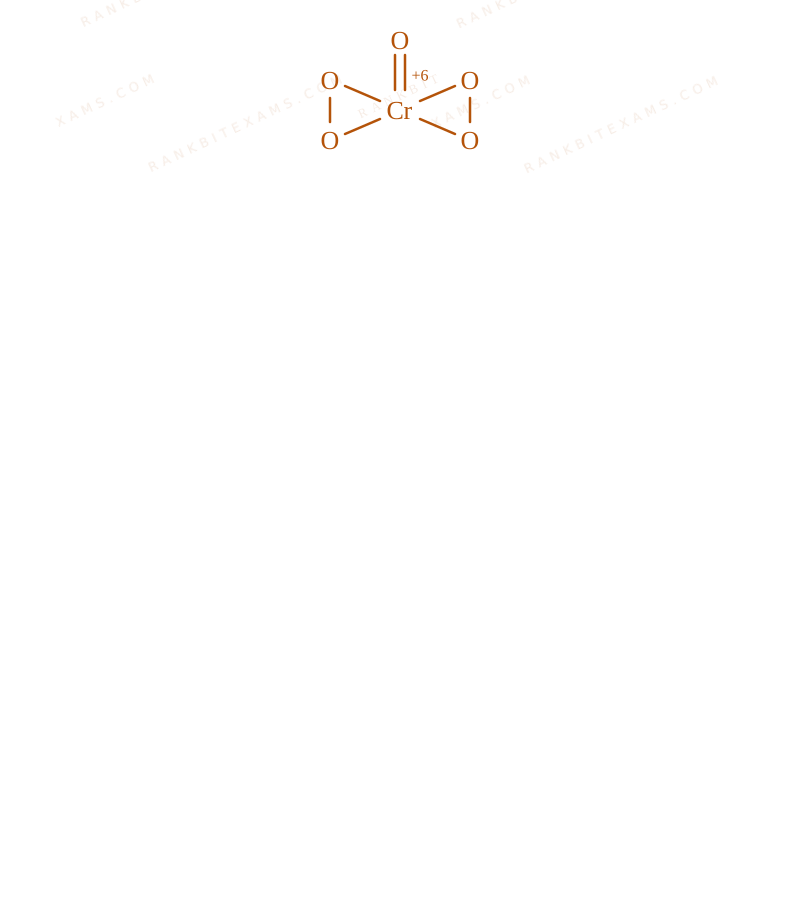
- It has a butterfly structure.
- Number of peroxy units (O₂²⁻), X = 2.
- Total number of oxygen atoms, Y = 5.
- Oxidation state of Cr, Z = +6.
Sum: X + Y + Z = 2 + 5 + 6 = 13.
Step 1: Final Calculation
X + Y + Z = 13
Pattern Recognition
Chromyl chloride test arrow CrO₂Cl₂ (red gas). Absorbed in NaOH arrow Na₂CrO₄ (yellow). Tested with H₂O₂/H^+ arrow CrO₅ (butterfly structure, blue, two peroxy links, Cr in +6).
Chapter Mix
Class 12 Chemistry: d and f Block Elements Class 11 Chemistry: Redox Reactions
