Related Formula
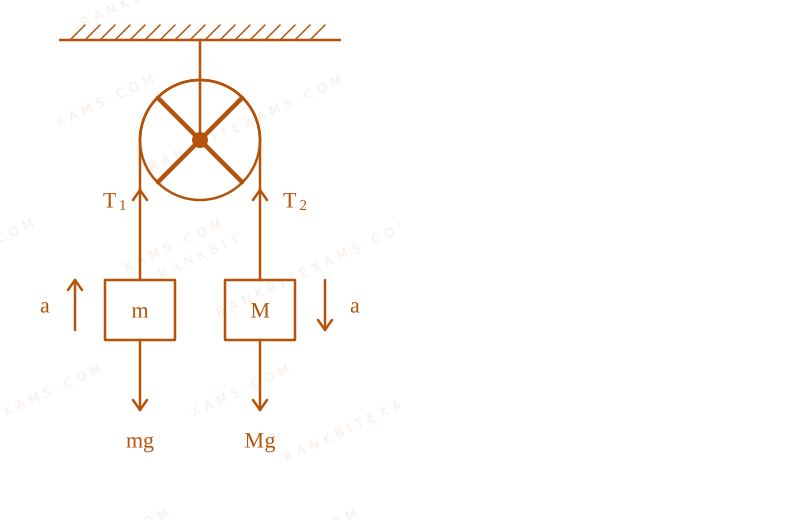
Mg - T₂ = Ma$Mg - T_2 = Ma$
T₁ - mg = ma$T_1 - mg = ma$
(T₂ - T₁)r = I α = I ((a)/(r))$$(T_2 - T_1)r = I \alpha = I \left(\frac{a}{r}\right)$$
Core Logic
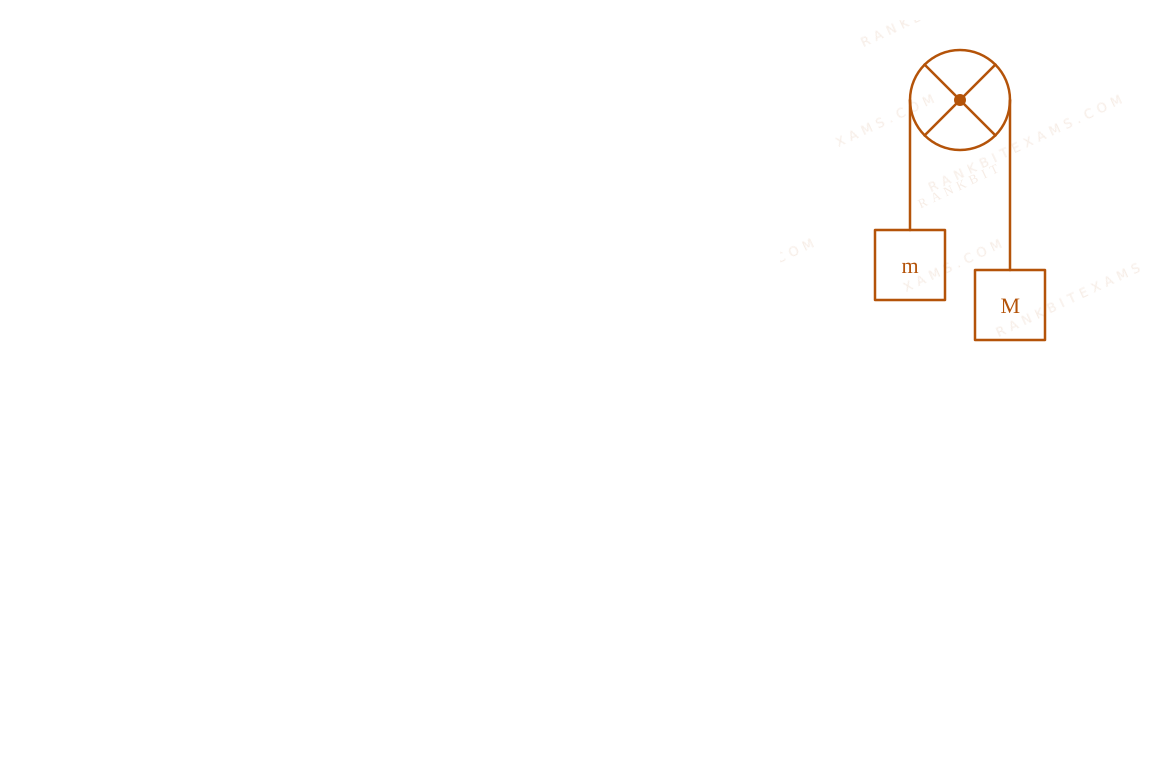
First, evaluate the moment of inertia of the pulley. The pulley consists of:
- A thin rim of mass M$M$ and radius r$r$.
- Two rods, each of mass M$M$ and length 2r$2r$ (diameter).
Moment of inertia of the rim: Irim = Mr²$I_{\text{rim}} = Mr^2$
Moment of inertia of two rods about the center: Irods = 2 × ((M(2r)²)/(12)) = 2 × (4Mr²)/(12) = (2)/(3)Mr²$I_{\text{rods}} = 2 \times \left(\frac{M(2r)^2}{12}\right) = 2 \times \frac{4Mr^2}{12} = \frac{2}{3}Mr^2$
Total I = Mr² + (2)/(3)Mr² = (5)/(3)Mr²$I = Mr^2 + \frac{2}{3}Mr^2 = \frac{5}{3}Mr^2$
Step 1: Force Equations
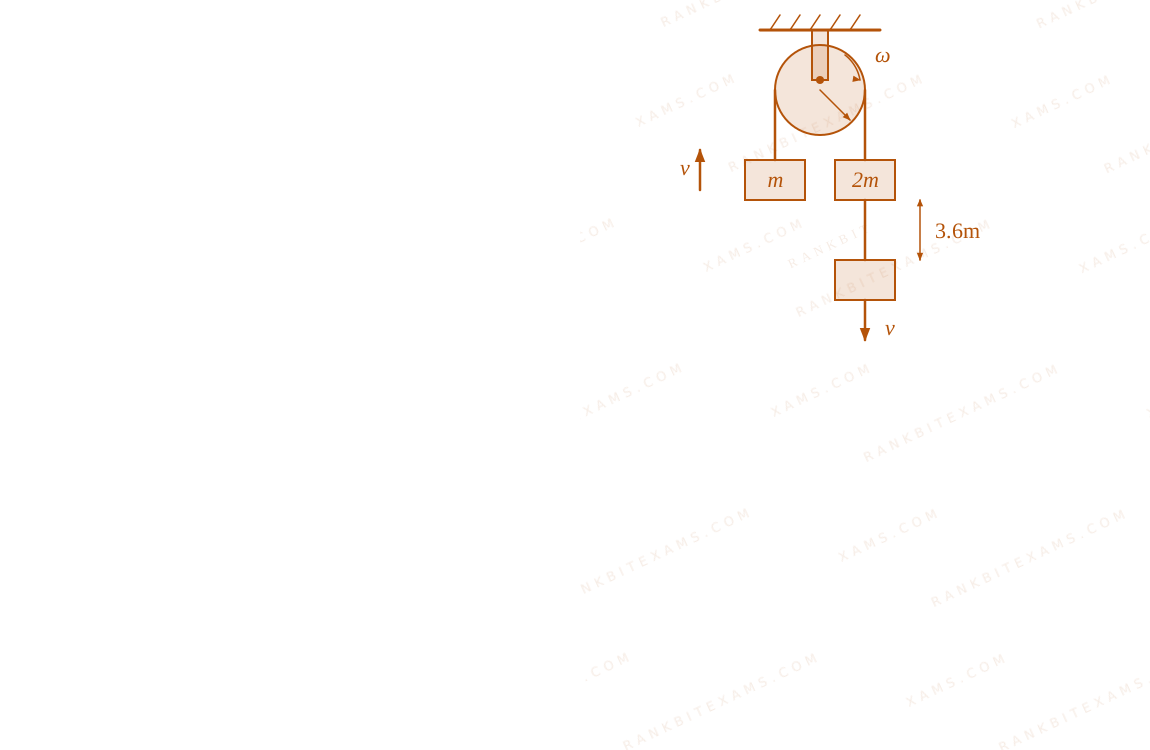
From the free body diagrams of the descending block (mass M$M$) and ascending block (mass m$m$):
Mg - T₂ = Ma --- (1)$$Mg - T_2 = Ma \quad \text{--- (1)}$$
T₁ - mg = ma --- (2)$$T_1 - mg = ma \quad \text{--- (2)}$$
Torque on the pulley:
(T₂ - T₁)r = Iα = I(a)/(r) T₂ - T₁ = (I)/(r²)a --- (3)$$(T_2 - T_1)r = I\alpha = I\frac{a}{r} \implies T_2 - T_1 = \frac{I}{r^2}a \quad \text{--- (3)}$$
Step 2: Final Conclusion
Adding equations (1), (2), and (3):
Mg - mg = (M + m + (I)/(r²))a$$Mg - mg = \left(M + m + \frac{I}{r^2}\right)a$$
Substitute I = (5)/(3)Mr²$I = \frac{5}{3}Mr^2$:
(M - m)g = (M + m + (5M)/(3))a$$(M - m)g = \left(M + m + \frac{5M}{3}\right)a$$
(M - m)g = ((8M)/(3) + m)a$$(M - m)g = \left(\frac{8M}{3} + m\right)a$$
a = ((M-m)g)/([((8)/(3))M + m])$$a = \frac{(M-m)g}{\left[\left(\frac{8}{3}\right)M + m\right]}$$
Pattern Recognition
For a real pulley system, the effective mass acting against acceleration incorporates an inertia term: meff = m₁ + m₂ + (I)/(R²)$m_{\text{eff}} = m_1 + m_2 + \frac{I}{R^2}$. Breaking the complex pulley into fundamental shapes (ring + rods) solves the inertia safely.
Chapter Mix
Class 11 Physics: Systems of Particles and Rotational Motion
Class 11 Physics: Laws of Motion