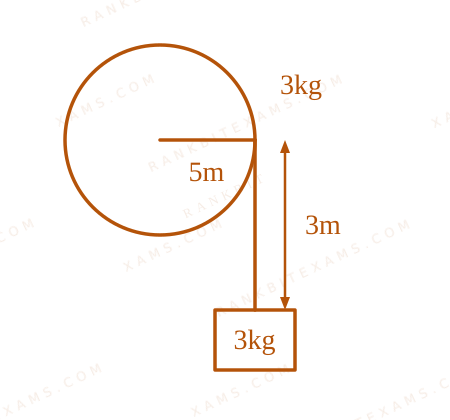
A fly wheel having mass 3 text kg and radius 5 text m is free to rotate about a horizontal axis. A string having negligible mass is wound around the wheel and the loose end of the string is connected to a 3 text kg mass. The mass is kept at rest initially and released. Kinetic energy of the wheel when the mass descends by 3 text m is ____ J. (g = 10 text m/s^2 )

Numerical Answer Type:
Enter a numerical value Answer: 30 to 30 +4 marks

Solution & Explanation

### Related Formula Delta K.E. + Delta P.E. = 0 K_textwheel = frac12 I omega^2 I_textdisc = fracm R^22 ### Core Logic
Solution for Rotation about Fixed Axis
By conservation of mechanical energy, the loss in gravitational potential energy of the descending mass equals the gain in kinetic energy of the block and the rotational kinetic energy of the flywheel. mg h = frac12 I omega^2 + frac12 m v^2 ### Step 1: Relate Velocity and Angular Velocity Since the string does not slip, the linear velocity v of the mass is related to the angular velocity omega of the wheel by: v = omega R Rightarrow omega = fracvR ### Step 2: Energy Conservation The flywheel is treated as a solid disc/cylinder (from the I = mR^2/2 usage in the solution): mg h = frac12 left(fracM R^22right) omega^2 + frac12 m v^2 Given M = 3 text kg (wheel), m = 3 text kg (block), h = 3 text m. Notice that the solution text specifies the flywheel mass as m and block mass also as m, both being 3text kg. Let's follow the PDF exactly: mg times 3 = frac12 left(fracm R^22right) omega^2 + frac12 m v^2 ### Step 3: Solve for Velocity Squared Substitute omega R = v: mg times 3 = frac14 m v^2 + frac12 m v^2 3mg = frac34 m v^2 v^2 = 4g = 4 times 10 = 40 text (m/s)^2 ### Step 4: Calculate Kinetic Energy of Flywheel K.E._textwheel = frac12 I omega^2 = frac14 m v^2 K.E._textwheel = frac14 times 3 times 40 = 30 text J ### Pattern Recognition For a mass pulling a wheel of identical mass (disc), the total K.E. is split between translational (1/2 mv^2) and rotational (1/4 mv^2). Rotational gets exactly 1/3 of the total potential energy lost, 30text J out of 90text J total. ### Evaluation Rubric / Model Answer null ### Chapter Mix Class 11 Physics: Systems of Particles and Rotational Motion Class 11 Physics: Work, Energy and Power

Reference Study Guides

More Systems of Particles and Rotational Motion Previous-Year Questions

Q31 jee_main_2026_21_jan_evening Angular Momentum
Two cars A and B each of mass 10^3 text kg are moving on parallel tracks separated by a distance of 10 text m, in same direction with speeds 72 text km/h and 36 text km/h. The magnitude of angular momentum of car A with respect to car B is ________ textJcdottexts.
  • A. 3.6 times 10^5
  • B. 10^5
  • C. 3 times 10^5
  • D. 2 times 10^5

Solution

### Related Formula L_textrel = m cdot V_textrel cdot r_perp ### Core Logic The relative angular momentum of a particle translating uniformly with respect to another moving reference frame can be found using their relative velocity and the perpendicular distance between their lines of motion. Relative velocity of A with respect to B: V_textrel = V_A - V_B = 72 - 36 = 36 text km/h ### Step 1: Conversion to SI units V_textrel = 36 times frac518 text m/s = 10 text m/s ### Step 2: Final Conclusion Using the perpendicular distance (r_perp = 10 text m) and mass (m = 10^3 text kg): L = m cdot V_textrel cdot r_perp L = 1000 times 10 times 10 = 10^5 text kg m^2text/s text (or Jcdottexts) ### Pattern Recognition For parallel tracks, the angular momentum of one translating body relative to another is simply m times v_textrelative times texttrack separation. ### Evaluation Rubric / Model Answer null ### Chapter Mix Class 11 Physics: Systems of Particles and Rotational Motion Class 11 Physics: Kinematics
Q32 jee_main_2026_21_jan_evening Rotational Dynamics
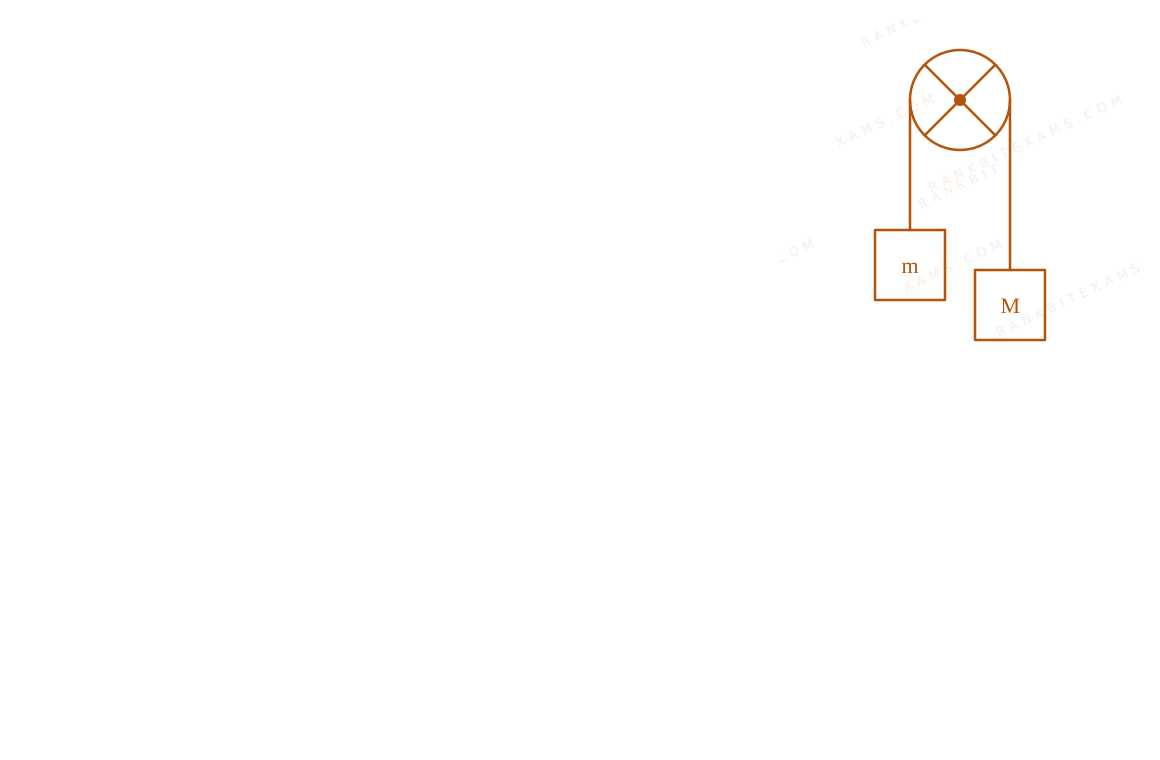
The pulley shown in figure is made using a thin rim and two rods of length equal to diameter of the rim. The rim and each rod have a mass of M. Two blocks of mass of M and m are attached to two ends of a light string passing over the pulley, which is hinged to rotate freely in vertical plane about its centre. The magnitudes of the acceleration experienced by the blocks is ________ (assume no slipping of string on pulley.)
Pulley dynamics diagram for Q32 - JEE Main 2026 Evening
Pulley system with a thin rim and two crossed rods supporting masses M and m.
  • A. frac(M-m)gleft[left(frac136right)M+mright]
  • B. frac(M-m)gM+m
  • C. frac(M-m)gleft[left(frac83right)M+mright]
  • D. frac(M-m)g2M+m

Solution

### Related Formula Mg - T_2 = Ma T_1 - mg = ma (T_2 - T_1)r = I alpha = I left(fracarright) ### Core Logic First, evaluate the moment of inertia of the pulley. The pulley consists of: 1. A thin rim of mass M and radius r. 2. Two rods, each of mass M and length 2r (diameter). Moment of inertia of the rim: I_textrim = Mr^2 Moment of inertia of two rods about the center: I_textrods = 2 times left(fracM(2r)^212right) = 2 times frac4Mr^212 = frac23Mr^2 Total I = Mr^2 + frac23Mr^2 = frac53Mr^2 ### Step 1: Force Equations From the free body diagrams of the descending block (mass M) and ascending block (mass m): Mg - T_2 = Ma quad text--- (1) T_1 - mg = ma quad text--- (2) Torque on the pulley: (T_2 - T_1)r = Ialpha = Ifracar implies T_2 - T_1 = fracIr^2a quad text--- (3) ### Step 2: Final Conclusion Adding equations (1), (2), and (3): Mg - mg = left(M + m + fracIr^2right)a Substitute I = frac53Mr^2: (M - m)g = left(M + m + frac5M3right)a (M - m)g = left(frac8M3 + mright)a a = frac(M-m)gleft[left(frac83right)M + mright] ### Pattern Recognition For a real pulley system, the effective mass acting against acceleration incorporates an inertia term: m_texteff = m_1 + m_2 + fracIR^2. Breaking the complex pulley into fundamental shapes (ring + rods) solves the inertia safely. ### Evaluation Rubric / Model Answer null ### Chapter Mix Class 11 Physics: Systems of Particles and Rotational Motion Class 11 Physics: Laws of Motion
Q33 jee_main_2026_23_january_morning Moment of Inertia
The moment of inertia of a square loop made of four uniform solid cylinders, each having radius R and length L (R < L) about an axis passing through the mid points of opposite sides, is (Take the mass of the entire loop as M):
  • A. frac38MR^2 +frac712ML^2
  • B. frac34MR^2 +frac16ML^2
  • C. frac34MR^2 +frac712ML^2
  • D. frac38MR^2 +frac16ML^2

Solution

### Related Formula For a solid cylinder: Parallel to its length passing through center: I = fracM'R^22 Perpendicular to length through center: I = fracM'R^24 + fracM'L^212 Parallel Axis Theorem: I = I_textcm + M'd^2 ### Core Logic The square loop is formed by four identical solid cylinders, each of mass M' = fracM4. The given axis passes through the mid-points of two opposite cylinders. This means two cylinders have the axis passing perpendicularly through their centers, and the other two cylinders are parallel to the axis at a distance of L/2. ### Step 1: Moment of Inertia for cylinders bisected perpendicularly For the two cylinders perpendicular to the axis of rotation: I_1 = 2 times left(fracM'R^24 + fracM'L^212right) ### Step 2: Moment of Inertia for cylinders parallel to axis For the two cylinders parallel to the axis, distance d = L/2. Apply the parallel axis theorem: I_2 = 2 times left[fracM'R^22 + M'left(fracL2right)^2right] ### Step 3: Total Moment of Inertia I_textnet = I_1 + I_2 = 2left(fracM'R^24 + fracM'L^212right) + 2left(fracM'R^22 + fracM'L^24right) I_textnet = fracM'R^22 + fracM'L^26 + M'R^2 + fracM'L^22 I_textnet = frac3M'R^22 + frac4M'L^26 = frac3M'R^22 + frac2M'L^23 ### Step 4: Substitute Total Mass Substitute M' = M/4: I = frac32left(fracM4right)R^2 + frac23left(fracM4right)L^2 I = frac38MR^2 + frac16ML^2 ### Pattern Recognition Sees: "square loop of cylinders" + "mass M of entire loop" → Always remember M_i = M/4. Calculate individual moment of inertia carefully considering whether the cylinder is oriented parallel or perpendicular. ### Evaluation Rubric / Model Answer null ### Chapter Mix Class 11 Physics: Systems of Particles and Rotational Motion
Q42 jee_main_2026_23_january_morning Angular Momentum
Two small balls with masses m and 2m are attached to both ends of a rigid rod of length d and negligible mass. If angular momentum of this system is L about an axis (A) passing through its centre of mass and perpendicular to the rod then angular velocity of the system about A is:
  • A. frac32fracLmd^2
  • B. frac2Lmd^2
  • C. frac43fracLmd^2
  • D. frac2L5md^2

Solution

### Related Formula r_textcm = fracm_1r_1 + m_2r_2m_1 + m_2 I_textcm = mu d^2 = left(fracm_1m_2m_1 + m_2right)d^2 L = Iomega ### Step 1: Calculate Moment of Inertia about COM Let mass m be at the origin. Position of 2m is d. X_textcm = fracm(0) + 2m(d)m + 2m = frac2d3 Distance of mass m from COM is frac2d3. Distance of mass 2m from COM is d - frac2d3 = fracd3. I = mleft(frac2d3right)^2 + 2mleft(fracd3right)^2 I = frac4md^29 + frac2md^29 = frac6md^29 = frac2md^23 ### Step 2: Calculate Angular Velocity L = Iomega omega = fracLI omega = fracLfrac2md^23 = frac3L2md^2 ### Pattern Recognition Sees: "two point masses" + "rotation about COM" → Quickly use reduced mass mu moment of inertia shortcut: I_textcm = mu d^2 = (fracm cdot 2m3m)d^2 = frac23md^2 to save time. ### Evaluation Rubric / Model Answer null ### Chapter Mix Class 11 Physics: Systems of Particles and Rotational Motion
Q37 jee_main_2026_28_january_evening Cross Product and Vector Reversal
When the position vector vecr=xhati+yhatj+zhatk changes sign as -vecr , which one of the following vector will not flip under sign change?
  • A. textLinear momentum
  • B. textVelocity
  • C. textAcceleration
  • D. textAngular momentum

Solution

### Related Formula vecv = fracdvecrdt vecp = mvecv veca = fracdvecvdt vecL = vecr times vecp ### Core Logic Under a sign change of coordinates (parity transformation or spatial inversion) vecr rightarrow -vecr. Then, velocity vecv = fracdvecrdt rightarrow -vecv. Linear momentum vecp = mvecv rightarrow -vecp. Acceleration veca = fracdvecvdt rightarrow -veca. Angular momentum vecL = vecr times vecp. Under the transformation: vecL' = (-vecr) times (-vecp) = vecr times vecp = vecL. ### Step 1: Final Conclusion Since both position and momentum vectors change sign, their cross product (angular momentum) retains its original sign. It does not flip. ### Pattern Recognition Angular momentum is a pseudovector (or axial vector). True vectors (polar vectors) flip signs under spatial inversion, but pseudovectors (which are cross products of two polar vectors) do not. ### Evaluation Rubric / Model Answer null ### Chapter Mix Class 11 Physics: Systems of Particles and Rotational Motion

More Systems of Particles and Rotational Motion Questions — jee_main_2026_28_january_evening

Practice all Systems of Particles and Rotational Motion previous-year questions →

Rankbit System
JEE Physics: Waves (+15.5%) | Electrostatics: Concentric Shells (-29.7%) | Modern Physics: Photoelectric Clones (+34.2%) | Mathematics: Definite Integrals (+18.1%) | Chemistry: Coordination Splitting (-11.4%) | JEE Physics: Waves (+15.5%) | Electrostatics: Concentric Shells (-29.7%) | Modern Physics: Photoelectric Clones (+34.2%) | Mathematics: Definite Integrals (+18.1%) | Chemistry: Coordination Splitting (-11.4%)
