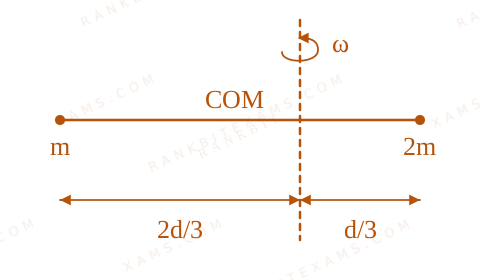
Two small balls with masses m and 2m are attached to both ends of a rigid rod of length d and negligible mass. If angular momentum of this system is L about an axis (A) passing through its centre of mass and perpendicular to the rod then angular velocity of the system about A is:

Solution & Explanation

### Related Formula r_textcm = fracm_1r_1 + m_2r_2m_1 + m_2 I_textcm = mu d^2 = left(fracm_1m_2m_1 + m_2right)d^2 L = Iomega ### Step 1: Calculate Moment of Inertia about COM Let mass m be at the origin. Position of 2m is d. X_textcm = fracm(0) + 2m(d)m + 2m = frac2d3 Distance of mass m from COM is frac2d3. Distance of mass 2m from COM is d - frac2d3 = fracd3. I = mleft(frac2d3right)^2 + 2mleft(fracd3right)^2 I = frac4md^29 + frac2md^29 = frac6md^29 = frac2md^23 ### Step 2: Calculate Angular Velocity L = Iomega omega = fracLI omega = fracLfrac2md^23 = frac3L2md^2 ### Pattern Recognition Sees: "two point masses" + "rotation about COM" → Quickly use reduced mass mu moment of inertia shortcut: I_textcm = mu d^2 = (fracm cdot 2m3m)d^2 = frac23md^2 to save time. ### Evaluation Rubric / Model Answer null ### Chapter Mix Class 11 Physics: Systems of Particles and Rotational Motion
Angular Momentum diagram for Q42 - JEE Main 2026 Morning

Reference Study Guides

More Systems of Particles and Rotational Motion Previous-Year Questions

Q31 jee_main_2026_21_jan_evening Angular Momentum
Two cars A and B each of mass 10^3 text kg are moving on parallel tracks separated by a distance of 10 text m, in same direction with speeds 72 text km/h and 36 text km/h. The magnitude of angular momentum of car A with respect to car B is ________ textJcdottexts.
  • A. 3.6 times 10^5
  • B. 10^5
  • C. 3 times 10^5
  • D. 2 times 10^5

Solution

### Related Formula L_textrel = m cdot V_textrel cdot r_perp ### Core Logic The relative angular momentum of a particle translating uniformly with respect to another moving reference frame can be found using their relative velocity and the perpendicular distance between their lines of motion. Relative velocity of A with respect to B: V_textrel = V_A - V_B = 72 - 36 = 36 text km/h ### Step 1: Conversion to SI units V_textrel = 36 times frac518 text m/s = 10 text m/s ### Step 2: Final Conclusion Using the perpendicular distance (r_perp = 10 text m) and mass (m = 10^3 text kg): L = m cdot V_textrel cdot r_perp L = 1000 times 10 times 10 = 10^5 text kg m^2text/s text (or Jcdottexts) ### Pattern Recognition For parallel tracks, the angular momentum of one translating body relative to another is simply m times v_textrelative times texttrack separation. ### Evaluation Rubric / Model Answer null ### Chapter Mix Class 11 Physics: Systems of Particles and Rotational Motion Class 11 Physics: Kinematics
Q32 jee_main_2026_21_jan_evening Rotational Dynamics
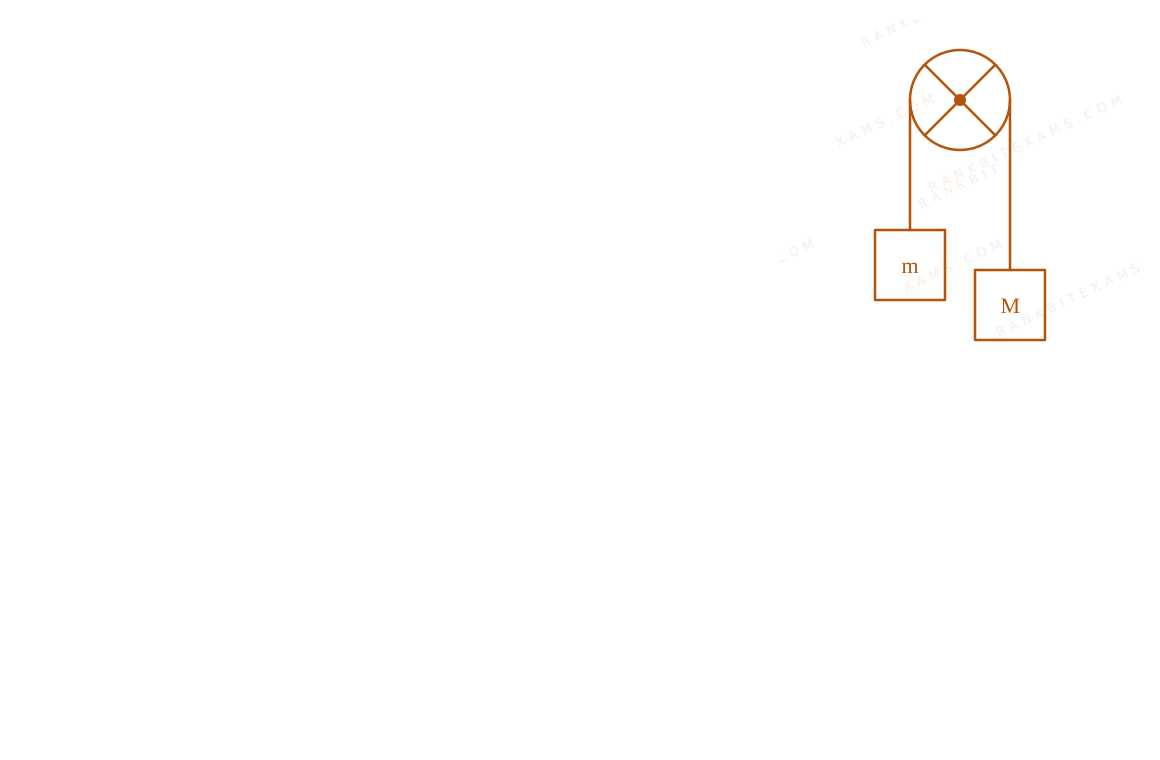
The pulley shown in figure is made using a thin rim and two rods of length equal to diameter of the rim. The rim and each rod have a mass of M. Two blocks of mass of M and m are attached to two ends of a light string passing over the pulley, which is hinged to rotate freely in vertical plane about its centre. The magnitudes of the acceleration experienced by the blocks is ________ (assume no slipping of string on pulley.)
Pulley dynamics diagram for Q32 - JEE Main 2026 Evening
Pulley system with a thin rim and two crossed rods supporting masses M and m.
  • A. frac(M-m)gleft[left(frac136right)M+mright]
  • B. frac(M-m)gM+m
  • C. frac(M-m)gleft[left(frac83right)M+mright]
  • D. frac(M-m)g2M+m

Solution

### Related Formula Mg - T_2 = Ma T_1 - mg = ma (T_2 - T_1)r = I alpha = I left(fracarright) ### Core Logic First, evaluate the moment of inertia of the pulley. The pulley consists of: 1. A thin rim of mass M and radius r. 2. Two rods, each of mass M and length 2r (diameter). Moment of inertia of the rim: I_textrim = Mr^2 Moment of inertia of two rods about the center: I_textrods = 2 times left(fracM(2r)^212right) = 2 times frac4Mr^212 = frac23Mr^2 Total I = Mr^2 + frac23Mr^2 = frac53Mr^2 ### Step 1: Force Equations From the free body diagrams of the descending block (mass M) and ascending block (mass m): Mg - T_2 = Ma quad text--- (1) T_1 - mg = ma quad text--- (2) Torque on the pulley: (T_2 - T_1)r = Ialpha = Ifracar implies T_2 - T_1 = fracIr^2a quad text--- (3) ### Step 2: Final Conclusion Adding equations (1), (2), and (3): Mg - mg = left(M + m + fracIr^2right)a Substitute I = frac53Mr^2: (M - m)g = left(M + m + frac5M3right)a (M - m)g = left(frac8M3 + mright)a a = frac(M-m)gleft[left(frac83right)M + mright] ### Pattern Recognition For a real pulley system, the effective mass acting against acceleration incorporates an inertia term: m_texteff = m_1 + m_2 + fracIR^2. Breaking the complex pulley into fundamental shapes (ring + rods) solves the inertia safely. ### Evaluation Rubric / Model Answer null ### Chapter Mix Class 11 Physics: Systems of Particles and Rotational Motion Class 11 Physics: Laws of Motion
Q33 jee_main_2026_23_january_morning Moment of Inertia
The moment of inertia of a square loop made of four uniform solid cylinders, each having radius R and length L (R < L) about an axis passing through the mid points of opposite sides, is (Take the mass of the entire loop as M):
  • A. frac38MR^2 +frac712ML^2
  • B. frac34MR^2 +frac16ML^2
  • C. frac34MR^2 +frac712ML^2
  • D. frac38MR^2 +frac16ML^2

Solution

### Related Formula For a solid cylinder: Parallel to its length passing through center: I = fracM'R^22 Perpendicular to length through center: I = fracM'R^24 + fracM'L^212 Parallel Axis Theorem: I = I_textcm + M'd^2 ### Core Logic The square loop is formed by four identical solid cylinders, each of mass M' = fracM4. The given axis passes through the mid-points of two opposite cylinders. This means two cylinders have the axis passing perpendicularly through their centers, and the other two cylinders are parallel to the axis at a distance of L/2. ### Step 1: Moment of Inertia for cylinders bisected perpendicularly For the two cylinders perpendicular to the axis of rotation: I_1 = 2 times left(fracM'R^24 + fracM'L^212right) ### Step 2: Moment of Inertia for cylinders parallel to axis For the two cylinders parallel to the axis, distance d = L/2. Apply the parallel axis theorem: I_2 = 2 times left[fracM'R^22 + M'left(fracL2right)^2right] ### Step 3: Total Moment of Inertia I_textnet = I_1 + I_2 = 2left(fracM'R^24 + fracM'L^212right) + 2left(fracM'R^22 + fracM'L^24right) I_textnet = fracM'R^22 + fracM'L^26 + M'R^2 + fracM'L^22 I_textnet = frac3M'R^22 + frac4M'L^26 = frac3M'R^22 + frac2M'L^23 ### Step 4: Substitute Total Mass Substitute M' = M/4: I = frac32left(fracM4right)R^2 + frac23left(fracM4right)L^2 I = frac38MR^2 + frac16ML^2 ### Pattern Recognition Sees: "square loop of cylinders" + "mass M of entire loop" → Always remember M_i = M/4. Calculate individual moment of inertia carefully considering whether the cylinder is oriented parallel or perpendicular. ### Evaluation Rubric / Model Answer null ### Chapter Mix Class 11 Physics: Systems of Particles and Rotational Motion

More Systems of Particles and Rotational Motion Questions — jee_main_2026_23_january_morning

Practice all Systems of Particles and Rotational Motion previous-year questions →

Rankbit System
JEE Physics: Waves (+15.5%) | Electrostatics: Concentric Shells (-29.7%) | Modern Physics: Photoelectric Clones (+34.2%) | Mathematics: Definite Integrals (+18.1%) | Chemistry: Coordination Splitting (-11.4%) | JEE Physics: Waves (+15.5%) | Electrostatics: Concentric Shells (-29.7%) | Modern Physics: Photoelectric Clones (+34.2%) | Mathematics: Definite Integrals (+18.1%) | Chemistry: Coordination Splitting (-11.4%)
