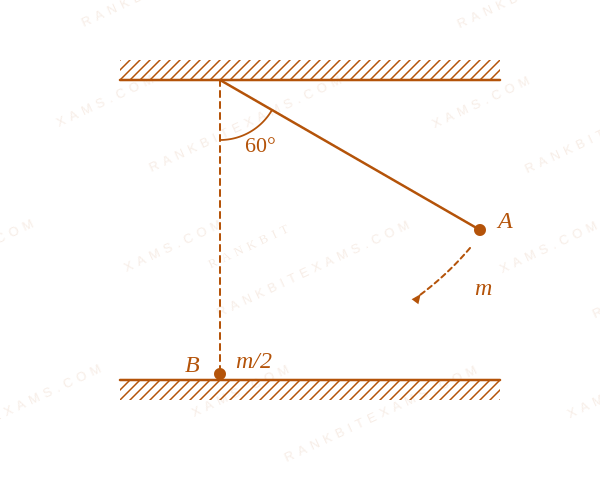
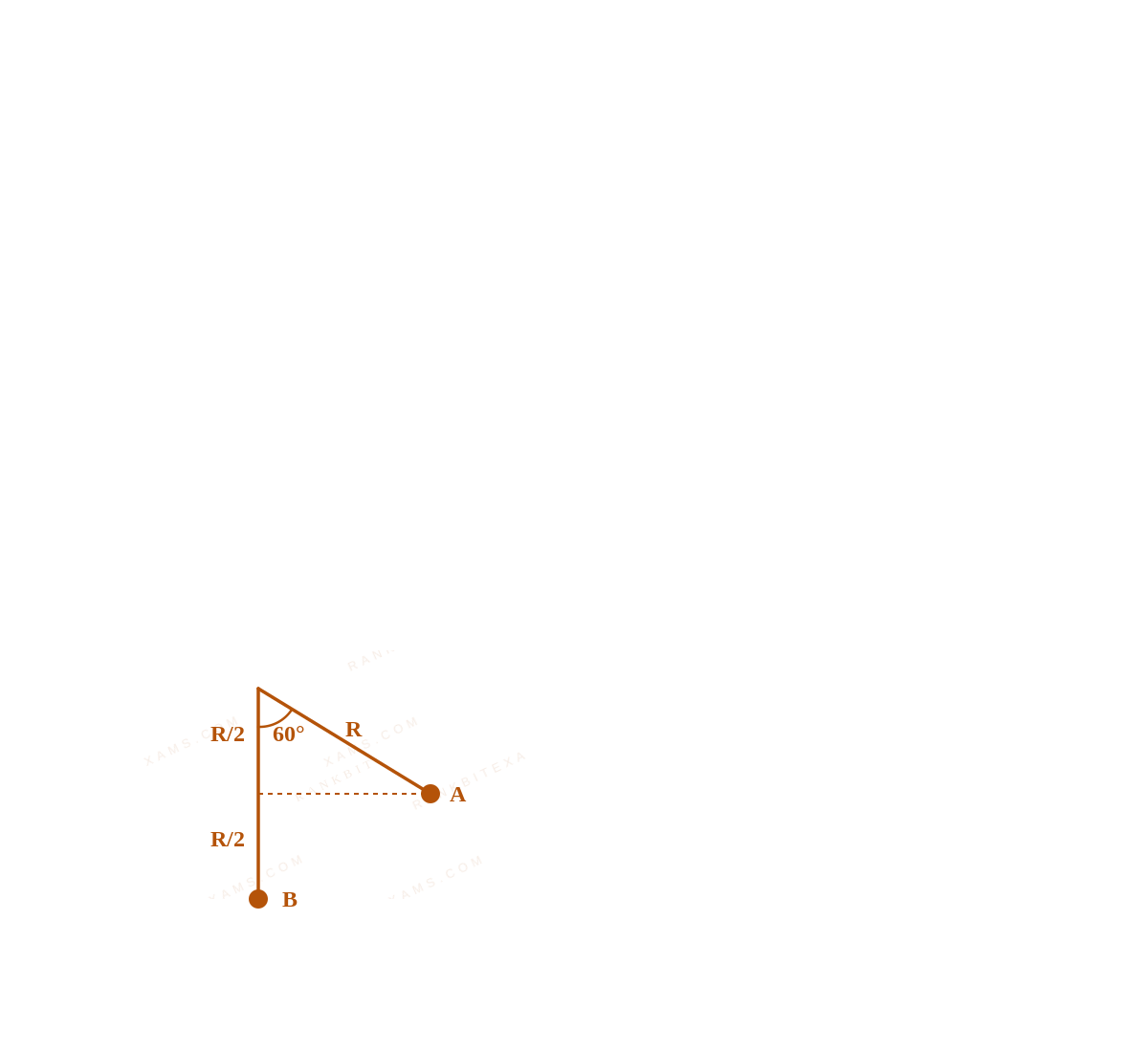
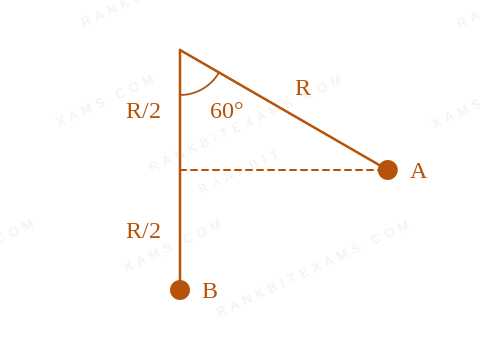
As shown below, bob A of a pendulum having massless string of length 'R' is released from 60°$60^{\circ}$ to the vertical. It hits another bob B of half the mass that is at rest on a friction less table in the centre. Assuming elastic collision, the magnitude of the velocity of bob A after the collision will be (take g as acceleration due to gravity)
The diagram displays a pendulum bob A suspended at an angle of 60 degrees ready to strike bob B at the lowest equilibrium center point.
Velocity of bob A just prior to collision :
u = 2g(R - R 60°) = √(2g(R)/(2)) = √(gR)$$u = \sqrt{2g\left(R - R\cos 60^{\circ}\right)} = \sqrt{2g\frac{R}{2}} = \sqrt{gR}$$
Using conservation of momentum and coefficient of restitution e=1$e=1$ for elastic interaction [cite: 660, 662]:
mA u = mA v₁ + mB v₂ m u = m v₁ + (m)/(2) v₂ 2v₁ + v₂ = 2u$$m_A u = m_A v_1 + m_B v_2 \implies m u = m v_1 + \frac{m}{2} v_2 \implies 2v_1 + v_2 = 2u$$
3v₁ = u v₁ = (u)/(3) = (1)/(3)√(gR)$$3v_1 = u \implies v_1 = \frac{u}{3} = \frac{1}{3}\sqrt{gR}$$
Pattern Recognition
In an elastic head-on collision where one body hits half its mass at rest, it retains exactly one-third of its initial hitting speed[cite: 661, 663].
Chapter Mix
Class 11 Physics: Work, Energy and Power
The diagram displays a pendulum bob A suspended at an angle of 60 degrees ready to strike bob B at the lowest equilibrium center point.
Keywords:#pendulum impact#elastic collision#momentum transfer
More Work, Energy and Power Previous-Year Questions — Page 7
Q49jee_main_2024_31_jan_morningConservation Of Momentum
An artillery piece of mass M₁$M_1$ fires a shell of mass M₂$M_2$ horizontally. Instantaneously after the firing, the ratio of kinetic energy of the artillery and that of the shell is :
A.M₁ / (M₁ + M₂)$M_1 / (M_1 + M_2)$
B.(M₂)/(M₁)$\frac{M_2}{M_1}$
C.M₂ / (M₁ + M₂)$M_2 / (M_1 + M_2)$
D.(M₁)/(M₂)$\frac{M_1}{M_2}$
Solution
Related Formula
KE = (p²)/(2m)$$\text{KE} = \frac{p^2}{2m}$$
Core Logic
By conservation of linear momentum (since no external horizontal force acts on the system):
Practice past-year questions one chapter at a time. Pick an exam → subject → chapter and get every PYQ for that topic — pulled together from all past papers — with the chapter's key formulas alongside.
