The maximum speed of a boat in still water is 27 km/h . Now this boat is moving downstream in a river flowing at 9 km/h . A man in the boat throws a ball vertically upwards with speed of 10 m/s . Range of the ball as observed by an observer at rest on the river bank, is ________ cm. (Take g = 10 m/s² )

Numerical Answer Type:
Enter a numerical value Answer: 2000 to 2000 +4 marks

Solution & Explanation

Related Formula
T = (2uy)/(g), R = vₓ · T
Core Logic

Relative range tracking frame vector

The total horizontal velocity components combine due to downstream motion addition

vₓ = 27 + 9 = 36 km/h = 36 · (5)/(18) = 10 m/s

The time of flight for the vertical launch tracking stands at :

T = (2 · 10)/(10) = 2 s

Horizontal range measured along the river bank frame is :

Range = vₓ · T = 10 · 2 = 20 m = 2000 cm
Chapter Mix

Class 11 Physics: Motion in a Straight Line Class 11 Physics: Motion in a Plane

More Motion in a Plane Previous-Year Questions

Q39 jee_main_2026_21_jan_evening Relative Motion in 2D
A river of width 200 m is flowing from west to east with a speed of 18 km/h. A boat, moving with speed of 36 km/h in still water, is made to travel one-round trip (bank to bank of the river). Minimum time taken by the boat for this journey and also the displacement along the river bank are ________ and ________ respectively.
  • A. 20 s and 100 m
  • B. 40 s and 0 m
  • C. 40 s and 200 m
  • D. 40 s and 100 m

Solution

Related Formula
tmin = dvbr Drift (displacement along bank) = vᵣ × ttotal
Core Logic

First, convert speeds to m/s. River speed vR = 18 × (5)/(18) = 5 m/s. Boat speed in still water vBR = 36 × (5)/(18) = 10 m/s. River width d = 200 m.
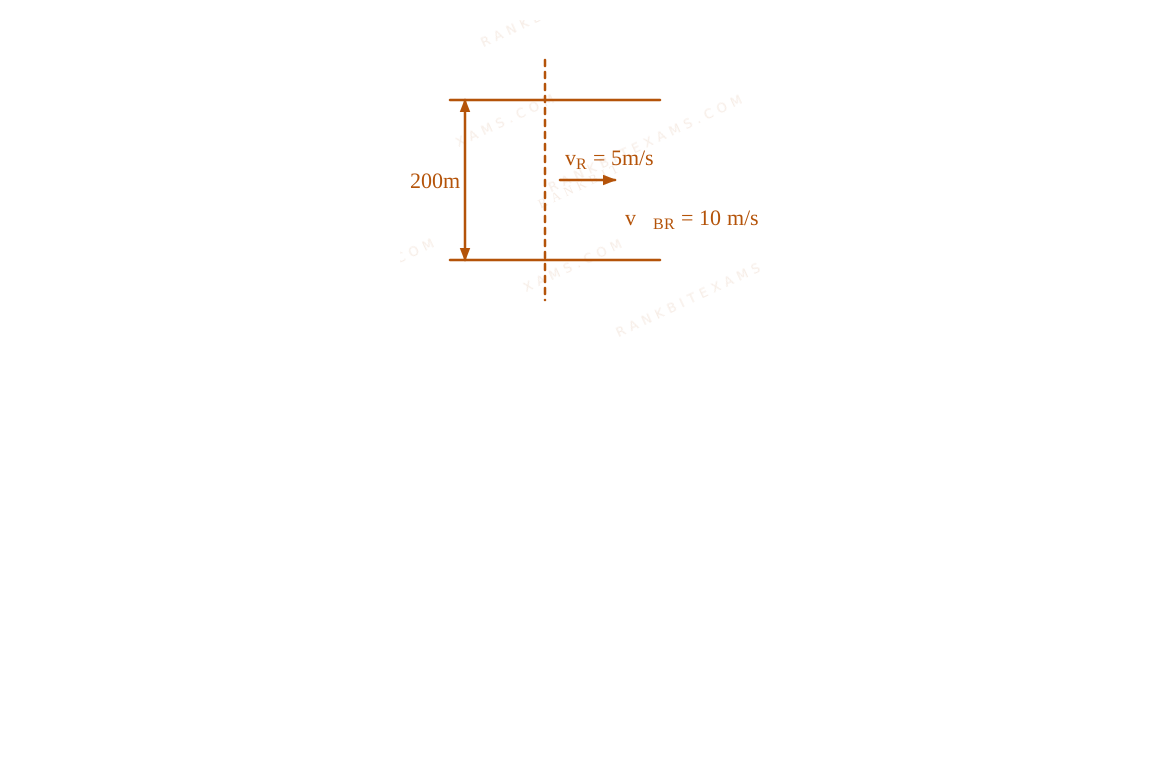
River boat vector diagram for Q39 - JEE Main 2026 Evening

For minimum time across the river, the boat must head exactly perpendicular to the river flow.

Step 1: Calculating Minimum Time

Time taken for one crossing (bank to bank):

tone-way = dvBR = (200)/(10) = 20 s

Since it is a round trip (bank to bank and back), total minimum time is:

ttotal = 2 × 20 = 40 s
Step 2: Calculating Displacement along Bank

Displacement along the river bank (drift) happens exclusively due to the river's flow during this total time:

Displacement = vR × ttotal = 5 × 40 = 200 m
Pattern Recognition

Minimum time always ignores drift and maxes out the perpendicular velocity vector. Drift simply becomes Vriver × Ttotal.

Chapter Mix

Class 11 Physics: Kinematics
Q32 jee_main_2026_22_january_morning Projectile Motion
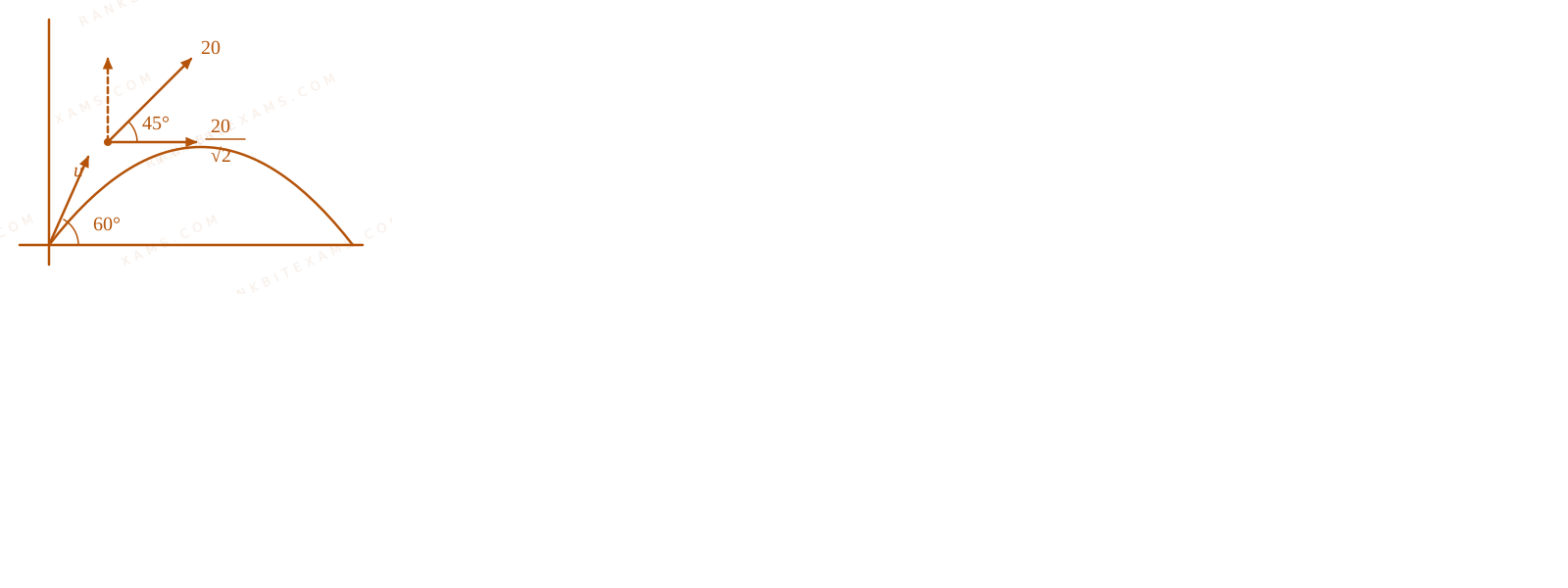
A projectile is thrown upward at an angle 60circ with the horizontal. The speed of the projectile is 20 m/s when its direction of motion is 45circ with the horizontal. The initial speed of the projectile is \_\_\_\_ m/s.
  • A. 40√(2)
  • B. 40
  • C. 20√(3)
  • D. 20√(2)

Solution

Related Formula
uₓ = u θ = v φ
Core Logic

Solution diagram for Q32 - JEE Main 2026 Morning

Since horizontal component of velocity remains constant:

u 60° = 20 45° (u)/(2) = 20√(2) u = 40√(2) = 20√(2) m/s
Pattern Recognition

Sees: Projectile motion speed at intermediate angle. Shortcut: Equate horizontal velocity components before and during flight. Check: Matches option (4). ✓

Chapter Mix

Class 11 Physics: Motion in a Plane

Q39 jee_main_2026_23_january_morning Projectile Motion
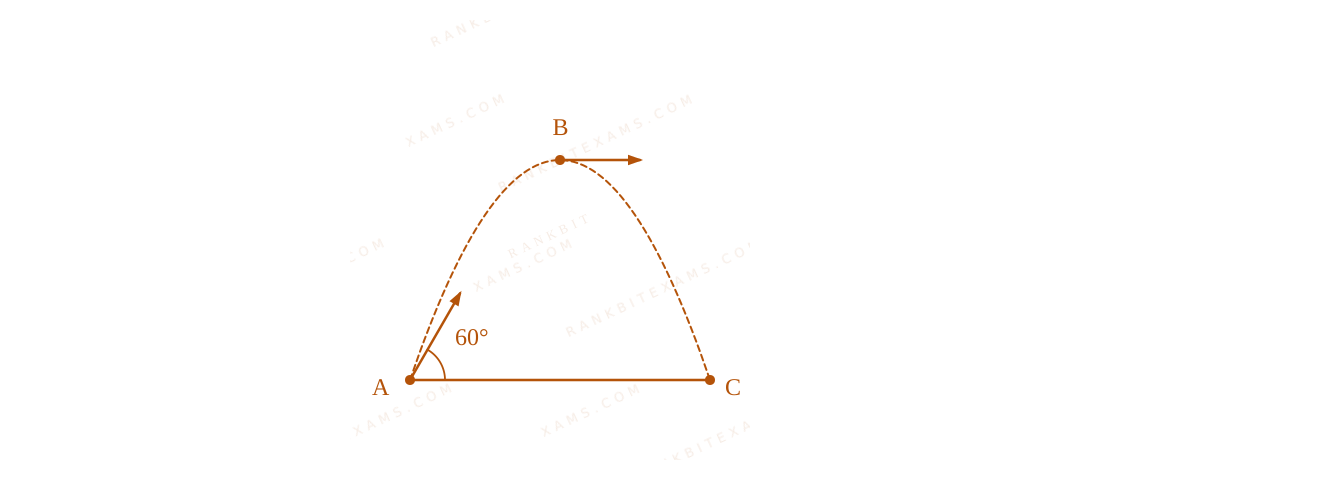
An object is projected with kinetic energy K from a point A at an angle 60° with the horizontal. The ratio of the difference in kinetic energies points B and C to that at point A (see figure), in the absence of air friction is :
Projectile Motion diagram for Q39 - JEE Main 2026 Morning
Parabolic path of a projectile marked with start A, peak B, and end C.
  • A. 1:2
  • B. 2:3
  • C. 1:4
  • D. 3:4

Solution

Related Formula
K = (1)/(2)mu² Kₓ = (1)/(2)m(u θ)² = K ² θ
Core Logic

For a projectile with no air resistance, horizontal velocity remains constant. At the highest point (B), the vertical velocity is zero, so the kinetic energy is entirely due to the horizontal velocity. At point C, it hits the ground with the same speed as projected, restoring full kinetic energy.

Step 1: Find KE at distinct points
(KE)A = K = (1)/(2)mu²

At maximum height (B), velocity is vB = u 60° = (u)/(2).

(KE)B = (1)/(2)m((u)/(2))² = (1)/(4)((1)/(2)mu²) = (K)/(4)

At landing point (C), speed is identical to initial speed u.

(KE)C = K
Step 2: Calculate Ratio

The required ratio is between the difference in kinetic energies at points C and B, to that at point A:

Ratio = KC - KBKA Ratio = (K - (K)/(4))/(K) = ((3K)/(4))/(K) = (3)/(4)
Pattern Recognition

Sees: "KE at highest point" → Substitute K ² θ. For θ = 60°, 60° = 1/2, so KB = K/4. The difference with ground is 3K/4.

Chapter Mix

Class 11 Physics: Motion in a Plane

Q30 jee_main_2026_23_january_evening Motion under Gravity
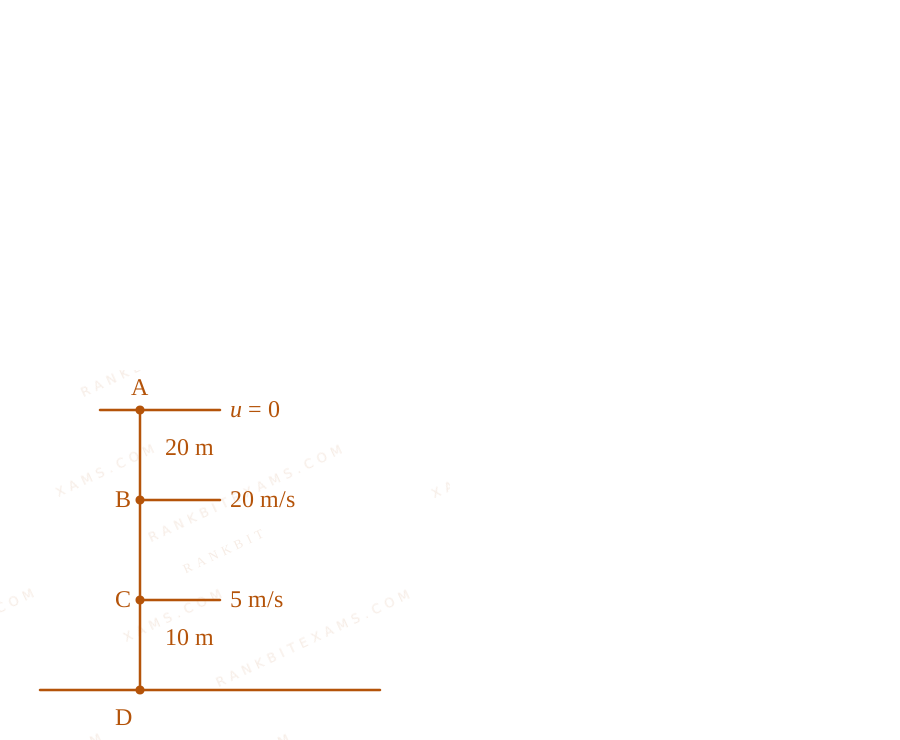
A paratrooper jumps from an aeroplane and opens a parachute after 2 s of free fall and starts deaccelerating with 3 m/s² . At 10 m height from ground, while descending with the help of parachute, the speed of paratrooper is 5 m/s. The initial height of the aeroplane is ____ m. (g = 10 m/s ² )
  • A. 62.5
  • B. 92.5
  • C. 20
  • D. 82.5

Solution

Related Formula
s = ut + (1)/(2)at²

v = u + at v² = u² + 2as

Core Logic

The motion is divided into three distinct vertical sections:

Motion under Gravity diagram for Q30 - JEE Main 2026 Evening

  • Free fall phase (A → B)
  • Deceleration phase with parachute (B → C)
  • Final descent phase to the ground (C → D)
Step 1: Free Fall (A to B)

Initial velocity u = 0, t = 2 s, g = 10 m/s².

x₁ = (1)/(2) × 10 × 2² = 20 m

Velocity at B:

VB = 0 + 10 × 2 = 20 m/s
Step 2: Deceleration Phase (B to C)

Starts with VB = 20 m/s, decelerates at 3 m/s² (a = -3 m/s²), and reaches VC = 5 m/s.

VC² = VB² + 2a x₂ 5² = 20² - 2(3)x₂

25 = 400 - 6x₂

6x₂ = 375 x₂ = (375)/(6) = 62.5 m
Step 3: Final Phase and Total Height

The last phase x₃ is given as 10 m above the ground.

H = x₁ + x₂ + x₃ H = 20 + 62.5 + 10 = 92.5 m
Pattern Recognition

Split multi-stage motion problems into clear intervals. The final velocity of interval N becomes the initial velocity of interval N+1. Calculate displacement for each interval independently and sum them up.

Chapter Mix

Class 11 Physics: Kinematics
Q43 jee_main_2026_24_january_morning Projectile Motion
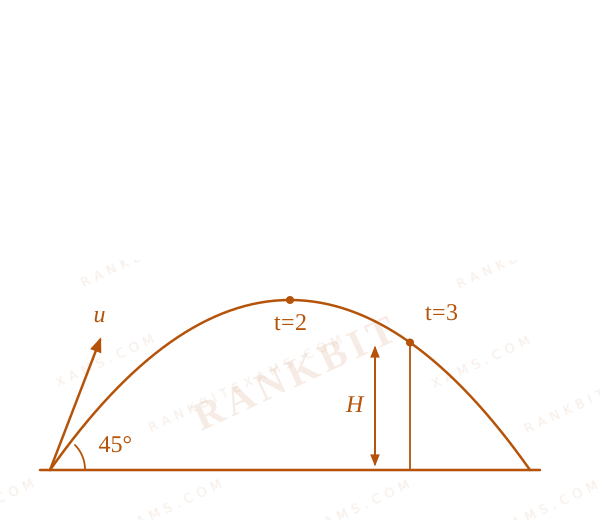
A boy thrown a ball into air at 45° from the horizontal to land it on a roof of a building of height H. If the ball attains maximum height in 2 s and lands on the building in 3 s after launch, then value of H is ____ m. (g = 10 m/s²)
  • A. 20
  • B. 10
  • C. 25
  • D. 15

Solution

Related Formula
tmaxheight = (uy)/(g) y = uy t - (1)/(2) g t²
Core Logic

Projectile motion onto a building

The time taken to reach the maximum height is given as 2 s. This means:

tpeak = (uy)/(g) = 2 uy = 2 × 10 = 20 m/s
Step 1: Calculate Building Height

The ball lands on the roof at t = 3 s. The height H at this instant is the vertical displacement y. Using the kinematic equation for vertical motion:

H = uy t - (1)/(2) g t² H = (20)(3) - (1)/(2)(10)(3)²

H = 60 - 5(9)

H = 60 - 45 = 15 m
Pattern Recognition

The launch angle (45°) is distractor data! Maximum height timing strictly dictates initial vertical velocity, which is all you need for the vertical height calculation.

Chapter Mix

Class 11 Physics: Motion in a Plane

More Motion in a Plane Questions — jee_main_2025_29_jan_morning

Practice all Motion in a Plane previous-year questions →

Rankbit System
JEE Physics: Waves (+15.5%) | Electrostatics: Concentric Shells (-29.7%) | Modern Physics: Photoelectric Clones (+34.2%) | Mathematics: Definite Integrals (+18.1%) | Chemistry: Coordination Splitting (-11.4%) | JEE Physics: Waves (+15.5%) | Electrostatics: Concentric Shells (-29.7%) | Modern Physics: Photoelectric Clones (+34.2%) | Mathematics: Definite Integrals (+18.1%) | Chemistry: Coordination Splitting (-11.4%)