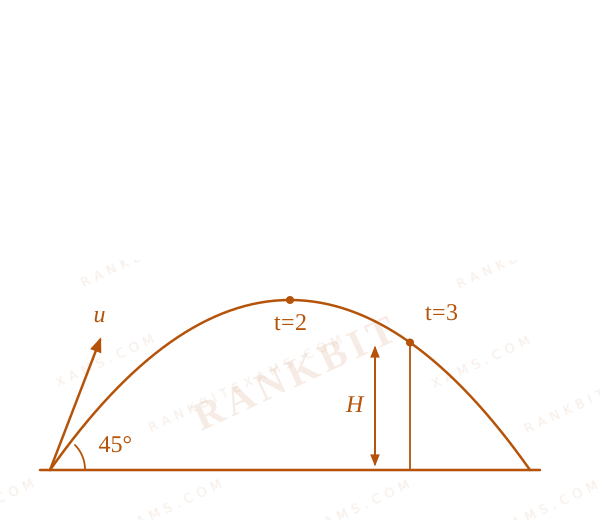
A boy thrown a ball into air at 45^circ$45^{\circ}$ from the horizontal to land it on a roof of a building of height H. If the ball attains maximum height in 2 s and lands on the building in 3 s after launch, then value of H is ____ m.
(g = 10 text m/s^2$g = 10 \text{ m/s}^{2}$)
A.20$20$
B.10$10$
C.25$25$
D.15$15$
Solution & Explanation
### Related Formula
t_textmax_height = fracu_yg$$t_{\text{max_height}} = \frac{u_y}{g}$$y = u_y t - frac12 g t^2$$y = u_y t - \frac{1}{2} g t^2$$
### Core Logic
Projectile motion onto a building
The time taken to reach the maximum height is given as 2 text s$2 \text{ s}$.
This means:
t_textpeak = fracu_yg = 2$$t_{\text{peak}} = \frac{u_y}{g} = 2$$u_y = 2 times 10 = 20 text m/s$$u_y = 2 \times 10 = 20 \text{ m/s}$$
### Step 1: Calculate Building Height
The ball lands on the roof at t = 3 text s$t = 3 \text{ s}$. The height H$H$ at this instant is the vertical displacement y$y$.
Using the kinematic equation for vertical motion:
H = u_y t - frac12 g t^2$$H = u_y t - \frac{1}{2} g t^2$$H = (20)(3) - frac12(10)(3)^2$$H = (20)(3) - \frac{1}{2}(10)(3)^2$$H = 60 - 5(9)$H = 60 - 5(9)$H = 60 - 45 = 15 text m$$H = 60 - 45 = 15 \text{ m}$$
### Pattern Recognition
The launch angle (45^circ$45^{\circ}$) is distractor data! Maximum height timing strictly dictates initial vertical velocity, which is all you need for the vertical height calculation.
### Evaluation Rubric / Model Answer
null
### Chapter Mix
Class 11 Physics: Motion in a Plane
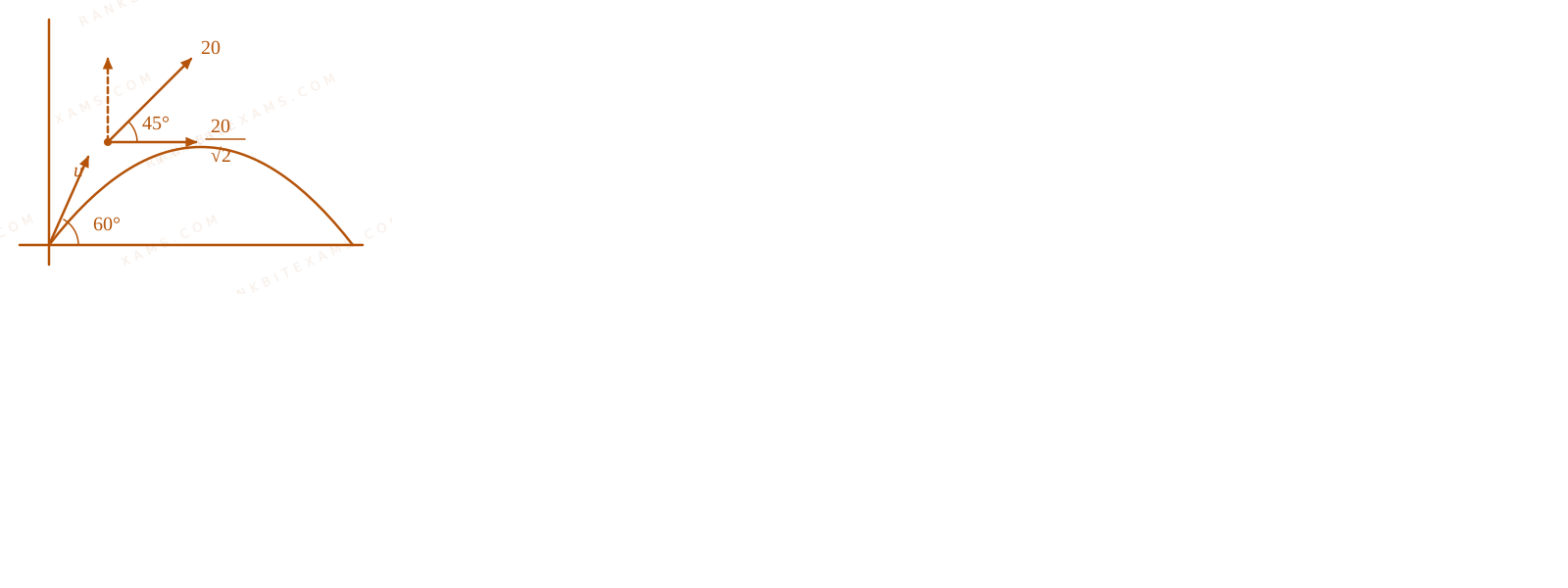
A projectile is thrown upward at an angle 60^circ$60^{circ}$ with the horizontal. The speed of the projectile is 20 m/s when its direction of motion is 45^circ$45^{circ}$ with the horizontal. The initial speed of the projectile is \_\_\_\_ m/s.
A.40sqrt2$40\sqrt{2}$
B. 40
C.20sqrt3$20\sqrt{3}$
D.20sqrt2$20\sqrt{2}$
Solution
### Related Formula
u_x = u costheta = v cosphi$$u_x = u \cos\theta = v \cos\phi$$
### Core Logic
Solution diagram for Q32 - JEE Main 2026 Morning
Since horizontal component of velocity remains constant:
u cos 60^circ = 20 cos 45^circ$$u \cos 60^{\circ} = 20 \cos 45^{\circ}$$fracu2 = frac20sqrt2$$\frac{u}{2} = \frac{20}{\sqrt{2}}$$u = frac40sqrt2 = 20sqrt2 text m/s$$u = \frac{40}{\sqrt{2}} = 20\sqrt{2} \text{ m/s}$$
### Pattern Recognition
Sees: Projectile motion speed at intermediate angle.
Shortcut: Equate horizontal velocity components before and during flight.
Check: Matches option (4). ✓
### Chapter Mix
Class 11 Physics: Motion in a Plane
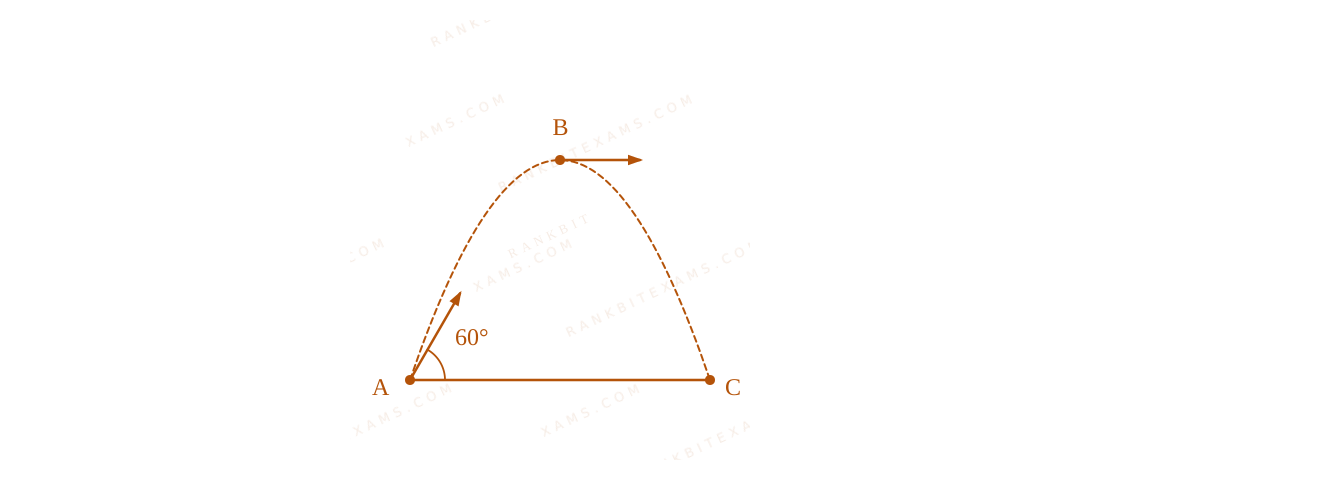
An object is projected with kinetic energy K from a point A at an angle 60^circ$60^{\circ}$ with the horizontal. The ratio of the difference in kinetic energies points B and C to that at point A (see figure), in the absence of air friction is :
Parabolic path of a projectile marked with start A, peak B, and end C.
A.1:2$1:2$
B.2:3$2:3$
C.1:4$1:4$
D.3:4$3:4$
Solution
### Related Formula
K = frac12mu^2$$K = \frac{1}{2}mu^{2}$$K_x = frac12m(u cos theta)^2 = K cos^2 theta$$K_{x} = \frac{1}{2}m(u \cos \theta)^{2} = K \cos^{2} \theta$$
### Core Logic
For a projectile with no air resistance, horizontal velocity remains constant. At the highest point (B), the vertical velocity is zero, so the kinetic energy is entirely due to the horizontal velocity. At point C, it hits the ground with the same speed as projected, restoring full kinetic energy.
### Step 1: Find KE at distinct points
(textKE)_A = K = frac12mu^2$$(\text{KE})_{A} = K = \frac{1}{2}mu^{2}$$
At maximum height (B), velocity is v_B = u cos 60^circ = fracu2$v_{B} = u \cos 60^{\circ} = \frac{u}{2}$.
(textKE)_B = frac12mleft(fracu2right)^2 = frac14left(frac12mu^2right) = fracK4$$(\text{KE})_{B} = \frac{1}{2}m\left(\frac{u}{2}\right)^{2} = \frac{1}{4}\left(\frac{1}{2}mu^{2}\right) = \frac{K}{4}$$
At landing point (C), speed is identical to initial speed u$u$.
(textKE)_C = K$$(\text{KE})_{C} = K$$
### Step 2: Calculate Ratio
The required ratio is between the difference in kinetic energies at points C and B, to that at point A:
textRatio = fracK_C - K_BK_A$$\text{Ratio} = \frac{K_{C} - K_{B}}{K_{A}}$$textRatio = fracK - fracK4K = fracfrac3K4K = frac34$$\text{Ratio} = \frac{K - \frac{K}{4}}{K} = \frac{\frac{3K}{4}}{K} = \frac{3}{4}$$
### Pattern Recognition
Sees: "KE at highest point" → Substitute K cos^2 theta$K \cos^2 \theta$. For theta = 60^circ$\theta = 60^{\circ}$, cos 60^circ = 1/2$\cos 60^{\circ} = 1/2$, so K_B = K/4$K_B = K/4$. The difference with ground is 3K/4$3K/4$.
### Evaluation Rubric / Model Answer
null
### Chapter Mix
Class 11 Physics: Motion in a Plane
A particle is projected with velocity u$u$ so that its horizontal range is three times the maximum height attained by it. The horizontal range of the projectile is given as fracnu^225g$\frac{nu^2}{25g}$ , where value of n$n$ is:
(Given ' g$g$' is the acceleration due to gravity).
A. 6
B. 18
C. 12
D. 24
Solution
### Related Formula
For a projectile with launch speed u$u$ and angle theta$\theta$:
- Horizontal Range:
R = fracu^2 sin(2theta)g = frac2 u^2 sintheta costhetag$$R = \frac{u^2 \sin(2\theta)}{g} = \frac{2 u^2 \sin\theta \cos\theta}{g}$$
- Maximum Height:
H = fracu^2 sin^2theta2g$$H = \frac{u^2 \sin^2\theta}{2g}$$
The general ratio linking range and maximum height is:
tantheta = frac4HR$$\tan\theta = \frac{4H}{R}$$
### Core Logic
Given state:
R = 3H Rightarrow fracHR = frac13$$R = 3H \Rightarrow \frac{H}{R} = \frac{1}{3}$$
### Step 1: Determine the projection angle (theta$\theta$)
Substitute the ratio into the relation:
tantheta = 4 left(fracHRright) = 4 left(frac13right) = frac43$$\tan\theta = 4 \left(\frac{H}{R}\right) = 4 \left(\frac{1}{3}\right) = \frac{4}{3}$$
This is a standard Pythagorean triangle angle:
sintheta = frac45, quad costheta = frac35$$\sin\theta = \frac{4}{5}, \quad \cos\theta = \frac{3}{5}$$
### Step 2: Compute the horizontal range (R$R$)
R = frac2 u^2 sintheta costhetag$$R = \frac{2 u^2 \sin\theta \cos\theta}{g}$$R = frac2 u^2 left(frac45right) left(frac35right)g = frac24 u^225 g$$R = \frac{2 u^2 \left(\frac{4}{5}\right) \left(\frac{3}{5}\right)}{g} = \frac{24 u^2}{25 g}$$
Comparing this with the given format fracnu^225g$\frac{nu^2}{25g}$:
n = 24$n = 24$
### Pattern Recognition
The relation tantheta = 4H/R$\tan\theta = 4H/R$ is an essential identity in projectile dynamics. Whenever R = k H$R = k H$, then tantheta = 4/k$\tan\theta = 4/k$. Recognizing standard angles like tantheta = 4/3$\tan\theta = 4/3$ or 3/4$3/4$ directly yields trigonometric values immediately.
### Evaluation Rubric / Model Answer
null
### Chapter Mix
Class 11 Physics: Motion in a Plane
Two projectiles are fired from ground with same initial speeds from same point at angles (45^circ + alpha)$(45^{\circ} + \alpha)$ and (45^circ - alpha)$(45^{\circ} - \alpha)$ with horizontal direction. The ratio of their times of flights is
### Related Formula
The time of flight T$T$ of a projectile launched with speed u$u$ at an angle theta$\theta$ with the horizontal is:
T = frac2u sinthetag$$T = \frac{2u \sin\theta}{g}$$
### Core Logic
The launch angles of the two projectiles are:
$
### Core Logic
The launch angles of the two projectiles are:
$theta_1 = 45^circ + alpha$\theta_1 = 45^\circ + \alpha$$
$theta_2 = 45^circ - alpha$\theta_2 = 45^\circ - \alpha$
Since they have the same speed $
Since they have the same speed $u:
$:
$fracT_1T_2 = fracsin(45^circ + alpha)sin(45^circ - alpha)$\frac{T_1}{T_2} = \frac{\sin(45^\circ + \alpha)}{\sin(45^\circ - \alpha)}$
### Step 1: Simplify Trigonometric Ratio
Using the angle sum and difference formulas:
$
### Step 1: Simplify Trigonometric Ratio
Using the angle sum and difference formulas:
$fracT_1T_2 = fracsin 45^circ cos alpha + cos 45^circ sin alphasin 45^circ cos alpha - cos 45^circ sin alpha$\frac{T_1}{T_2} = \frac{\sin 45^\circ \cos \alpha + \cos 45^\circ \sin \alpha}{\sin 45^\circ \cos \alpha - \cos 45^\circ \sin \alpha}$$
$fracT_1T_2 = fracfrac1sqrt2cosalpha + frac1sqrt2sinalphafrac1sqrt2cosalpha - frac1sqrt2sinalpha = fraccosalpha + sinalphacosalpha - sinalpha$\frac{T_1}{T_2} = \frac{\frac{1}{\sqrt{2}}\cos\alpha + \frac{1}{\sqrt{2}}\sin\alpha}{\frac{1}{\sqrt{2}}\cos\alpha - \frac{1}{\sqrt{2}}\sin\alpha} = \frac{\cos\alpha + \sin\alpha}{\cos\alpha - \sin\alpha}$
Divide numerator and denominator by $
Divide numerator and denominator by $\cos\alpha:
$:
$fracT_1T_2 = frac1 + tanalpha1 - tanalpha$\frac{T_1}{T_2} = \frac{1 + \tan\alpha}{1 - \tan\alpha}$$
### Pattern Recognition
Sees: Projectile angles complementary to $
### Pattern Recognition
Sees: Projectile angles complementary to $45^\circ.
Shortcut: Remember the identity $.
Shortcut: Remember the identity $\tan(45^\circ + \alpha) = \frac{1+\tan\alpha}{1-\tan\alpha}. Since complementary angles have sine ratios proportional to $. Since complementary angles have sine ratios proportional to $\sin(45^\circ + \alpha)/\sin(45^\circ - \alpha) = \tan(45^\circ + \alpha), the answer is directly $, the answer is directly $\frac{1+\tan\alpha}{1-\tan\alpha}$.
### Evaluation Rubric / Model Answer
null
### Chapter Mix
Class 11 Physics: Motion in a Plane
More Motion in a Plane Questions — jee_main_2026_24_january_morning
We Map Every Repeating Question in Competitive Exams.
Say goodbye to generic mock test fatigue. RankBit uses smart analysis to group past exam questions into their foundational Repeating Question Types. Find chapter weightage, track repeating questions, and score higher with targeted practice.
Select Your Target Exam
Choose an exam track below to find formulas per chapter and patterns.
Syncing Exam Intelligence
Mapping formulas and patterns across all tracks…
PATH A — FULL LENGTH PRACTICE
Full Mock Test Hub
Simulate real NTA exam conditions with fully tracked mocks. Time yourself against past papers.
Practice past-year questions one chapter at a time. Pick an exam → subject → chapter and get every PYQ for that topic — pulled together from all past papers — with the chapter's key formulas alongside.