JEE Main · Physics → Steady

Electrostatics appeared 79 times across 3 years — 9.1% of Physics. This question is from Gauss\'s Law.

Year 2026 2025 2024 Total
Questions 24 39 16 79

Match List-I with List-II.
List-IList-II
(A) Electric field inside (distance r > 0 from center) of a uniformly charged spherical shell with surface charge density σ, and radius R.(I) σ / ε₀
(B) Electric field at distance r > 0 from a uniformly charged infinite plane sheet with surface charge density σ.(II) σ / 2ε₀
(C) Electric field outside (distance r > 0 from center) of a uniformly charged spherical shell with surface charge density σ, and radius R(III) 0
(D) Electric field between 2 oppositely charged infinite plane parallel sheets with uniform surface charge density σ.(IV) σ R² / ε₀ r²
Choose the correct answer from the options given below:

Solution & Explanation

Core Logic

Mapping electrostatics equations via Gauss\'s law applications :

  • (A) Inside a shell, enclosed charge is zero E = 0 (III) .
  • (B) Near an infinite sheet, E = (σ)/(2ε₀) (II) .
  • (C) Outside a shell, E = (kQ)/(r²) = (σ R²)/(ε₀ r²) (IV) .
  • (D) Between opposite sheets, fields add up: (σ)/(2ε₀) + (σ)/(2ε₀) = (σ)/(ε₀) (I) .
  • Hence, the proper combination sequence is (A)-(III), (B)-(II), (C)-(IV), (D)-(I).

Chapter Mix

Class 12 Physics: Electrostatics

More Electrostatics Previous-Year Questions

Q jee_main_2026_21_jan_morning Capacitance with Dielectric
A parallel plate capacitor has capacitance C, when there is vacuum within the parallel plates. A sheet having thickness ((1)/(3))rd of the separation between the plates and relative permittivity K is introduced between the plates. The new capacitance of the system is :
  • A. 3KC2K + 1
  • B. CK2 + K
  • C. 3CK²(2K + 1)²
  • D. 4KC3K - 1

Solution

Related Formula
C = (ε₀ A)/(d - t + (t)/(K))

Alternatively, treat as two capacitors in series: Ceq = (C₁ C₂)/(C₁ + C₂)

Core Logic

Initial capacitance (vacuum): C = A ε₀d.

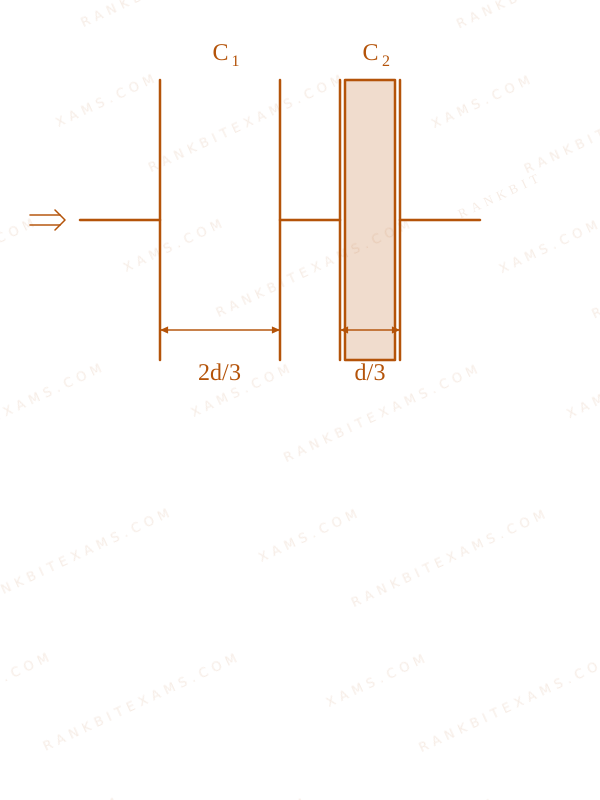
Capacitance with Dielectric diagram for Q34 - JEE Main 2026 Morning

The system can be modelled as two capacitors in series:

  • A vacuum capacitor of thickness d - (d)/(3) = (2d)/(3)
  • A dielectric capacitor of thickness (d)/(3) and dielectric constant K.
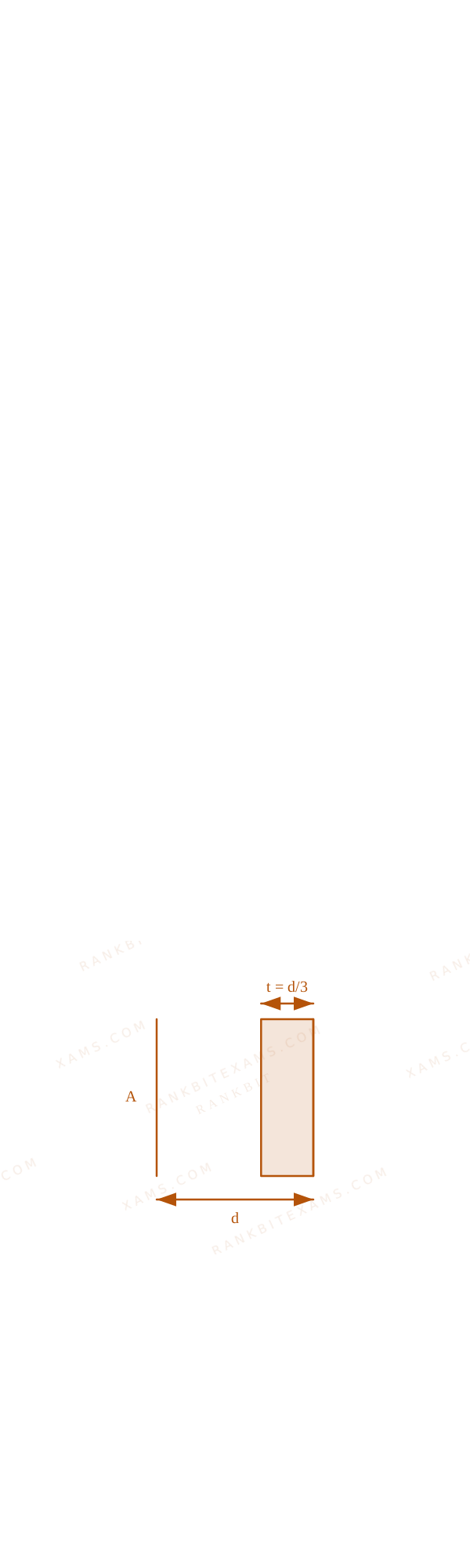
  • Capacitance with Dielectric diagram for Q34 - JEE Main 2026 Morning
    Capacitance with Dielectric diagram for Q34 - JEE Main 2026 Morning
    Capacitance with Dielectric diagram for Q34 - JEE Main 2026 Morning
    Capacitance with Dielectric diagram for Q34 - JEE Main 2026 Morning

Step 1: Capacitors in Series

The capacitances are:

C₁ = (ε₀ A)/(((2d)/(3))) = (3)/(2) ((ε₀ A)/(d)) = (3)/(2) C C₂ = (K ε₀ A)/(((d)/(3))) = 3K ((ε₀ A)/(d)) = 3KC

Now, equivalent capacitance in series:

Ceq = (C₁ C₂)/(C₁ + C₂) = (((3)/(2) C) × (3KC))/((3)/(2) C + 3KC) Ceq = ((9)/(2)KC²)/((3)/(2)C(1 + 2K)) Ceq = (3KC)/(2K + 1)
Pattern Recognition

Partial dielectric filling of thickness t: Use formula Cnew = (ε₀ A)/(d - t + t/K). Plugging t = d/3 directly gives (ε₀ A)/(d - d/3 + d/3K) = (ε₀ A)/((2d)/(3) + (d)/(3K)) = (3K ε₀ A)/(2Kd + d) = (3KC)/(2K+1).

Chapter Mix

Class 12 Physics: Electrostatics
Q45 jee_main_2026_21_jan_morning Electric Potential Energy
A point charge of 10⁻⁸ C is placed at origin. The work done in moving a point charge 2 μC from point A(4, 4, 2) m to B(2, 2, 1) m is ____ J. ( 14πε₀=9×10⁹ in SI units)
  • A. 45 × 10⁻⁶
  • B. 0
  • C. 30 × 10⁻⁶
  • D. 15 × 10⁻⁶

Solution

Related Formula
Wₑₓₜ = Δ U = Uf - Uᵢ U = (1)/(4πε₀) (q₁ q₂)/(r)
Core Logic

Work done by external agent: Wₑₓₜ = Δ U, where Δ U is the change in potential energy.

Wₑₓₜ = 14π ε₀ q₁ q₂rf - 14π ε₀ q₁ q₂rᵢ

Calculate the distances of points A and B from the origin: rᵢ = |A| = √(4² + 4² + 2²) = √(16+16+4) = √(36) = 6 m rf = |B| = √(2² + 2² + 1²) = √(4+4+1) = √(9) = 3 m

Step 1: Calculate Work Done
Wₑₓₜ = (9 × 10⁹) × (10⁻⁸ × 2 × 10⁻⁶) [ (1)/(3) - (1)/(6) ] Wₑₓₜ = 18 × 10⁻⁵ × ((2-1)/(6)) Wₑₓₜ = 18 × 10⁻⁵ × (1)/(6) = 3 × 10⁻⁵ J = 30 × 10⁻⁶ J
Pattern Recognition

Electric field is conservative. Work done simply equals change in kqq/r from initial to final radial coordinate. No path dependence.

Chapter Mix

Class 12 Physics: Electrostatics
Q26 jee_main_2026_21_jan_evening Electric Potential Energy
Consider two identical metallic spheres of radius R each having charge Q and mass m. Their centers have an initial separation of 4R. Both the spheres are given an initial speed of u towards each other. The minimum value of u, so that they can just touch each other is: (Take k= 14πε₀ and assume kQ²>Gm² where G is the Gravitational constant)
  • A. kQ²4mR(1- Gm²kQ²)
  • B. kQ²4mR(1+ Gm²kQ²)
  • C. kQ²2mR(1- Gm²kQ²)
  • D. kQ²2mR(1- Gm²2kQ²)

Solution

Related Formula
Kᵢ + Uᵢ = Kf + Uf U = (kq₁q₂)/(r) - (Gm₁m₂)/(r)
Core Logic

Using energy conservation from the initial state (separation 4R) to the final state (just touching, so center-to-center separation is 2R). Both spheres have mass m and speed u.

Initial Energy:

Eᵢ = 2((1)/(2)mu²) - (Gm²)/(4R) + (kQ²)/(4R)

Final Energy (just touching implies final velocity is zero):

Ef = - (Gm²)/(2R) + (kQ²)/(2R)
Step 1: Equating Energies
mu² - (Gm²)/(4R) + (kQ²)/(4R) = - (Gm²)/(2R) + (kQ²)/(2R) mu² = ((kQ²)/(2R) - (kQ²)/(4R)) - ((Gm²)/(2R) - (Gm²)/(4R)) mu² = (kQ²)/(4R) - (Gm²)/(4R) u² = (1)/(4mR)(kQ² - Gm²)
Step 2: Final Conclusion
u = √((kQ²)/(4mR)(1 - (Gm²)/(kQ²)))
Pattern Recognition

When dealing with two forces (electrostatic repulsion and gravitational attraction), their potentials simply superimpose linearly. The change in total potential energy equals the loss in kinetic energy.

Chapter Mix

Class 12 Physics: Electrostatics Class 11 Physics: Gravitation
Q27 jee_main_2026_21_jan_evening Capacitance
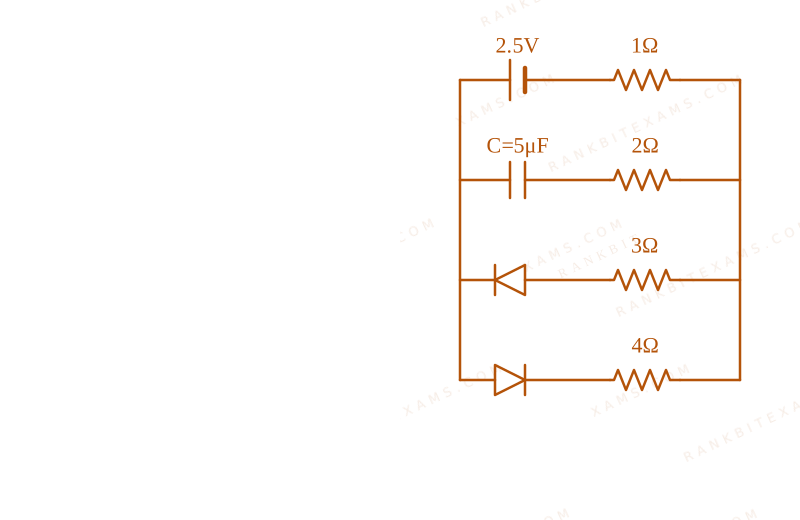
The charge stored by the capacitor C in the given circuit in the steady state is ________ .
Capacitance diagram for Q27 - JEE Main 2026 Evening
Circuit diagram showing a 5 microfarad capacitor connected in parallel with branches containing resistors and diodes.
  • A. 12.5
  • B. 10
  • C. 7.5
  • D. 5

Solution

Related Formula

Q = C Vc where Vc is the steady-state voltage across the capacitor.

Core Logic

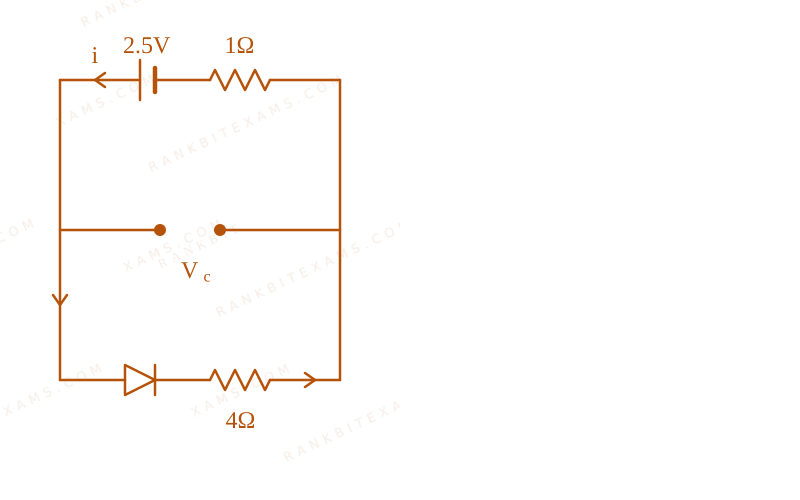
In steady state, the capacitor acts as an open circuit (blocks DC current). We must analyze the active branches.

Solution diagram for Q27 - JEE Main 2026 Evening
Circuit diagram showing a 5 microfarad capacitor connected in parallel with branches containing resistors and diodes.

The branch with the reversed-biased diode will carry no current. Current flows through the outer loop via the forward-biased diode. Total active resistance Req = 1 Ω + 4 Ω = 5 Ω.

Current in the steady state:

i = VReq = (2.5)/(5) = 0.5 A
Step 1: Voltage Calculation

The voltage across the capacitor Vc is equal to the voltage drop across the 4 Ω resistor, because the branch is connected in parallel.

Vc = i × 4 Ω Vc = 0.5 × 4 = 2 V
Step 2: Final Conclusion

The charge stored is: Q = C Vc

Q = 5 × 2 V = 10
Pattern Recognition

Capacitor in steady-state DC = open wire. Analyze only the paths where current can physically flow, check diode polarity, find nodal voltage across the capacitor terminals, apply Q=CV.

Chapter Mix

Class 12 Physics: Electrostatics Class 12 Physics: Current Electricity Class 12 Physics: Semiconductor Electronics
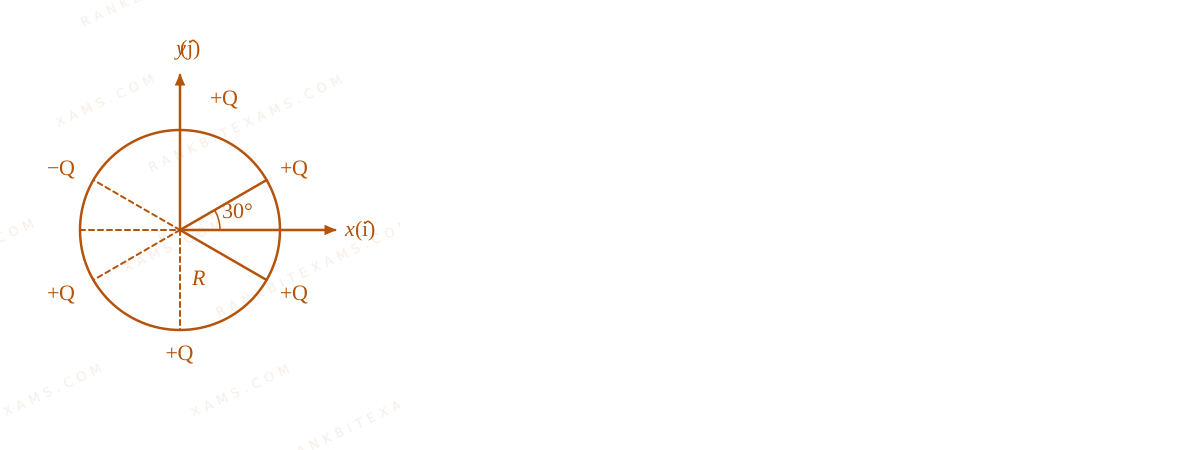
Q28 jee_main_2026_22_january_morning Electric Field and Superposition
Six point charges are kept 60circ apart from each other on the circumference of a circle of radius R as shown in figure. The net electric field at the centre of the circle is \_\_\_\_. (εₒ is permittivity of free space)
Electrostatics diagram for Q28 - JEE Main 2026 January Morning
Six point charges arranged at 60 degree intervals along a circular circumference.
  • A. - 5Q8πε₀R²( i+√(3) j)
  • B. - Q4πε₀R²(√(3) i- j)
  • C. -( 5Q8πε₀R²)( i-3 j)
  • D. Q4πε₀R²(√(3) i- j)

Solution

Related Formula
E = (kQ)/(r²)
Core Logic

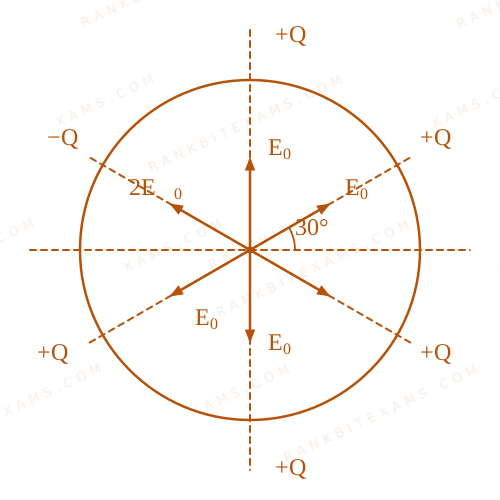
Solution vector diagram for Q28 - JEE Main 2026 Morning
Six point charges arranged at 60 degree intervals along a circular circumference.

By symmetry and vector addition of electric fields due to the point charges placed on the circle:

Eₙₑₜ = 2E₀ 30°(- i) + 2E₀ 30°( j) = (2kQ)/(r²)[ √(3)2(- i) + (1)/(2) j] = -(Q)/(4πε₀ R²)(√(3) i - j)
Pattern Recognition

Sees: Symmetrical charge distribution on a circle. Shortcut: Resolve components symmetrically and combine vector contributions. Check: Matches option (2). ✓

Chapter Mix

Class 12 Physics: Electrostatics

More Electrostatics Questions — jee_main_2025_29_jan_morning

Practice all Electrostatics previous-year questions →

Rankbit System
JEE Physics: Waves (+15.5%) | Electrostatics: Concentric Shells (-29.7%) | Modern Physics: Photoelectric Clones (+34.2%) | Mathematics: Definite Integrals (+18.1%) | Chemistry: Coordination Splitting (-11.4%) | JEE Physics: Waves (+15.5%) | Electrostatics: Concentric Shells (-29.7%) | Modern Physics: Photoelectric Clones (+34.2%) | Mathematics: Definite Integrals (+18.1%) | Chemistry: Coordination Splitting (-11.4%)