Related Formula
The change in potential energy Δ U$\Delta U$ of a charge q$q$ moved between two points of potentials VC$V_C$ and VD$V_D$ is:
Δ U = q₃ (VD - VC)$$\Delta U = q_3 (V_D - V_C)$$
Potential due to a point charge q$q$ at distance r$r$ is:
V = (1)/(4πε₀) (q)/(r)$$V = \frac{1}{4\pi\epsilon_0} \frac{q}{r}$$
Core Logic
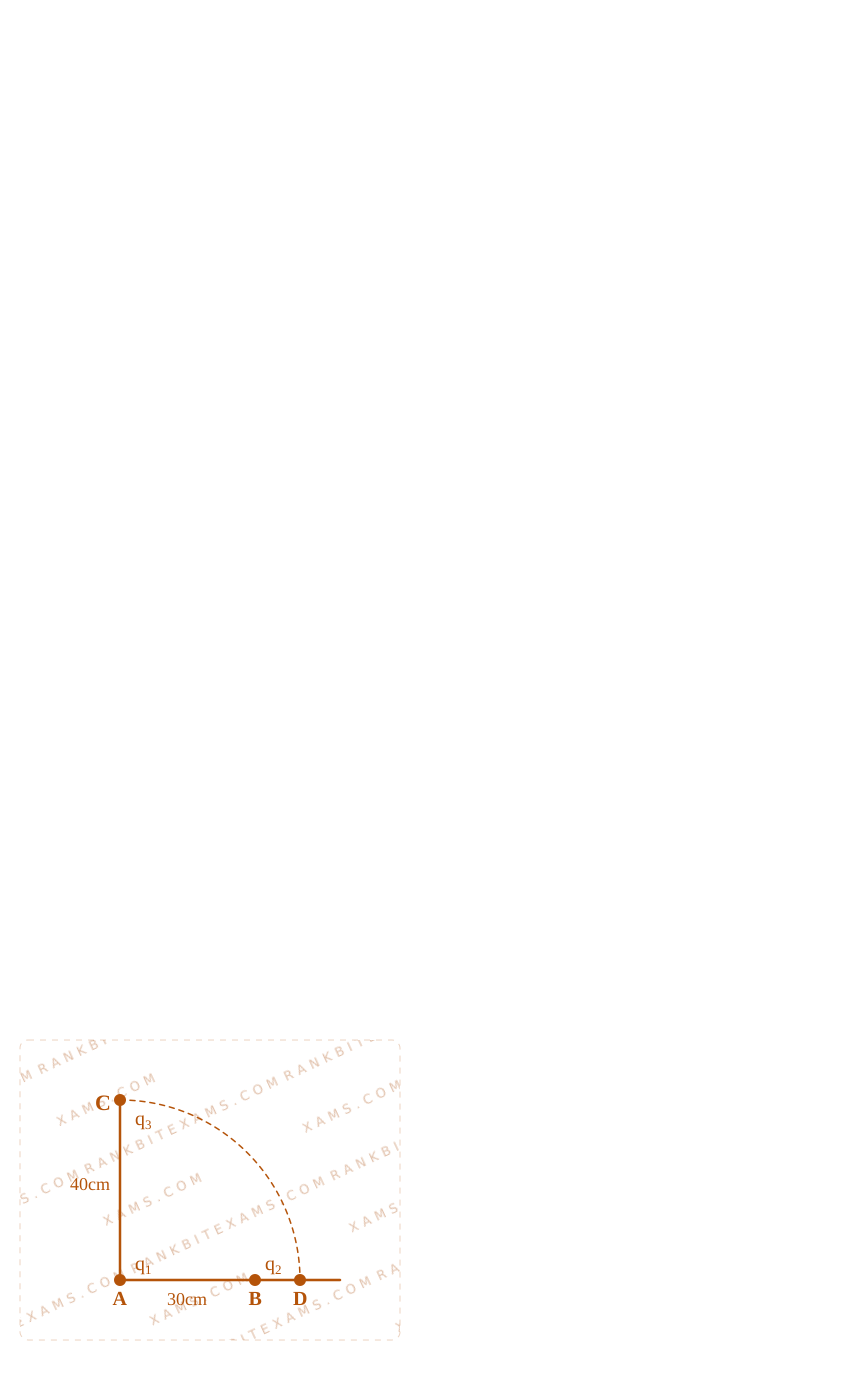
Let point A$A$ hold charge q₁$q_1$ and B$B$ hold q₂$q_2$ separated by 30 ~cm = 0.3 ~m$30 \mathrm{~cm} = 0.3 \mathrm{~m}$.
- The path of q₃$q_3$ is a circular arc of radius R = 40 ~cm = 0.4 ~m$R = 40 \mathrm{~cm} = 0.4 \mathrm{~m}$ centered at A$A$. Thus, distance of C$C$ and D$D$ from q₁$q_1$ is constant:
r1C = r1D = 0.4 ~m$$r_{1C} = r_{1D} = 0.4 \mathrm{~m}$$
- Distance of C$C$ from q₂$q_2$ (B$B$):
r2C = √(AC² + AB²) = √(40² + 30²) = 50 ~cm = 0.5 ~m$$r_{2C} = \sqrt{AC^2 + AB^2} = \sqrt{40^2 + 30^2} = 50 \mathrm{~cm} = 0.5 \mathrm{~m}$$
- Distance of D$D$ from q₂$q_2$ (B$B$):
r2D = AD - AB = 40 cm - 30 cm = 10 cm = 0.1 m$$r_{\text{2D}} = \text{AD} - \text{AB} = 40\text{ cm} - 30\text{ cm} = 10\text{ cm} = 0.1\text{ m}$$
Step 1: Calculate Potentials
Potential at C$C$ due to q₁$q_1$ and q₂$q_2$:
VC = (1)/(4πε₀) ( (q₁)/(0.4) + (q₂)/(0.5) )$$V_C = \frac{1}{4\pi\epsilon_0} \left( \frac{q_1}{0.4} + \frac{q_2}{0.5} \right)$$
Potential at D$D$ due to q₁$q_1$ and q₂$q_2$:
VD = (1)/(4πε₀) ( (q₁)/(0.4) + (q₂)/(0.1) )$$V_D = \frac{1}{4\pi\epsilon_0} \left( \frac{q_1}{0.4} + \frac{q_2}{0.1} \right)$$
Step 2: Difference in Potential Energy
The potential difference is:
VD - VC = (1)/(4πε₀) ( (q₂)/(0.1) - (q₂)/(0.5) ) = (q₂)/(4πε₀) [10 - 2] = (8q₂)/(4πε₀)$$V_D - V_C = \frac{1}{4\pi\epsilon_0} \left( \frac{q_2}{0.1} - \frac{q_2}{0.5} \right) = \frac{q_2}{4\pi\epsilon_0} [10 - 2] = \frac{8q_2}{4\pi\epsilon_0}$$
(Notice that the potential contribution of q₁$q_1$ cancels out because C$C$ and D$D$ are equidistant from q₁$q_1$).
The change in potential energy is:
Δ U = q₃ (VD - VC) = (q₃ (8q₂))/(4πε₀)$$\Delta U = q_3 (V_D - V_C) = \frac{q_3 (8q_2)}{4\pi\epsilon_0}$$
Comparing with (q₃ K)/(4πε₀)$\frac{q_3 K}{4\pi\epsilon_0}$ yields K = 8q₂$K = 8q_2$.
Pattern Recognition
Sees: Arc path centered on one of the charges.
Shortcut: Since the path is circular about q₁$q_1$, q₁$q_1$ contributes nothing to the potential difference between the end points. The entire change in potential energy is due to q₂$q_2$. The distance difference translates to potential difference Δ V = q₂ ((1)/(0.1) - (1)/(0.5)) = 8q₂$\Delta V = q_2 \left(\frac{1}{0.1} - \frac{1}{0.5}\right) = 8q_2$, so K = 8q₂$K = 8q_2$.
Chapter Mix
Class 12 Physics: Electrostatic Potential and Capacitance