
JEE Main · Physics ↓ Falling

Work, Energy and Power appeared 31 times across 3 years — 3.6% of Physics. This question is from Elastic Collisions in One Dimension.

Year 2026 2025 2024 Total
Questions 8 15 8 31

Given below are two statements. One is labelled as Assertion (A) and the other is labelled as Reason (R). Assertion (A): Three identical spheres of same mass undergo one dimensional motion as shown in figure with initial velocities vA = 5~m/s, vB = 2~m/s, vC = 4~m/s. If we wait sufficiently long for elastic collision to happen, then vA = 4~m/s, vB = 2~m/s, vC = 5~m/s will be the final velocities. Reason (R): In an elastic collision between identical masses, two objects exchange their velocities. In the light of the above statements, choose the correct answer from the options given below:

Solution & Explanation

Related Formula
v₁' = v₂ and v₂' = v₁

for perfectly elastic collision (e=1) when masses are identical (m₁ = m₂).

Core Logic

Reason (R) states that identical masses exchange their velocities during elastic collision, which is mathematically correct.

Let us trace the sequence of collisions chronologically:

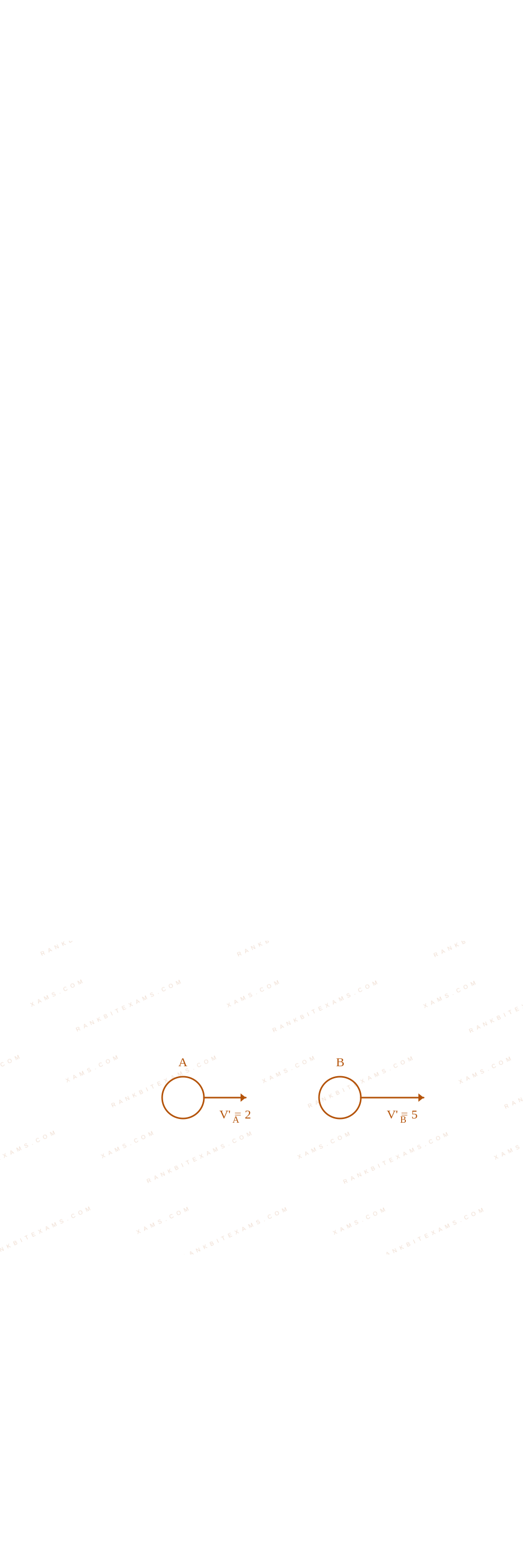
  • Since vA = 5~m/s and vB = 2~m/s, sphere A collides with sphere B. After this collision, they swap velocities:
vA' = 2~m/s, vB' = 5~m/s
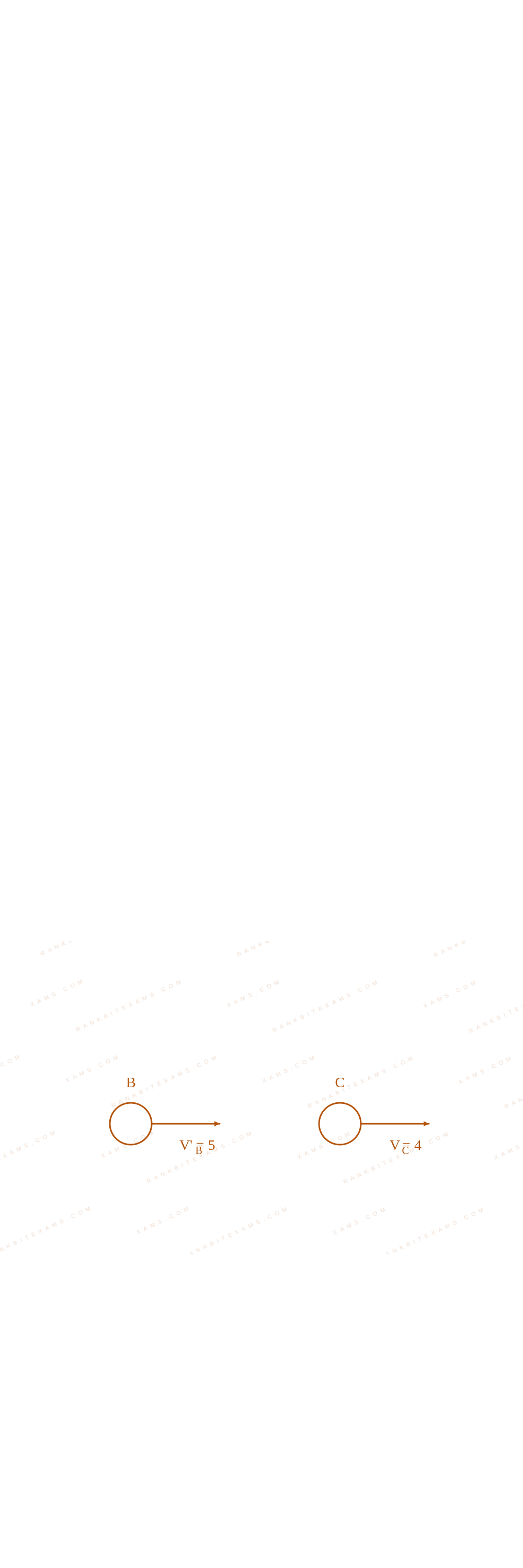
  • Now sphere B has velocity vB' = 5~m/s and sphere C has vC = 4~m/s. Sphere B will collide with C. After swapping:
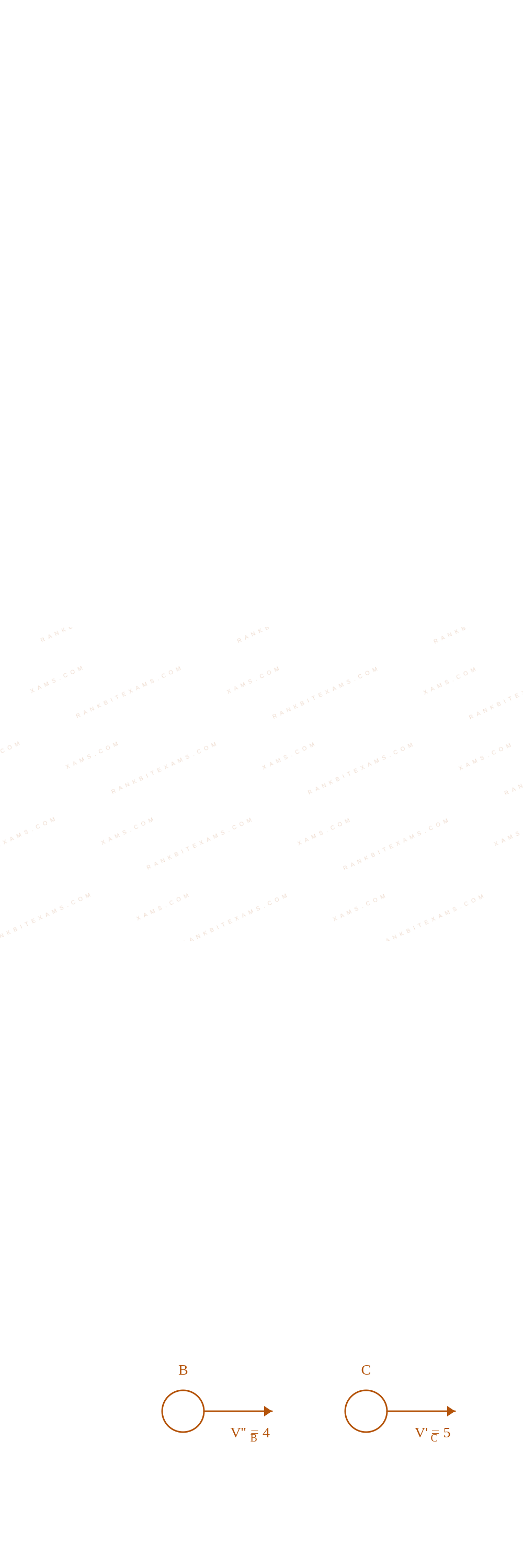
vB'' = 4~m/s, vC' = 5~m/s
  • Looking at the values now: vA' = 2~m/s and vB'' = 4~m/s. No more collisions occur.
  • Therefore, the final velocities are vA = 2~m/s, vB = 4~m/s, vC = 5~m/s. The values given in Assertion (A) are wrong. Hence, (A) is false but (R) is true.

    Elastic Collisions Step 1 diagram for Q11 - JEE Main 2025 Evening
    Elastic Collisions Step 1 diagram for Q11 - JEE Main 2025 Evening
    Elastic Collisions Step 1 diagram for Q11 - JEE Main 2025 Evening
    Elastic Collisions Step 1 diagram for Q11 - JEE Main 2025 Evening
    Elastic Collisions Step 1 diagram for Q11 - JEE Main 2025 Evening
    Elastic Collisions Step 1 diagram for Q11 - JEE Main 2025 Evening
    Elastic Collisions Step 1 diagram for Q11 - JEE Main 2025 Evening
    Elastic Collisions Step 1 diagram for Q11 - JEE Main 2025 Evening

Pattern Recognition

Velocity exchange happens pairwise in sequential order. Do not try to solve simultaneous conservation laws across all three blocks at once; handle each collision step-by-step from left to right.

Chapter Mix

Class 11 Physics: Work, Energy and Power

Reference Study Guides

More Work, Energy and Power Previous-Year Questions — Page 7

Q49 jee_main_2024_31_jan_morning Conservation Of Momentum
An artillery piece of mass M₁ fires a shell of mass M₂ horizontally. Instantaneously after the firing, the ratio of kinetic energy of the artillery and that of the shell is :
  • A. M₁ / (M₁ + M₂)
  • B. (M₂)/(M₁)
  • C. M₂ / (M₁ + M₂)
  • D. (M₁)/(M₂)

Solution

Related Formula
KE = (p²)/(2m)
Core Logic

By conservation of linear momentum (since no external horizontal force acts on the system):

0 = M₁ v₁ + M₂ v₂ | p₁| = | p₂| = p

Both the artillery and the shell acquire the exact same magnitude of momentum during firing.

Step 2: Kinetic Energy Ratio

The kinetic energy is related to momentum by KE = (p²)/(2m). Since p is identical for both bodies:

KE ∝ (1)/(m)

Therefore, the ratio of kinetic energy of the artillery (M₁) to the shell (M₂) is:

KE₁KE₂ = ((p²)/(2M₁))/((p²)/(2M₂)) = (M₂)/(M₁)
Chapter Mix

Class 11 Physics: Work, Energy And Power

More Work, Energy and Power Questions — jee_main_2025_29_jan_evening

Practice all Work, Energy and Power previous-year questions →

Rankbit System
JEE Physics: Waves (+15.5%) | Electrostatics: Concentric Shells (-29.7%) | Modern Physics: Photoelectric Clones (+34.2%) | Mathematics: Definite Integrals (+18.1%) | Chemistry: Coordination Splitting (-11.4%) | JEE Physics: Waves (+15.5%) | Electrostatics: Concentric Shells (-29.7%) | Modern Physics: Photoelectric Clones (+34.2%) | Mathematics: Definite Integrals (+18.1%) | Chemistry: Coordination Splitting (-11.4%)