
JEE Main · Physics → Steady

System of Particles and Rotational Motion appeared 58 times across 3 years — 6.7% of Physics. This question is from Angular Momentum of a System of Particles.

Year 2026 2025 2024 Total
Questions 20 27 11 58

Three equal masses m are kept at vertices (A, B, C) of an equilateral triangle of side a in free space. At t = 0 , they are given an initial velocity VA = V₀ AC , VB = V₀ BA and VC = V₀ CB . Here, AC, CB and BA are unit vectors along the edges of the triangle. If the three masses interact gravitationally, then the magnitude of the net angular momentum of the system at the point of collision is:
Angular Momentum of a System of Particles diagram for Q15 - JEE Main 2025 Evening
The graphic exhibits three mass particles at the vertices of an equilateral triangle with velocity vectors pointed along the cyclic boundary directions.

Solution & Explanation

Related Formula
L = Σ ( rᵢ × m vᵢ) τₑₓₜ = d Ldt
Core Logic

Since the three masses interact purely through mutual internal gravitational forces, the net external torque acting on the system about any central reference point is zero:

τₑₓₜ = 0 Linitial = Lfinal

Let us compute the total angular momentum about the centroid of the equilateral triangle:

Angular Momentum Calculation Geometry diagram for Q15 - JEE Main 2025 Evening
The graphic exhibits three mass particles at the vertices of an equilateral triangle with velocity vectors pointed along the cyclic boundary directions.
From trigonometry, the perpendicular distance from the centroid to the velocity vector along any edge is:

r⊥ = a2√(3)

The initial angular momentum for one mass about the centroid is L₁ = m V₀ r⊥. Since all three particles move cyclically in the same direction, their angular momenta reinforce cleanly:

Lₙₑₜ = 3 · (m V₀ a2√(3)) = 32√(3) m V₀ a = √(3)2 a m V₀

By conservation of angular momentum, this configuration value remains unchanged up to the point of collision.

Pattern Recognition

Mutual internal central forces can never alter the angular momentum of a system. Hence, the solution completely reduces to measuring the static configuration values at t=0 about the center of mass symmetry.

Chapter Mix

Class 11 Physics: System of Particles and Rotational Motion Class 11 Physics: Gravitation

Reference Study Guides

More System of Particles and Rotational Motion Previous-Year Questions — Page 2

Q49 jee_main_2026_22_january_morning Moment of Inertia of Circular Discs
A circular disc has radius R₁ and thickness T₁. Another circular disc made of the same material has radius R₂ and thickness T₂. If the moment of inertia of both discs are same and R₁R₂ = 2 then T₁T₂ = (1)/(α). The value of α is \_\_\_\_.
Numerical Answer. Answer: 16 to 16

Solution

Related Formula
I = (mR²)/(2), m = π R² T ρ
Core Logic

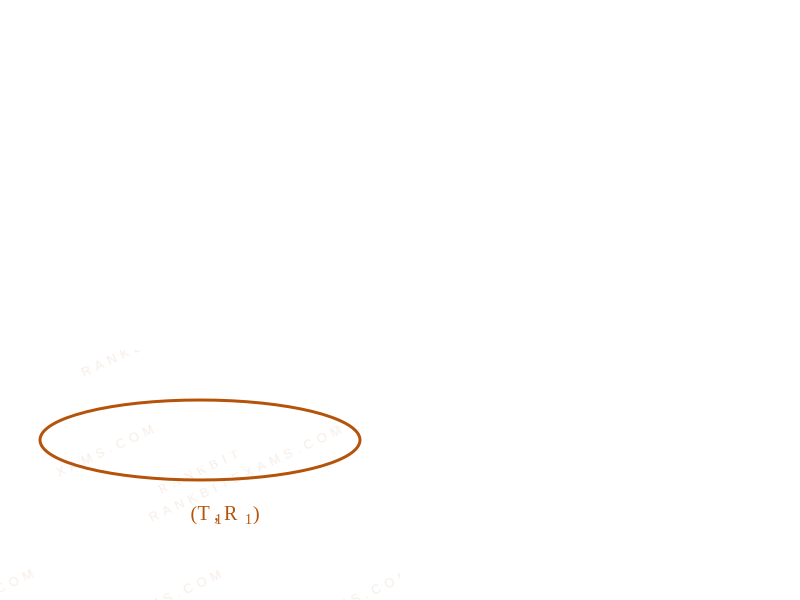
Solution disc moment of inertia diagram for Q49 - JEE Main 2026 Morning

Mass of discs:

m₁ = π R₁² T₁ ρ, m₂ = π R₂² T₂ ρ

Moments of inertia:

I₁ = (m₁ R₁²)/(2), I₂ = (m₂ R₂²)/(2)

Equating I₁ = I₂:

(π R₁² T₁ ρ R₁²)/(2) = (π R₂² T₂ ρ R₂²)/(2) (T₁)/(T₂) = ((R₂)/(R₁))⁴ = ((1)/(2))⁴ = (1)/(16)

Therefore, α = 16.

Pattern Recognition

Sees: Equal moment of inertia for two discs of different radii and thicknesses. Shortcut: Equate mR² expressions and substitute radius ratio (R₁)/(R₂) = 2. Check: Numerical answer is 16. ✓

Chapter Mix

Class 11 Physics: Rotational Motion
Q29 jee_main_2026_22_january_evening Angular Momentum Conservation
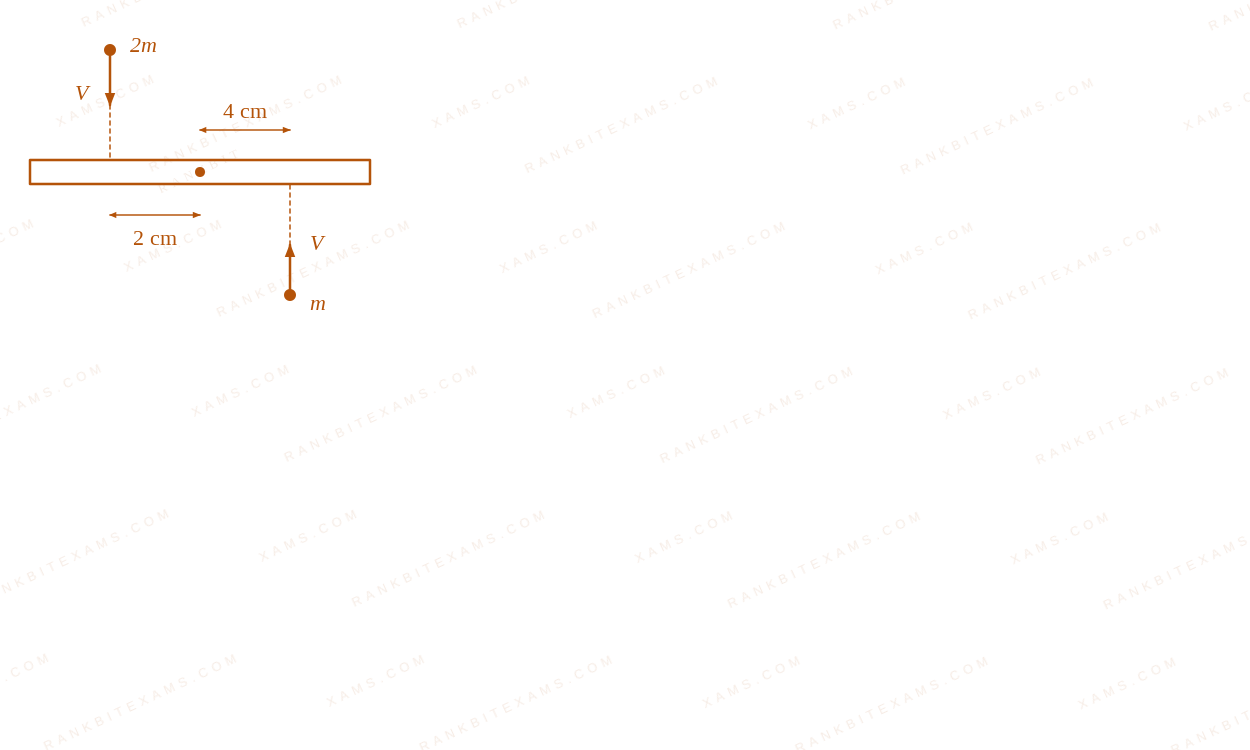
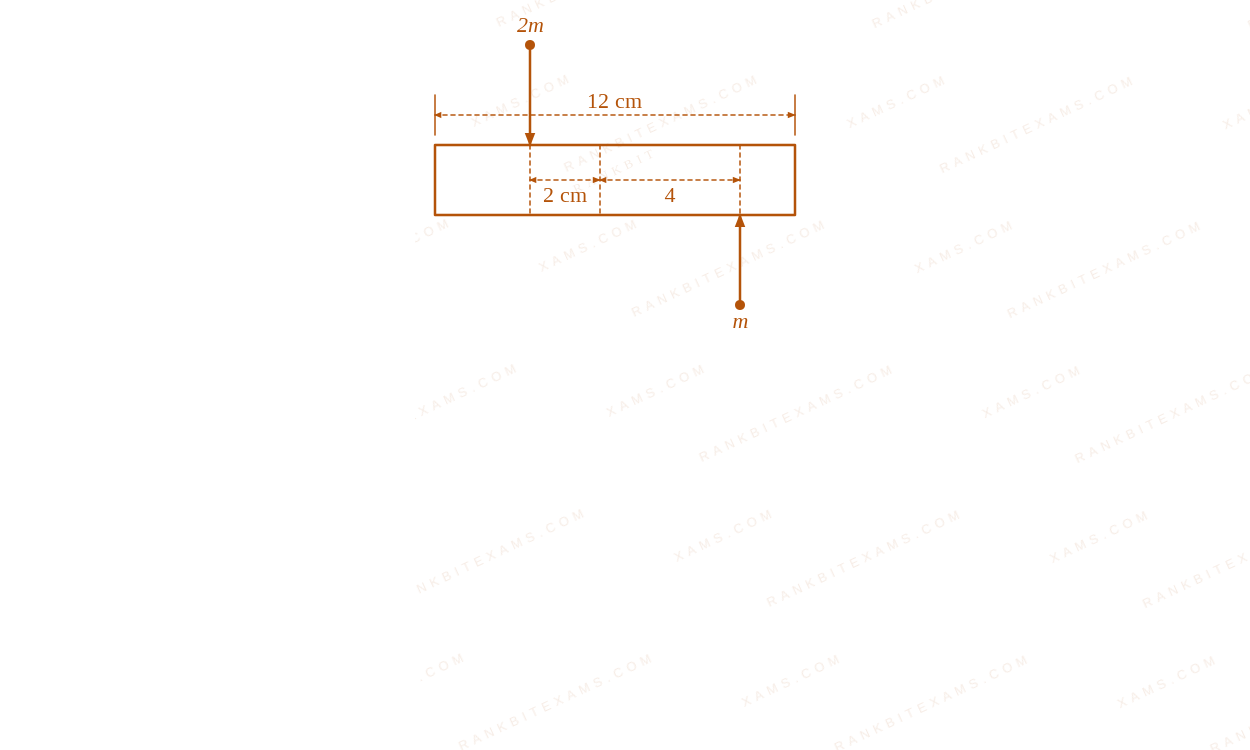
A uniform bar of length 12 cm and mass 20 m lies on a smooth horizontal table. Two point masses m and 2 m are moving in opposite directions with same speed of v and in the same plane as the bar, as shown in figure. These masses strike the bar simultaneously and get stuck to it. After collision the entire system is rotating with angular frequency ω. The ratio of v and ω is :
Angular momentum collision diagram for Q29 - JEE Main 2026 Evening
The figure illustrates a uniform bar of length 12 cm with two point masses m and 2m approaching it perpendicularly from opposite directions.
  • A. 33
  • B. 2√(88)
  • C. 66
  • D. 32

Solution

Related Formula

Lᵢ = Lf

I = M Lbar²12 + Σ mᵢ rᵢ²
Core Logic

Applying angular momentum conservation about the center of mass of the rod:

Lᵢ = m · v · 4 + 2m · v · 2

Calculating total moment of inertia Ifinal after collision:

Ifinal = ( (20m(12)²)/(12) + m(4)² + 2m(2)² ) Ifinal = (240m + 16m + 8m) = 264m

Equating initial and final angular momentum:

4mv + 4mv = 264m · ω 8v = 264 ω (v)/(ω) = (264)/(8) = 33

Rotational dynamics post-collision diagram for Q29 - JEE Main 2026 Evening
The figure illustrates a uniform bar of length 12 cm with two point masses m and 2m approaching it perpendicularly from opposite directions.

Step 1: Final Conclusion

The ratio (v)/(ω) is 33.

Pattern Recognition

Collision on rotating bar: Conserve angular momentum about COM of rod since net external torque about COM is zero during collision.

Chapter Mix

Class 11 Physics: System of Particles and Rotational Motion

Q45 jee_main_2026_22_january_evening Kinetic Energy of Multi-Particle Systems
Given below are two statements : Statement I : For a mechanical system of many particles total kinetic energy is the sum of kinetic energies of all the particles. Statement II : The total kinetic energy can be the sum of kinetic energy of the center of mass w.r.t. to the origin and the kinetic energy of all the particles w.r.t. the center of mass as the reference. In the light of the above statements, choose the correct answer from the options given below :
  • A. Both Statement I and Statement II are true
  • B. Statement I is true but Statement II is false
  • C. Statement I is false but Statement II is true
  • D. Both Statement I and Statement II are false

Solution

Related Formula
Ktotal = Σ (1)/(2) mᵢ vᵢ² Ktotal = (1)/(2) Mtotal vcm² + Krel, cm
Core Logic

Evaluating Statement I: By definition, total kinetic energy of a discrete system of particles is scalar sum of kinetic energies of individual particles: KE = Σ (1)/(2)mᵢ vᵢ². Statement I is true.

Evaluating Statement II: According to König's theorem, total kinetic energy breaks down into kinetic energy of COM translation plus internal kinetic energy relative to COM:

KE = (1)/(2)(m₁+m₂) vcm² + (1)/(2) (m₁ m₂)/(m₁+m₂) | v₁ - v₂|²

Statement II is also true.

Step 1: Final Conclusion

Both Statement I and Statement II are true.

Pattern Recognition

König's Theorem for system of particles: Ktotal = Kcm + Kw.r.t cm. Both definitions represent valid expressions for mechanical energy.

Chapter Mix

Class 11 Physics: System of Particles and Rotational Motion

Q47 jee_main_2026_22_january_evening Pulley-Mass System Dynamics
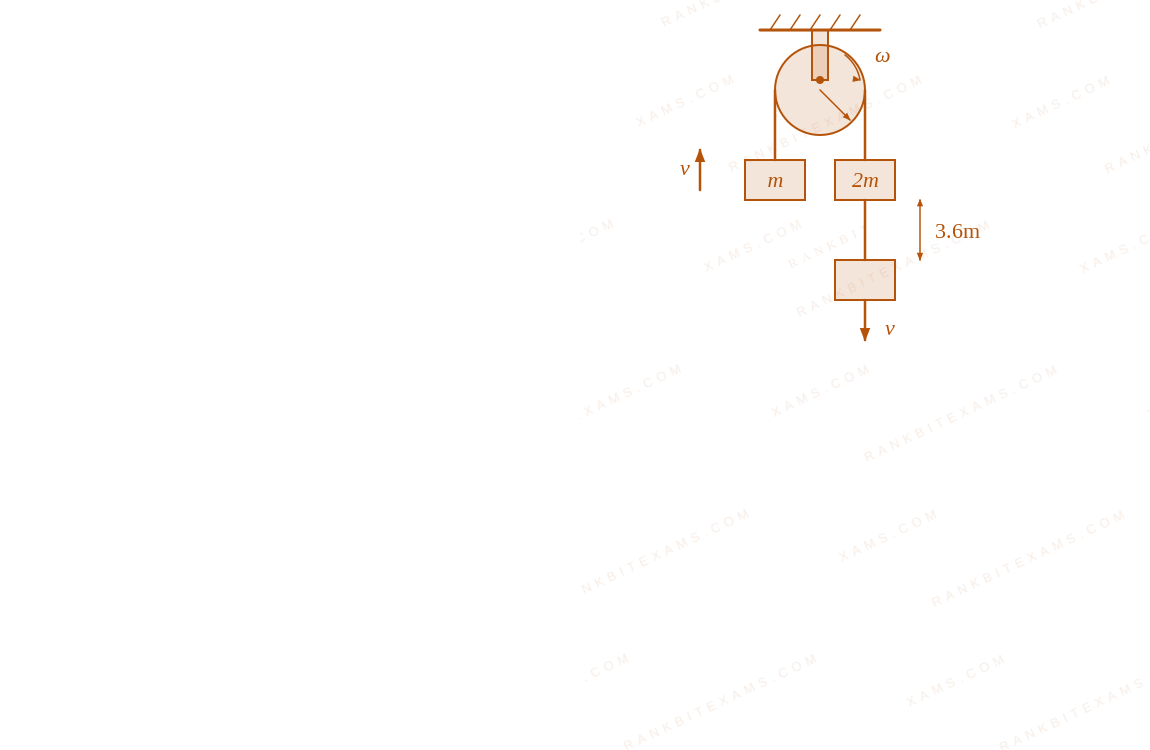
Two masses m and 2m are connected by a light string going over a pulley (disc) of mass 30m with radius r = 0.1 m. The pulley is mounted in a vertical plane and it is free to rotate about its axis. The 2m mass is released from rest and its speed when it has descended through a height of 3.6 m is ____ m/s. (Assume string does not slip and g = 10 m/s²)
Numerical Answer. Answer: 2 to 2

Solution

Related Formula
Δ U + Δ K = 0 Ipulley = (1)/(2) M R² = (1)/(2) (30m) R² = 15m R² ω = (v)/(R)
Core Logic

Using law of conservation of mechanical energy:

Loss in potential energy = Gain in kinetic energy

2m g h - m g h = (1)/(2) m v² + (1)/(2) (2m) v² + (1)/(2) I ω² m g h = (3)/(2) m v² + (1)/(2) (15 m R²) ((v²)/(R²)) m g h = (3)/(2) m v² + (15)/(2) m v² = 9 m v² v = √((g h)/(9))

Substituting g = 10 ~m/s² and h = 3.6 ~m:

v = √((10 × 3.6)/(9)) = √((36)/(9)) = √(4) = 2 ~m/s

Pulley mass system energy conservation diagram for Q47 - JEE Main 2026 Evening

Step 1: Final Conclusion

The speed of the mass is 2 ~m/s.

Pattern Recognition

Energy conservation on pulley system: Net potential loss mgh = sum of linear and rotational kinetic energies 9mv² v = √(gh/9).

Chapter Mix

Class 11 Physics: System of Particles and Rotational Motion

Q33 jee_main_2026_23_january_morning Moment of Inertia
The moment of inertia of a square loop made of four uniform solid cylinders, each having radius R and length L (R < L) about an axis passing through the mid points of opposite sides, is (Take the mass of the entire loop as M):
  • A. (3)/(8)MR² +(7)/(12)ML²
  • B. (3)/(4)MR² +(1)/(6)ML²
  • C. (3)/(4)MR² +(7)/(12)ML²
  • D. (3)/(8)MR² +(1)/(6)ML²

Solution

Related Formula

For a solid cylinder: Parallel to its length passing through center: I = M'R²2 Perpendicular to length through center: I = M'R²4 + M'L²12 Parallel Axis Theorem: I = Icm + M'd²

Core Logic

The square loop is formed by four identical solid cylinders, each of mass M' = (M)/(4). The given axis passes through the mid-points of two opposite cylinders. This means two cylinders have the axis passing perpendicularly through their centers, and the other two cylinders are parallel to the axis at a distance of L/2.

Step 1: Moment of Inertia for cylinders bisected perpendicularly

For the two cylinders perpendicular to the axis of rotation:

I₁ = 2 × ( M'R²4 + M'L²12)
Step 2: Moment of Inertia for cylinders parallel to axis

For the two cylinders parallel to the axis, distance d = L/2. Apply the parallel axis theorem:

I₂ = 2 × [ M'R²2 + M'((L)/(2))²]
Step 3: Total Moment of Inertia
Iₙₑₜ = I₁ + I₂ = 2( M'R²4 + M'L²12) + 2( M'R²2 + M'L²4) Iₙₑₜ = M'R²2 + M'L²6 + M'R² + M'L²2 Iₙₑₜ = 3M'R²2 + 4M'L²6 = 3M'R²2 + 2M'L²3
Step 4: Substitute Total Mass

Substitute M' = M/4:

I = (3)/(2)((M)/(4))R² + (2)/(3)((M)/(4))L² I = (3)/(8)MR² + (1)/(6)ML²
Pattern Recognition

Sees: "square loop of cylinders" + "mass M of entire loop" → Always remember Mᵢ = M/4. Calculate individual moment of inertia carefully considering whether the cylinder is oriented parallel or perpendicular.

Chapter Mix

Class 11 Physics: Systems of Particles and Rotational Motion

More System of Particles and Rotational Motion Questions — jee_main_2025_29_jan_evening

Practice all System of Particles and Rotational Motion previous-year questions →

Rankbit System
JEE Physics: Waves (+15.5%) | Electrostatics: Concentric Shells (-29.7%) | Modern Physics: Photoelectric Clones (+34.2%) | Mathematics: Definite Integrals (+18.1%) | Chemistry: Coordination Splitting (-11.4%) | JEE Physics: Waves (+15.5%) | Electrostatics: Concentric Shells (-29.7%) | Modern Physics: Photoelectric Clones (+34.2%) | Mathematics: Definite Integrals (+18.1%) | Chemistry: Coordination Splitting (-11.4%)