
JEE Main · Physics ↓ Falling

Kinematics appeared 38 times across 3 years — 4.4% of Physics. This question is from Relative Motion in One Dimension.

Year 2026 2025 2024 Total
Questions 8 16 14 38

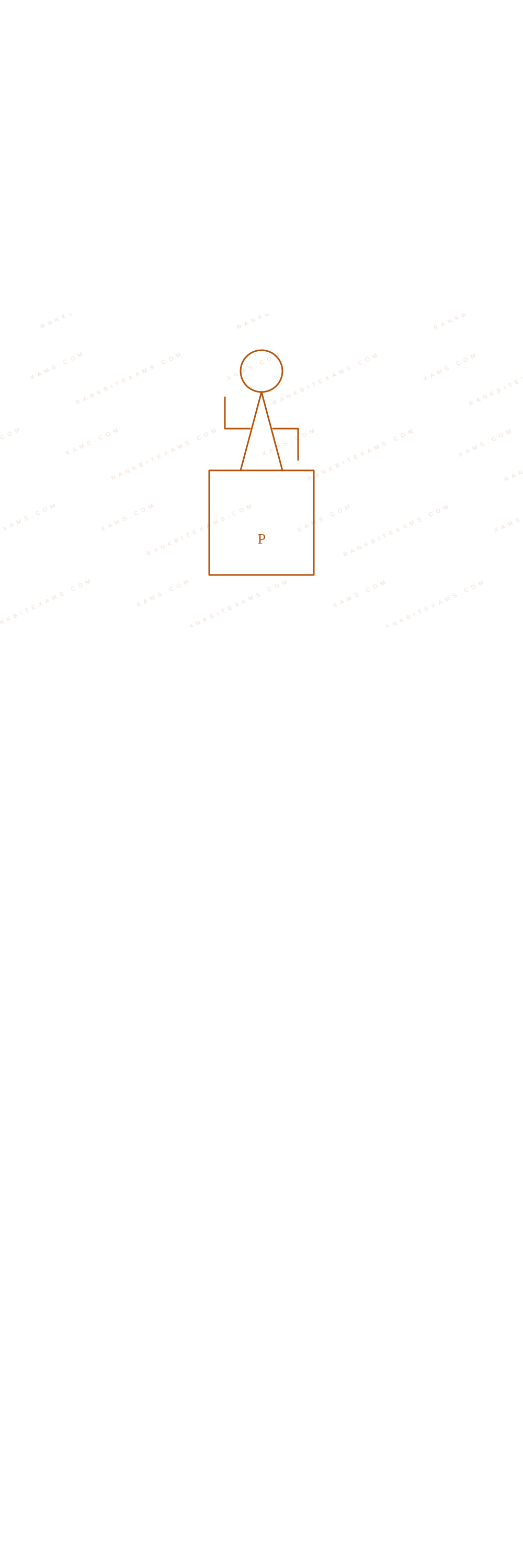
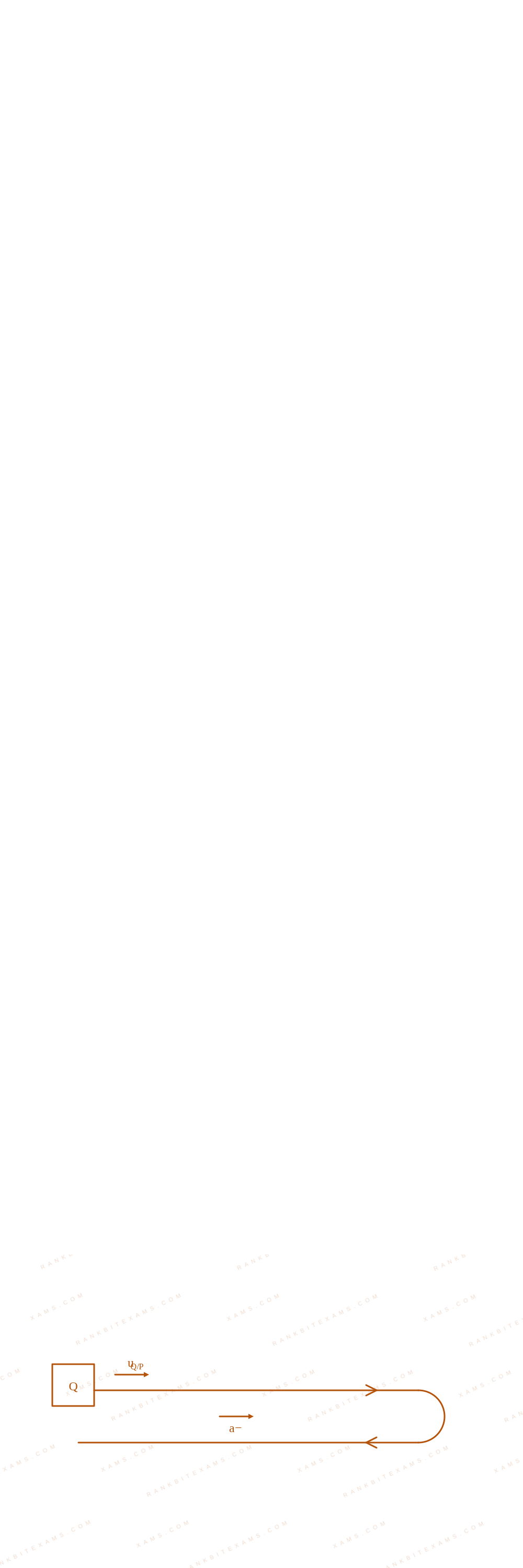
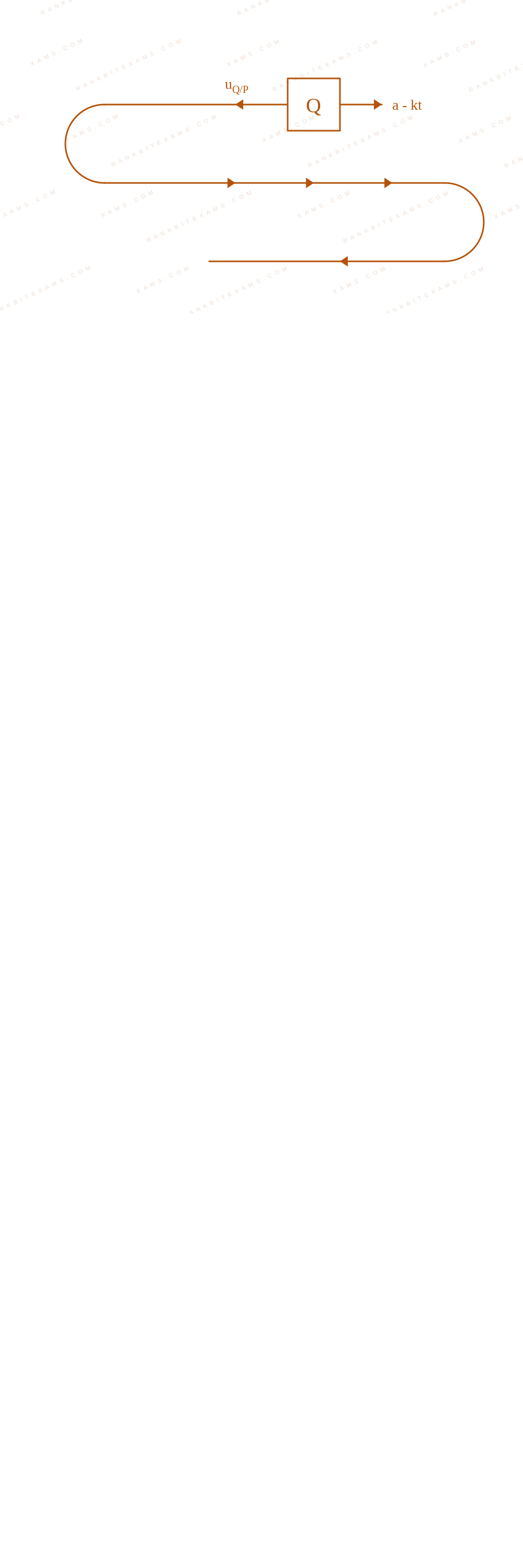
Two cars P and Q are moving on a road in the same direction. Acceleration of car P increases linearly with time whereas car Q moves with a glass constant acceleration. Both cars cross each other at time t = 0 , for the first time. The maximum possible number of crossing(s) (including the crossing at t = 0 ) is ______.

Numerical Answer Type:
Enter a numerical value Answer: 3 to 3 +4 marks

Solution & Explanation

Related Formula
aP = kt vP = (1)/(2)kt² + v0P xP = (1)/(6)kt³ + v0Pt + x₀ aQ = a vQ = at + v0Q xQ = (1)/(2)at² + v0Qt + x₀
Core Logic

To find the relative crossings, set the position functions equal: xP(t) = xQ(t).

(1)/(6)kt³ + v0Pt = (1)/(2)at² + v0Qt (1)/(6)kt³ - (1)/(2)at² + (v0P - v0Q)t = 0

This is a cubic polynomial equation in terms of time t. A cubic function can yield a maximum of 3 distinct real roots.

Relative Crossings Case 1 Curve diagram for Q25 - JEE Main 2025 Evening

Depending on the initial velocity profiles (v0P, v0Q), the curves can intersect at t=0 and potentially create up to two additional crossing paths downstream as acceleration profiles cross over. Thus, the maximum possible number of total crossings is exactly 3.

Pattern Recognition

Crossings correspond mathematically to intersections of relative displacement polynomials. A linear acceleration profile produces a cubic position curve (t³), which can cross a quadratic curve (t²) at up to 3 distinct coordinate points.

Chapter Mix

Class 11 Physics: Kinematics

Reference Study Guides

More Kinematics Previous-Year Questions — Page 8

Q44 jee_main_2024_31_jan_evening Vector Algebra
If two vectors A and B having equal magnitude R are inclined at an angle θ, then
  • A. | A - B| = √(2)R ((θ)/(2))
  • B. | A + B| = 2R ((θ)/(2))
  • C. | A + B| = 2R ((θ)/(2))
  • D. | A - B| = 2R ((θ)/(2))

Solution

Related Formula

The magnitude of the resultant vector is given by:

| Rᵣₑₛ| = √(A² + B² + 2AB θ)
Core Logic

Let | A| = | B| = R. Then for vector addition:

| A + B| = √(R² + R² + 2R² θ)
Step 1: Simplify Addition Form
| A + B| = √(2R² (1 + θ))

Using the trigonometric identity 1 + θ = 2 ² ((θ)/(2)):

| A + B| = √(2R² × 2 ² ((θ)/(2))) = 2R ((θ)/(2))
Step 2: Cross-check Subtraction Form

For subtraction:

| A - B| = √(R² + R² - 2R² θ) | A - B| = √(2R² (1 - θ)) = √(2R² × 2 ² ((θ)/(2))) = 2R ((θ)/(2))

Checking options, only | A + B| = 2R ((θ)/(2)) is correctly paired in the choice list.

Pattern Recognition

Standard geometry shortcut: Addition of two equal vectors yields a cosine half-angle dependency. Subtraction yields a sine half-angle dependency. (+ → ), (- → ).

Chapter Mix

Class 11 Physics: Motion in a Plane
Q jee_main_2024_31_jan_morning Projectile Motion
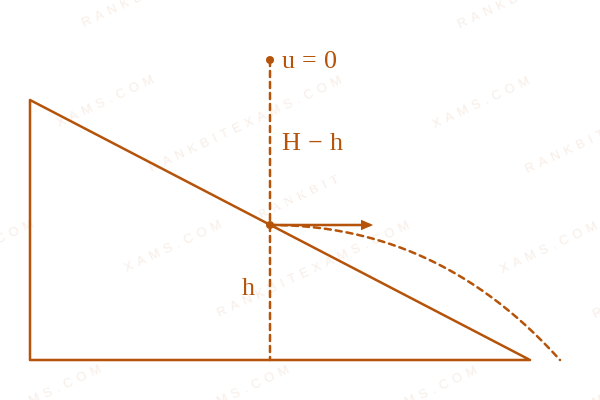
A body starts falling freely from height H hits an inclined plane in its path at height h. As a result of this perfectly elastic impact, the direction of the velocity of the body becomes horizontal. The value of (H)/(h) for which the body will take the maximum time to reach the ground is
Numerical Answer. Answer: 2 to 2

Solution

Related Formula
t = √((2d)/(g))
Core Logic

Projectile Motion diagram for Q55 - JEE Main 2024 Morning

The body falls freely from height H to height h. The distance fallen is (H - h). Time taken to fall this distance:

t₁ = √((2(H - h))/(g))

After elastic impact, the vertical velocity becomes zero (the entire velocity is directed horizontally). From height h, it now acts as a horizontal projectile. The time taken to reach the ground vertically from height h is:

t₂ = √((2h)/(g))

Total time of flight T = t₁ + t₂:

T = √((2(H - h))/(g)) + √((2h)/(g))
Step 2: Maximizing Time

To find the maximum time T, differentiate T with respect to h and equate to zero:

(dT)/(dh) = √((2)/(g)) ( -12√(H - h) + 12√(h) ) = 0 12√(h) = 12√(H - h) √(H - h) = √(h)

Squaring both sides: H - h = h H = 2h

(H)/(h) = 2
Chapter Mix

Class 11 Physics: Kinematics

Q33 jee_main_2024_31_jan_morning Differentiation In Kinematics
The relation between time 't' and distance 'x' is t = α x² + β x, where α and β are constants. The relation between acceleration (a) and velocity (v) is:
  • A. a = -2α v³
  • B. a = -5α v⁵
  • C. a = -3α v²
  • D. a = -4α v⁴

Solution

Related Formula
v = (dx)/(dt) a = (dv)/(dt) = v(dv)/(dx)
Step 1: Differentiate with respect to time

Given the equation:

t = α x² + β x

Differentiating with respect to time t:

(dt)/(dt) = (d)/(dt)(α x² + β x) 1 = 2α x (dx)/(dt) + β (dx)/(dt) 1 = (2α x + β) v v = (2α x + β)⁻¹
Step 2: Calculate Acceleration

Now, acceleration a = (dv)/(dt). Differentiating v with respect to time t:

a = (d)/(dt) [ (2α x + β)⁻¹ ] a = -1(2α x + β)⁻² · (d)/(dt)(2α x + β) a = -(2α x + β)⁻² · (2α) (dx)/(dt)

Substitute v and (2α x + β)⁻² = v²:

a = -(v²) · (2α) · v a = -2α v³
Pattern Recognition

Standard kinematic shortcut: Whenever t = Ax² + Bx, v = (2Ax+B)⁻¹ and a = -2A v³. Memorizing this directly saves derivation time during the exam.

Chapter Mix

Class 11 Physics: Kinematics

More Kinematics Questions — jee_main_2025_29_jan_evening

Practice all Kinematics previous-year questions →

Rankbit System
JEE Physics: Waves (+15.5%) | Electrostatics: Concentric Shells (-29.7%) | Modern Physics: Photoelectric Clones (+34.2%) | Mathematics: Definite Integrals (+18.1%) | Chemistry: Coordination Splitting (-11.4%) | JEE Physics: Waves (+15.5%) | Electrostatics: Concentric Shells (-29.7%) | Modern Physics: Photoelectric Clones (+34.2%) | Mathematics: Definite Integrals (+18.1%) | Chemistry: Coordination Splitting (-11.4%)
