Two cars P and Q are moving on a road in the same direction. Acceleration of car P increases linearly with time whereas car Q moves with a glass constant acceleration. Both cars cross each other at time t = 0$t = 0$ , for the first time. The maximum possible number of crossing(s) (including the crossing at t = 0$t = 0$ ) is ______.
This is a cubic polynomial equation in terms of time t$t$. A cubic function can yield a maximum of 3 distinct real roots.
Relative Crossings Case 1 Curve diagram for Q25 - JEE Main 2025 EveningRelative Crossings Case 1 Curve diagram for Q25 - JEE Main 2025 EveningRelative Crossings Case 1 Curve diagram for Q25 - JEE Main 2025 EveningRelative Crossings Case 1 Curve diagram for Q25 - JEE Main 2025 Evening
Depending on the initial velocity profiles (v0P, v0Q$v_{0P}, v_{0Q}$), the curves can intersect at t=0$t=0$ and potentially create up to two additional crossing paths downstream as acceleration profiles cross over. Thus, the maximum possible number of total crossings is exactly 3.
Pattern Recognition
Crossings correspond mathematically to intersections of relative displacement polynomials. A linear acceleration profile produces a cubic position curve (t³$t^3$), which can cross a quadratic curve (t²$t^2$) at up to 3 distinct coordinate points.
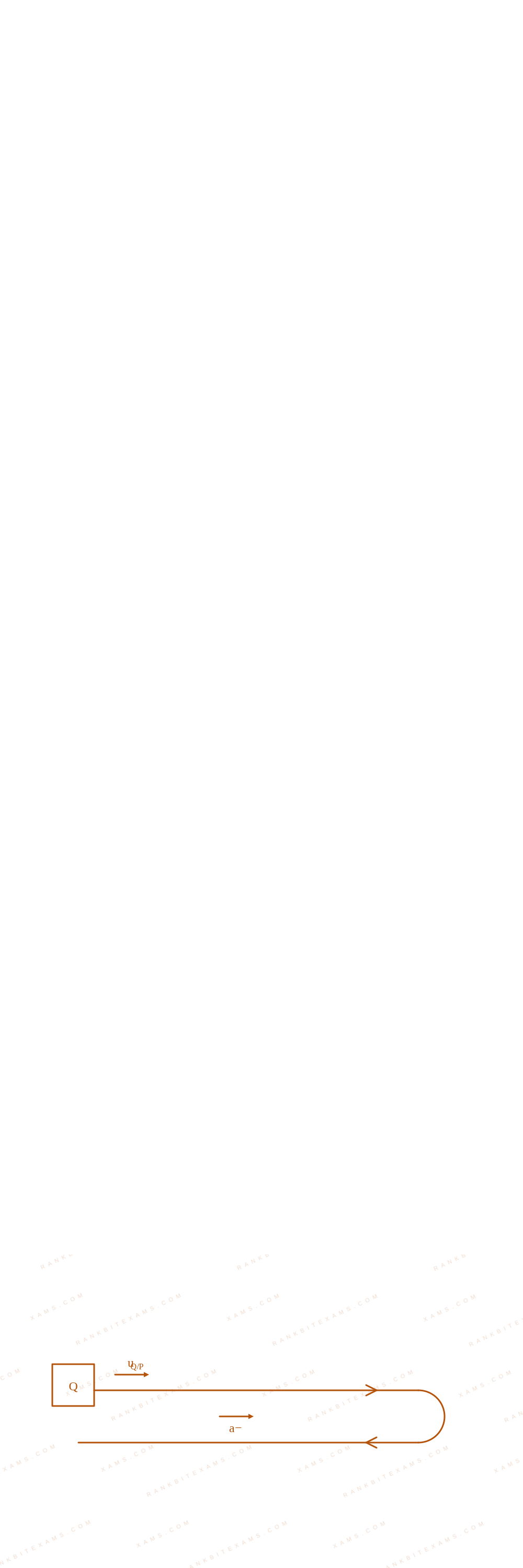
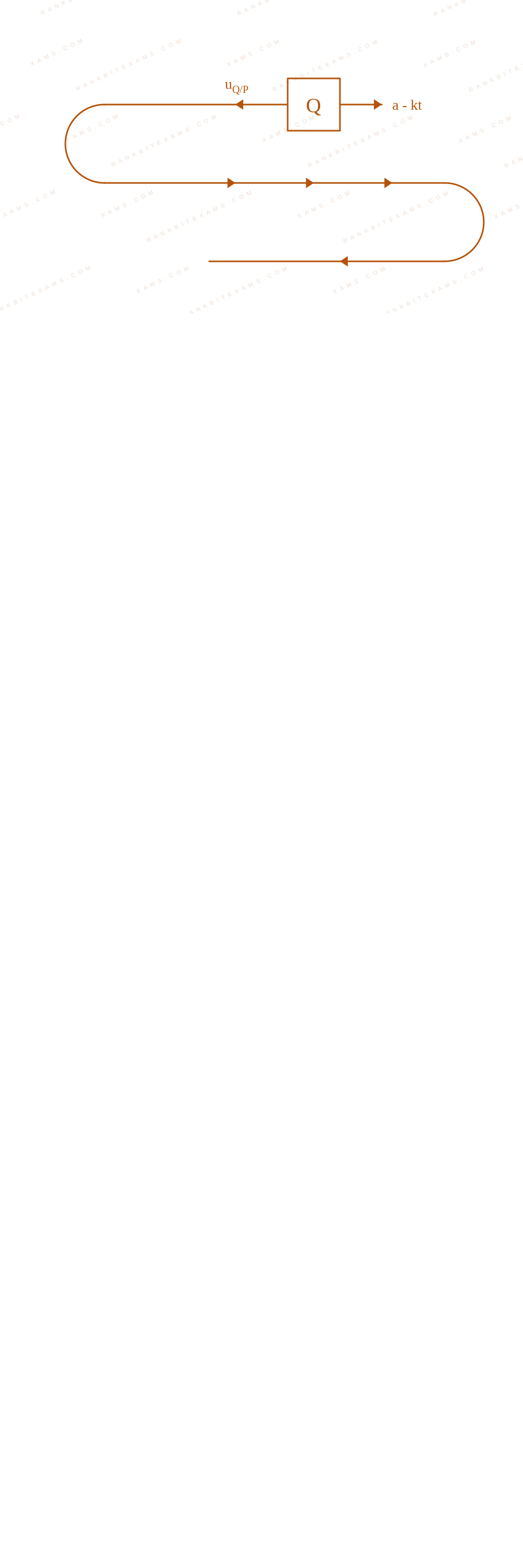
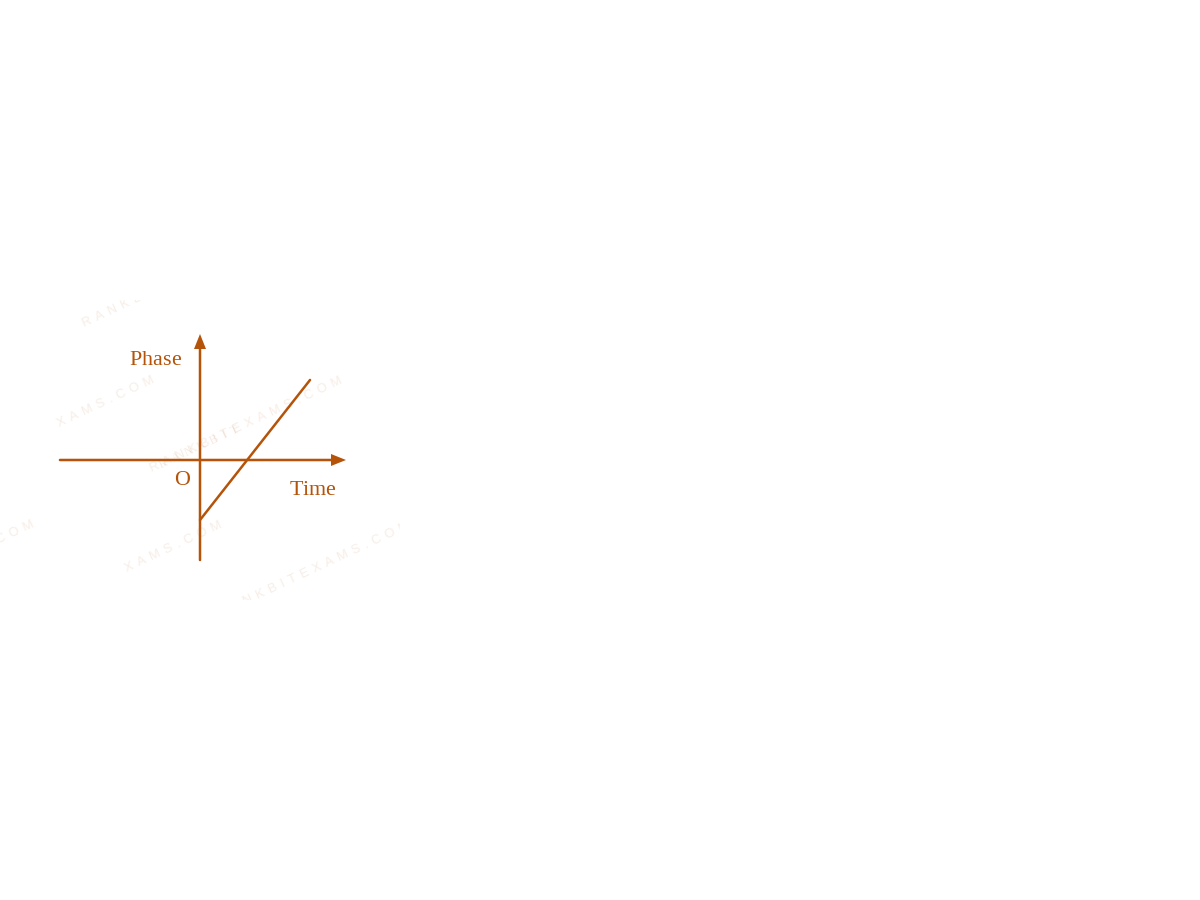
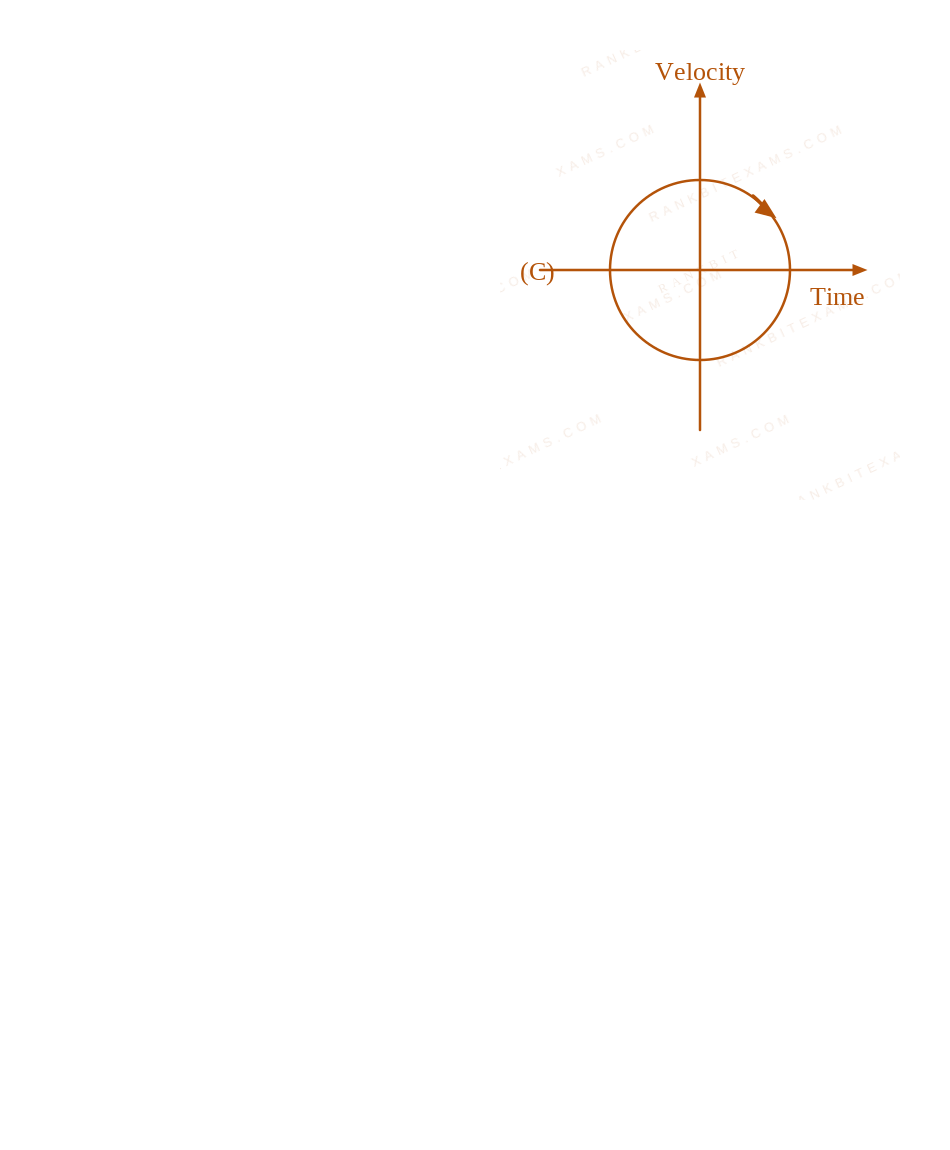
Which of the following curves possibly represent one-dimensional motion of a particle?
(A)
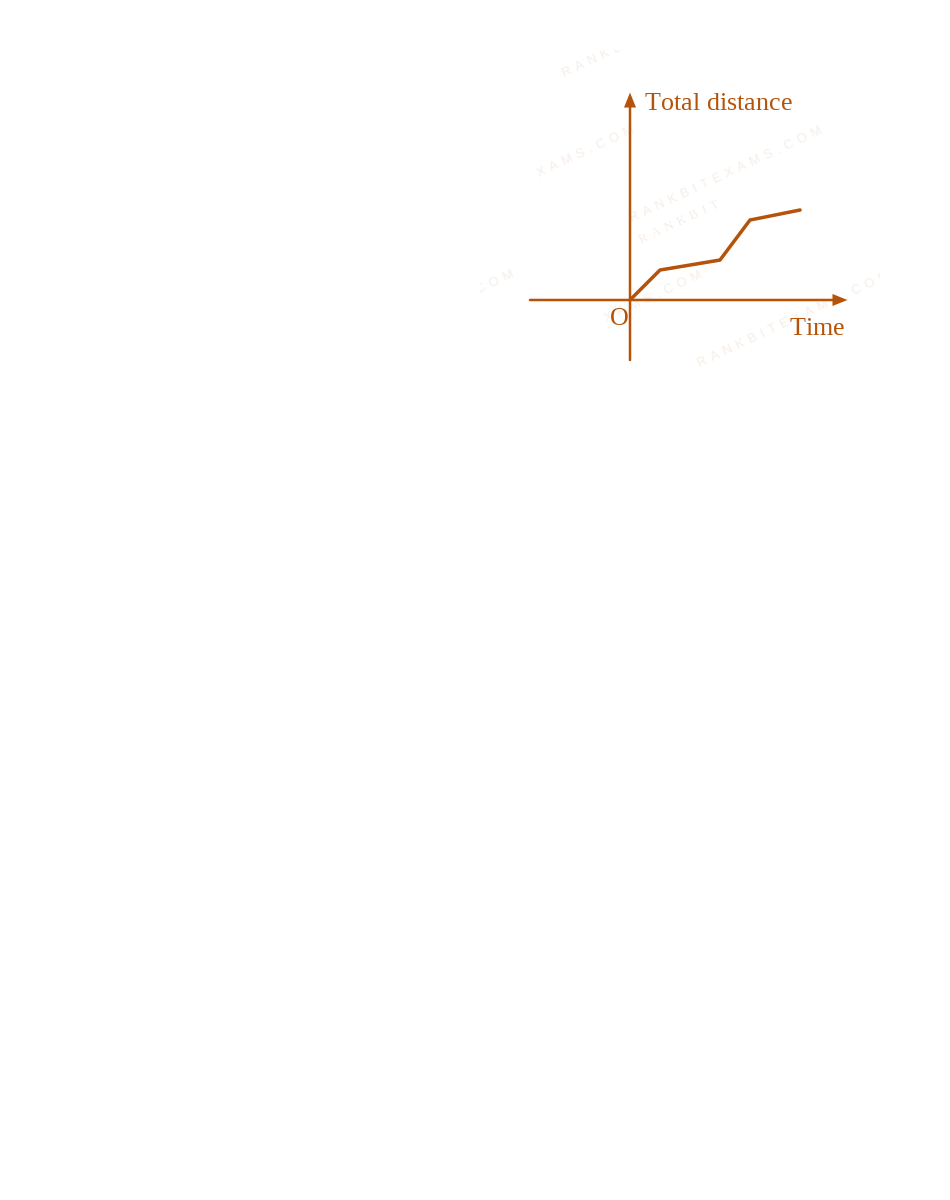
Displays graph A showing phase varying over time, graph B showing velocity versus displacement, graph C showing velocity versus negative time, and graph D showing distance versus time.
(B)
Displays graph A showing phase varying over time, graph B showing velocity versus displacement, graph C showing velocity versus negative time, and graph D showing distance versus time.
(C)
Displays graph A showing phase varying over time, graph B showing velocity versus displacement, graph C showing velocity versus negative time, and graph D showing distance versus time.
(D)
Displays graph A showing phase varying over time, graph B showing velocity versus displacement, graph C showing velocity versus negative time, and graph D showing distance versus time.
Choose the correct answer from the options given below:
A. A, B and D only
B. A, B and C only
C. A and B only
D. A, C and D only
Solution
Related Formula
For realistic physical motion in one dimension:
Time t$t$ can never be negative during a normal positive time sequence, and cannot flow backwards.
Total distance covered can never decrease over time.
A particle cannot have two different values of position or velocity at the exact same instant of time.
Core Logic
Let us analyze each curve:
Curve (A) (Phase φ$\phi$ vs Time t$t$): Represents φ = kt + C$\phi = kt + C$, which is a valid linear relationship of phase over time (e.g., in Simple Harmonic Motion x = A (kt + C)$x = A\sin(kt + C)$). (Valid)
Curve (B) (Velocity v$v$ vs Displacement x$x$): A closed loop, which represents symmetric harmonic-type oscillation. For example, v² + ω² x² = const$v^2 + \omega^2 x^2 = \text{const}$ (ellipse) is a perfectly physically valid 1D SHM velocity-displacement phase portrait. (Valid)
Curve (C) (Velocity vs Time): The curve enters into the negative time quadrant. Time cannot go backwards or exist in negative values relative to starting sequence in standard physical scenarios. (Invalid)
Curve (D) (Total Distance vs Time): Represents total distance increasing over time. Total distance is a non-decreasing function of time (d(d)/dt ≥ 0$d(d)/dt \ge 0$). Thus, this curve is physically valid. (Valid)
Step 1: Conclusion
Therefore, curves A, B, and D possibly represent physical one-dimensional motion. The correct option is (1).
Pattern Recognition
Quick check for graph validity:
Time cannot run backwards (ruling out C).
Total distance can never decrease (D is valid because it strictly goes upwards).
v$v$ vs x$x$ can be circular/elliptical in SHM (B is valid).
Chapter Mix
Class 11 Physics: Motion in a Straight Line
Q19jee_main_2025_03_april_morningProjectile Motion Maximum Height
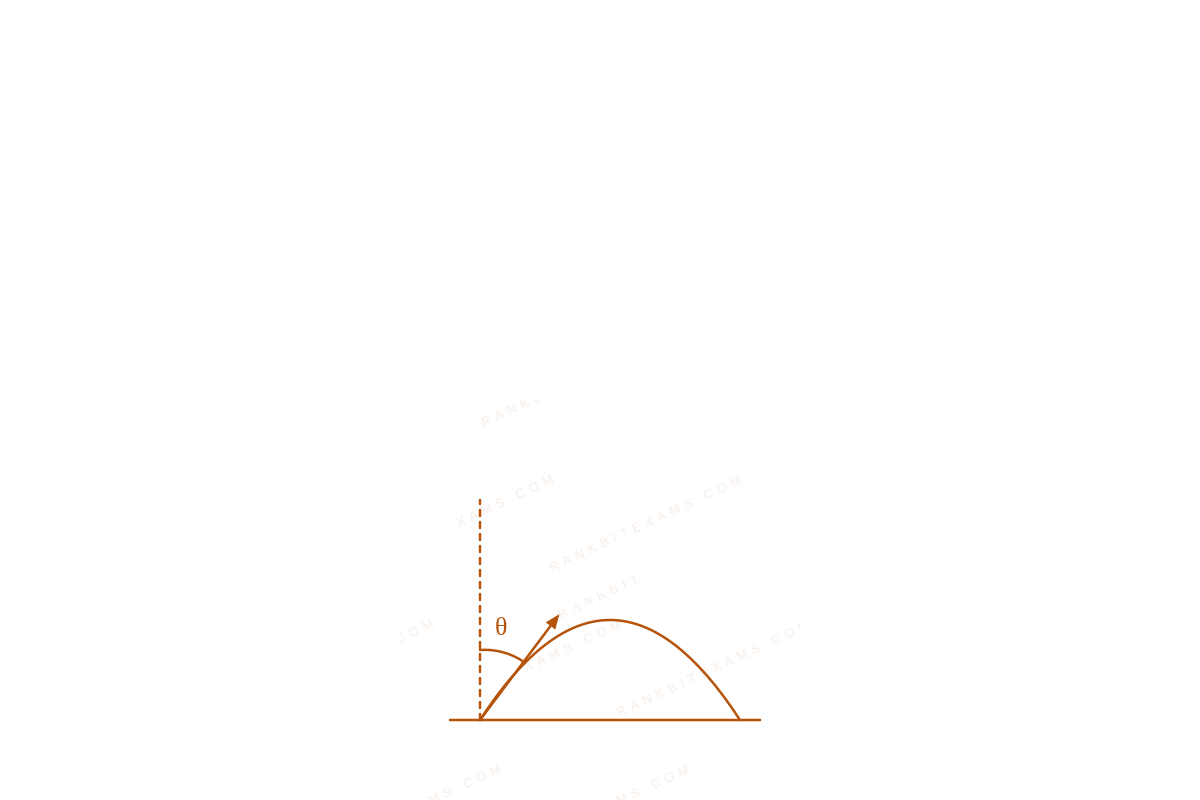
The angle of projection of a particle is measured from the vertical axis as φ$\phi$ and the maximum height reached by the particle is hm$h_m$. Here hm$h_m$ as function of φ$\phi$ can be presented as:
At φ = 90°$\phi = 90^{\circ}$ (fired horizontally along the ground):
hm(90°) = 0$$h_m(90^{\circ}) = 0$$
Let's evaluate the behavior of hm(φ)$h_m(\phi)$:
At small angles φ ≈ 0$\phi \approx 0$, the slope (d hm)/(dφ) = -(u²)/(2g) (2φ) ≈ 0$\frac{d h_m}{d\phi} = -\frac{u^2}{2g} \sin(2\phi) \approx 0$. This means the curve starts with a horizontal slope (flat top).
As φ$\phi$ increases towards 90°$90^{\circ}$, hm$h_m$ falls smoothly, reaching 0 at 90°$90^{\circ}$ with flat slope again.
This sinusoidal falloff perfectly matches Curve (3).
Curve plot of vertical height hm versus launch angle phi for Q19
Pattern Recognition
Always read the coordinate origin carefully! Measuring angle from the vertical instead of the horizontal turns ²θ$\sin^2\theta$ into ²φ$\cos^2\phi$. Checking extremes: vertical shot (0°$0^{\circ}$) yields maximum height, while flat shot (90°$90^{\circ}$) yields zero height.
Chapter Mix
Class 11 Physics: Motion in a Plane: Projectile Motion
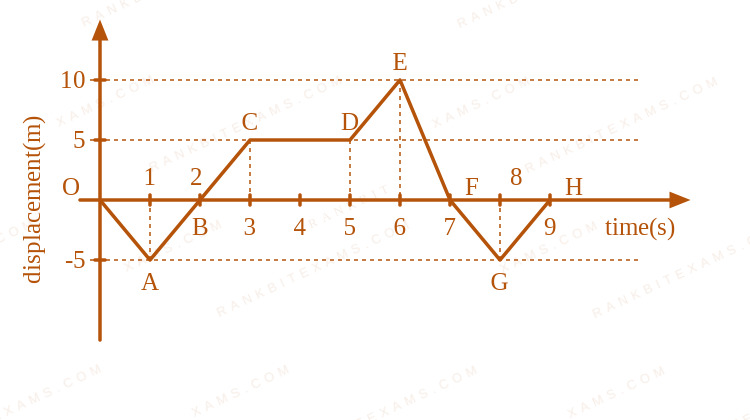
The displacement x$x$ versus time graph is shown below. A graph plotting displacement vs time tracking linear changes, plateaus, and reversals.
(A) The average velocity during 0 to 3 s is 10 m/s
(B) The average velocity during 3 to 5 s is 0 m/s
(C) The instantaneous velocity at t=2$t=2$ s is 5 m/s
(D) The average velocity during 5 to 7 s and instantaneous velocity at t=6.5$t=6.5$ s are equal
(E) The average velocity from t=0$t=0$ to t=9$t=9$ s is zero
Choose the correct answer from the options given below:
A. (A), (D), (E) only
B. (B), (C), (D) only
C. (B), (D), (E) only
D. (B), (C), (E) only
Solution
Related Formula
v = (Δ x)/(Δ t) = (xf - xᵢ)/(tf - tᵢ)$$\langle v \rangle = \frac{\Delta x}{\Delta t} = \frac{x_f - x_i}{t_f - t_i}$$vᵢₙₛₜ = (dx)/(dt) = slope of x-t graph$$v_{\text{inst}} = \frac{dx}{dt} = \text{slope of } x\text{-}t \text{ graph}$$
Core Logic
Let's test each statement using coordinates from the given graph:
For (A): At t=0, x=0$t=0, x=0$; at t=3, x=5$t=3, x=5$. v = (5-0)/(3) = (5)/(3) m/s ≠ 10 m/s$\langle v \rangle = \frac{5-0}{3} = \frac{5}{3}\text{ m/s} \neq 10\text{ m/s}$ (Incorrect).
For (B): At t=3, x=5$t=3, x=5$; at t=5, x=5$t=5, x=5$. v = (5-5)/(2) = 0 m/s$\langle v \rangle = \frac{5-5}{2} = 0\text{ m/s}$ (Correct).
Step 1: Evaluate Remaining Statements
For (C): Segment from 0 to 3s passes through points (0, -5)$(0, -5)$ or starts linearly. The slope from t=0$t=0$ to t=3$t=3$ can be calculated from the linear line segment: slope = (5 - (-10))/(3) = 5 m/s$\text{slope} = \frac{5 - (-10)}{3} = 5\text{ m/s}$. Thus, instantaneous velocity at t=2 s$t=2\text{ s}$ is 5 m/s$5\text{ m/s}$ (Correct).
For (D): Slope during 5 to 7s vs instantaneous slope at t=6.5 s$t=6.5\text{ s}$ are completely different because the path changes slope.
For (E): At t=0, x=-5$t=0, x=-5$ and at t=9, x=-5$t=9, x=-5$. Since net displacement is zero, the average velocity from t=0$t=0$ to t=9 s$t=9\text{ s}$ is zero (Correct).
Thus, (B), (C), and (E) are the correct statements.
Pattern Recognition
Average velocity requires only initial and final positions (xf, xᵢ$x_f, x_i$). Instantaneous velocity reads directly off the segment's geometric slope. If initial and final coordinates match, average velocity is unconditionally zero.
A helicopter flying horizontally with a speed of 360~km/h$360~km/h$ at an altitude of 2 km, drops an object at an instant. The object hits the ground at a point O, 20 s after it is dropped. Displacement of 'O' from the position of helicopter where the object was released is:
(use acceleration due to gravity g=10~m/s²$g=10~m/s^{2}$ and neglect air resistance) [cite: 157, 158, 159, 160]
The vertical displacement height H$H$ is explicitly given as 2 km = 2000 m$2\ \text{km} = 2000\ \text{m}$[cite: 157, 769]. Let's confirm with free-fall height calculation matching the solution template: [cite: 764]
Be careful with the wording: the question asks for the displacement from the release coordinate position [cite: 159], which is the hypotenuse vector √(x² + H²)$\sqrt{x^2 + H^2}$[cite: 774]. Do not mistake it for the horizontal range distance alone.
Chapter Mix
Class 11 Physics: Motion in a Plane
More Kinematics Questions — jee_main_2025_29_jan_evening
Practice past-year questions one chapter at a time. Pick an exam → subject → chapter and get every PYQ for that topic — pulled together from all past papers — with the chapter's key formulas alongside.