JEE Main · Mathematics ↓ Falling

Complex Numbers appeared 41 times across 3 years — 4.7% of Mathematics. This question is from Determinants and Roots of Unity.

Year 2026 2025 2024 Total
Questions 11 16 14 41

Let integers a, b in [-3, 3] be such that a + b ≠ 0. Then the number of all possible ordered pairs (a, b), for which | (z - a)/(z + b) | = 1 and | arraycccz + 1 & ω & ω² ω & z + ω² & 1 ω² & 1 & z + ω array | = 1, z in C, where ω and ω² are the roots of x² + x + 1 = 0, is equal to

Numerical Answer Type:
Enter a numerical value Answer: 10 to 10 +4 marks

Solution & Explanation

Related Formula

Properties of cube roots of unity:

1 + ω + ω² = 0, ω³ = 1
Core Logic

Simplify the determinant by performing row operation R₁ → R₁ + R₂ + R₃:

Δ = vmatrix z + 1 + ω + ω² & z + 1 + ω + ω² & z + 1 + ω + ω² ω & z + ω² & 1 ω² & 1 & z + ω vmatrix

Using 1 + ω + ω² = 0, the top row simplifies to vector [z, z, z]. Factoring out z:

Δ = z · (z²) = z³

Given modulus constraint |z³| = 1 |z| = 1. The root solutions are:

z in 1, ω, ω²
Step 1: Evaluate Geometric Magnitude Metric

The condition |(z - a)/(z + b)| = 1 |z - a| = |z + b|. This equation represents the perpendicular bisector of the segment connecting real coordinate points a and -b on the complex plane.

Since a and b are integers, the bisector is a vertical line: x = (a - b)/(2).

Step 2: Match Root Solutions and Count Pairs

For z=1, it must lie on the line: (a-b)/(2) = 1 a - b = 2. For z = ω, ω², their real part is -(1)/(2), so the line must be: (a-b)/(2) = -(1)/(2) a - b = -1.

Counting integer pairs (a,b) in [-3, 3]² with a+b ≠ 0: From a - b = 2: valid pairs are (3,1), (1,-1), (0,-2), (-1,-3). Note: (2,0) is valid, but a+b=2 ≠ 0. Total = 5 pairs. From a - b = -1: valid pairs match another 5 configurations.

Combining both groups gives a final count of 10 pairs.

Pattern Recognition

Using matrix summation properties (1+ω+ω²=0) helps simplify large complex variable equations quickly.

Chapter Mix

Class 11 Mathematics: Complex Numbers Class 12 Mathematics: Matrices and Determinants
More Complex Numbers Previous-Year Questions — Page 2

Q17 jee_main_2026_23_january_evening De Moivre's Theorem
If z = √(3)2 + (i)/(2), i = √(-1), then (z²⁰¹ - i)⁸ is equal to
  • A. -1
  • B. 0
  • C. 1
  • D. 256

Solution

Related Formula
eiθ = θ + i θ (r eiθ)ⁿ = rⁿ ei(nθ)
Core Logic

Represent z in polar form:

z = √(3)2 + i(1)/(2) = ((π)/(6)) + i ((π)/(6)) = eiπ/6

Calculate z²⁰¹:

z²⁰¹ = (eiπ/6)²⁰¹ = ei(201π/6) = ei(67π/2)
Step 1: Simplify Exponent
ei(67π/2) = ((67π)/(2)) + i ((67π)/(2))

Note that (67π)/(2) = 33π + (π)/(2).

(33π + (π)/(2)) = (odd multiple of π + (π)/(2)) = 0 (33π + (π)/(2)) = - ((π)/(2)) = -1

Thus, z²⁰¹ = -i.

Step 2: Final Calculation

Substitute z²⁰¹ into the expression:

(z²⁰¹ - i)⁸ = (-i - i)⁸ = (-2i)⁸ (-2)⁸ (i)⁸ = 256 × 1 = 256
Pattern Recognition

Convert standard coordinate complex numbers into Euler form immediately when large powers are present.

Chapter Mix

Class 11 Maths: Complex Numbers

Q9 jee_main_2026_24_january_morning Locus in Complex Plane
Let S = z in C : | (z - 6i)/(z - 2i) | = 1 and | (z - 8 + 2i)/(z + 2i) | = (3)/(5). Then Σz in S |z|² is equal to
  • A. 398
  • B. 413
  • C. 423
  • D. 385

Solution

Related Formula
|z - z₁| = |z - z₂| represents the perpendicular bisector of the segment joining z₁ and z₂ |x+iy|² = x² + y²
Core Logic

First condition: |z - 6i| = |z - 2i|. This means z lies on the perpendicular bisector of (0,6) and (0,2). Let z = x + iy. Thus, y = 4.

Step 1: Circle Equation

Second condition: 5|z - 8 + 2i| = 3|z + 2i|. Substitute y = 4 into z: z = x + 4i.

5|x + 4i - 8 + 2i| = 3|x + 4i + 2i| 5|x - 8 + 6i| = 3|x + 6i|

Squaring both sides:

25((x - 8)² + 36) = 9(x² + 36) 25(x² - 16x + 64 + 36) = 9x² + 324 25x² - 400x + 2500 = 9x² + 324 16x² - 400x + 2176 = 0

Divide by 16:

x² - 25x + 136 = 0
Step 2: Roots and Modulus

Roots of x² - 25x + 136 = 0:

(x - 17)(x - 8) = 0 ⇒ x = 17 or x = 8

Thus, the points in S are z₁ = 17 + 4i and z₂ = 8 + 4i.

Σz in S |z|² = |17 + 4i|² + |8 + 4i|² = (17² + 4²) + (8² + 4²) = (289 + 16) + (64 + 16) = 305 + 80 = 385
Pattern Recognition

Whenever an absolute value ratio equals 1, immediately map it to a line (perpendicular bisector) and substitute its constraint directly into the second curve equation to reduce dimensionality.

Chapter Mix

Class 11 Maths: Complex Numbers and Quadratic Equations

Q23 jee_main_2026_24_january_evening Properties of Moduli
Let z = (1 + i)(1 + 2i)(1 + 3i) (1 + ni), where i = √(-1). If |z|² = 44200, then n is equal to
Numerical Answer. Answer: 5 to 5

Solution

Related Formula
|z₁ · z₂ zₙ| = |z₁| · |z₂| |zₙ| |1 + ri|² = 1² + r² = 1 + r²
Core Logic

Given z = Πr=1ⁿ (1 + ri). Take the modulus of both sides:

|z| = Πr=1ⁿ |1 + ri|

Square both sides:

|z|² = Πr=1ⁿ |1 + ri|² = Πr=1ⁿ (1 + r²)
Step 1: Factoring the Target Number

We are given |z|² = 44200. Factorizing 44200:

44200 = 442 × 100 = (2 × 221) × (10²) = 2 × (13 × 17) × (2² × 5²) = 2³ · 5² · 13 · 17
Step 2: Expanding the Product

Calculate the product series step-by-step for small values of n: For r=1: 1 + 1² = 2 For r=2: 1 + 2² = 5 For r=3: 1 + 3² = 10 = 2 × 5 For r=4: 1 + 4² = 17 For r=5: 1 + 5² = 26 = 2 × 13

Now, multiply these first 5 terms together:

P₅ = 2 × 5 × 10 × 17 × 26 = 2 × 5 × (2 × 5) × 17 × (2 × 13) = 2³ × 5² × 13 × 17
Step 3: Comparing and Concluding

The calculated product for n=5 exactly matches the prime factorization of 44200. Therefore, n = 5.

Pattern Recognition

Modulus is multiplicative. In problems featuring chains of complex multiplications set equal to a huge real magnitude, instantly switch to magnitudes and map to integer factorization.

Chapter Mix

Class 11 Maths: Complex Numbers

Q5 jee_main_2026_28_january_morning Geometry of Complex Numbers
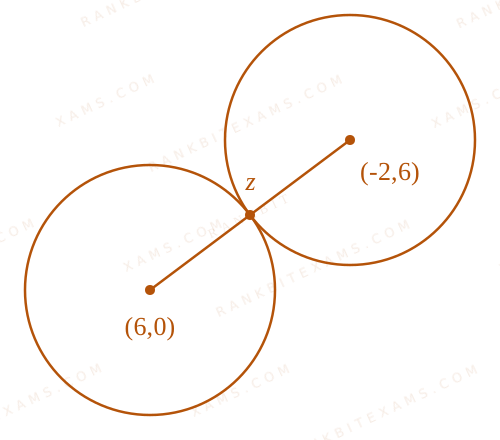
Let z be a complex number such that |z - 6| = 5 and |z + 2 - 6i| = 5. Then the value of z³ + 3z² - 15z + 141 is equal to
  • A. 42
  • B. 37
  • C. 50
  • D. 61

Solution

Core Logic

Geometry of Complex Numbers
The given equations represent two circles in the complex plane: Circle 1: Center C₁(6, 0), radius r₁ = 5 Circle 2: Center C₂(-2, 6), radius r₂ = 5

Distance between the centers C₁ and C₂:

C₁C₂ = √((-2 - 6)² + (6 - 0)²) = √(64 + 36) = 10

Notice that C₁C₂ = r₁ + r₂ = 5 + 5 = 10. This means the two circles touch each other externally at exactly one point.

Step 1: Finding z

Since the circles touch externally, the common point z is the midpoint of the line segment joining the centers C₁ and C₂.

z = (6 + (-2))/(2) + i (0 + 6)/(2)

z = 2 + 3i

Step 2: Simplifying the Polynomial

We have z = 2 + 3i. z - 2 = 3i Squaring both sides: (z - 2)² = -9

z² - 4z + 4 = -9 z² - 4z + 13 = 0

z² = 4z - 13

Step 3: Evaluating the Expression

We need to evaluate z³ + 3z² - 15z + 141. First, find z³:

z³ = z · z² = z(4z - 13) = 4z² - 13z

Substitute z² = 4z - 13 again:

z³ = 4(4z - 13) - 13z = 16z - 52 - 13z = 3z - 52

Now substitute z³ and z² into the target expression:

(3z - 52) + 3(4z - 13) - 15z + 141 = 3z - 52 + 12z - 39 - 15z + 141 = (3z + 12z - 15z) + (-52 - 39 + 141)

= 0 + 50 = 50

Pattern Recognition

When given two complex distance modulus equations |z-z₁|=r₁ and |z-z₂|=r₂, always check the distance between centers |z₁ - z₂|. If it exactly equals r₁ + r₂, the single unique solution is the section formula midpoint.

Chapter Mix

Class 11 Mathematics: Complex Numbers and Quadratic Equations

Q10 jee_main_2026_28_january_morning Nature of Roots
If α, β, where α < β, are the roots of the equation λ x² - (λ + 3)x + 3 = 0 such that (1)/(α) - (1)/(β) = (1)/(3), then the sum of all possible values of λ is:
  • A. 6
  • B. 2
  • C. 4
  • D. 8

Solution

Related Formula

For a quadratic equation ax² + bx + c = 0: Sum of roots: α + β = -(b)/(a) Product of roots: αβ = (c)/(a)

Core Logic

From the given equation λ x² - (λ + 3)x + 3 = 0:

α + β = (λ + 3)/(λ) αβ = (3)/(λ)

We are given the condition:

(1)/(α) - (1)/(β) = (1)/(3) (β - α)/(αβ) = (1)/(3) β - α = (αβ)/(3) = (3/λ)/(3) = (1)/(λ)
Step 1: Square Identity

We know that (α + β)² - 4αβ = (β - α)². Substitute the known values:

(β - α)² = (1)/(λ²) (α + β)² = ((λ + 3)²)/(λ²)

So, we substitute these into the identity:

((λ + 3)²)/(λ²) - 4((3)/(λ)) = (1)/(λ²)
Step 2: Solving for Lambda

Multiply the entire equation by λ² (assuming λ ≠ 0 because it's a quadratic leading coefficient):

(λ + 3)² - 12λ = 1 λ² + 6λ + 9 - 12λ - 1 = 0 λ² - 6λ + 8 = 0
Step 3: Finding Roots
(λ - 2)(λ - 4) = 0

So, λ = 2 or λ = 4. (The solution notes λ=0 derived from λ³ - 6λ² + 8λ = 0 by cross multiplication, but λ=0 degrades the quadratic. Thus valid λ in 2, 4). Sum of possible values of λ = 2 + 4 = 6.

Chapter Mix

Class 11 Mathematics: Complex Numbers and Quadratic Equations

More Complex Numbers Questions — jee_main_2025_29_jan_evening

Practice all Complex Numbers previous-year questions →

Rankbit System
JEE Physics: Waves (+15.5%) | Electrostatics: Concentric Shells (-29.7%) | Modern Physics: Photoelectric Clones (+34.2%) | Mathematics: Definite Integrals (+18.1%) | Chemistry: Coordination Splitting (-11.4%) | JEE Physics: Waves (+15.5%) | Electrostatics: Concentric Shells (-29.7%) | Modern Physics: Photoelectric Clones (+34.2%) | Mathematics: Definite Integrals (+18.1%) | Chemistry: Coordination Splitting (-11.4%)
