Total number of non bonded electrons present in NO2^- ion based on Lewis theory is ________.

Numerical Answer Type:
Enter a numerical value Answer: 12 to 12 +4 marks

Solution & Explanation

### Core Logic Let's compute the total valence electrons for the nitrite ion (NO_2^-): textValence electrons = 5text (from N) + 2 times 6text (from O) + 1text (negative charge) = 18text electrons In the valid Lewis structural representation: * The central nitrogen atom forms one single bond and one double bond with the terminal oxygens, consuming 2 + 4 = 6 bonding electrons. * Remaining non-bonded valence electrons = 18 - 6 = 12 electrons. ### Step 1: Account for Lone Pairs Distribution of non-bonded electrons across the individual atoms: * Central Nitrogen atom has 1 lone pair (2 electrons). * Single-bonded Oxygen atom has 3 lone pairs (6 electrons). * Double-bonded Oxygen atom has 2 lone pairs (4 electrons). textTotal non-bonded electrons = 2 + 6 + 4 = 12 ### Pattern Recognition Non-bonded electrons can always be obtained directly by subtracting total bonding electrons from total valence electrons. ### Evaluation Rubric / Model Answer null ### Chapter Mix Class 11 Chemistry: Chemical Bonding and Molecular Structure

Reference Study Guides

More Chemical Bonding and Molecular Structure Previous-Year Questions — Page 5

Q89 jee_main_2024_27_jan_morning Molecular Orbital Theory
Sum of bond order of textCO and textNO^+ is textquadquad.
Numerical Answer. Answer: 6 to 6

Solution

### Step 1: Determine the bond order of textCO Carbon monoxide (textCO) contains 6 + 8 = 14 total electrons. Its structural representation is textCequivtextO, matching a bond order value of 3. ### Step 2: Determine the bond order of textNO^+ The nitrosonium ion (textNO^+) contains 7 + 8 - 1 = 14 total electrons. Since it is isoelectronic with textN_2 and textCO (14text electrons), its corresponding bond order value is also 3. ### Step 3: Sum the results textSum = 3 + 3 = 6 ### Pattern Recognition Isoelectronic species possessing 14 total electrons consistently demonstrate a bond order value of 3. ### Chapter Mix Class 11 Chemistry: Chemical Bonding and Molecular Structure
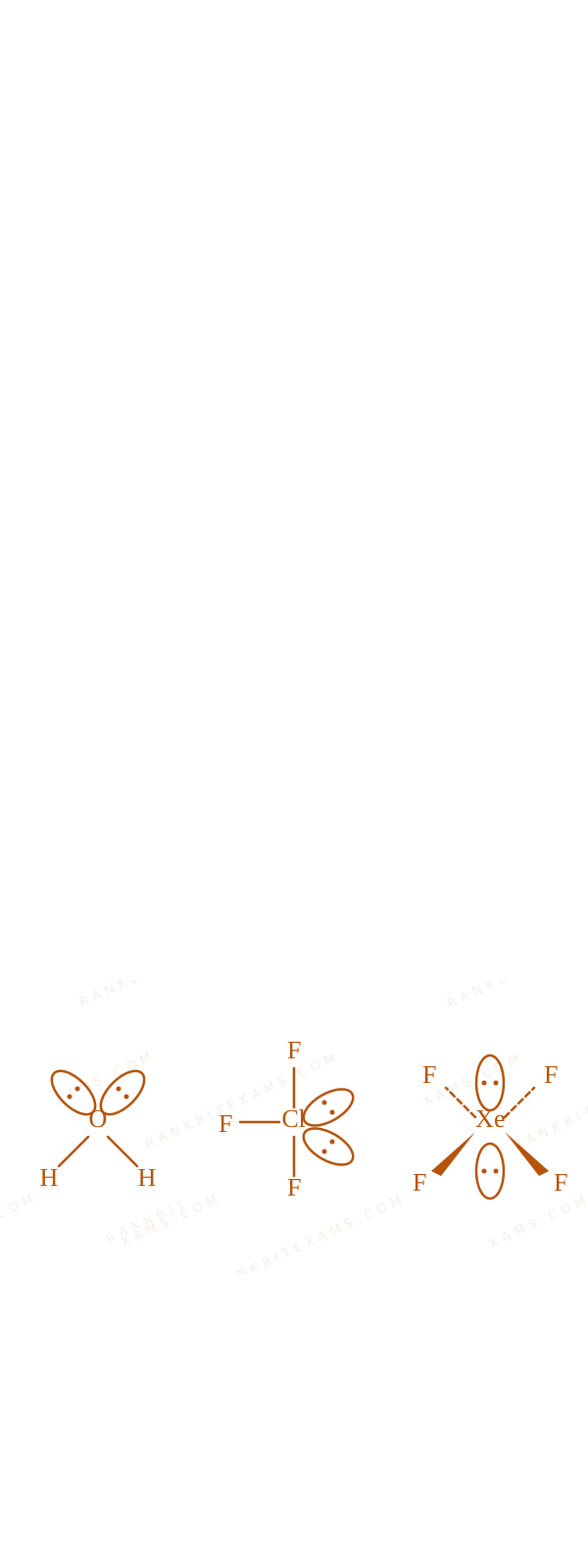
Q81 jee_main_2024_29_jan_morning VSEPR Theory
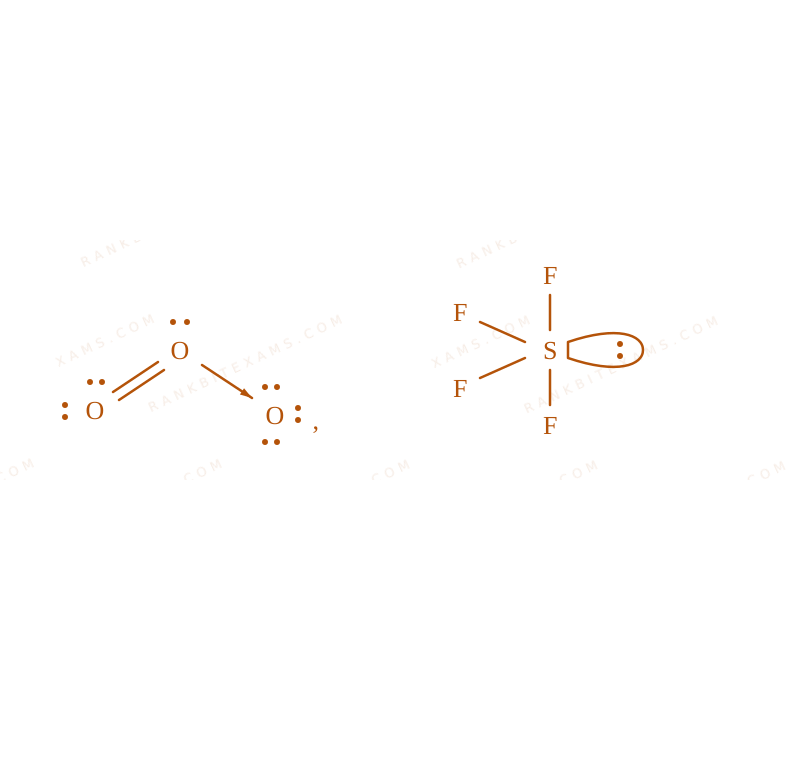
Number of compounds with one lone pair of electrons on central atom amongst following is O_3, H_2O, SF_4, ClF_3, NH_3, BrF_5, XeF_4
Numerical Answer. Answer: 4 to 4

Solution

### Core Logic Let us determine the steric number (Z) and number of lone pairs (LP) for the central atom in each given molecule. Formula: Z = frac12 (V + M - C + A) Where V = valence electrons on central atom, M = number of monovalent atoms, C = cationic charge, A = anionic charge. LP = Z - textBond Pairs (B.P.) 1. **O_3**: Central atom O (V=6). It forms one double bond and one dative bond. It has 1 lone pair remaining. 2. **H_2O**: Central atom O (V=6). Z = frac12(6 + 2) = 4. LP = 4 - 2 = 2. 3. **SF_4**: Central atom S (V=6). Z = frac12(6 + 4) = 5. LP = 5 - 4 = 1 (See-saw shape). 4. **ClF_3**: Central atom Cl (V=7). Z = frac12(7 + 3) = 5. LP = 5 - 3 = 2 (T-shape). 5. **NH_3**: Central atom N (V=5). Z = frac12(5 + 3) = 4. LP = 4 - 3 = 1 (Pyramidal). 6. **BrF_5**: Central atom Br (V=7). Z = frac12(7 + 5) = 6. LP = 6 - 5 = 1 (Square Pyramidal). 7. **XeF_4**: Central atom Xe (V=8). Z = frac12(8 + 4) = 6. LP = 6 - 4 = 2 (Square Planar). ### Step 1: Final Counting
VSEPR Theory diagram for Q81 - JEE Main 2024 Morning
The compounds containing exactly ONE lone pair on the central atom are O_3, SF_4, NH_3, and BrF_5. Total count = 4. ### Evaluation Rubric / Model Answer null ### Chapter Mix Class 11 Chemistry: Chemical Bonding and Molecular Structure
Q88 jee_main_2024_29_jan_morning Molecular Orbital Theory
The number of species from the following which are paramagnetic and with bond order equal to one is mathrm H_2, mathrmHe_2^+, mathrmO_2^+, mathrmN_2^2-, mathrmO_2^2-, mathrmF_2, mathrmNe_2^+, mathrmB_2
Numerical Answer. Answer: 1 to 1

Solution

### Core Logic Using Molecular Orbital (MO) Theory, we evaluate the bond order (BO = fracN_b - N_a2) and magnetic nature (unpaired electrons = paramagnetic, all paired = diamagnetic) for each species:
SpeciesMagnetic behaviourBond order
H_2Diamagnetic1
He_2^+Paramagnetic0.5
O_2^+Paramagnetic2.5
N_2^2-Paramagnetic2
O_2^2-Diamagnetic1
F_2Diamagnetic1
Ne_2^+Paramagnetic0.5
B_2Paramagnetic1
### Step 1: Final Selection We need the species that satisfies BOTH conditions: 1. Paramagnetic 2. Bond Order = 1 Looking at the table, B_2 is the only molecule that is paramagnetic (it has 2 unpaired electrons in degenerate pi_2p orbitals) and has a bond order of 1. Total number of such species = 1. ### Pattern Recognition B_2 (10 electrons) and O_2 (16 electrons) are the classic exceptions in MO theory that are paramagnetic despite having an even number of electrons. B_2 has BO = 1, and O_2 has BO = 2. ### Evaluation Rubric / Model Answer null ### Chapter Mix Class 11 Chemistry: Chemical Bonding and Molecular Structure
Q69 jee_main_2024_30_january_evening VSEPR Theory and Molecular Shapes
The molecule/ion with square pyramidal shape is:
  • A. text[Ni(CN)_4]^2-
  • B. textPCl_5
  • C. textBrF_5
  • D. textPF_5

Solution

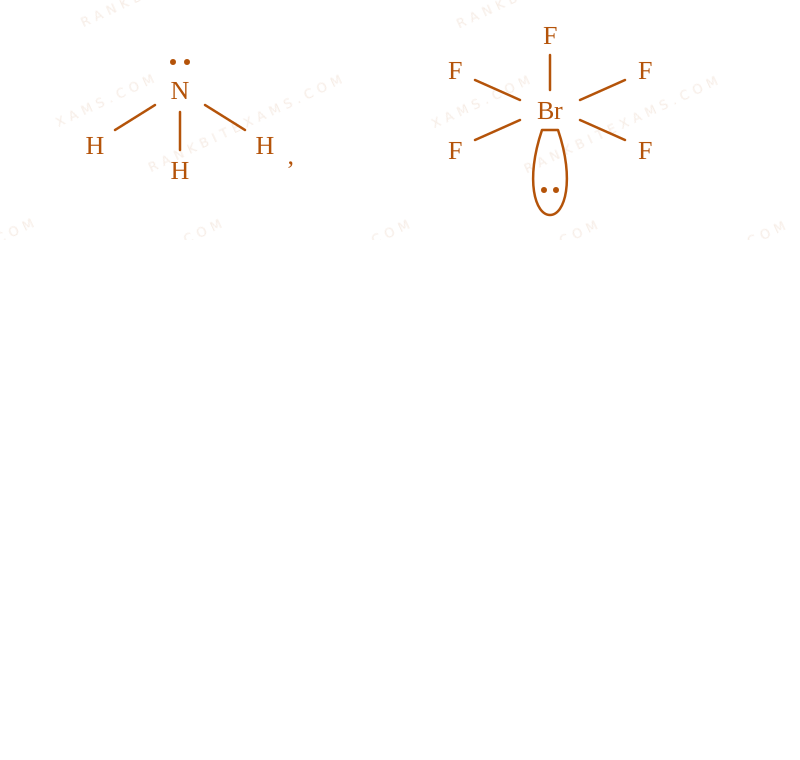
### Core Logic According to VSEPR theory: 1. [Ni(CN)_4]^2-: dsp^2 hybridization rightarrow Square Planar. 2. PCl_5: sp^3d hybridization with 0 lone pairs rightarrow Trigonal Bipyramidal. 3. BrF_5: Bromine has 7 valence electrons. It forms 5 single bonds with Fluorine, leaving 1 lone pair. sp^3d^2 hybridization rightarrow geometry is octahedral, but shape is Square Pyramidal. 4. PF_5: sp^3d hybridization with 0 lone pairs rightarrow Trigonal Bipyramidal.
Square Pyramidal structure of BrF5 diagram for Q69 - JEE Main 2024 Evening
### Pattern Recognition AX_5E_1 configuration (5 bond pairs + 1 lone pair) typically yields a Square Pyramidal shape. ### Evaluation Rubric / Model Answer null ### Chapter Mix Class 11 Chemistry: Chemical Bonding and Molecular Structure Class 12 Chemistry: Coordination Compounds
Q75 jee_main_2024_30_january_evening Dipole Moment
Given below are two statements: Statement-I: Since fluorine is more electronegative than nitrogen, the net dipole moment of NF_3 is greater than NH_3. Statement-II: In NH_3, the orbital dipole due to lone pair and the dipole moment of NH bonds are in opposite direction, but in NF_3 the orbital dipole due to lone pair and dipole moments of N-F bonds are in same direction. In the light of the above statements. Choose the most appropriate from the options given below.
  • A. textStatement I is true but Statement II is false.
  • B. textBoth Statement I and Statement II are false.
  • C. textBoth statement I and Statement II is are true.
  • D. textStatement I is false but Statement II is are true.

Solution

### Core Logic Statement I: The net dipole moment of NH_3 (1.47\, D) is actually greater than that of NF_3 (0.23\, D). Therefore, Statement I is false. Statement II: In NH_3, the N-H bond dipole moments (pointing towards the more electronegative N) reinforce the orbital dipole moment of the lone pair. In NF_3, the N-F bond dipole moments point away from N (towards the more electronegative F), opposing the orbital dipole moment of the lone pair. This partial cancellation in NF_3 makes its net dipole moment lower. Therefore, Statement II is also false, as it reverses the correct orientations.
Dipole moments in NH3 and NF3 diagram for Q75 - JEE Main 2024 Evening
### Step 1: Final Conclusion Since both statements assert the opposite of established facts regarding NH_3 and NF_3, both are false. ### Evaluation Rubric / Model Answer null ### Chapter Mix Class 11 Chemistry: Chemical Bonding and Molecular Structure

More Chemical Bonding and Molecular Structure Questions — jee_main_2025_29_jan_evening

Practice all Chemical Bonding and Molecular Structure previous-year questions →

Rankbit System
JEE Physics: Waves (+15.5%) | Electrostatics: Concentric Shells (-29.7%) | Modern Physics: Photoelectric Clones (+34.2%) | Mathematics: Definite Integrals (+18.1%) | Chemistry: Coordination Splitting (-11.4%) | JEE Physics: Waves (+15.5%) | Electrostatics: Concentric Shells (-29.7%) | Modern Physics: Photoelectric Clones (+34.2%) | Mathematics: Definite Integrals (+18.1%) | Chemistry: Coordination Splitting (-11.4%)