JEE Main · Chemistry ↓ Falling

Chemical Bonding and Molecular Structure appeared 42 times across 3 years — 4.9% of Chemistry. This question is from Hybridisation.

Year 2026 2025 2024 Total
Questions 12 14 16 42

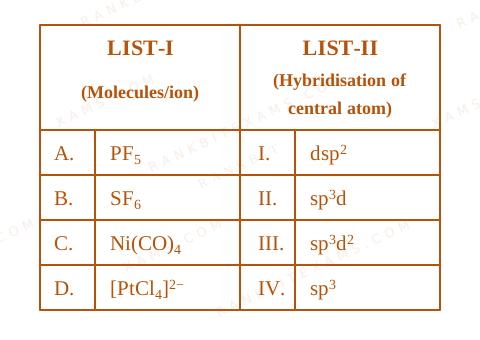
Match the LIST-I with LIST-II. Choose the correct answer from the options given below:

Hybridisation
Hybridisation

Solution & Explanation

Core Logic

Let us evaluate each central atom configuration systematically:

  • A. PF₅: Phosphorus has 5 valence electrons, forming 5σ bonds with zero lone pairs. Steric number = 5 sp³d hybridisation.
  • B. SF₆: Sulfur has 6 valence electrons, forming 6σ bonds with zero lone pairs. Steric number = 6 sp³d² hybridisation.
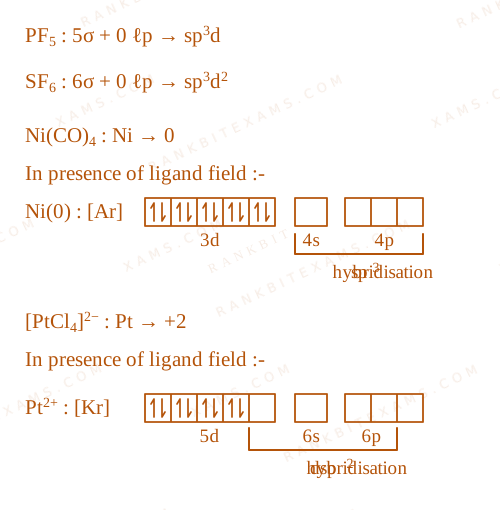
  • C. Ni(CO)₄: Nickel is in a 0 oxidation state (3d⁸ 4s²). Carbon monoxide is a strong field ligand, forcing rearrangement into a filled 3d¹⁰ state. The vacant 4s and three 4p orbitals hybridise to give an sp³ configuration.
    Orbital configuration matrix for Q43 - JEE Main 2025 Morning
    Orbital configuration matrix for Q43 - JEE Main 2025 Morning
  • D. [PtCl₄]²⁻: Platinum is in the +2 oxidation state (5d⁸). Since it belongs to the 5d transition series, all ligands behave as strong field elements, leading to interior spin-pairing and an inner orbital square-planar dsp² hybridisation state.
    Orbital configuration matrix for Q43 - JEE Main 2025 Morning
    Orbital configuration matrix for Q43 - JEE Main 2025 Morning
Pattern Recognition

Shortcut: Match main-group species first: PF₅ arrow sp³d (II), SF₆ arrow sp³d² (III). This immediately isolates Option (A) without needing to evaluate coordination fields.

Evaluation Rubric / Model Answer

Option (A)

Chapter Mix

Class 11 Chemistry: Chemical Bonding and Molecular Structure Class 12 Chemistry: Coordination Compounds

Orbital configuration matrix for Q43 - JEE Main 2025 Morning

More Chemical Bonding and Molecular Structure Previous-Year Questions

Q64 jee_main_2026_21_jan_morning VSEPR Theory
Given below are two statements: Statement I: The number of species among SF₄, NH₄^+, [NiCl₄]²⁻, XeF₄, [PtCl₄]²⁻, SeF₄ and [Ni(CN)₄]²⁻, that have tetrahedral geometry is 3. Statement II: In the set [NO₂, BeH₂, BF₃, AlCl₃], all the molecules have incomplete octet around central atom. In the light of the above statements, choose the correct answer from the options given below:
  • A. Statement I is true but Statement II is false
  • B. Both Statement I and Statement II are false
  • C. Statement I is false but Statement II is true
  • D. Both Statement I and Statement II are true

Solution

Core Logic

Evaluating Statement I:

  • SF₄: sp³d (1 lone pair) arrow See-saw
  • XeF₄: sp³d² (2 lone pairs) arrow Square planar
  • [PtCl₄]²⁻: dsp² arrow Square planar
  • [NiCl₄]²⁻: sp³ arrow Tetrahedral
  • [Ni(CN)₄]²⁻: dsp² arrow Square planar
  • SeF₄: sp³d (1 lone pair) arrow See-saw
  • NH₄^+: sp³ (0 lone pairs) arrow Tetrahedral
  • Total tetrahedral species = 2 ([NiCl₄]²⁻ and NH₄^+). Statement I says 3, so it is false.

    Evaluating Statement II:

  • NO₂: Central N has 7 valence electrons (odd-electron molecule, incomplete octet).
  • BeH₂: Central Be has 4 electrons (incomplete octet).
  • BF₃: Central B has 6 electrons (incomplete octet).
  • AlCl₃ (monomer): Central Al has 6 electrons (incomplete octet).
  • Therefore, all molecules have incomplete octets. Statement II is true.

Step 1: Final Conclusion

Statement I is false, Statement II is true.

Chapter Mix

Class 11 Chemistry: Chemical Bonding and Molecular Structure Class 12 Chemistry: Coordination Compounds

Q64 jee_main_2026_21_jan_evening Bond Length Trends
The correct increasing order of C-H (A), C-O (B), C=O (C) and C (D) bonds in terms of covalent bond length is: (1) A < B < C < D (2) A < D < C < B (3) D < C < B < A (4) D < C < A < B
  • A. (1) A < B < C < D
  • B. (2) A < D < C < B
  • C. (3) D < C < B < A
  • D. (4) D < C < A < B

Solution

Core Logic

Comparing bond lengths:

  • C–H (A): 107 pm
  • C≡N (D): 116 pm
  • C=O (C): 121 pm
  • C–O (B): 143 pm
Step 1: Final Conclusion

Thus, the increasing order is A < D < C < B, corresponding to option (2).

Pattern Recognition

Sees: covalent bond length comparison across bond orders and atomic radii. Trap: Assuming triple bonds are always longer or shorter without accounting for smaller atomic radii like hydrogen.

Chapter Mix

Class 11 Chemistry: Chemical Bonding and Molecular Structure

Q69 jee_main_2026_21_jan_evening Bond Dissociation Enthalpy and Fajan's Rules
Given below are two statements: Statement I: The correct order in terms of bond dissociation enthalpy is Cl₂ > Br₂ > F₂ > I₂. Statement II: The correct trend in the covalent character of the metal halides is [SnCl₄ > SnCl₂], [PbCl₄ > PbCl₂] and [UF₄ > UF₆] (or similar Fajan's rule trend). In the light of the above statements, choose the correct answer from the options given below:
  • A. (1) Statement I is true but Statement II is false
  • B. (2) Both Statement I and Statement II are true
  • C. (3) Statement I is false but Statement II is true
  • D. (4) Both Statement I and Statement II are false

Solution

Core Logic
  • Statement I: Bond dissociation energy order for halogens is Cl₂ > Br₂ > F₂ > I₂ due to small size and lone-pair repulsions in fluorine weakening its bond. Statement I is true.
  • Statement II: According to Fajan's rules, higher charge on cation increases covalent character, so UF₆ > UF₄ (higher oxidation state has greater covalent character), making the statement II claim regarding UF₄ > UF₆ false.
Step 1: Final Conclusion

Statement I is true but Statement II is false, corresponding to option (1).

Pattern Recognition

Sees: halogen bond dissociation energy anomalies and Fajan's rules for covalent character. Trap: Assuming fluorine has the highest bond dissociation energy among halogens.

Chapter Mix

Class 11 Chemistry: Chemical Bonding and Molecular Structure

Q52 jee_main_2026_22_january_morning Lewis Structures and Formal Charge
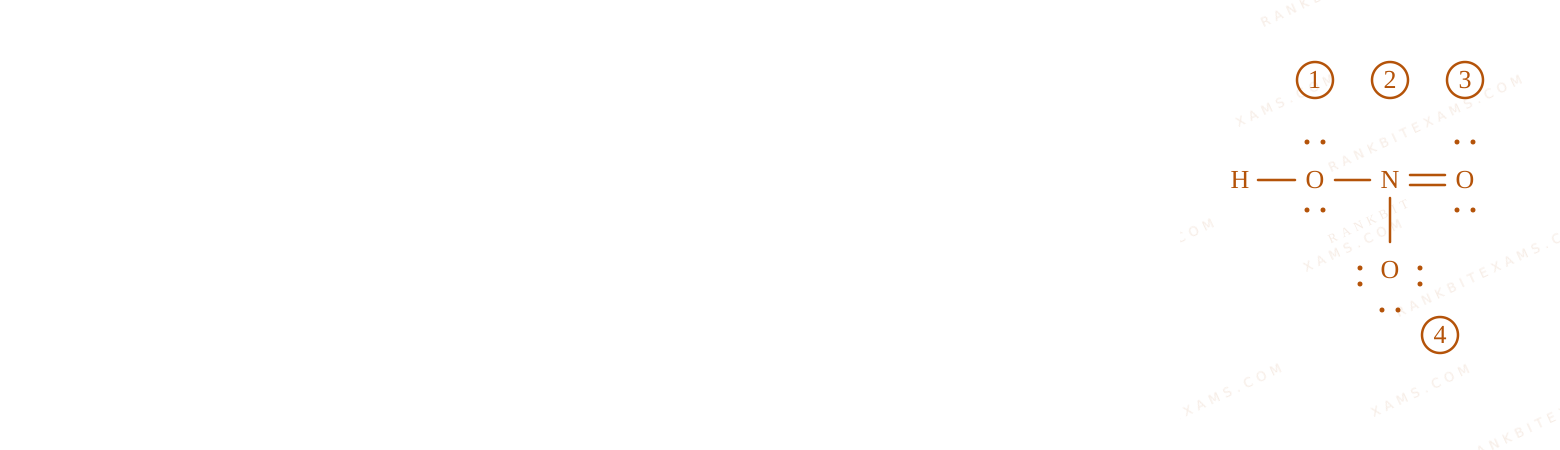
The formal changes on the atoms marked as (1) to (4) in the Lewis representation of HNO₃ molecule respectively are
Lewis structure of HNO3 diagram for Q52 - JEE Main 2026 Morning
The image shows the Lewis structure of HNO3 with four atoms numbered 1 through 4.
  • A. +1, 0, 0, -1
  • B. 0, -1, 0, +1
  • C. 0, +1, 0, -1
  • D. 0, 0, -1, +1

Solution

Related Formula
Formal charge = (Valence e⁻) - (Non-bonding e⁻) - Bonding e⁻2
Core Logic

Evaluate the structure of HNO₃ shown in the solution image:

Detailed Lewis structure of HNO3 diagram
The image shows the Lewis structure of HNO3 with four atoms numbered 1 through 4.

Atom 1 (Oxygen with H and N): F.C. = 6 - 4 - (4)/(2) = 0

Atom 2 (Nitrogen): F.C. = 5 - 0 - (8)/(2) = +1

Atom 3 (Double bonded Oxygen): F.C. = 6 - 4 - (4)/(2) = 0

Atom 4 (Single bonded Oxygen): F.C. = 6 - 6 - (2)/(2) = -1

Step 1: Final Conclusion

The formal charges on atoms (1), (2), (3), and (4) are respectively 0, +1, 0, -1.

Pattern Recognition

In nitro groups (-NO₂), the central nitrogen is always +1, the single bonded oxygen is -1, and the double-bonded oxygen is 0.

Chapter Mix

Class 11 Chemistry: Chemical Bonding and Molecular Structure

Q68 jee_main_2026_22_january_morning Hybridization and VSEPR Theory
Two p-block elements X and Y form fluroides of the type EF₃. The fluoride compound XF₃ is a Lewis acid and YF₃ is a Lewis base. The hybridization of the central atoms of XF₃ and YF₃ respectively are
  • A. Both sp³
  • B. sp² and sp³
  • C. sp³ and sp²
  • D. Both sp²

Solution

Core Logic

XF₃ acts as a Lewis acid, meaning it is an electron-deficient species capable of accepting an electron pair. A common example from the p-block is BF₃. The central Boron atom has 3 bond pairs and 0 lone pairs. Therefore, its steric number is 3, corresponding to sp² hybridization.

YF₃ acts as a Lewis base, meaning it has an available lone pair to donate. A common example is NF₃. The central Nitrogen atom has 3 bond pairs and 1 lone pair. Its steric number is 4, corresponding to sp³ hybridization.

Step 1: Final Conclusion

The hybridization of X and Y respectively are sp² and sp³.

Pattern Recognition

Electron deficient central atoms (Group 13) form sp² planar molecules. Atoms with a lone pair (Group 15) form sp³ pyramidal molecules.

Chapter Mix

Class 11 Chemistry: Chemical Bonding and Molecular Structure Class 11 Chemistry: p-Block Elements

Rankbit System
JEE Physics: Waves (+15.5%) | Electrostatics: Concentric Shells (-29.7%) | Modern Physics: Photoelectric Clones (+34.2%) | Mathematics: Definite Integrals (+18.1%) | Chemistry: Coordination Splitting (-11.4%) | JEE Physics: Waves (+15.5%) | Electrostatics: Concentric Shells (-29.7%) | Modern Physics: Photoelectric Clones (+34.2%) | Mathematics: Definite Integrals (+18.1%) | Chemistry: Coordination Splitting (-11.4%)