JEE Main · Physics ↓ Falling

Work, Energy and Power appeared 31 times across 3 years — 3.6% of Physics. This question is from Conservation of Mechanical Energy.

Year 2026 2025 2024 Total
Questions 8 15 8 31

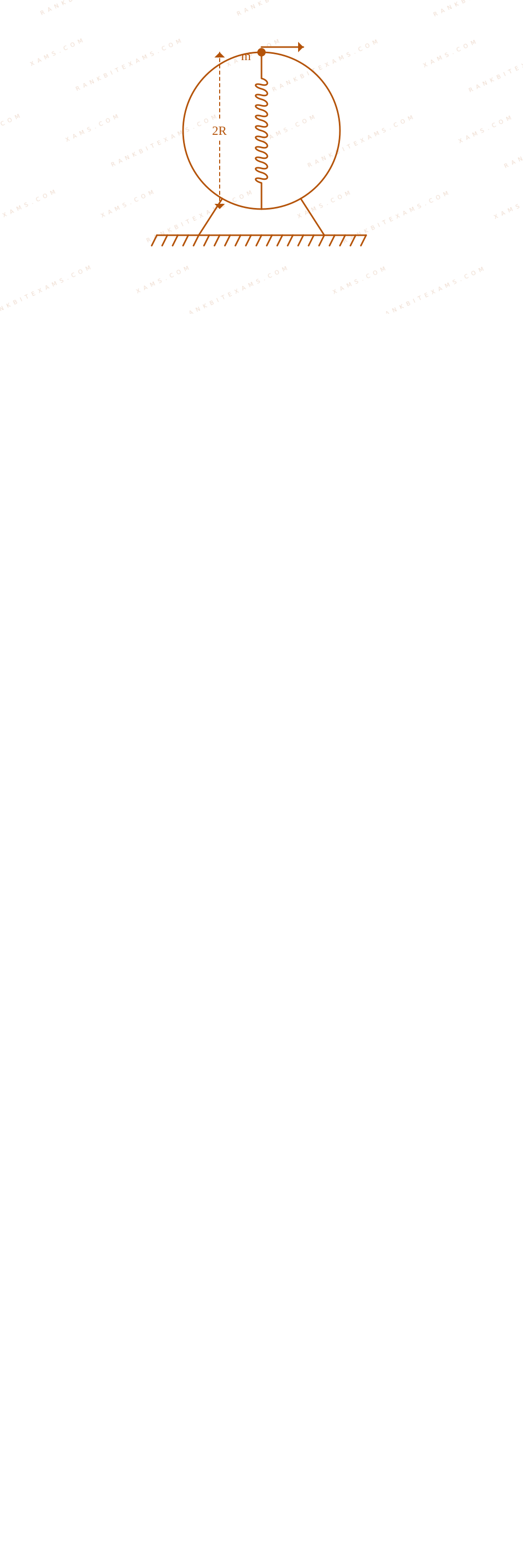
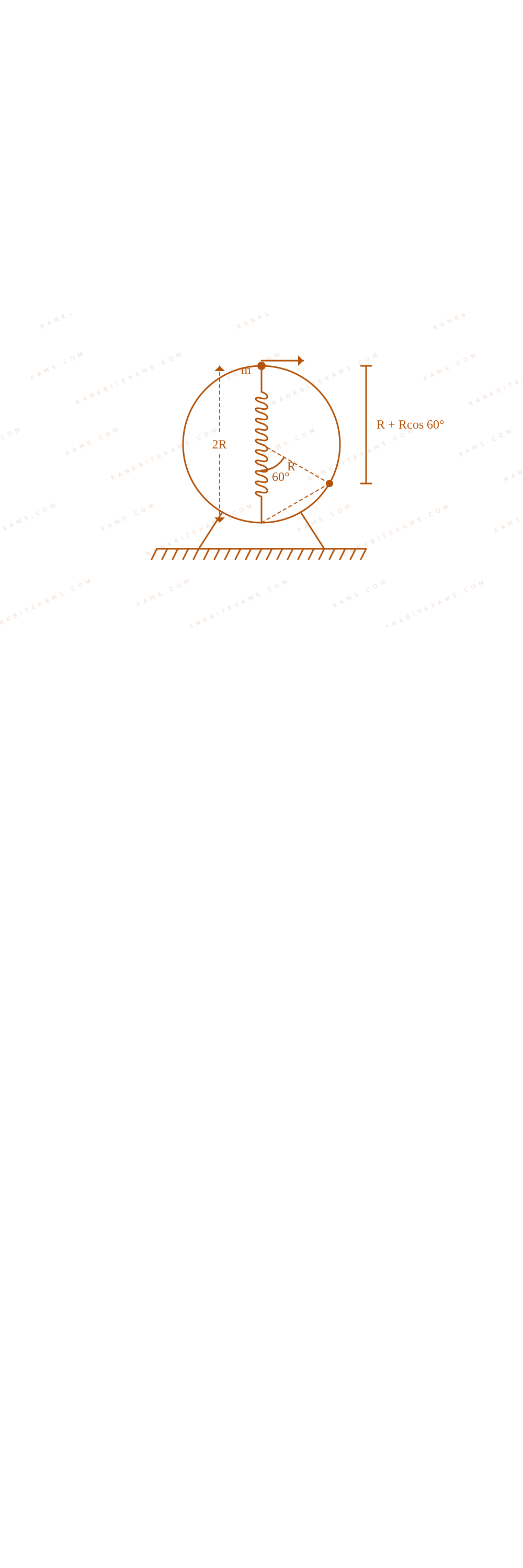
A bead of mass m slides without friction on the wall of a vertical circular hoop of radius R as shown in figure. The bead moves under the combined action of gravity and a massless spring (k) attached to the bottom of the hoop. The equilibrium length of the spring is R . If the bead is released from top of the hoop with (negligible) zero initial speed, velocity of bead, when the length of spring becomes R , would be (spring constant is k , g is acceleration due to gravity)
Conservation of Mechanical Energy diagram for Q10 - JEE Main 2025 Morning
A bead sliding along a vertical circular ring constrained by a tracking baseline spring system.

Solution & Explanation

Core Logic

Let's apply the comprehensive Work-Energy theorem framework across key layout tracking nodes:

Geometric resolution angle resolution profile for Q10
A bead sliding along a vertical circular ring constrained by a tracking baseline spring system.

Wall = Δ K M g (R + R 60°) + (1)/(2) k (R² - 0²) = (1)/(2) m v²

Simplifying the gravitational shift and potential expansions:

M g 3R2 + kR²2 = (1)/(2) m v²
Step 1: Final Kinematic Value
v = 3gR + kR²m

Matches parameters specified by option (4).

Pattern Recognition

Isolate spring metrics at node points: Initial extension equals 2R - R = R. Final extension is 0 since spring length matching R satisfies unextended conditions.

Chapter Mix

Class 11 Physics: Work, Energy and Power

More Work, Energy and Power Previous-Year Questions — Page 2

Q43 jee_main_2026_23_january_morning Collisions
In a perfectly inelastic collision, two spheres made of the same material with masses 15 kg and 25 kg, moving in opposite directions with speeds of 10 m/s and 30 m/s, respectively, strike each other and stick together. The rise in temperature (in °C), if all the heat produced during the collision is retained by these spheres, is : (specific heat of sphere material 31 cal/kg·°C and 1 cal = 4.2 J)
  • A. 1.75
  • B. 1.44
  • C. 1.15
  • D. 1.95

Solution

Related Formula
Δ K = (1)/(2) m₁m₂m₁ + m₂ urel² (1 - e²)

Q = msΔ T

Step 1: Loss of Kinetic Energy

For a perfectly inelastic collision, e = 0. Relative speed urel = v₁ + v₂ (since moving in opposite directions). urel = 10 + 30 = 40 m/s.

Δ K = (1)/(2)((15 × 25)/(15 + 25))(40)² Δ K = (1)/(2)((375)/(40))(1600) Δ K = (1)/(2) × 375 × 40 = 7500 J
Step 2: Heat Conversion

This lost energy turns into heat Q. The combined mass is m = 15 + 25 = 40 kg. Specific heat s = 31 cal/kg·°C = 31 × 4.2 J/kg·°C = 130.2 J/kg·°C.

Q = mtotal · s · Δ T 7500 = 40 × 130.2 × Δ T
Step 3: Calculate Temperature Rise
Δ T = (7500)/(40 × 130.2) Δ T = (750)/(520.8) ≈ 1.44°C
Pattern Recognition

Sees: "inelastic collision" + "rise in temperature" → Lost kinetic energy = Heat gained. Use reduced mass relative velocity shortcut to find Δ K instantly instead of conserving momentum first.

Chapter Mix

Class 11 Physics: Work, Energy and Power Class 11 Physics: Thermal Properties of Matter
Q33 jee_main_2026_23_january_evening Motion on Curved Path
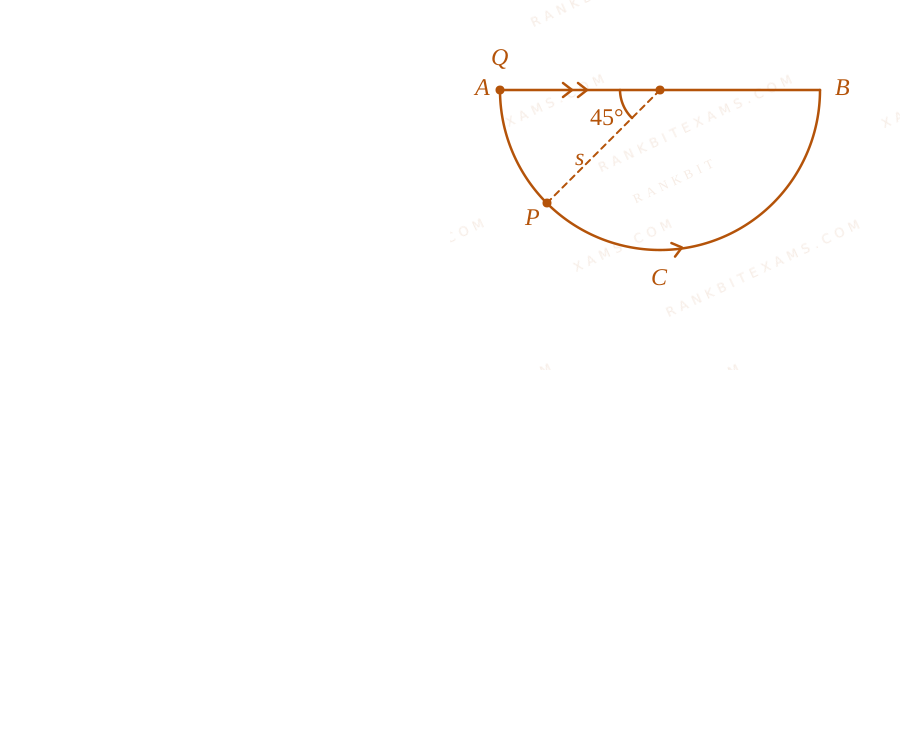
A bead P sliding on a frictionless semi-circular string (ACB) and it is at point S at t = 0 and at this instant the horizontal component of its velocity is v. Another bead Q of the same mass as P is ejected from point A at t = 0 along the horizontal string AB, with the speed v, friction between the beads and the respective strings may be neglected in both cases. Let tₚ and tQ be the respective times taken by beads P and Q to reach the point B, then the relation between tₚ and tQ is
Motion on Curved Path diagram for Q33 - JEE Main 2026 Evening
Diagram showing bead P on a curved path and bead Q on a straight horizontal path.
  • A. tP > tQ
  • B. tₚ < tQ
  • C. tₚ > 1.25tQ
  • D. tₚ = tQ

Solution

Related Formula
t = SVhorizontal
Core Logic

Motion on Curved Path diagram for Q33 - JEE Main 2026 Evening
Diagram showing bead P on a curved path and bead Q on a straight horizontal path.

For bead Q on the straight horizontal wire, its horizontal velocity remains constant at v. Total distance is XQ. For bead P on the semi-circular wire, as it moves down the curve, gravity increases its total speed, thus increasing its horizontal velocity component significantly compared to its initial value. Over the path, horizontal displacement of Q is greater than the direct horizontal projection of P's remaining path.

Step 1: Compare Horizontal Displacement and Time

Horizontal displacement required to reach B from their respective starting states: XQ > XP.

Time taken by bead Q:

tQ = (XQ)/(v)

Time taken by bead P:

tP = XPvhorizontal, avg

Since XQ > XP and vhorizontal, P > v for a major part of the journey, tP < tQ.

Pattern Recognition

A particle on a frictionless downward curve gains kinetic energy, resulting in a higher average horizontal velocity than a particle moving strictly horizontally at the initial horizontal velocity. It covers less or equal horizontal distance but at a higher average speed.

Chapter Mix

Class 11 Physics: Work, Energy and Power Class 11 Physics: Kinematics

Q30 jee_main_2026_24_january_evening Vertical Circular Motion
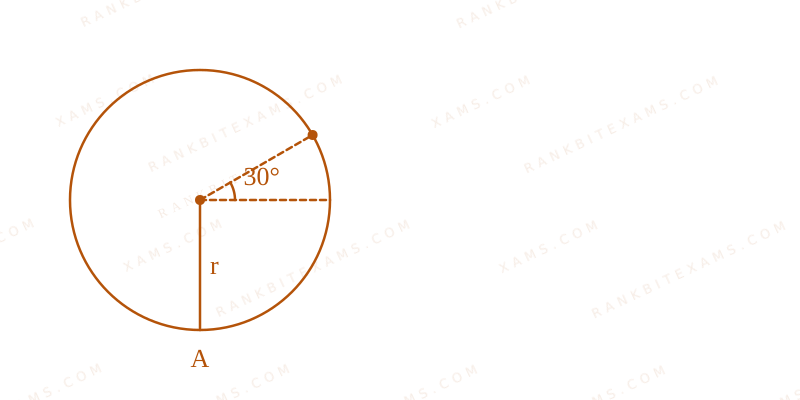
In case of vertical circular motion of a particle by a thread of length r if the tension in the thread is zero at an angle 30° shown in figure, the velocity at the bottom point (A) of the circular path is (g = gravitational acceleration)
Vertical Circular Motion diagram for Q30 - JEE Main 2026 Evening
A particle on a circular track of radius r with tension becoming zero at 30 degrees to the horizontal.
  • A. 5gr
  • B. (7)/(2) gr
  • C. 4gr
  • D. (5)/(2) gr

Solution

Related Formula
T + mg θ = (mV²)/(r)

Einitial = Efinal (Mechanical Energy Conservation)

Core Logic

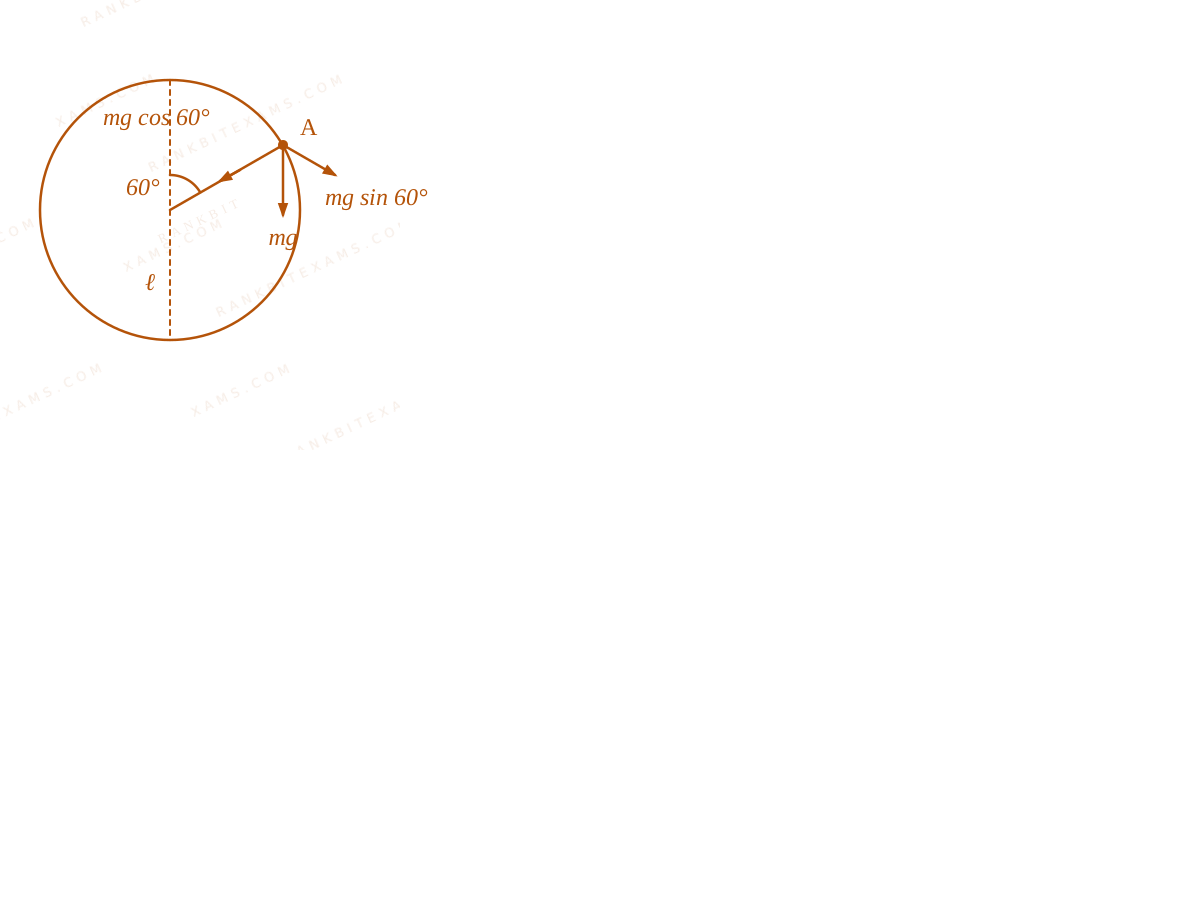
Vertical Circular Motion diagram for Q30 - JEE Main 2026 Evening
A particle on a circular track of radius r with tension becoming zero at 30 degrees to the horizontal.

At the point where the string makes an angle of 60° with the upward vertical (which corresponds to 30° above the horizontal diameter):

T + mg 60° = (mV²)/( )

Given that T = 0:

V² = (g )/(2)

Here, V is the speed at the topmost point.

Step 1: Energy Conservation

Applying Mechanical Energy Conservation (M.E.C.) between the bottom point and the point of zero tension:

(1)/(2) m u² = mg( + 60°) + (1)/(2) m V²
Step 2: Solving for u
(1)/(2) m u² = mg ( + ( )/(2)) + (1)/(2) m ((g )/(2)) u² = 3g + (g )/(2) u = √((7g )/(2))

(Note: The problem uses r as the length, so substituting r for yields √((7)/(2) gr)).

Pattern Recognition

When tension is zero at an angle θ above the horizontal, the required bottom velocity is derived by finding the critical velocity (mv²)/(r) = mg θ and then equating energy.

Chapter Mix

Class 11 Physics: Work, Energy and Power Class 11 Physics: Laws of Motion

Q10 jee_main_2025_03_april_evening Collisions and Spring Potential Energy
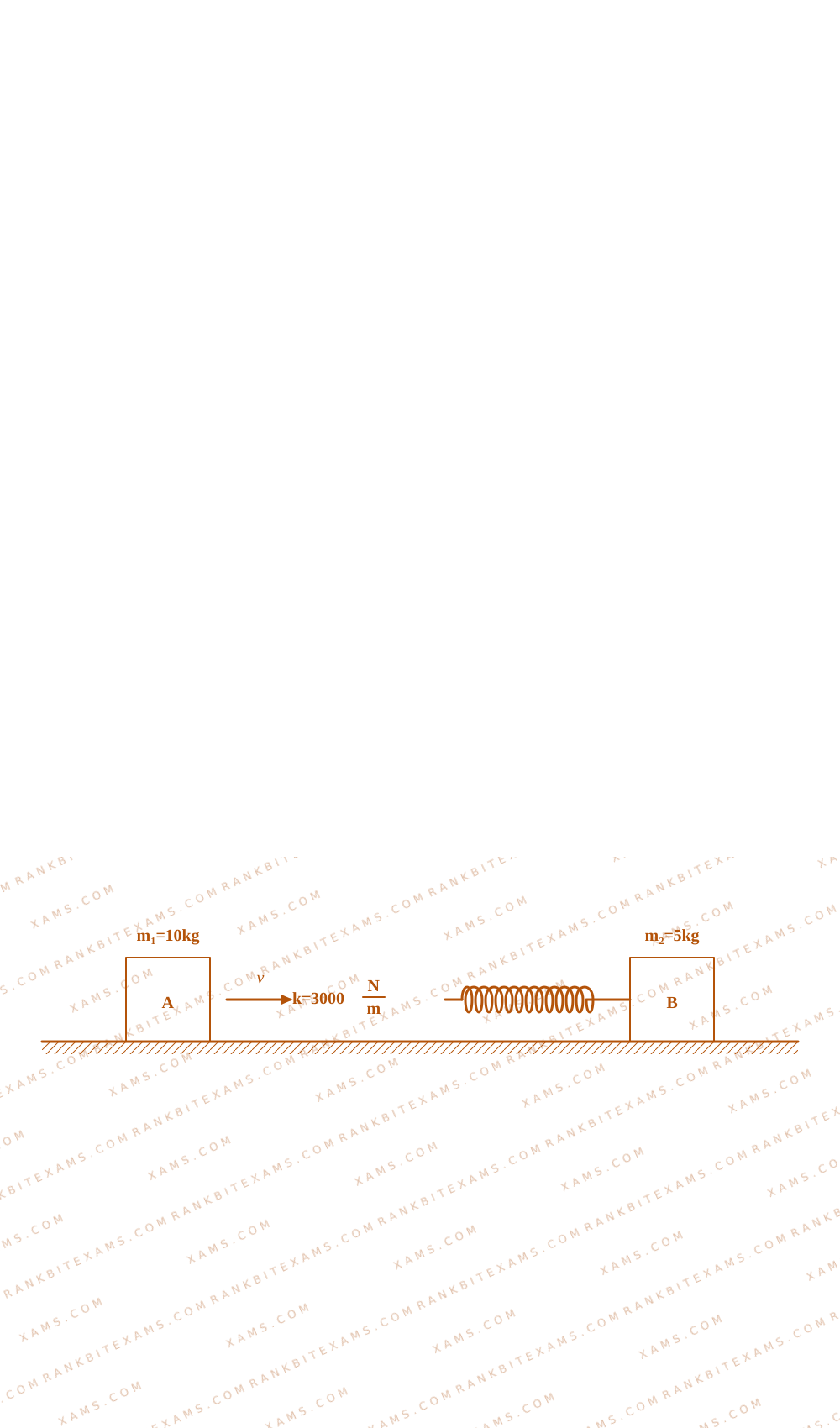
Consider two blocks A and B of masses m₁=10~kg and m₂=5~kg that are placed on a frictionless table. The block A moves with a constant speed v=3~m/s towards the block B kept at rest. A spring with spring constant k=3000~N/m is attached with the block B as shown in the figure.
Spring block collision diagram for Q10 - JEE Main 2025 Evening
Diagram showing Block A of mass m1 moving with velocity v towards Block B of mass m2 with a spring attached on a frictionless table.
After the collision, suppose that the blocks A and B, along with the spring in constant compression state, move together, then the compression in the spring is, (Neglect the mass of the spring)
  • A. 0.2 m
  • B. 0.4 m
  • C. 0.1 m
  • D. 0.3 m

Solution

Related Formula

By conservation of linear momentum, the common velocity vcm of the combined mass system is:

m₁ v₁ + m₂ v₂ = (m₁ + m₂) vcm

By conservation of energy, the loss in Kinetic Energy during maximum compression converted to the potential energy of the spring:

Δ K = (1)/(2) k x² ⇒ (1)/(2) m₁ v² - (1)/(2) (m₁ + m₂) vcm² = (1)/(2) k x²
Core Logic

Given parameters:

  • m₁ = 10~kg, m₂ = 5~kg
  • Initial velocity of A: v = 3~m/s
  • Initial velocity of B: v₂ = 0
  • Spring constant k = 3000~N/m
Step 1: Calculate the common center of mass velocity (vcm)
vcm = (10 × 3 + 5 × 0)/(10 + 5) = (30)/(15) = 2~m/s
Step 2: Apply Energy Conservation to find spring compression (
$
(1)/(2) k x² = Kᵢ - Kf(1)/(2) (3000) x² = [ (1)/(2) (10) (3²) ] - [ (1)/(2) (10 + 5) (2²) ]1500 x² = (1)/(2)(90) - (1)/(2)(15)(4)1500 x² = 45 - 30 = 15x² = (15)/(1500) = (1)/(100)x = (1)/(10)~m = 0.1~m
Pattern Recognition

For maximum compression in block-spring-block collisions, the relative kinetic energy gets fully transformed into spring potential energy.

(1)/(2) μ vrel² = (1)/(2) k x²

where

where $\mu = \frac{m_1 m_2}{m_1 + m_2}is the reduced mass. Here:

μ = (10 × 5)/(15) = (10)/(3)~kg(1)/(2) ((10)/(3)) (3)² = (1)/(2) (3000) x² ⇒ 15 = 1500 x² ⇒ x = 0.1~m$

Using reduced mass simplifies center-of-mass collision problems instantly.

Chapter Mix

Class 11 Physics: Work, Energy and Power

Q18 jee_main_2025_03_april_evening Power and Efficiency of Motor
A motor operating on 100~V draws a current of 1 A. If the efficiency of the motor is 91.6%, then the loss of power in units of cal/s is :
  • A. 4
  • B. 8.4
  • C. 2
  • D. 6.2

Solution

Related Formula

The electrical input power Pᵢₙ delivered to the motor is:

Pᵢₙ = V · I

The fraction of power lost is determined by the efficiency η:

Plost = Pᵢₙ - Pout = Pᵢₙ (1 - η)

To convert watts (J/s) to calories per second:

Plost (cal/s) = Plost (W)4.2
Core Logic

Given parameters:

  • Potential
Step 1: Calculate Input Power ($P_{\text{in}})
Pᵢₙ = 100 × 1 = 100~W
Step 2: Calculate Power Loss in Watts
Plost = 100 × (1 - 0.916) = 100 × 0.084 = 8.4~W
Step 3: Convert Power Loss to cal/s
Plost = (8.4)/(4.2) = 2~cal/s
Pattern Recognition

Efficiency calculations often feature clean conversion rates. Recognizing that

Pattern Recognition

Efficiency calculations often feature clean conversion rates. Recognizing that $8.4is exactly twice4.2$ (the conversion factor for Joules to calories) simplifies the final step.

Chapter Mix

Class 11 Physics: Work, Energy and Power

More Work, Energy and Power Questions — jee_main_2025_28_jan_morning

Practice all Work, Energy and Power previous-year questions →

Rankbit System
JEE Physics: Waves (+15.5%) | Electrostatics: Concentric Shells (-29.7%) | Modern Physics: Photoelectric Clones (+34.2%) | Mathematics: Definite Integrals (+18.1%) | Chemistry: Coordination Splitting (-11.4%) | JEE Physics: Waves (+15.5%) | Electrostatics: Concentric Shells (-29.7%) | Modern Physics: Photoelectric Clones (+34.2%) | Mathematics: Definite Integrals (+18.1%) | Chemistry: Coordination Splitting (-11.4%)