Q
jee_main_2025_08_april_evening
Superposition of Waves
The amplitude and phase of a wave that is formed by the superposition of two harmonic travelling waves, y₁(x,t) = 4 (kx - ω t) and y₂(x,t) = 2 (kx - ω t + (2π)/(3)), are:
(Take the angular frequency of initial waves same as ω)
Solution
Related Formula
Aᵣₑₛ = √(A₁² + A₂² + 2 A₁ A₂ φ) θ = (A₂ φ)/(A₁ + A₂ φ)where, A₁, A₂ = amplitudes of individual harmonic waves φ = phase difference between the waves Aᵣₑₛ = resultant amplitude θ = resultant phase angle relative to the first wave
Core Logic
Given parameters:
- A₁ = 4
- A₂ = 2
- Phase difference, φ = (2π)/(3) = 120^°
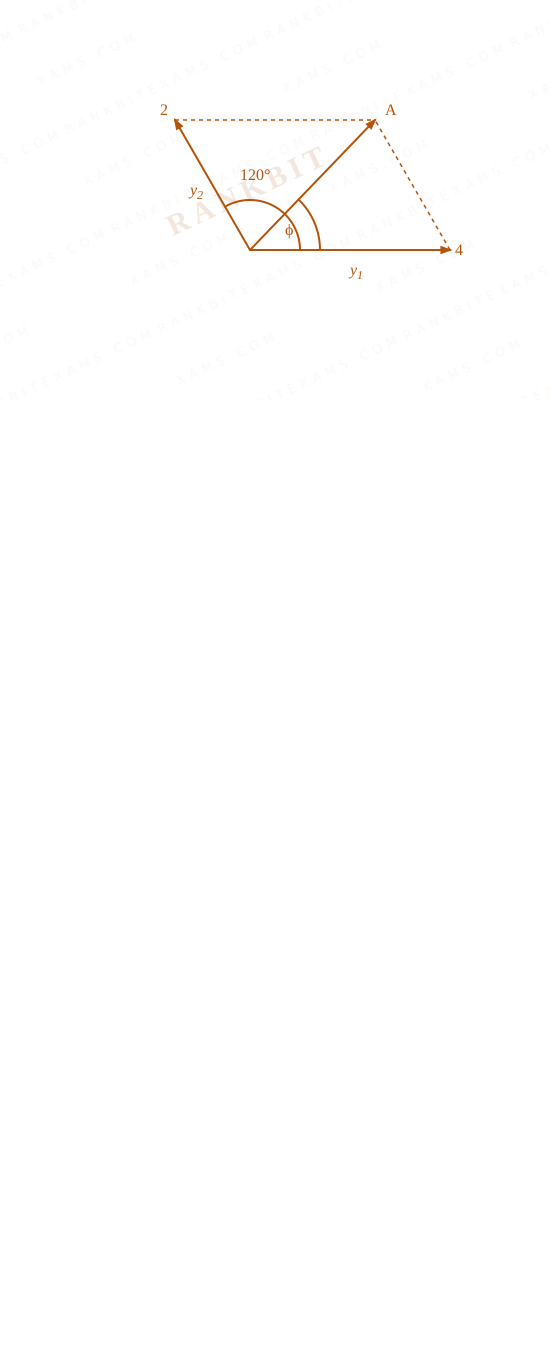
Calculate Resultant Phase (angle θ):
θ = (2 120^°)/(4 + 2 120^°) = 2 ( √(3)2)4 + 2 (-0.5) = √(3)3 = 1√(3) θ = (π)/(6)Step 1: Result Format
Represent the resultant amplitude and phase as a pair:
[2√(3), (π)/(6)]Pattern Recognition
Sees: Vector-like addition of wave amplitudes. Shortcut: Solve it like a vector addition problem. Vector A₁ along horizontal (0), and Vector A₂ at 120^°. The magnitude is √(4²+2²-2(4)(2)(0.5)) = 2√(3) and direction is π/6. ✓
Chapter Mix
Class 11 Physics: Waves
