


JEE Main · Physics → Steady

System of Particles and Rotational Motion appeared 57 times across 3 years — 6.6% of Physics. This question is from Moment of Inertia.

Year 2026 2025 2024 Total
Questions 19 27 11 57

The moment of inertia of a solid disc rotating along its diameter is 2.5 times higher than the moment of inertia of a ring rotating in similar way. The moment of inertia of a solid sphere which has same radius as the disc and rotating in similar way, is n times higher than the moment of inertia of the given ring. Here, n = _____. Consider all the bodies have equal masses.

Numerical Answer Type:
Enter a numerical value Answer: 4 to 4 +4 marks

Solution & Explanation

Related Formula
Idisc = MR₁²4, Iring = MR₂²2, Isphere = 2MR₁²5
Core Logic

Let's list the relevant moment of inertia formulas based on their rotation axes:

Moment of inertia axial comparison steps for Q22

Moment of inertia axial comparison steps for Q22

Moment of inertia axial comparison steps for Q22

From the given problem statements:

IdiscIring = 2.5 MR₁²4 MR₂²2 = (5)/(2) R₁²R₂² = 5

Now, evaluating the second geometric layout ratio:

IsphereIring = n 2MR₁²5 MR₂²2 = n 4R₁²5R₂² = n

Substituting our radius parameter (R₁²R₂² = 5):

n = (4)/(5) · 5 = 4
Step 1: Final Value Conclusion

The scale value parameter is found to be:

n = 4

Pattern Recognition

Be careful with rotation axis descriptions. Disc and ring components rotating along their structural diameter axes use values that are half of their standard perpendicular planar formulas.

Chapter Mix

Class 11 Physics: System of Particles and Rotational Motion

Reference Study Guides

More System of Particles and Rotational Motion Previous-Year Questions — Page 8

Q22 jee_main_2025_04_april_evening Conservation of Angular Momentum
A solid sphere with uniform density and radius R is rotating initially with constant angular velocity (ω₁) about its diameter. After some time during the rotation its starts loosing mass at a uniform rate, with no change in its shape. The angular velocity of the sphere when its radius becomes R / 2 is xω₁. The value of x is ________.
Numerical Answer. Answer: 32 to 32

Solution

Related Formula

Conservation of Angular Momentum (since no external torque acts):

I₁ ω₁ = I₂ ω₂

For a solid sphere, moment of inertia is:

I = (2)/(5)MR²

Mass scales with volume: M ∝ R³

Core Logic

When the radius reduces to R₂ = (R)/(2), the mass scales cubically:

M₂ = M₁ ((R/2)/(R))³ = (M₁)/(8)

Now, compute the new moment of inertia I₂:

I₂ = (2)/(5) M₂ R₂² = (2)/(5) ((M₁)/(8)) ((R)/(2))² = (2)/(5) M₁ R² × (1)/(32) = (I₁)/(32)
Step 1: Compute Final Angular Velocity

Using conservation of angular momentum:

I₁ ω₁ = ((I₁)/(32)) ω₂ ω₂ = 32 ω₁

Hence, the value of x is 32.

Pattern Recognition

Since inertia of a solid sphere scales with M R² and M ∝ R³, the net moment of inertia scales with R⁵. Shrinking the radius by half (1/2) cuts down inertia by a factor of (1/2)⁵ = 1/32. Velocity must scale up by 32 to conserve momentum.

Chapter Mix

Class 11 Physics: Rotational Motion
Q jee_main_2025_04_april_morning Torque and Angular Momentum
Which of the following are correct expressions for torque acting on a body? A. τ = r × L B. τ = (d)/(dt)( r × p) C. τ = r × d pdt D. τ = I α E. τ = r × F ( r = position vector; p = linear momentum; L = angular momentum; α = angular acceleration; I = moment of inertia; F = force; t = time) Choose the correct answer from the options given below:
  • A. B, D and E Only
  • B. C and D Only
  • C. B, C, D and E Only
  • D. A, B, D and E Only

Solution

Related Formula

Fundamental mathematical definition of torque:

τ = r × F

Rotational analogue of Newton's second law:

τ = d Ldt = I α

Linear momentum relations:

L = r × p τ = (d)/(dt)( r × p)
Core Logic

Let's check each expression sequentially:

  • A. τ = I × L is dimensionally incorrect (Moment of inertia I is primarily treated as a tensor or scalar placeholder, not crossed directly like this).
  • B. τ = d Ldt = (d)/(dt)( r × p) is fundamentally correct.
  • C. τ = r × F = r × d pdt is correct since F = d pdt.
  • D. τ = I α is the standard scalar component/fixed axis formulation.
  • E. τ = r × F is the true physical vector definition.
  • Thus, statements B, C, D, and E are universally correct representations.

Pattern Recognition

Torque can be represented either through geometric structural parameters (position and force cross products) or via kinematic response properties (rate of change of angular momentum or product of rotational inertia and acceleration).

Chapter Mix

Class 11 Physics: System of Particles and Rotational Motion

Q jee_main_2025_04_april_morning Uniform Circular Motion and Dynamics
If L and P represent the angular momentum and linear momentum respectively of a particle of mass 'm' having position vector r = a( i ω t + j ω t). The direction of force is
  • A. Opposite to the direction of r
  • B. Opposite to the direction of L
  • C. Opposite to the direction of P
  • D. Opposite to the direction of L × P

Solution

Related Formula

Acceleration vector equation via secondary derivation:

a = d² rdt²

Force equation:

F = m a
Core Logic

Given position tracking trace:

r = a( i ω t + j ω t)

Velocity vector v:

v = d rdt = aω(- i ω t + j ω t)
Step 1: Differentiate to find Acceleration
a = d vdt = aω²(- i ω t - j ω t) a = -ω² [ a( i ω t + j ω t) ] = -ω² r
Step 2: Establish Force Direction
F = m a = -mω² r

The minus sign indicates the net centripetal pulling force aligns explicitly opposite to the direction of r.

Pattern Recognition

The expression describes a standard uniform circular motion profile. In circular configurations, acceleration and centripetal forces point radially inward, directly opposing the outbound position tracker vector.

Chapter Mix

Class 11 Physics: Kinematics Class 11 Physics: System of Particles and Rotational Motion

Q21 jee_main_2025_04_april_morning Rolling Motion on an Inclined Plane
A circular ring and a solid sphere having same radius roll down on an inclined plane from rest without slipping. The ratio of their velocities when reached at the bottom of the plane is √((x)/(5)) where x =
Numerical Answer. Answer: 3.5 to 4

Solution

Related Formula

Velocity of a rolling body from mechanical energy conservation:

v = √((2gh)/(1 + (k²)/(R²)))
Core Logic

Evaluate radius of gyration factor coefficients:

  • For a circular ring: (k²)/(R²) = 1
  • For a solid sphere: (k²)/(R²) = (2)/(5)
Step 1: Compute Velocity Expressions
vring = √((2gh)/(1 + 1)) = √(gh) vsphere = √((2gh)/(1 + (2)/(5))) = √((10gh)/(7))
Step 2: Calculate the Velocity Ratio
vringvsphere = √(gh)√((10gh)/(7)) = √((7)/(10)) = √((3.5)/(5))

Matching with the prompt expression format √((x)/(5)) reveals: x = 3.5

Rounding to the nearest integer yields 4.

Pattern Recognition

Objects with lower mass concentration near the center (lower (k²)/(R²) like the sphere) convert gravitational potential energy into translational kinetic energy more efficiently, rolling faster than hollow equivalents.

Chapter Mix

Class 11 Physics: System of Particles and Rotational Motion

Q25 jee_main_2025_07_april_evening Moment of Inertia of a Disc with Cavity
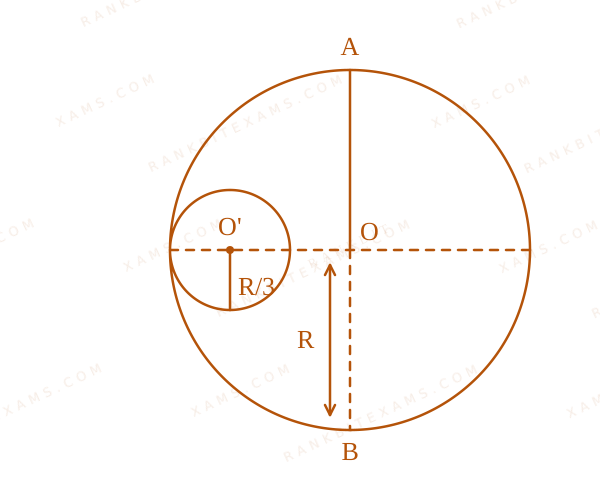
M and R be the mass and radius of a disc. A small disc of radius R/3 is removed from the bigger disc as shown in figure. The moment of inertia of remaining part of bigger disc about an axis AB passing through the centre O and perpendicular to the plane of disc is 4xMR² The value of x is
Moment of Inertia diagram for Q25 - JEE Main 2025 Evening
The graphic depicts a flat circular uniform disk of radius R with a smaller circular cut-out cavity of radius R/3 touching the perimeter.
[cite: 197, 198, 199, 200, 208]
Numerical Answer. Answer: 9 to 9

Solution

Related Formula

Idisc = (1)/(2) M R² [cite: 833]

I = Icm + M d² (Parallel Axis Theorem) [cite: 848]

Core Logic

Let the original mass density per unit area be σ. Without any cavity, the moment of inertia is: [cite: 198, 833]

I₁ = (MR²)/(2) [cite: 833]

The mass of the removed small section scales directly with its cut-out area profile: [cite: 198, 834]

m = (M)/(π R²) × π ((R)/(3))² = (M)/(9) [cite: 198, 834, 844]

The center of mass of the removed disk sits at a distance d = R - (R)/(3) = (2R)/(3) away from the primary center O[cite: 198, 205, 848]. Calculating its partial moment of inertia about O via the parallel axis theorem: [cite: 199, 848]

I₂ = (m r²)/(2) + m d² = ((M)/(9)((R)/(3))²)/(2) + (M)/(9)((2R)/(3))² [cite: 848]

I₂ = (MR²)/(162) + (4MR²)/(81) = (MR² + 8MR²)/(162) = (9MR²)/(162) = (MR²)/(18) [cite: 848, 850]

Subtracting the removed component from the original configuration: [cite: 851]

I = I₁ - I₂ = (MR²)/(2) - (MR²)/(18) = (9MR² - MR²)/(18) = (8MR²)/(18) = (4)/(9)MR² [cite: 851]

Matching this with (4)/(x)MR², we find x = 9[cite: 200, 208, 851, 853].

Pattern Recognition

For uniform planar surfaces, mass always scales squarely with linear dimension changes (r arrow (r)/(3) m arrow (m)/(9))[cite: 198, 834, 844]. Always apply the parallel axis theorem to bring the component values to a unified reference point before executing addition or subtraction[cite: 848, 851].

Chapter Mix

Class 11 Physics: System of Particles and Rotational Motion

More System of Particles and Rotational Motion Questions — jee_main_2025_28_jan_morning

Practice all System of Particles and Rotational Motion previous-year questions →

Rankbit System
JEE Physics: Waves (+15.5%) | Electrostatics: Concentric Shells (-29.7%) | Modern Physics: Photoelectric Clones (+34.2%) | Mathematics: Definite Integrals (+18.1%) | Chemistry: Coordination Splitting (-11.4%) | JEE Physics: Waves (+15.5%) | Electrostatics: Concentric Shells (-29.7%) | Modern Physics: Photoelectric Clones (+34.2%) | Mathematics: Definite Integrals (+18.1%) | Chemistry: Coordination Splitting (-11.4%)
