


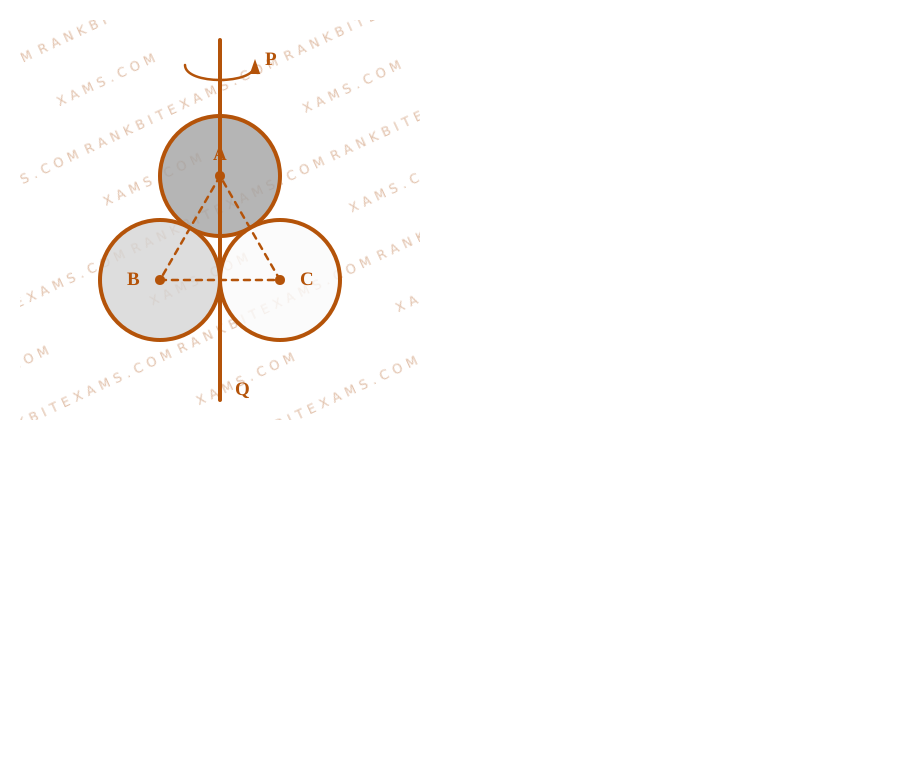
Solution
Related Formula
Parallel Axis Theorem:
Iₐₓᵢₛ = Icom + M R²Standard Moments of Inertia about center of mass:
- Disc about diameter: Idisc,dia = (MR²)/(4)
- Solid sphere: Isphere = (2)/(5)MR²
- Spherical shell: Ishell = (2)/(3)MR²
Core Logic
The axis of rotation PQ passes through the center of the top disc (A) along its diameter.
- Top disc (A):
- Bottom-left solid sphere (B): Center lies at distance R from the axis PQ.
- Bottom-right spherical shell (C): Center lies at distance R from the axis PQ.
Step 1: Calculate Total System Moment of Inertia
Sum the contributions:
IPQ = IA + IB + IC IPQ = (MR²)/(4) + (7)/(5)MR² + (5)/(3)MR²To add the fractions, find a common denominator (60):
IPQ = ( (15 + 84 + 100)/(60) ) MR² = (199)/(60) MR²Step 2: Express in terms of standard Disc Moment
We are given I = (MR²)/(4) MR² = 4I. Substitute this in the expression:
IPQ = (199)/(60) (4I) = (199)/(15) IComparing with IPQ = (x)/(15) I yields x = 199.
Pattern Recognition
Sees: Composite body consisting of three standard symmetric shapes about a tangent/offset axis. Shortcut: Sum the central inertia terms and the offset terms separately. Offset masses are only B and C, so the offset sum is 2MR². The central sum is (1/4 + 2/5 + 2/3)MR². Adding these directly yields the combined fractional factor of 199/60.
Chapter Mix
Class 11 Physics: System of Particles and Rotational Motion