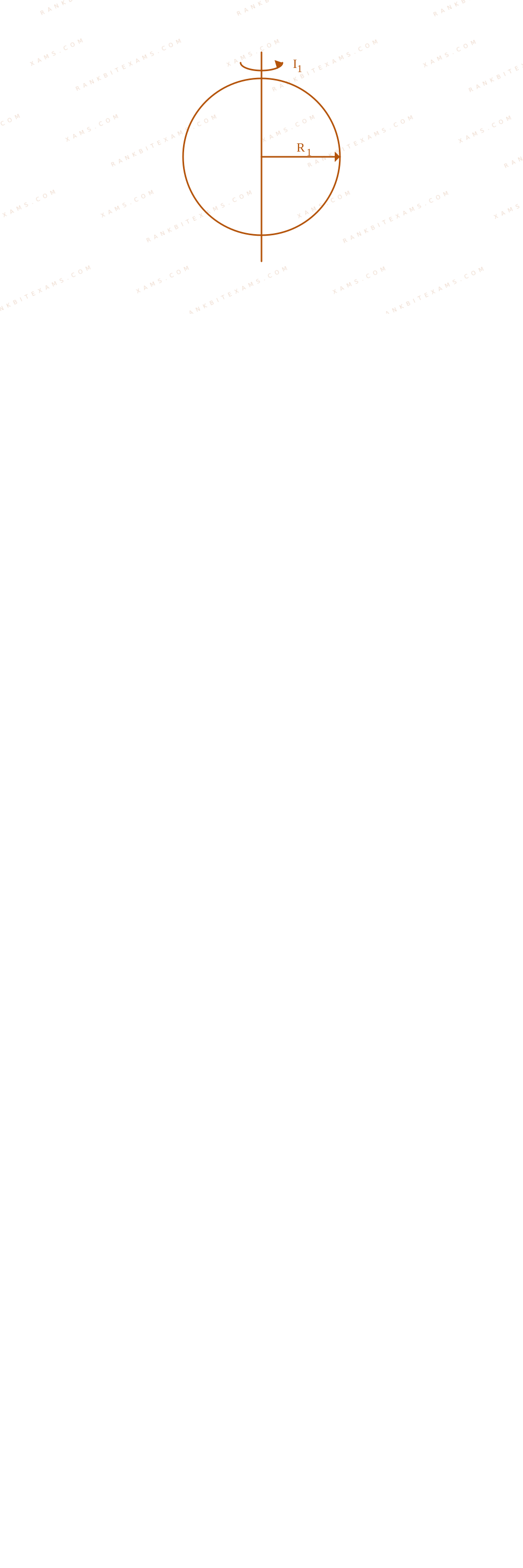
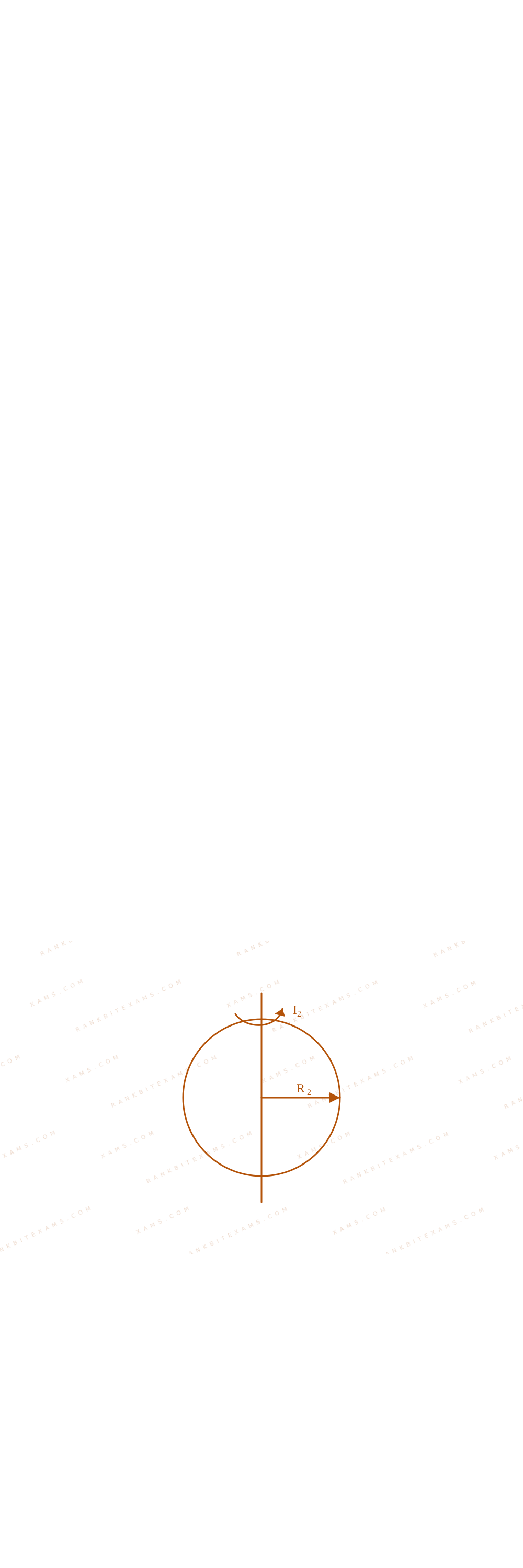
The moment of inertia of a solid disc rotating along its diameter is 2.5 times higher than the moment of inertia of a ring rotating in similar way. The moment of inertia of a solid sphere which has same radius as the disc and rotating in similar way, is n times higher than the moment of inertia of the given ring. Here, n =$\mathrm{n} =$ _____. Consider all the bodies have equal masses.
Be careful with rotation axis descriptions. Disc and ring components rotating along their structural diameter axes use values that are half of their standard perpendicular planar formulas.
Chapter Mix
Class 11 Physics: System of Particles and Rotational Motion
Keywords:#moment of inertia disc ring sphere comparison#JEE Main 2025 Morning Q22#System of Particles and Rotational Motion JEE Main 2025#Moment of Inertia JEE Main 2025
More System of Particles and Rotational Motion Previous-Year Questions — Page 10
Qjee_main_2025_29_jan_morningTorque
The coordinates of a particle with respect to origin in a given reference frame is (1, 1, 1) meters. If a force of F = i - j + k$\vec{\mathrm{F}} = \hat{\mathrm{i}} -\hat{\mathrm{j}} +\hat{\mathrm{k}}$ acts on the particle, then the magnitude of torque (with respect to origin) in z$z$ -direction is
Numerical Answer.Answer: 2 to 2
Solution
Related Formula
τ = r × F$$\vec{\tau} = \vec{r} \times \vec{F}$$
Core Logic
Given position vector r = i + j + k$\vec{r} = \hat{i} + \hat{j} + \hat{k}$ and force F = i - j + k$\vec{F} = \hat{i} - \hat{j} + \hat{k}$:
The absolute magnitude of the torque component in the z$z$-direction equals 2 ~N · m$2 \mathrm{~N \cdot m}$.
Chapter Mix
Class 11 Physics: System of Particles and Rotational Motion
Qjee_main_2024_01_february_morningCentre of Mass
The identical spheres each of mass 2M are placed at the corners of a right angled triangle with mutually perpendicular sides equal to 4~m$4\mathrm{~m}$ each. Taking point of intersection of these two sides as origin, the magnitude of position vector of the centre of mass of the system is 4√(2)x$\frac{4\sqrt{2}}{x}$, where the value of x$x$ is ______.
Matching this directly with the given template 4√(2)x$\frac{4\sqrt{2}}{x}$ shows that x = 3$x = 3$.
Pattern Recognition
Since the mass layout is completely symmetric along both right-angle legs, the COM coordinates are identical (xCOM = yCOM$x_{\text{COM}} = y_{\text{COM}}$).
Chapter Mix
Class 11 Physics: System of Particles and Rotational Motion
Q60jee_main_2024_29_january_eveningAngular Momentum of a Particle
A body of mass 5 kg$5\text{ kg}$ moving with a uniform speed 3√(2) ms⁻¹$3\sqrt{2}\text{ ms}^{-1}$ in X–Y plane along the line y = x + 4$y = x + 4$. The angular momentum of the particle about the origin will be ______ kg m²s⁻¹$\text{kg m}^2\text{s}^{-1}$.
Numerical Answer.Answer: 60 to 60
Solution
Related Formula
The magnitude of the angular momentum L$L$ of a particle of mass m$m$ moving with velocity v$v$ is:
L = m v d$L = m v d$
where:
d$d$ is the perpendicular distance from the axis of rotation (origin) to the line of motion of the particle.
Core Logic
Given parameters:
Mass, m = 5 kg$m = 5\text{ kg}$
Velocity, v = 3√(2) ms⁻¹$v = 3\sqrt{2}\text{ ms}^{-1}$
Line of motion: y = x + 4 x - y + 4 = 0$y = x + 4 \implies x - y + 4 = 0$
Step 1: Calculate Perpendicular Distance
The perpendicular distance d$d$ from the origin (0,0)$(0,0)$ to the line Ax + By + C = 0$Ax + By + C = 0$ is:
Instead of complicated vector cross products, find the perpendicular distance of the straight line from the origin using standard coordinate geometry. L = mvd$L = mvd$ is extremely fast and reliable.
Chapter Mix
Class 11 Physics: System of Particles and Rotational Motion
Qjee_main_2024_27_jan_morningMoment of Inertia
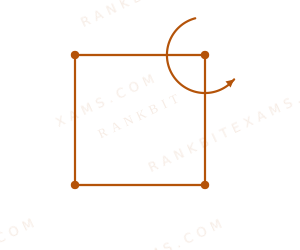
Four particles each of mass 1 kg$1\text{ kg}$ are placed at four corners of a square of side 2 m$2\text{ m}$. The moment of inertia of the system about an axis perpendicular to its plane and passing through one of its vertices is ______ kg ²$\text{kg}\cdot\text{m}^{2}$.
{{IMG}}
Moment of Inertia
Numerical Answer.Answer: 16 to 16
Solution
Related Formula
I = Σ mᵢ rᵢ²$$I = \sum m_i r_i^2$$
Core Logic
Let the axis pass through vertex 1. Evaluate distances (r$r$) for each corner particle:
For a standard planar configuration system, total orthogonal moment components map predictably via basic summation configurations matching 4ma²$4ma^2$ exactly.
Chapter Mix
Class 11 Physics: System of Particles and Rotational Motion
Qjee_main_2024_29_jan_morningRolling Motion
A cylinder is rolling down on an inclined plane of inclination 60°$60^{\circ}$. It's acceleration during rolling down will be x√(3) ~m / s²$\frac{x}{\sqrt{3}} \mathrm{~m / s^{2}}$, where x =$x =$ ________ (use g = 10 ~m/s²$g = 10 \mathrm{~m/s}^{2}$).
Numerical Answer.Answer: 10 to 10
Solution
Related Formula
The linear acceleration (a$a$) of a symmetric body performing pure rolling down an inclined plane of angle θ$\theta$ is given by:
a = g θ1 + IcmM R²$$a = \frac{g \sin \theta}{1 + \frac{I_{\text{cm}}}{M R^2}}$$
Core Logic
For a solid cylinder, the moment of inertia about its central longitudinal axis is:
Icm = (1)/(2) M R² IcmM R² = (1)/(2)$$I_{\text{cm}} = \frac{1}{2} M R^2 \implies \frac{I_{\text{cm}}}{M R^2} = \frac{1}{2}$$
Given inclination angle, θ = 60^°$\theta = 60^\circ$, and g = 10 ~m/s²$g = 10 \mathrm{~m/s^2}$.
Free body diagram of a rolling cylinder on an incline for Q54
Step 1: Calculate Linear Acceleration
Substituting the values into the acceleration template:
Comparing this evaluated value with the expression
$
Step 2: Solve for x
Comparing this evaluated value with the expression $
\frac{x}{\sqrt{3}}:$:
$10√(3) = x√(3) x = 10$\frac{10}{\sqrt{3}} = \frac{x}{\sqrt{3}} \implies x = 10$
Therefore, the value of
$
Therefore, the value of $
xis$ is $10.
Pattern Recognition
Pure rolling problems reduce down to tracking the shape factor fraction
$.
Pattern Recognition
Pure rolling problems reduce down to tracking the shape factor fraction $
\beta = 1 + \frac{I}{MR^2}. For solid cylinders it is$. For solid cylinders it is $1.5, for solid spheres it is$, for solid spheres it is $1.4, and for hoops it is$, and for hoops it is $2.0$. This value acts as an effective inertial scaling factor for gravity.
Chapter Mix
Class 11 Physics: System of Particles and Rotational Motion
More System of Particles and Rotational Motion Questions — jee_main_2025_28_jan_morning
Practice past-year questions one chapter at a time. Pick an exam → subject → chapter and get every PYQ for that topic — pulled together from all past papers — with the chapter's key formulas alongside.