System of Particles and Rotational Motion appeared 57 times across 3 years — 6.6% of Physics.
This question is from Centre of Mass of Continuous Mass Distribution.
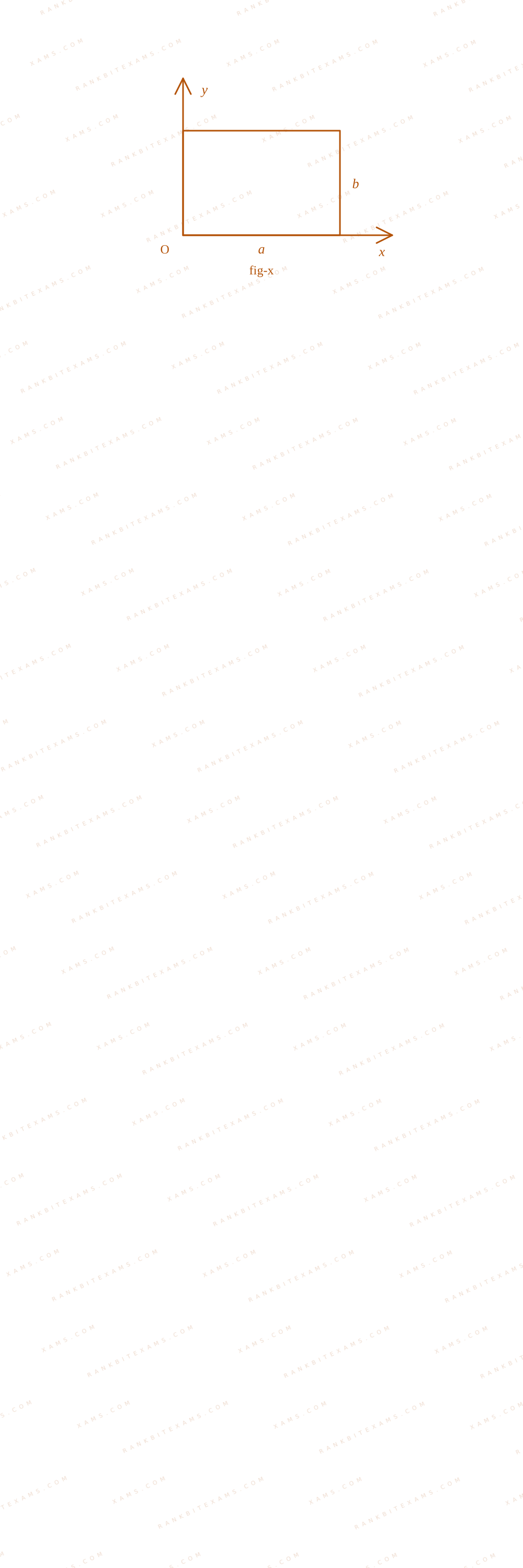
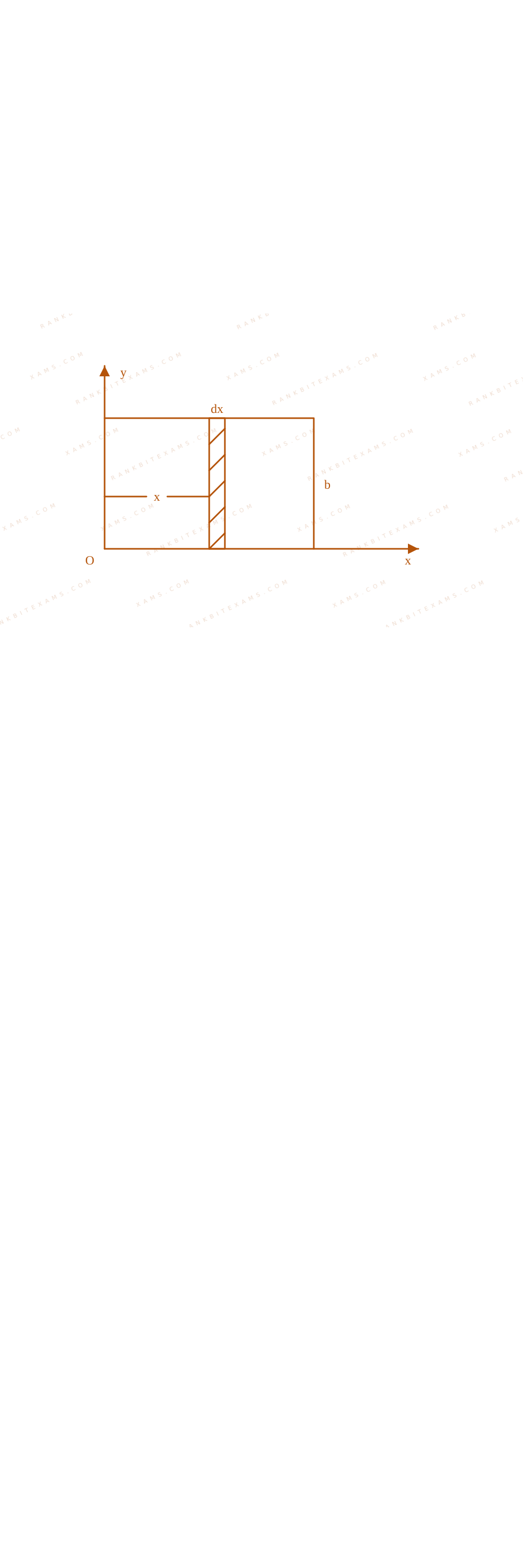
The centre of mass of a thin rectangular plate (fig - x) with sides of length a and b, whose mass per unit area (σ)$(\sigma)$ varies as σ = (σ₀x)/(ab)$\sigma = \frac{\sigma_0x}{ab}$ (where σ₀$\sigma_0$ is a constant), would be
A thin plate with variable linear density coordinates mapped across an XY grid system.
A.((2)/(3) a, (b)/(2))$\left(\frac{2}{3} a, \frac{b}{2}\right)$
B.((2)/(3) a, (2)/(3) b)$\left(\frac{2}{3} a, \frac{2}{3} b\right)$
The center of mass coordinates are ((2)/(3) a, b2)$\left(\frac{2}{3} \mathrm{a}, \frac{\mathrm{b}}{2}\right)$, which matches option (1).
Pattern Recognition
When density varies linearly with position (σ ∝ x$\sigma \propto \mathrm{x}$), the mass distribution shifts outward, moving the center of mass from the geometric midpoint a2$\frac{\mathrm{a}}{2}$ to the (2)/(3)a$\frac{2}{3}\mathrm{a}$ mark.
Chapter Mix
Class 11 Physics: System of Particles and Rotational Motion
Keywords:#centre of mass of thin rectangular plate#JEE Main 2025 Morning Q19#System of Particles and Rotational Motion JEE Main 2025#Centre of Mass of Continuous Mass Distribution JEE Main 2025#Rectangular plate#Mass per unit area#Centre of mass
More System of Particles and Rotational Motion Previous-Year Questions — Page 10
Qjee_main_2025_29_jan_morningTorque
The coordinates of a particle with respect to origin in a given reference frame is (1, 1, 1) meters. If a force of F = i - j + k$\vec{\mathrm{F}} = \hat{\mathrm{i}} -\hat{\mathrm{j}} +\hat{\mathrm{k}}$ acts on the particle, then the magnitude of torque (with respect to origin) in z$z$ -direction is
Numerical Answer.Answer: 2 to 2
Solution
Related Formula
τ = r × F$$\vec{\tau} = \vec{r} \times \vec{F}$$
Core Logic
Given position vector r = i + j + k$\vec{r} = \hat{i} + \hat{j} + \hat{k}$ and force F = i - j + k$\vec{F} = \hat{i} - \hat{j} + \hat{k}$:
The absolute magnitude of the torque component in the z$z$-direction equals 2 ~N · m$2 \mathrm{~N \cdot m}$.
Chapter Mix
Class 11 Physics: System of Particles and Rotational Motion
Qjee_main_2024_01_february_morningCentre of Mass
The identical spheres each of mass 2M are placed at the corners of a right angled triangle with mutually perpendicular sides equal to 4~m$4\mathrm{~m}$ each. Taking point of intersection of these two sides as origin, the magnitude of position vector of the centre of mass of the system is 4√(2)x$\frac{4\sqrt{2}}{x}$, where the value of x$x$ is ______.
Matching this directly with the given template 4√(2)x$\frac{4\sqrt{2}}{x}$ shows that x = 3$x = 3$.
Pattern Recognition
Since the mass layout is completely symmetric along both right-angle legs, the COM coordinates are identical (xCOM = yCOM$x_{\text{COM}} = y_{\text{COM}}$).
Chapter Mix
Class 11 Physics: System of Particles and Rotational Motion
Q60jee_main_2024_29_january_eveningAngular Momentum of a Particle
A body of mass 5 kg$5\text{ kg}$ moving with a uniform speed 3√(2) ms⁻¹$3\sqrt{2}\text{ ms}^{-1}$ in X–Y plane along the line y = x + 4$y = x + 4$. The angular momentum of the particle about the origin will be ______ kg m²s⁻¹$\text{kg m}^2\text{s}^{-1}$.
Numerical Answer.Answer: 60 to 60
Solution
Related Formula
The magnitude of the angular momentum L$L$ of a particle of mass m$m$ moving with velocity v$v$ is:
L = m v d$L = m v d$
where:
d$d$ is the perpendicular distance from the axis of rotation (origin) to the line of motion of the particle.
Core Logic
Given parameters:
Mass, m = 5 kg$m = 5\text{ kg}$
Velocity, v = 3√(2) ms⁻¹$v = 3\sqrt{2}\text{ ms}^{-1}$
Line of motion: y = x + 4 x - y + 4 = 0$y = x + 4 \implies x - y + 4 = 0$
Step 1: Calculate Perpendicular Distance
The perpendicular distance d$d$ from the origin (0,0)$(0,0)$ to the line Ax + By + C = 0$Ax + By + C = 0$ is:
Instead of complicated vector cross products, find the perpendicular distance of the straight line from the origin using standard coordinate geometry. L = mvd$L = mvd$ is extremely fast and reliable.
Chapter Mix
Class 11 Physics: System of Particles and Rotational Motion
Qjee_main_2024_27_jan_morningMoment of Inertia
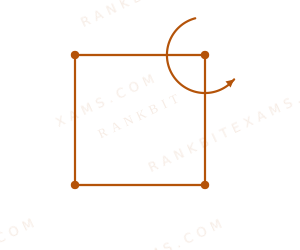
Four particles each of mass 1 kg$1\text{ kg}$ are placed at four corners of a square of side 2 m$2\text{ m}$. The moment of inertia of the system about an axis perpendicular to its plane and passing through one of its vertices is ______ kg ²$\text{kg}\cdot\text{m}^{2}$.
{{IMG}}
Moment of Inertia
Numerical Answer.Answer: 16 to 16
Solution
Related Formula
I = Σ mᵢ rᵢ²$$I = \sum m_i r_i^2$$
Core Logic
Let the axis pass through vertex 1. Evaluate distances (r$r$) for each corner particle:
For a standard planar configuration system, total orthogonal moment components map predictably via basic summation configurations matching 4ma²$4ma^2$ exactly.
Chapter Mix
Class 11 Physics: System of Particles and Rotational Motion
Qjee_main_2024_29_jan_morningRolling Motion
A cylinder is rolling down on an inclined plane of inclination 60°$60^{\circ}$. It's acceleration during rolling down will be x√(3) ~m / s²$\frac{x}{\sqrt{3}} \mathrm{~m / s^{2}}$, where x =$x =$ ________ (use g = 10 ~m/s²$g = 10 \mathrm{~m/s}^{2}$).
Numerical Answer.Answer: 10 to 10
Solution
Related Formula
The linear acceleration (a$a$) of a symmetric body performing pure rolling down an inclined plane of angle θ$\theta$ is given by:
a = g θ1 + IcmM R²$$a = \frac{g \sin \theta}{1 + \frac{I_{\text{cm}}}{M R^2}}$$
Core Logic
For a solid cylinder, the moment of inertia about its central longitudinal axis is:
Icm = (1)/(2) M R² IcmM R² = (1)/(2)$$I_{\text{cm}} = \frac{1}{2} M R^2 \implies \frac{I_{\text{cm}}}{M R^2} = \frac{1}{2}$$
Given inclination angle, θ = 60^°$\theta = 60^\circ$, and g = 10 ~m/s²$g = 10 \mathrm{~m/s^2}$.
Free body diagram of a rolling cylinder on an incline for Q54
Step 1: Calculate Linear Acceleration
Substituting the values into the acceleration template:
Comparing this evaluated value with the expression
$
Step 2: Solve for x
Comparing this evaluated value with the expression $
\frac{x}{\sqrt{3}}:$:
$10√(3) = x√(3) x = 10$\frac{10}{\sqrt{3}} = \frac{x}{\sqrt{3}} \implies x = 10$
Therefore, the value of
$
Therefore, the value of $
xis$ is $10.
Pattern Recognition
Pure rolling problems reduce down to tracking the shape factor fraction
$.
Pattern Recognition
Pure rolling problems reduce down to tracking the shape factor fraction $
\beta = 1 + \frac{I}{MR^2}. For solid cylinders it is$. For solid cylinders it is $1.5, for solid spheres it is$, for solid spheres it is $1.4, and for hoops it is$, and for hoops it is $2.0$. This value acts as an effective inertial scaling factor for gravity.
Chapter Mix
Class 11 Physics: System of Particles and Rotational Motion
More System of Particles and Rotational Motion Questions — jee_main_2025_28_jan_morning
Practice past-year questions one chapter at a time. Pick an exam → subject → chapter and get every PYQ for that topic — pulled together from all past papers — with the chapter's key formulas alongside.