
Q22
jee_main_2025_04_april_evening
Conservation of Angular Momentum
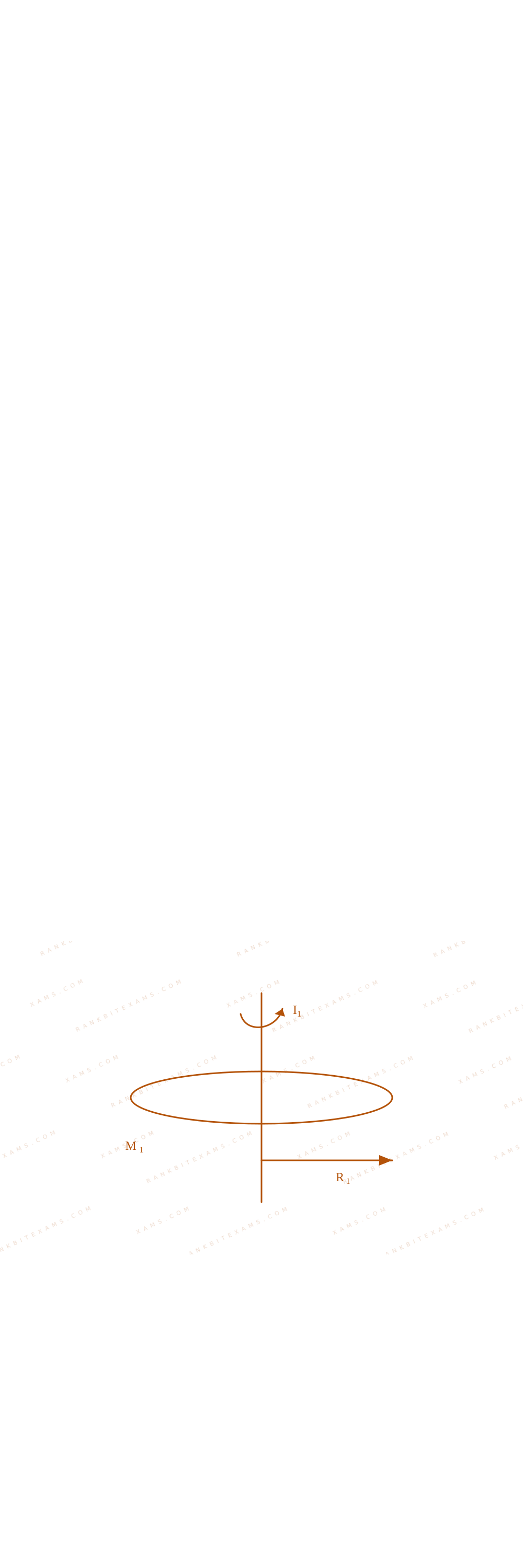
A solid sphere with uniform density and radius R is rotating initially with constant angular velocity (ω₁) about its diameter. After some time during the rotation its starts loosing mass at a uniform rate, with no change in its shape. The angular velocity of the sphere when its radius becomes R / 2 is xω₁. The value of x is ________.
Numerical Answer. Answer: 32 to 32
Solution
Related Formula
Conservation of Angular Momentum (since no external torque acts):
I₁ ω₁ = I₂ ω₂For a solid sphere, moment of inertia is:
I = (2)/(5)MR²Mass scales with volume: M ∝ R³
Core Logic
When the radius reduces to R₂ = (R)/(2), the mass scales cubically:
M₂ = M₁ ((R/2)/(R))³ = (M₁)/(8)Now, compute the new moment of inertia I₂:
I₂ = (2)/(5) M₂ R₂² = (2)/(5) ((M₁)/(8)) ((R)/(2))² = (2)/(5) M₁ R² × (1)/(32) = (I₁)/(32)Step 1: Compute Final Angular Velocity
Using conservation of angular momentum:
I₁ ω₁ = ((I₁)/(32)) ω₂ ω₂ = 32 ω₁Hence, the value of x is 32.
Pattern Recognition
Since inertia of a solid sphere scales with M R² and M ∝ R³, the net moment of inertia scales with R⁵. Shrinking the radius by half (1/2) cuts down inertia by a factor of (1/2)⁵ = 1/32. Velocity must scale up by 32 to conserve momentum.
Chapter Mix
Class 11 Physics: Rotational Motion