Keywords:#Three infinitely long wires with linear charge density#JEE Main 2025 Morning Q4#Electrostatic Potential and Capacitance JEE Main 2025#Equipotential Surfaces JEE Main 2025
More Electrostatic Potential and Capacitance Previous-Year Questions — Page 3
Q35jee_main_2024_01_february_morningCapacitors and Capacitance
Two identical capacitors have same capacitance C$C$. One of them is charged to the potential V$V$ and other to the potential 2V$2V$. The negative ends of both are connected together. When the positive ends are also joined together, the decrease in energy of the combined system is:
Class 12 Physics: Electrostatic Potential and Capacitance

Q56jee_main_2024_29_january_eveningCapacitance and Resistor Networks at Steady State
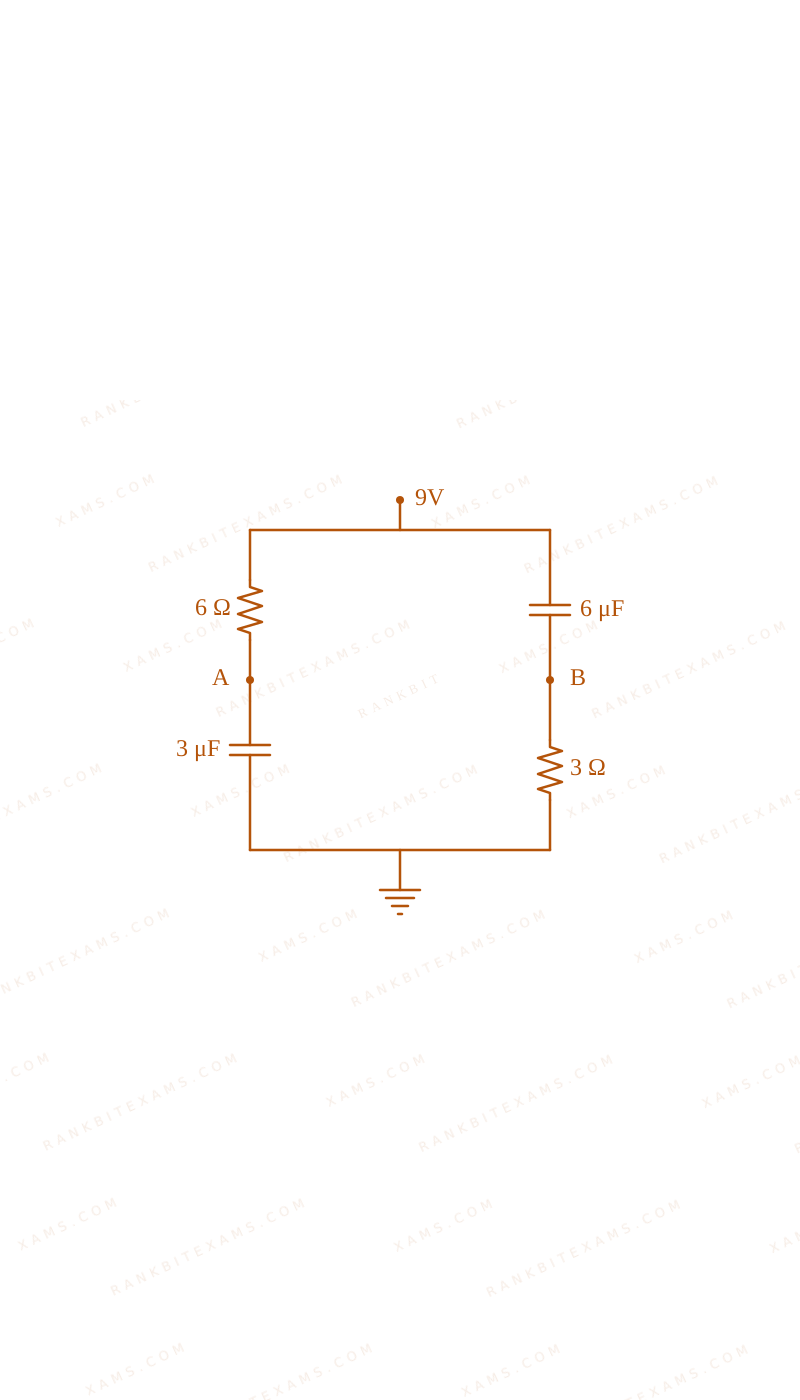
In the given figure, the charge stored in 6$6\mu\text{F}$ capacitor, when points A and B are joined by a connecting wire is ________ $\mu\text{C}$.
The diagram displays a bridge-like network containing a 6 Ohm resistor, 3uF capacitor, 6uF capacitor, and 3 Ohm resistor powered by a 9V supply.
Numerical Answer.Answer: 36 to 36
Solution
Related Formula
At steady state, a capacitor acts as an open circuit to DC current.
The charge on a capacitor is:
Q = C Δ V$Q = C \Delta V$
Core Logic
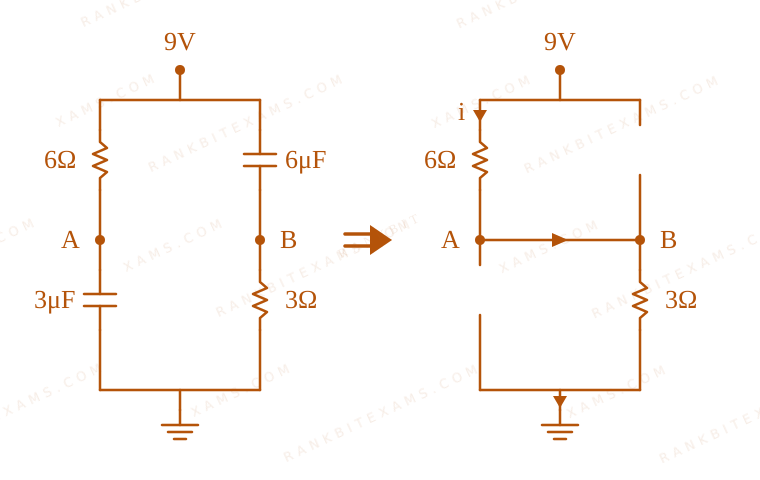
When node A$A$ and node B$B$ are connected by a wire, they reach the same electrical potential (VA = VB = VM$V_A = V_B = V_M$).
At DC steady state, capacitors block current, so current only flows through the resistors from the 9 V$9\text{ V}$ source to ground:
The 6 Ω$6\ \Omega$ resistor is connected between 9 V$9\text{ V}$ and node M$M$.
The 3 Ω$3\ \Omega$ resistor is connected between node M$M$ and ground.
Hence, the equivalent series resistance for the DC current path is:
The charge stored in the 6$6\mu\text{F}$ capacitor is:
Q = C Δ V = 6 × 6 V = 36$$Q = C \Delta V = 6\mu\text{F} \times 6\text{ V} = 36\ \mu\text{C}$$
Thus, the charge stored is 36$36\ \mu\text{C}$.
Pattern Recognition
Shorting A$A$ and B$B$ makes the network a simple voltage divider for resistors at steady state. Once potential of the middle node is found (3 V$3\text{ V}$), the capacitor charge is calculated instantly using Q = C Δ V$Q = C \Delta V$.
Chapter Mix
Class 12 Physics: Electrostatic Potential and Capacitance
Q57jee_main_2024_30_jan_morningEnergy Loss in Capacitors
A capacitor of capacitance C and potential V has energy E. It is connected to another capacitor of capacitance 2C and potential 2V. Then the loss of energy is (x)/(3)E$\frac{x}{3}E$, where x is ________.
Numerical Answer.Answer: 2 to 2
Solution
Related Formula
E = (1)/(2) C V²$$E = \frac{1}{2} C V^2$$Δ E = (1)/(2) (C₁ C₂)/(C₁ + C₂) (V₁ - V₂)²$$\Delta E = \frac{1}{2} \frac{C_1 C_2}{C_1 + C_2} (V_1 - V_2)^2$$
Core Logic
When two charged capacitors are connected in parallel, charge redistributes until they reach a common potential. During this redistribution, energy is dissipated as heat, strictly governed by the standard loss formula.
Step 1: Assign Values
Initial energy of first capacitor: E = (1)/(2) C V²$E = \frac{1}{2} C V^2$
Capacitor 1: C₁ = C$C_1 = C$, V₁ = V$V_1 = V$
Capacitor 2: C₂ = 2C$C_2 = 2C$, V₂ = 2V$V_2 = 2V$
Step 2: Calculate Energy Loss
Δ E = (1)/(2) ((C)(2C))/(C + 2C) (V - 2V)²$$\Delta E = \frac{1}{2} \frac{(C)(2C)}{C + 2C} (V - 2V)^2$$Δ E = (1)/(2) (2C²)/(3C) (-V)²$$\Delta E = \frac{1}{2} \frac{2C^2}{3C} (-V)^2$$Δ E = (1)/(2) ((2C)/(3)) V²$$\Delta E = \frac{1}{2} \left(\frac{2C}{3}\right) V^2$$Δ E = (2)/(3) ((1)/(2) C V²)$$\Delta E = \frac{2}{3} \left(\frac{1}{2} C V^2\right)$$Δ E = (2)/(3) E$$\Delta E = \frac{2}{3} E$$
Step 3: Match the Pattern
Given loss is (x)/(3)E$\frac{x}{3}E$.
Comparing, we get x = 2$x = 2$.
Pattern Recognition
The loss formula Δ E = (1)/(2) Ceq(Δ V)²$\Delta E = \frac{1}{2} C_{\text{eq}}(\Delta V)^2$ elegantly bypasses recalculating common potential Vc$V_c$ and summing final state energies.
Chapter Mix
Class 12 Physics: Electrostatic Potential and Capacitance
More Electrostatic Potential and Capacitance Questions — jee_main_2025_28_jan_morning
Practice past-year questions one chapter at a time. Pick an exam → subject → chapter and get every PYQ for that topic — pulled together from all past papers — with the chapter's key formulas alongside.