JEE Main · Physics ↓ Falling

Electrostatic Potential and Capacitance appeared 13 times across 3 years — 1.5% of Physics. This question is from Energy Stored in a Capacitor.

Year 2026 2025 2024 Total
Questions 3 7 3 13

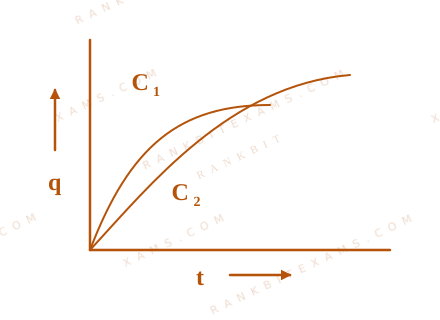
Two capacitors C₁ and C₂ are connected in parallel to a battery. Charge-time graph is shown below for the two capacitors. The energy stored with them are U₁ and U₂ , respectively. Which of the given statements is true?
Energy Stored in a Capacitor diagram for Q1 - JEE Main 2025 Morning
The graph shows the variation of charge with time for two different capacitors connected in parallel.

Solution & Explanation

Related Formula
V = same U = (1)/(2) CV² q = CV
Core Logic

Since both capacitors are connected in parallel across the same battery, their potential difference V is identical.

From the given charge-time graph, at any specific instant of time, the charge accumulated on the second capacitor is greater than that on the first:

q₂ > q₁

Using the relation q = CV, since V is identical, we get:

C₂ > C₁

Now, the electrostatic energy stored in a capacitor is given by:

U = (1)/(2) CV²

Since C₂ > C₁ and V is constant, the stored energy satisfies:

U₂ > U₁
Step 1: Final Conclusion

Thus, the correct relationships are C₂ > C₁ and U₂ > U₁.

Pattern Recognition

Sees parallel connection → Immediately lock potential difference V as constant. This simplifies q ∝ C and U ∝ C, creating a direct linear bridge from graph height to energy capacity.

Chapter Mix

Class 12 Physics: Electrostatic Potential and Capacitance

Reference Study Guides

More Electrostatic Potential and Capacitance Previous-Year Questions

Q30 jee_main_2026_22_january_evening Electric Potential of Coalescing Bubbles
Three small identical bubbles of water having same charge on each coalesce to form a bigger bubble. Then the ratio of the potentials on one initial bubble and that on the resultant bigger bubble is :
  • A. 1:31/3
  • B. 1:22/3
  • C. 32/3:1
  • D. 1:32/3

Solution

Related Formula
V = (kq)/(r) Volume Conservation: N · ((4)/(3)π r³) = (4)/(3)π R³
Core Logic

From volume conservation of 3 coalescing droplets:

3 ((4)/(3)π r³) = (4)/(3)π R³ R = 31/3r

Total charge on resultant bigger bubble Q = 3q.

Calculating initial potential Vᵢ and final potential Vf:

Vᵢ = (kq)/(r) Vf = (k(3q))/(R) = 3kq31/3r = 32/3 (kq)/(r)

Ratio of initial to final potential:

(Vᵢ)/(Vf) = 132/3 = 1 : 32/3

Coalescing charged bubbles diagram for Q30 - JEE Main 2026 Evening

Step 1: Final Conclusion

The ratio of potentials is 1 : 32/3.

Pattern Recognition

Coalescing droplets rule: For N identical drops, R = N1/3r and Q = Nq. Potential ratio Vᵢ / Vf = 1 / N2/3. For N=3, ratio is 1 / 32/3.

Chapter Mix

Class 12 Physics: Electrostatic Potential and Capacitance
Q48 jee_main_2026_22_january_evening Sharing of Charges between Capacitors
A capacitor P with capacitance 10 × 10⁻⁶ F is fully charged with a potential difference of 6.0 V and disconnected from the battery. The charged capacitor P is connected across another capacitor Q with capacitance 20 × 10⁻⁶ F. The charge on capacitor Q when equilibrium is established will be α × 10⁻⁵ C (assume capacitor Q does not have any charge initially), the value of α is ____.
Numerical Answer. Answer: 4 to 4

Solution

Related Formula
Vcommon = (C₁ V₁ + C₂ V₂)/(C₁ + C₂) Q₂ = C₂ Vcommon
Core Logic

Given C₁ = 10 × 10⁻⁶ ~F, V₁ = 6.0 ~V and C₂ = 20 × 10⁻⁶ ~F, V₂ = 0 ~V:

Vcommon = 10⁻⁵ × 6 + 010⁻⁵ + 2 × 10⁻⁵ = 6 × 10⁻⁵3 × 10⁻⁵ = 2 ~V

Calculating final charge on capacitor Q (C₂):

Q₂ = C₂ Vcommon = (20 × 10⁻⁶ ~F) × 2 ~V = 40 × 10⁻⁶ ~C = 4 × 10⁻⁵ ~C

Comparing with α × 10⁻⁵ ~C α = 4.

Step 1: Final Conclusion

The value of α is 4.

Pattern Recognition

Charge distribution rule: Total initial charge Qtotal = C₁ V₁ = 60. Final charge splits in proportion to capacitance ratio C₂ / (C₁+C₂) = 2/3. Q₂ = (2/3) × 60 = 40 = 4 × 10⁻⁵~C.

Chapter Mix

Class 12 Physics: Electrostatic Potential and Capacitance
Q44 jee_main_2026_28_january_morning Potential Energy of System of Charges
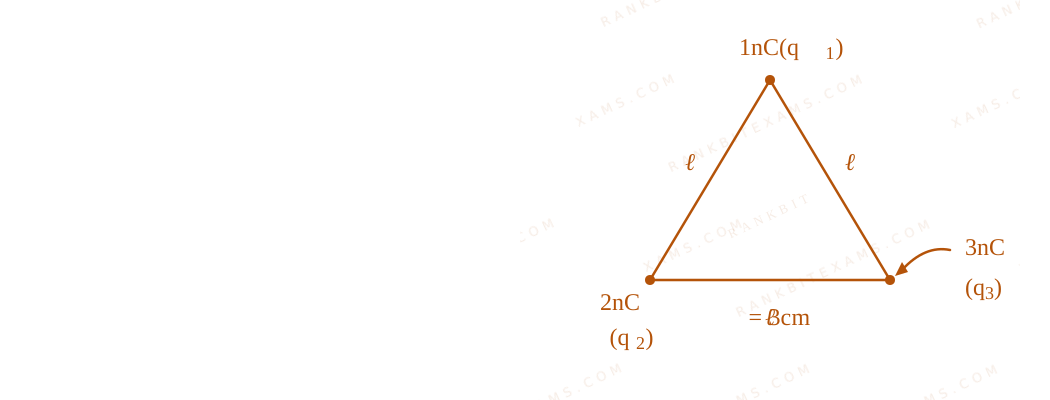
Two point charges of 1 nC and 2 nC are placed at the two corners of equilateral triangle of side 3 cm. The work done in bringing a charge of 3 nC from infinity to the third corner of the triangle is ____ . 14πε₀=9×10⁹ N· m²/C²
  • A. 2.7
  • B. 5.4
  • C. 3.3
  • D. 27

Solution

Related Formula
W = q₃ · Vsystem V = (kq₁)/(r₁) + (kq₂)/(r₂)
Core Logic

Work done is equal to the potential energy acquired by the 3 nC charge in the electric field of the other two charges.

Equilateral triangle charge diagram

Step 1: Formula Setup
W = ( (kq₁)/( ) + (kq₂)/( ) ) q₃
Step 2: Value Substitution
q₁ = 1 × 10⁻⁹ ~C q₂ = 2 × 10⁻⁹ ~C q₃ = 3 × 10⁻⁹ ~C = 3 × 10⁻² ~m W = 9 × 10⁹3 × 10⁻² ( 1 × 10⁻⁹ + 2 × 10⁻⁹ ) × 3 × 10⁻⁹
Step 3: Final Calculation
W = 3 × 10¹¹ × 3 × 10⁻⁹ × 3 × 10⁻⁹ W = 27 × 10⁻⁷ ~J = 2.7 × 10⁻⁶ ~J = 2.7
Pattern Recognition

Factor out common terms (k/) before substituting micro/nano orders to prevent simple arithmetic exponent errors.

Chapter Mix

Class 12 Physics: Electrostatic Potential and Capacitance

Q9 jee_main_2025_02_april_evening Electric Potential Difference
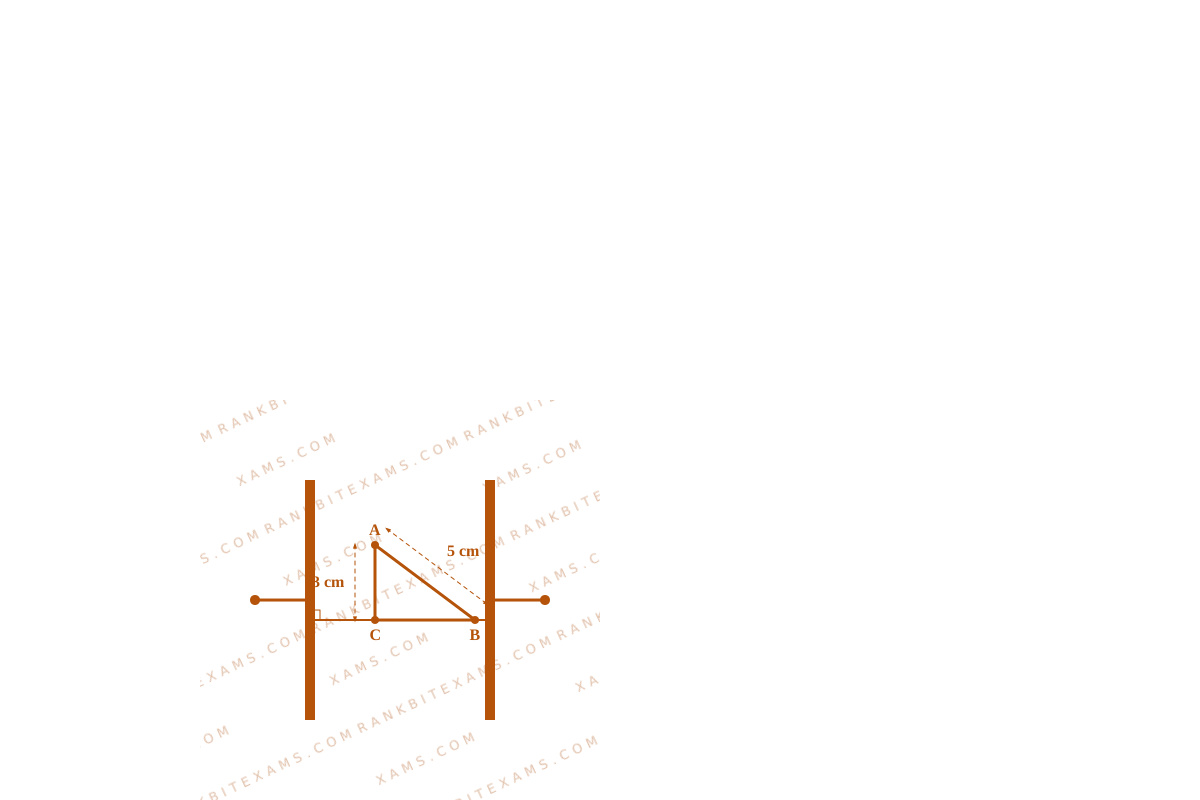
Two large plane parallel conducting plates are kept 10cm apart as shown in figure. The potential difference between them is V. The potential difference between the points A and B (shown in the figure) is :
Parallel conducting plates with potential difference V showing points A and B
The diagram shows two parallel plates separated by 10 cm, with points A and B defining a right triangle of legs 3 cm and 4 cm.
  • A. (1)/(4) ~V
  • B. (2)/(5) ~V
  • C. (3)/(4) ~V
  • D. 1 ~V

Solution

Related Formula
  • Uniform Electric Field between parallel plates:
E = (V)/(d)
  • Potential difference between two points along the direction of the field:
Δ V = E · Δ x
Core Logic

The separation between the plates is d = 10 cm. The electric field E between them is uniform and runs perpendicularly between the plates (along the horizontal direction, +x):

E = (V)/(10) V/cm

From the geometry shown in the figure:

  • AC = 3 cm is perpendicular to E (vertical direction).
  • CB = 4 cm is parallel to E (horizontal direction).
Step 1: Calculate potential difference between A and B

Since line AC is perpendicular to E:

VA - VC = 0 VA = VC

Thus, the potential difference between A and B is completely due to the horizontal displacement CB:

VAB = VA - VB = E · (CB)

Substitute the values:

VAB = ((V)/(10)) × 4 = (2)/(5) V

Thus, the potential difference between A and B is (2)/(5)V.

Pattern Recognition

Sees: Uniform electric field, potential difference over diagonal paths. Trap: Projecting along the hypotenuse length (5 cm) directly without considering the electric field's physical direction. Shortcut: Electric field is purely horizontal. Hence, only horizontal displacement matters. The horizontal displacement is 4 cm out of 10 cm total plate gap, so the potential difference is (4)/(10)V = (2)/(5)V.

Chapter Mix

Class 12 Physics: Electrostatic Potential and Capacitance

Q8 jee_main_2025_03_april_evening Combination of Capacitors and Charge Sharing
Using a battery, a 100~pF capacitor is charged to 60~V and then the battery is removed. After that, a second uncharged capacitor is connected to the first capacitor in parallel. If the final voltage across the second capacitor is 20~V, its capacitance is: (in pF)
  • A. 600
  • B. 200
  • C. 400
  • D. 100

Solution

Related Formula

When a charged capacitor C₁ with voltage V₁ is connected in parallel to an uncharged capacitor C₂, the common final potential Vc is determined by the conservation of charge:

Vc = (C₁ V₁ + C₂ V₂)/(C₁ + C₂)

Since C₂ is initially uncharged (V₂ = 0):

Vc = (C₁ V₁)/(C₁ + C₂)
Core Logic

Given parameters:

  • First capacitor C₁ = 100~pF
  • Initial potential V₁ = 60~V
  • Common final voltage Vc = 20~V
Step 1: Solve for C₂

Substitute the values into the common potential expression:

20 = (100 × 60)/(100 + C₂) 20(100 + C₂) = 6000 100 + C₂ = (6000)/(20) = 300 C₂ = 300 - 100 = 200~pF
Pattern Recognition

Think of common potential as dilution. The potential drops to 1/3 of its initial value (20~V/60~V). This requires the total capacitance to triple (3 × C₁). Since they are in parallel, the added capacitor must be 2 × C₁ = 200~pF.

Chapter Mix

Class 12 Physics: Electrostatic Potential and Capacitance

More Electrostatic Potential and Capacitance Questions — jee_main_2025_28_jan_morning

Practice all Electrostatic Potential and Capacitance previous-year questions →

Rankbit System
JEE Physics: Waves (+15.5%) | Electrostatics: Concentric Shells (-29.7%) | Modern Physics: Photoelectric Clones (+34.2%) | Mathematics: Definite Integrals (+18.1%) | Chemistry: Coordination Splitting (-11.4%) | JEE Physics: Waves (+15.5%) | Electrostatics: Concentric Shells (-29.7%) | Modern Physics: Photoelectric Clones (+34.2%) | Mathematics: Definite Integrals (+18.1%) | Chemistry: Coordination Splitting (-11.4%)