A capacitor P with capacitance 10 times 10^-6$10 \times 10^{-6}$ F is fully charged with a potential difference of 6.0 V and disconnected from the battery. The charged capacitor P is connected across another capacitor Q with capacitance 20 times 10^-6$20 \times 10^{-6}$ F. The charge on capacitor Q when equilibrium is established will be alpha times 10^-5$\alpha \times 10^{-5}$ C (assume capacitor Q does not have any charge initially), the value of alpha$\alpha$ is ____.
Numerical Answer Type:
Enter a numerical valueAnswer: 4 to 4+4 marks
Solution & Explanation
### Related Formula
V_textcommon = fracC_1 V_1 + C_2 V_2C_1 + C_2$$V_{\text{common}} = \frac{C_1 V_1 + C_2 V_2}{C_1 + C_2}$$Q_2 = C_2 V_textcommon$$Q_2 = C_2 V_{\text{common}}$$
### Core Logic
Given C_1 = 10 times 10^-6 mathrm~F, V_1 = 6.0 mathrm~V$C_1 = 10 \times 10^{-6} \mathrm{~F}, V_1 = 6.0 \mathrm{~V}$ and C_2 = 20 times 10^-6 mathrm~F, V_2 = 0 mathrm~V$C_2 = 20 \times 10^{-6} \mathrm{~F}, V_2 = 0 \mathrm{~V}$:
V_textcommon = frac10^-5 times 6 + 010^-5 + 2 times 10^-5 = frac6 times 10^-53 times 10^-5 = 2 mathrm~V$$V_{\text{common}} = \frac{10^{-5} \times 6 + 0}{10^{-5} + 2 \times 10^{-5}} = \frac{6 \times 10^{-5}}{3 \times 10^{-5}} = 2 \mathrm{~V}$$
Calculating final charge on capacitor Q (C_2$C_2$):
Q_2 = C_2 V_textcommon = (20 times 10^-6 mathrm~F) times 2 mathrm~V = 40 times 10^-6 mathrm~C = 4 times 10^-5 mathrm~C$$Q_2 = C_2 V_{\text{common}} = (20 \times 10^{-6} \mathrm{~F}) \times 2 \mathrm{~V} = 40 \times 10^{-6} \mathrm{~C} = 4 \times 10^{-5} \mathrm{~C}$$
Comparing with alpha times 10^-5 mathrm~C implies alpha = 4$\alpha \times 10^{-5} \mathrm{~C} \implies \alpha = 4$.
### Step 1: Final Conclusion
The value of alpha$\alpha$ is 4.
### Pattern Recognition
Charge distribution rule: Total initial charge Q_total = C_1 V_1 = 60\,mumathrmC$Q_{total} = C_1 V_1 = 60\,\mu\mathrm{C}$.
Final charge splits in proportion to capacitance ratio C_2 / (C_1+C_2) = 2/3$C_2 / (C_1+C_2) = 2/3$.
Q_2 = (2/3) times 60\,mumathrmC = 40\,mumathrmC = 4 times 10^-5mathrm~C$Q_2 = (2/3) \times 60\,\mu\mathrm{C} = 40\,\mu\mathrm{C} = 4 \times 10^{-5}\mathrm{~C}$.
### Evaluation Rubric / Model Answer
null
### Chapter Mix
Class 12 Physics: Electrostatic Potential and Capacitance
Keywords:#capacitor charge sharing common potential formula#JEE Main 2026 Evening Q48#Electrostatics JEE Main 2026#Capacitance JEE Main 2026
More Electrostatic Potential and Capacitance Previous-Year Questions
Q30jee_main_2026_22_january_eveningElectric Potential of Coalescing Bubbles
Three small identical bubbles of water having same charge on each coalesce to form a bigger bubble. Then the ratio of the potentials on one initial bubble and that on the resultant bigger bubble is :
A.1:3^1/3$1:3^{1/3}$
B.1:2^2/3$1:2^{2/3}$
C.3^2/3:1$3^{2/3}:1$
D.1:3^2/3$1:3^{2/3}$
Solution
### Related Formula
V = frackqr$$V = \frac{kq}{r}$$textVolume Conservation: N cdot left(frac43pi r^3right) = frac43pi R^3$$\text{Volume Conservation: } N \cdot \left(\frac{4}{3}\pi r^3\right) = \frac{4}{3}\pi R^3$$
### Core Logic
From volume conservation of 3 coalescing droplets:
3 left(frac43pi r^3right) = frac43pi R^3 implies R = 3^1/3r$$3 \left(\frac{4}{3}\pi r^3\right) = \frac{4}{3}\pi R^3 \implies R = 3^{1/3}r$$
Total charge on resultant bigger bubble Q = 3q$Q = 3q$.
Calculating initial potential V_i$V_i$ and final potential V_f$V_f$:
V_i = frackqr$$V_i = \frac{kq}{r}$$V_f = frack(3q)R = frac3kq3^1/3r = 3^2/3 frackqr$$V_f = \frac{k(3q)}{R} = \frac{3kq}{3^{1/3}r} = 3^{2/3} \frac{kq}{r}$$
Ratio of initial to final potential:
fracV_iV_f = frac13^2/3 = 1 : 3^2/3$$\frac{V_i}{V_f} = \frac{1}{3^{2/3}} = 1 : 3^{2/3}$$Coalescing charged bubbles diagram for Q30 - JEE Main 2026 Evening
### Step 1: Final Conclusion
The ratio of potentials is 1 : 3^2/3$1 : 3^{2/3}$.
### Pattern Recognition
Coalescing droplets rule: For N$N$ identical drops, R = N^1/3r$R = N^{1/3}r$ and Q = Nq$Q = Nq$.
Potential ratio V_i / V_f = 1 / N^2/3$V_i / V_f = 1 / N^{2/3}$. For N=3$N=3$, ratio is 1 / 3^2/3$1 / 3^{2/3}$.
### Evaluation Rubric / Model Answer
null
### Chapter Mix
Class 12 Physics: Electrostatic Potential and Capacitance
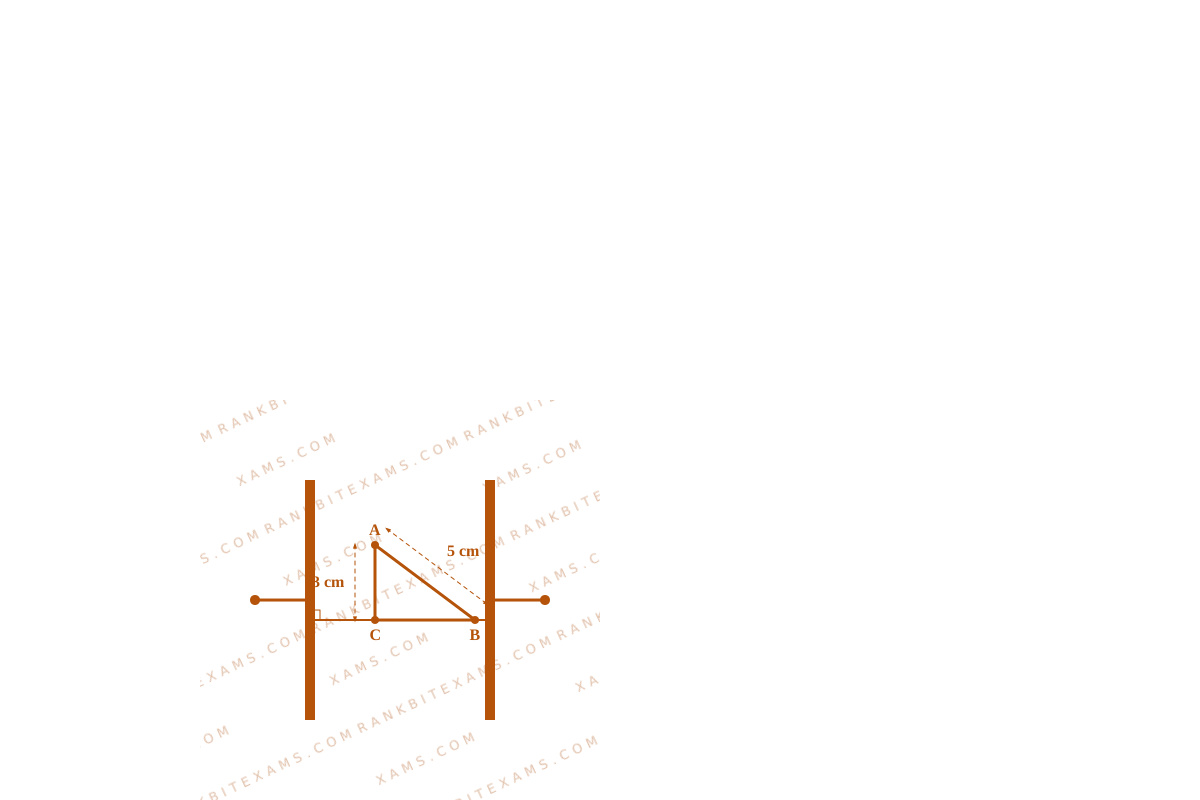
Two large plane parallel conducting plates are kept 10mathrmcm$10\mathrm{cm}$ apart as shown in figure. The potential difference between them is V. The potential difference between the points A and B (shown in the figure) is :
The diagram shows two parallel plates separated by 10 cm, with points A and B defining a right triangle of legs 3 cm and 4 cm.
A.frac14 mathrm~V$\frac{1}{4} \mathrm{~V}$
B.frac25 mathrm~V$\frac{2}{5} \mathrm{~V}$
C.frac34 mathrm~V$\frac{3}{4} \mathrm{~V}$
D.1 mathrm~V$1 \mathrm{~V}$
Solution
### Related Formula
1. Uniform Electric Field between parallel plates:
E = fracVd$$E = \frac{V}{d}$$
2. Potential difference between two points along the direction of the field:
Delta V = E cdot Delta x$$\Delta V = E \cdot \Delta x$$
### Core Logic
The separation between the plates is d = 10 \ mathrmcm$d = 10 \ \mathrm{cm}$. The electric field vecE$\vec{E}$ between them is uniform and runs perpendicularly between the plates (along the horizontal direction, +x$+x$):
E = fracV10 \ mathrmV/cm$$E = \frac{V}{10} \ \mathrm{V/cm}$$
From the geometry shown in the figure:
- AC = 3 \ mathrmcm$AC = 3 \ \mathrm{cm}$ is perpendicular to vecE$\vec{E}$ (vertical direction).
- CB = 4 \ mathrmcm$CB = 4 \ \mathrm{cm}$ is parallel to vecE$\vec{E}$ (horizontal direction).
### Step 1: Calculate potential difference between A and B
Since line AC$AC$ is perpendicular to vecE$\vec{E}$:
V_A - V_C = 0 implies V_A = V_C$$V_A - V_C = 0 \implies V_A = V_C$$
Thus, the potential difference between A$A$ and B$B$ is completely due to the horizontal displacement CB$CB$:
V_AB = V_A - V_B = E cdot (CB)$$V_{AB} = V_A - V_B = E \cdot (CB)$$
Substitute the values:
V_AB = left(fracV10right) times 4 = frac25 V$$V_{AB} = \left(\frac{V}{10}\right) \times 4 = \frac{2}{5} V$$
Thus, the potential difference between A$A$ and B$B$ is frac25V$\frac{2}{5}V$.
### Pattern Recognition
Sees: Uniform electric field, potential difference over diagonal paths.
Trap: Projecting along the hypotenuse length (5text cm$5\text{ cm}$) directly without considering the electric field's physical direction.
Shortcut: Electric field is purely horizontal. Hence, only horizontal displacement matters. The horizontal displacement is 4text cm$4\text{ cm}$ out of 10text cm$10\text{ cm}$ total plate gap, so the potential difference is frac410V = frac25V$\frac{4}{10}V = \frac{2}{5}V$.
### Evaluation Rubric / Model Answer
null
### Chapter Mix
Class 12 Physics: Electrostatic Potential and Capacitance
Q8jee_main_2025_03_april_eveningCombination of Capacitors and Charge Sharing
Using a battery, a 100mathrm~pF$100\mathrm{~pF}$ capacitor is charged to 60mathrm~V$60\mathrm{~V}$ and then the battery is removed. After that, a second uncharged capacitor is connected to the first capacitor in parallel. If the final voltage across the second capacitor is 20mathrm~V$20\mathrm{~V}$, its capacitance is: (in pF)
A. 600
B. 200
C. 400
D. 100
Solution
### Related Formula
When a charged capacitor C_1$C_1$ with voltage V_1$V_1$ is connected in parallel to an uncharged capacitor C_2$C_2$, the common final potential V_c$V_c$ is determined by the conservation of charge:
V_c = fracC_1 V_1 + C_2 V_2C_1 + C_2$$V_c = \frac{C_1 V_1 + C_2 V_2}{C_1 + C_2}$$
Since C_2$C_2$ is initially uncharged (V_2 = 0$V_2 = 0$):
V_c = fracC_1 V_1C_1 + C_2$$V_c = \frac{C_1 V_1}{C_1 + C_2}$$
### Core Logic
Given parameters:
- First capacitor C_1 = 100mathrm~pF$C_1 = 100\mathrm{~pF}$
- Initial potential V_1 = 60mathrm~V$V_1 = 60\mathrm{~V}$
- Common final voltage V_c = 20mathrm~V$V_c = 20\mathrm{~V}$
### Step 1: Solve for C_2$C_2$
Substitute the values into the common potential expression:
20 = frac100 times 60100 + C_2$$20 = \frac{100 \times 60}{100 + C_2}$$20(100 + C_2) = 6000$$20(100 + C_2) = 6000$$100 + C_2 = frac600020 = 300$$100 + C_2 = \frac{6000}{20} = 300$$C_2 = 300 - 100 = 200mathrm~pF$$C_2 = 300 - 100 = 200\mathrm{~pF}$$
### Pattern Recognition
Think of common potential as dilution. The potential drops to 1/3$1/3$ of its initial value (20mathrm~V/60mathrm~V$20\mathrm{~V}/60\mathrm{~V}$). This requires the total capacitance to triple (3 times C_1$3 \times C_1$). Since they are in parallel, the added capacitor must be 2 times C_1 = 200mathrm~pF$2 \times C_1 = 200\mathrm{~pF}$.
### Evaluation Rubric / Model Answer
null
### Chapter Mix
Class 12 Physics: Electrostatic Potential and Capacitance
Q20jee_main_2025_07_april_morningElectrostatic Potential Energy
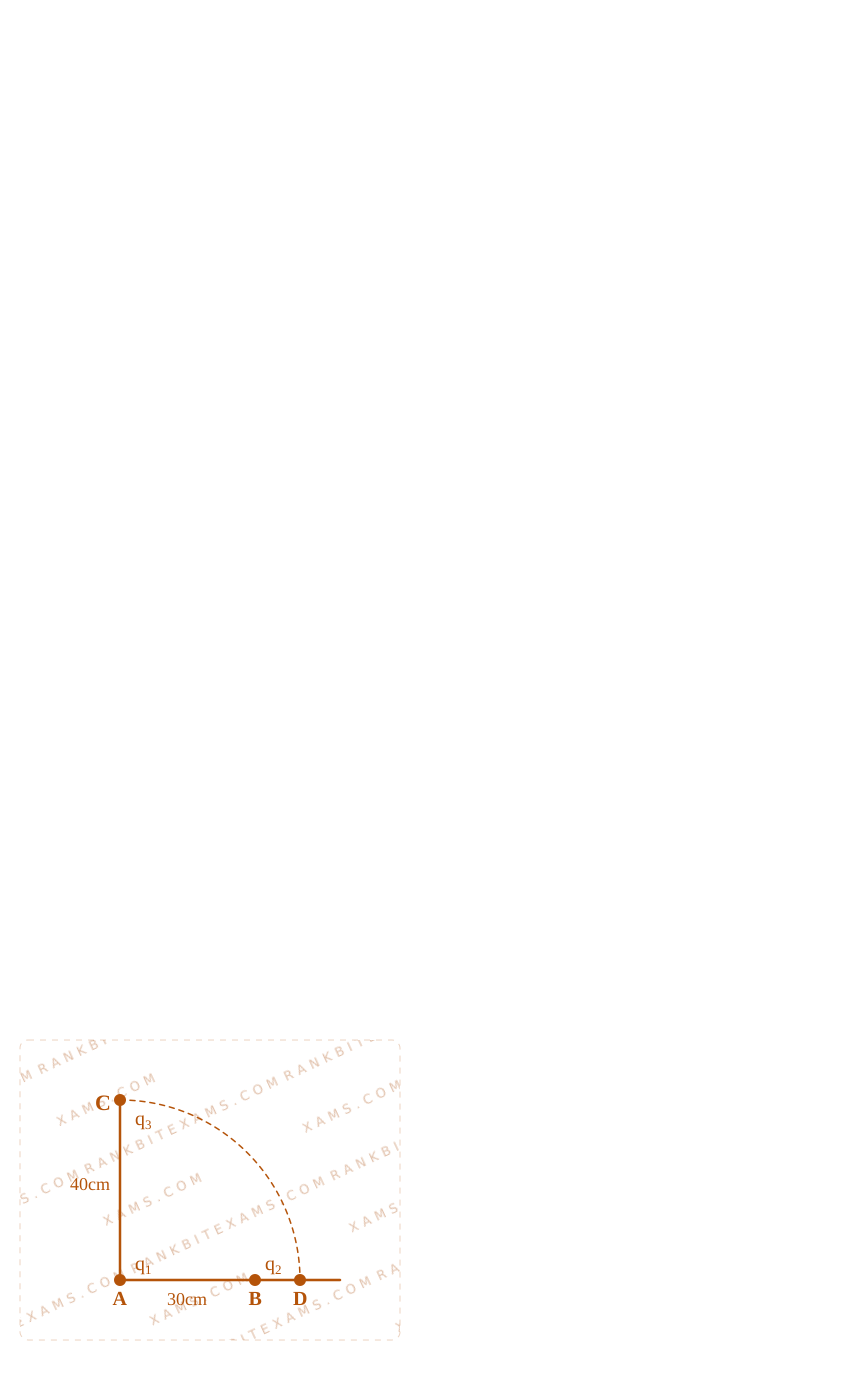
Two charges q_1$q_{1}$ and q_2$q_{2}$ are separated by a distance of 30 cm. A third charge q_3$q_{3}$ initially at 'C' as shown in the figure, is moved along the circular path of radius 40 cm from C to D. If the difference in potential energy due to movement of q_3$q_{3}$ from C to D is given by fracq_3K4pi in_0$\frac{q_3K}{4pi \in_0}$ , the value of K is: A charges layout with q1 at the center of the arc, q2 at 30 cm from q1, and q3 moving along the circular boundary of radius 40 cm.
A.8 mathrmq_2$8 \mathrm{q}_{2}$
B.6 mathrmq_2$6 \mathrm{q}_{2}$
C.8mathrmq_1$8\mathrm{q}_{1}$
D.6 mathrmq_1$6 \mathrm{q}_{1}$
Solution
### Related Formula
The change in potential energy Delta U$\Delta U$ of a charge q$q$ moved between two points of potentials V_C$V_C$ and V_D$V_D$ is:
Delta U = q_3 (V_D - V_C)$$\Delta U = q_3 (V_D - V_C)$$
Potential due to a point charge q$q$ at distance r$r$ is:
V = frac14piepsilon_0 fracqr$$V = \frac{1}{4\pi\epsilon_0} \frac{q}{r}$$
### Core Logic
Let point A$A$ hold charge q_1$q_1$ and B$B$ hold q_2$q_2$ separated by 30 mathrm~cm = 0.3 mathrm~m$30 \mathrm{~cm} = 0.3 \mathrm{~m}$.
- The path of q_3$q_3$ is a circular arc of radius R = 40 mathrm~cm = 0.4 mathrm~m$R = 40 \mathrm{~cm} = 0.4 \mathrm{~m}$ centered at A$A$. Thus, distance of C$C$ and D$D$ from q_1$q_1$ is constant:
r_1C = r_1D = 0.4 mathrm~m$$r_{1C} = r_{1D} = 0.4 \mathrm{~m}$$
- Distance of C$C$ from q_2$q_2$ (B$B$):
r_2C = sqrtAC^2 + AB^2 = sqrt40^2 + 30^2 = 50 mathrm~cm = 0.5 mathrm~m$$r_{2C} = \sqrt{AC^2 + AB^2} = \sqrt{40^2 + 30^2} = 50 \mathrm{~cm} = 0.5 \mathrm{~m}$$
- Distance of D$D$ from q_2$q_2$ (B$B$):
r_2D = AD - AB = 40 - 30 = 10 mathrm~cm = 0.1 mathrm~m$$r_{2D} = AD - AB = 40 - 30 = 10 \mathrm{~cm} = 0.1 \mathrm{~m}$$
### Step 1: Calculate Potentials
Potential at $
### Step 1: Calculate Potentials
Potential at $C due to $ due to $q_1 and $ and $q_2:
$:
$V_C = frac14piepsilon_0 left( fracq_10.4 + fracq_20.5 right)$V_C = \frac{1}{4\pi\epsilon_0} \left( \frac{q_1}{0.4} + \frac{q_2}{0.5} \right)$
Potential at $
Potential at $D due to $ due to $q_1 and $ and $q_2:
$:
$V_D = frac14piepsilon_0 left( fracq_10.4 + fracq_20.1 right)$V_D = \frac{1}{4\pi\epsilon_0} \left( \frac{q_1}{0.4} + \frac{q_2}{0.1} \right)$
### Step 2: Difference in Potential Energy
The potential difference is:
$
### Step 2: Difference in Potential Energy
The potential difference is:
$V_D - V_C = frac14piepsilon_0 left( fracq_20.1 - fracq_20.5 right) = fracq_24piepsilon_0 [10 - 2] = frac8q_24piepsilon_0$V_D - V_C = \frac{1}{4\pi\epsilon_0} \left( \frac{q_2}{0.1} - \frac{q_2}{0.5} \right) = \frac{q_2}{4\pi\epsilon_0} [10 - 2] = \frac{8q_2}{4\pi\epsilon_0}$
(Notice that the potential contribution of $
(Notice that the potential contribution of $q_1 cancels out because $ cancels out because $C and $ and $D are equidistant from $ are equidistant from $q_1).
The change in potential energy is:
$).
The change in potential energy is:
$Delta U = q_3 (V_D - V_C) = fracq_3 (8q_2)4piepsilon_0$\Delta U = q_3 (V_D - V_C) = \frac{q_3 (8q_2)}{4\pi\epsilon_0}$
Comparing with $
Comparing with $\frac{q_3 K}{4\pi\epsilon_0} yields $ yields $K = 8q_2.
### Pattern Recognition
Sees: Arc path centered on one of the charges.
Shortcut: Since the path is circular about $.
### Pattern Recognition
Sees: Arc path centered on one of the charges.
Shortcut: Since the path is circular about $q_1, $, $q_1 contributes nothing to the potential difference between the end points. The entire change in potential energy is due to $ contributes nothing to the potential difference between the end points. The entire change in potential energy is due to $q_2. The distance difference translates to potential difference $. The distance difference translates to potential difference $\Delta V = q_2 \left(\frac{1}{0.1} - \frac{1}{0.5}\right) = 8q_2, so $, so $K = 8q_2$.
### Evaluation Rubric / Model Answer
null
### Chapter Mix
Class 12 Physics: Electrostatic Potential and Capacitance
More Electrostatic Potential and Capacitance Questions — jee_main_2026_22_january_evening
We Map Every Repeating Question in Competitive Exams.
Say goodbye to generic mock test fatigue. RankBit uses smart analysis to group past exam questions into their foundational Repeating Question Types. Find chapter weightage, track repeating questions, and score higher with targeted practice.
Select Your Target Exam
Choose an exam track below to find formulas per chapter and patterns.
Syncing Exam Intelligence
Mapping formulas and patterns across all tracks…
PATH A — FULL LENGTH PRACTICE
Full Mock Test Hub
Simulate real NTA exam conditions with fully tracked mocks. Time yourself against past papers.
Practice past-year questions one chapter at a time. Pick an exam → subject → chapter and get every PYQ for that topic — pulled together from all past papers — with the chapter's key formulas alongside.