Q27
jee_main_2026_24_january_morning
Electric Dipole
Three charges +2q, +3q and -4q are situated at (0,-3a), (2a, 0) and (-2a,0) respectively in the xy plane. The resultant dipole moment about origin is
Solution
Related Formula
p = Σ qᵢ rᵢCore Logic
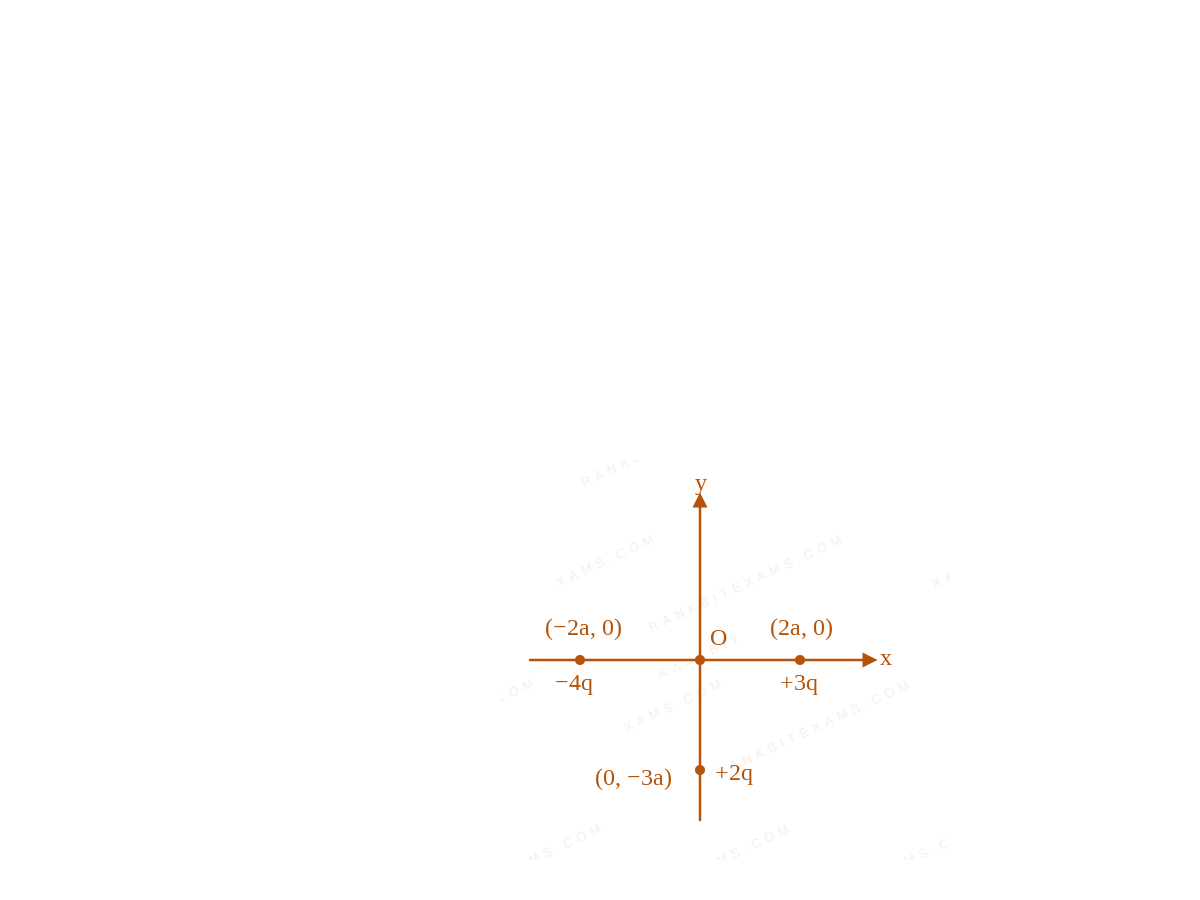
The resultant dipole moment for a system of charges is given by:
p = q₁ r₁ + q₂ r₂ + q₃ r₃Substituting the given values:
p = (2q)(-3a) j + (3q)(2a) i + (-4q)(-2a) i p = -6qa j + 6qa i + 8qa i p = 14qa i - 6qa j p = 2qa(7 i - 3 j)Pattern Recognition
For a system of point charges where the net charge is non-zero, the dipole moment depends on the origin. However, taking the standard formula Σ qᵢ rᵢ yields the required mathematical expression directly.
Chapter Mix
Class 12 Physics: Electric Charges and Fields