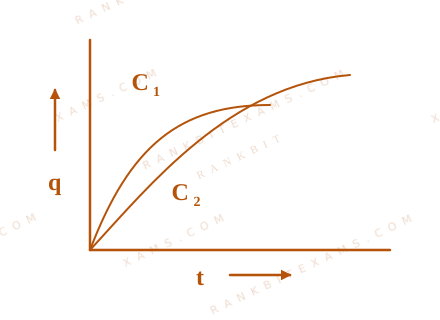
Two capacitors C₁$C_1$ and C₂$C_2$ are connected in parallel to a battery. Charge-time graph is shown below for the two capacitors. The energy stored with them are U₁$U_1$ and U₂$U_2$ , respectively. Which of the given statements is true?
The graph shows the variation of charge with time for two different capacitors connected in parallel.
Since both capacitors are connected in parallel across the same battery, their potential difference V$\mathrm{V}$ is identical.
From the given charge-time graph, at any specific instant of time, the charge accumulated on the second capacitor is greater than that on the first:
q₂ > q₁$$\mathrm{q}_2 > \mathrm{q}_1$$
Using the relation q = CV$\mathrm{q} = \mathrm{C}\mathrm{V}$, since V$\mathrm{V}$ is identical, we get:
C₂ > C₁$$\mathrm{C}_2 > \mathrm{C}_1$$
Now, the electrostatic energy stored in a capacitor is given by:
U = (1)/(2) CV²$$\mathrm{U} = \frac{1}{2} \mathrm{C}\mathrm{V}^2$$
Since C₂ > C₁$\mathrm{C}_2 > \mathrm{C}_1$ and V$\mathrm{V}$ is constant, the stored energy satisfies:
U₂ > U₁$$\mathrm{U}_2 > \mathrm{U}_1$$
Step 1: Final Conclusion
Thus, the correct relationships are C₂ > C₁$\mathrm{C}_2 > \mathrm{C}_1$ and U₂ > U₁$\mathrm{U}_2 > \mathrm{U}_1$.
Pattern Recognition
Sees parallel connection → Immediately lock potential difference V$\mathrm{V}$ as constant. This simplifies q ∝ C$\mathrm{q} \propto \mathrm{C}$ and U ∝ C$\mathrm{U} \propto \mathrm{C}$, creating a direct linear bridge from graph height to energy capacity.
Chapter Mix
Class 12 Physics: Electrostatic Potential and Capacitance
Keywords:#Two capacitors C1 and C2 are connected in parallel#JEE Main 2025 Morning Q1#Electrostatic Potential and Capacitance JEE Main 2025#Energy Stored in a Capacitor JEE Main 2025#Charge-time graph#Capacitor#Parallel combination
More Electrostatic Potential and Capacitance Previous-Year Questions — Page 3

Q35jee_main_2024_01_february_morningCapacitors and Capacitance
Two identical capacitors have same capacitance C$C$. One of them is charged to the potential V$V$ and other to the potential 2V$2V$. The negative ends of both are connected together. When the positive ends are also joined together, the decrease in energy of the combined system is:
Class 12 Physics: Electrostatic Potential and Capacitance
Q56jee_main_2024_29_january_eveningCapacitance and Resistor Networks at Steady State
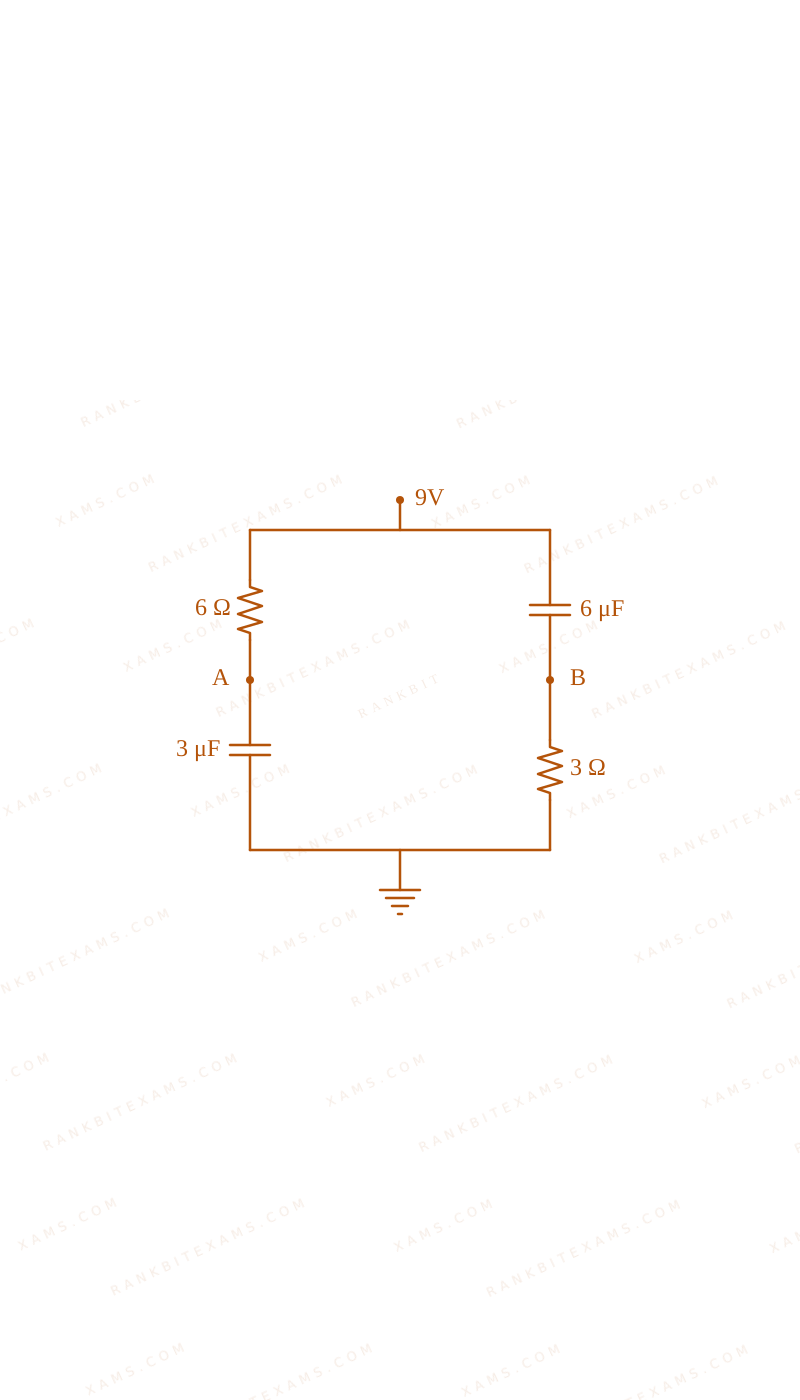
In the given figure, the charge stored in 6$6\mu\text{F}$ capacitor, when points A and B are joined by a connecting wire is ________ $\mu\text{C}$.
The diagram displays a bridge-like network containing a 6 Ohm resistor, 3uF capacitor, 6uF capacitor, and 3 Ohm resistor powered by a 9V supply.
Numerical Answer.Answer: 36 to 36
Solution
Related Formula
At steady state, a capacitor acts as an open circuit to DC current.
The charge on a capacitor is:
Q = C Δ V$Q = C \Delta V$
Core Logic
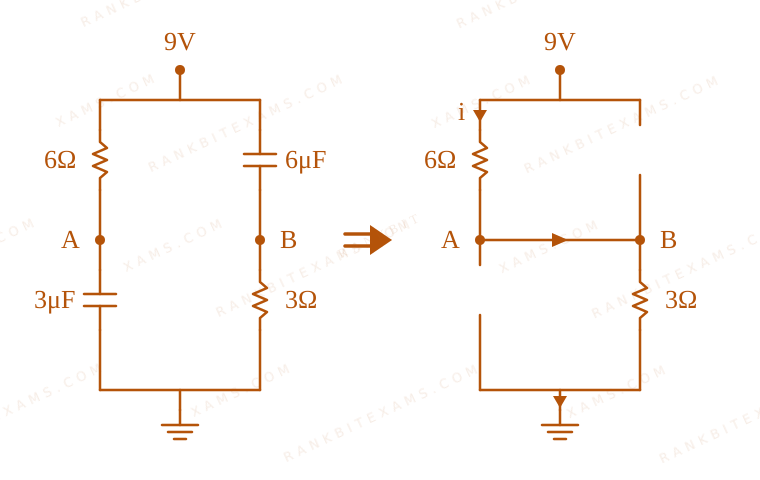
When node A$A$ and node B$B$ are connected by a wire, they reach the same electrical potential (VA = VB = VM$V_A = V_B = V_M$).
At DC steady state, capacitors block current, so current only flows through the resistors from the 9 V$9\text{ V}$ source to ground:
The 6 Ω$6\ \Omega$ resistor is connected between 9 V$9\text{ V}$ and node M$M$.
The 3 Ω$3\ \Omega$ resistor is connected between node M$M$ and ground.
Hence, the equivalent series resistance for the DC current path is:
The charge stored in the 6$6\mu\text{F}$ capacitor is:
Q = C Δ V = 6 × 6 V = 36$$Q = C \Delta V = 6\mu\text{F} \times 6\text{ V} = 36\ \mu\text{C}$$
Thus, the charge stored is 36$36\ \mu\text{C}$.
Pattern Recognition
Shorting A$A$ and B$B$ makes the network a simple voltage divider for resistors at steady state. Once potential of the middle node is found (3 V$3\text{ V}$), the capacitor charge is calculated instantly using Q = C Δ V$Q = C \Delta V$.
Chapter Mix
Class 12 Physics: Electrostatic Potential and Capacitance
Q57jee_main_2024_30_jan_morningEnergy Loss in Capacitors
A capacitor of capacitance C and potential V has energy E. It is connected to another capacitor of capacitance 2C and potential 2V. Then the loss of energy is (x)/(3)E$\frac{x}{3}E$, where x is ________.
Numerical Answer.Answer: 2 to 2
Solution
Related Formula
E = (1)/(2) C V²$$E = \frac{1}{2} C V^2$$Δ E = (1)/(2) (C₁ C₂)/(C₁ + C₂) (V₁ - V₂)²$$\Delta E = \frac{1}{2} \frac{C_1 C_2}{C_1 + C_2} (V_1 - V_2)^2$$
Core Logic
When two charged capacitors are connected in parallel, charge redistributes until they reach a common potential. During this redistribution, energy is dissipated as heat, strictly governed by the standard loss formula.
Step 1: Assign Values
Initial energy of first capacitor: E = (1)/(2) C V²$E = \frac{1}{2} C V^2$
Capacitor 1: C₁ = C$C_1 = C$, V₁ = V$V_1 = V$
Capacitor 2: C₂ = 2C$C_2 = 2C$, V₂ = 2V$V_2 = 2V$
Step 2: Calculate Energy Loss
Δ E = (1)/(2) ((C)(2C))/(C + 2C) (V - 2V)²$$\Delta E = \frac{1}{2} \frac{(C)(2C)}{C + 2C} (V - 2V)^2$$Δ E = (1)/(2) (2C²)/(3C) (-V)²$$\Delta E = \frac{1}{2} \frac{2C^2}{3C} (-V)^2$$Δ E = (1)/(2) ((2C)/(3)) V²$$\Delta E = \frac{1}{2} \left(\frac{2C}{3}\right) V^2$$Δ E = (2)/(3) ((1)/(2) C V²)$$\Delta E = \frac{2}{3} \left(\frac{1}{2} C V^2\right)$$Δ E = (2)/(3) E$$\Delta E = \frac{2}{3} E$$
Step 3: Match the Pattern
Given loss is (x)/(3)E$\frac{x}{3}E$.
Comparing, we get x = 2$x = 2$.
Pattern Recognition
The loss formula Δ E = (1)/(2) Ceq(Δ V)²$\Delta E = \frac{1}{2} C_{\text{eq}}(\Delta V)^2$ elegantly bypasses recalculating common potential Vc$V_c$ and summing final state energies.
Chapter Mix
Class 12 Physics: Electrostatic Potential and Capacitance
More Electrostatic Potential and Capacitance Questions — jee_main_2025_28_jan_morning
Practice past-year questions one chapter at a time. Pick an exam → subject → chapter and get every PYQ for that topic — pulled together from all past papers — with the chapter's key formulas alongside.