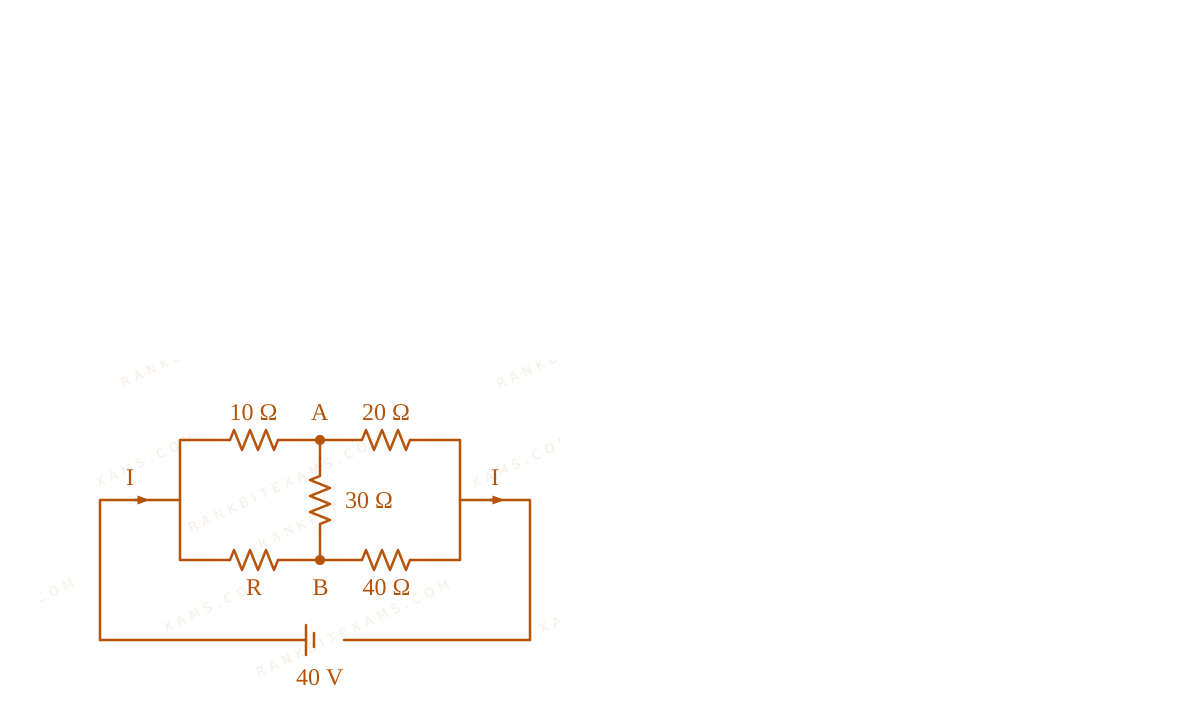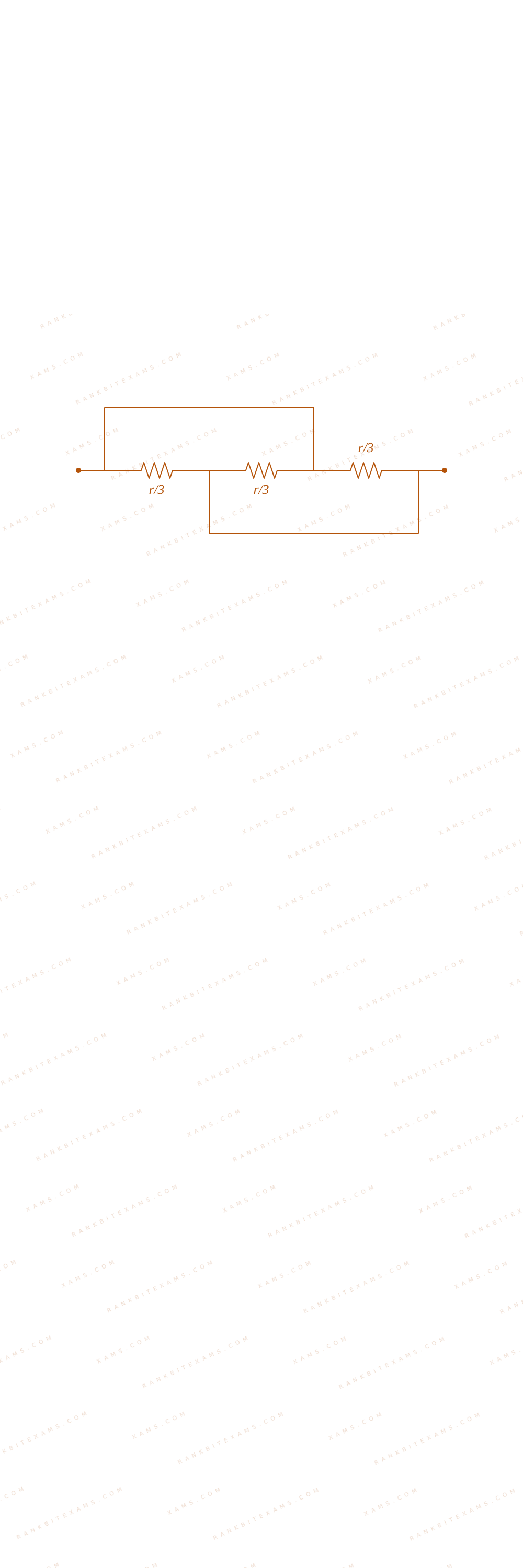

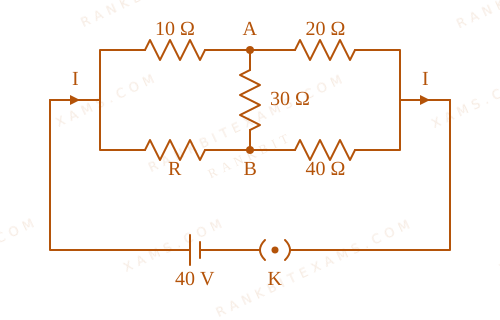
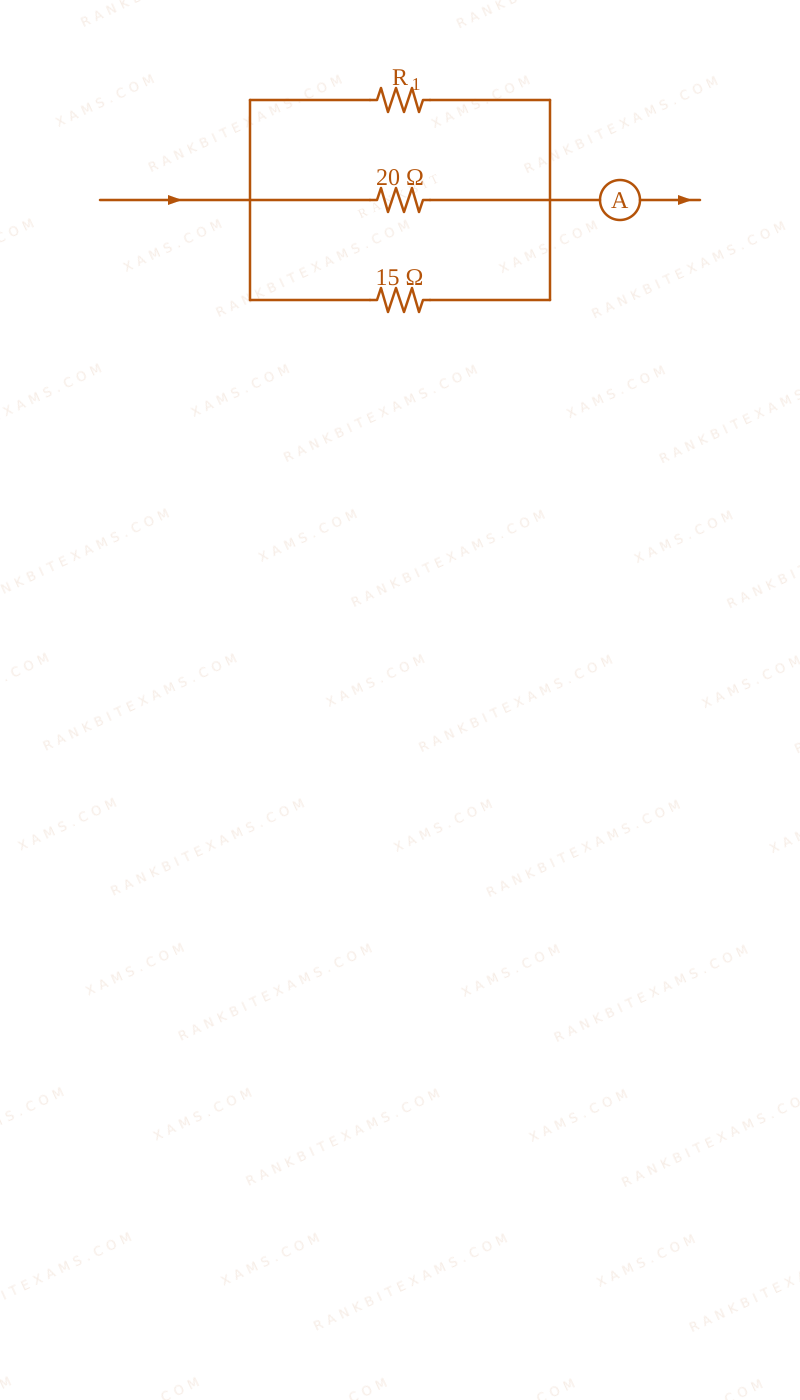
Find the equivalent resistance between two ends of the following circuit.
Combination of Resistors diagram for Q14 - JEE Main 2025 Morning
A complex looking resistive mesh whose node potentials reveal a simple symmetrical pattern.

Solution & Explanation

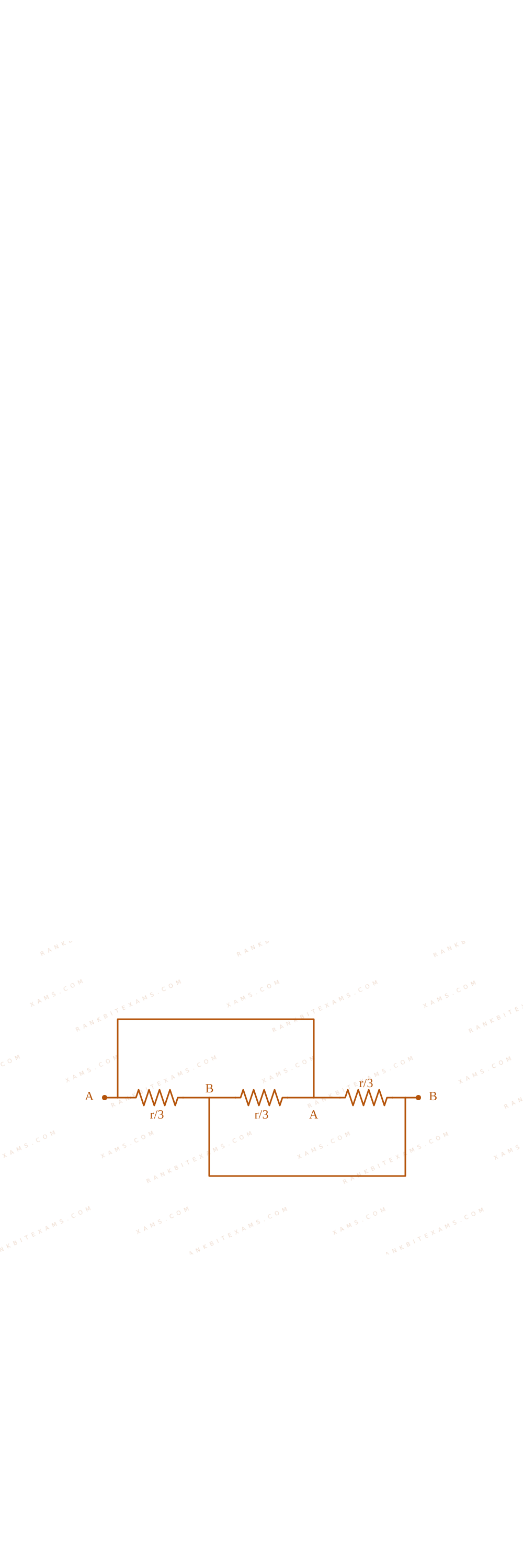
### Core Logic Label the circuit nodes carefully to see how the elements are connected across terminal zones:
Node potential labelling steps for Q14
A complex looking resistive mesh whose node potentials reveal a simple symmetrical pattern.
Node potential labelling steps for Q14
A complex looking resistive mesh whose node potentials reveal a simple symmetrical pattern.
Tracing parallel loops reveals all inner subsets share identical path boundaries. mathrmR_texteq = fracmathrmr/33 = fracmathrmr9 ### Step 1: Final Expression The overall simplified system network value equals fracmathrmr9, matching option (3). ### Pattern Recognition Short-circuit tracking lines allow collapsing complex meshes into basic parallel branches. If all nodes connect symmetrically, apply simple division: mathrmR/mathrmN. ### Evaluation Rubric / Model Answer null ### Chapter Mix Class 12 Physics: Current Electricity
Reference Study Guides

More Current Electricity Previous-Year Questions — Page 7

Q51 jee_main_2024_31_jan_evening Power in DC Circuits
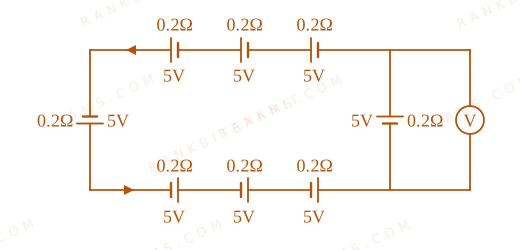
In the following circuit, the battery has an emf of 2 text V and an internal resistance of frac23 \, Omega. The power consumption in the entire circuit is ______ W.
Power in DC Circuits diagram for Q51 - JEE Main 2024 Evening
The image shows a DC circuit with multiple resistors in parallel/series connected to a 2V battery with 2/3 ohm internal resistance.
Numerical Answer. Answer: 3 to 3

Solution

### Related Formula P = fracV^2R_eq ### Core Logic To find total power, collapse the entire external circuit and battery internal resistance into a single equivalent resistance R_eq across the battery's ideal terminals. ### Step 1: Equivalent Resistance Calculation Analyzing the diagram: The circuit simplifies to an equivalent resistance R_eq combining the parallel/series elements along with the internal resistance r = 2/3 \, Omega. The final simplified equivalent resistance of the entire system calculates to: R_eq = frac43 \, Omega ### Step 2: Calculate Power P = fracV^2R_eq P = frac2^24/3 P = frac44/3 = 3 text W ### Pattern Recognition Whenever "entire circuit" power is asked, include the battery's internal resistance inside R_eq so you can use P = E^2 / R_total directly. ### Evaluation Rubric / Model Answer null ### Chapter Mix Class 12 Physics: Current Electricity
Q48 jee_main_2024_31_jan_morning Temperature Dependence Of Resistance
Two conductors have the same resistances at 0^circmathrmC but their temperature coefficients of resistance are alpha_1 and alpha_2. The respective temperature coefficients for their series and parallel combinations are :
  • A. alpha_1 + alpha_2, fracalpha_1 + alpha_22
  • B. fracalpha_1 + alpha_22, fracalpha_1 + alpha_22
  • C. alpha_1 + alpha_2, fracalpha_1alpha_2alpha_1 + alpha_2
  • D. fracalpha_1 + alpha_22, alpha_1 + alpha_2

Solution

### Related Formula R_T = R_0(1 + alpha Delta T) ### Step 1: Series Combination Let base resistance at 0^circ textC be R. For series: R_texteq = R_1 + R_2 (2R)[1 + alpha_texteq,s Delta T] = R(1 + alpha_1 Delta T) + R(1 + alpha_2 Delta T) 2 + 2alpha_texteq,s Delta T = 2 + (alpha_1 + alpha_2)Delta T alpha_texteq,s = fracalpha_1 + alpha_22 ### Step 2: Parallel Combination For parallel at 0^circ textC, R_texteq,0 = R/2. R_texteq,p = fracR_1 R_2R_1 + R_2 fracR2 [1 + alpha_texteq,p Delta T] = fracR^2 (1 + alpha_1 Delta T)(1 + alpha_2 Delta T)R(2 + (alpha_1 + alpha_2)Delta T) frac12 (1 + alpha_texteq,p Delta T) = frac1 + (alpha_1 + alpha_2)Delta T2left(1 + fracalpha_1 + alpha_22Delta Tright) Using binomial expansion for small Delta T: 1 + alpha_texteq,p Delta T approx [1 + (alpha_1 + alpha_2)Delta T] left[ 1 - fracalpha_1 + alpha_22Delta T right] 1 + alpha_texteq,p Delta T approx 1 + (alpha_1 + alpha_2)Delta T - fracalpha_1 + alpha_22Delta T alpha_texteq,p Delta T = fracalpha_1 + alpha_22Delta T alpha_texteq,p = fracalpha_1 + alpha_22 ### Pattern Recognition For two identical base resistances, the effective temperature coefficient is simply the arithmetic mean of their individual coefficients, regardless of whether they are in series or parallel. ### Evaluation Rubric / Model Answer null ### Chapter Mix Class 12 Physics: Current Electricity
Q53 jee_main_2024_31_jan_morning Resistor Circuits
Equivalent resistance of the following network is ________ Omega
Resistor Circuits diagram for Q53 - JEE Main 2024 Morning
A complex resistor bridge network connecting nodes A and B with multiple branches.
Numerical Answer. Answer: 1 to 1

Solution

### Related Formula R_textparallel = frac1sum frac1R_i ### Core Logic
Resistor Circuits diagram for Q53 - JEE Main 2024 Morning
A complex resistor bridge network connecting nodes A and B with multiple branches.
By carefully identifying the nodes, we can see that a 6\,Omega resistor in the middle branch is short-circuited by a direct zero-resistance wire path across it.
Resistor Circuits diagram for Q53 - JEE Main 2024 Morning
A complex resistor bridge network connecting nodes A and B with multiple branches.
Removing the short-circuited 6\,Omega resistor simplifies the circuit into three identical branches connected directly between the terminals A and B.
Resistor Circuits diagram for Q53 - JEE Main 2024 Morning
A complex resistor bridge network connecting nodes A and B with multiple branches.
### Step 2: Equivalent Calculation The simplified circuit consists of three identical 3\,Omega resistors in parallel. R_texteq = 3 times frac13 = 1\,Omega ### Pattern Recognition Always trace nodes directly connected by straight wires (zero resistance). Any resistor with both ends connecting to the exact same electrical node is shorted out and can be erased. ### Evaluation Rubric / Model Answer null ### Chapter Mix Class 12 Physics: Current Electricity
More Current Electricity Questions — jee_main_2025_28_jan_morning

Practice all Current Electricity previous-year questions →

Rankbit System
JEE Physics: Waves (+15.5%) | Electrostatics: Concentric Shells (-29.7%) | Modern Physics: Photoelectric Clones (+34.2%) | Mathematics: Definite Integrals (+18.1%) | Chemistry: Coordination Splitting (-11.4%) | JEE Physics: Waves (+15.5%) | Electrostatics: Concentric Shells (-29.7%) | Modern Physics: Photoelectric Clones (+34.2%) | Mathematics: Definite Integrals (+18.1%) | Chemistry: Coordination Splitting (-11.4%)