
JEE Main · Physics → Steady

Current Electricity appeared 50 times across 3 years — 5.8% of Physics. This question is from Combination of Resistors.

Year 2026 2025 2024 Total
Questions 18 13 19 50

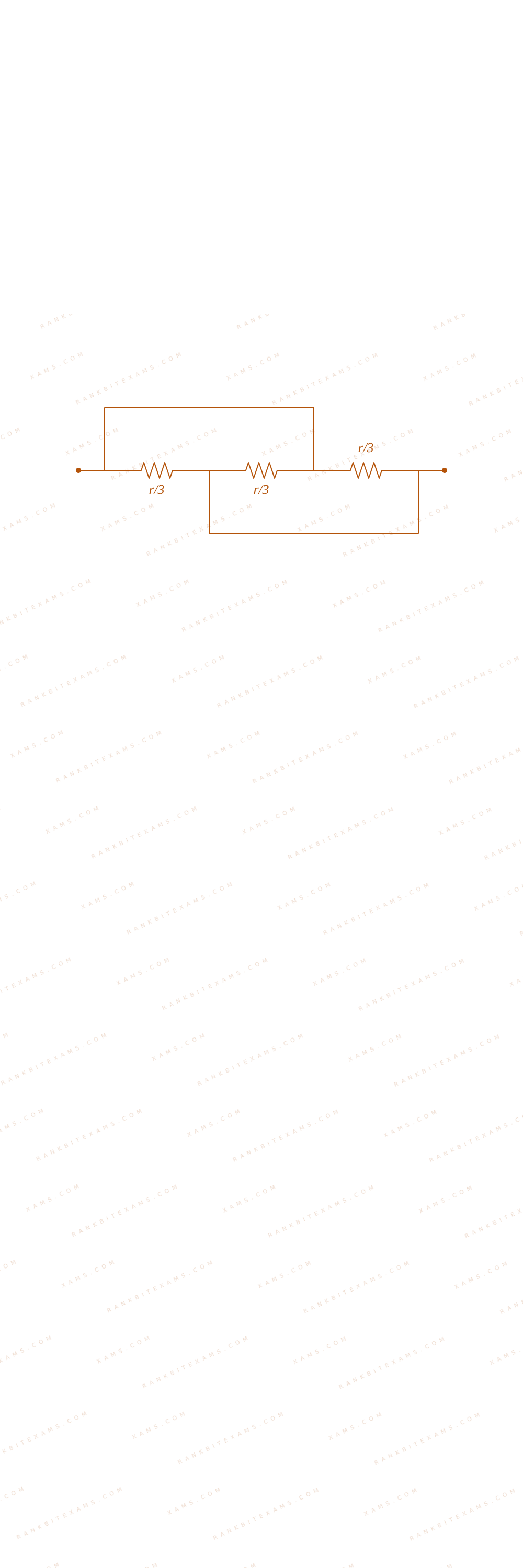
Find the equivalent resistance between two ends of the following circuit.
Combination of Resistors diagram for Q14 - JEE Main 2025 Morning
A complex looking resistive mesh whose node potentials reveal a simple symmetrical pattern.

Solution & Explanation

Core Logic

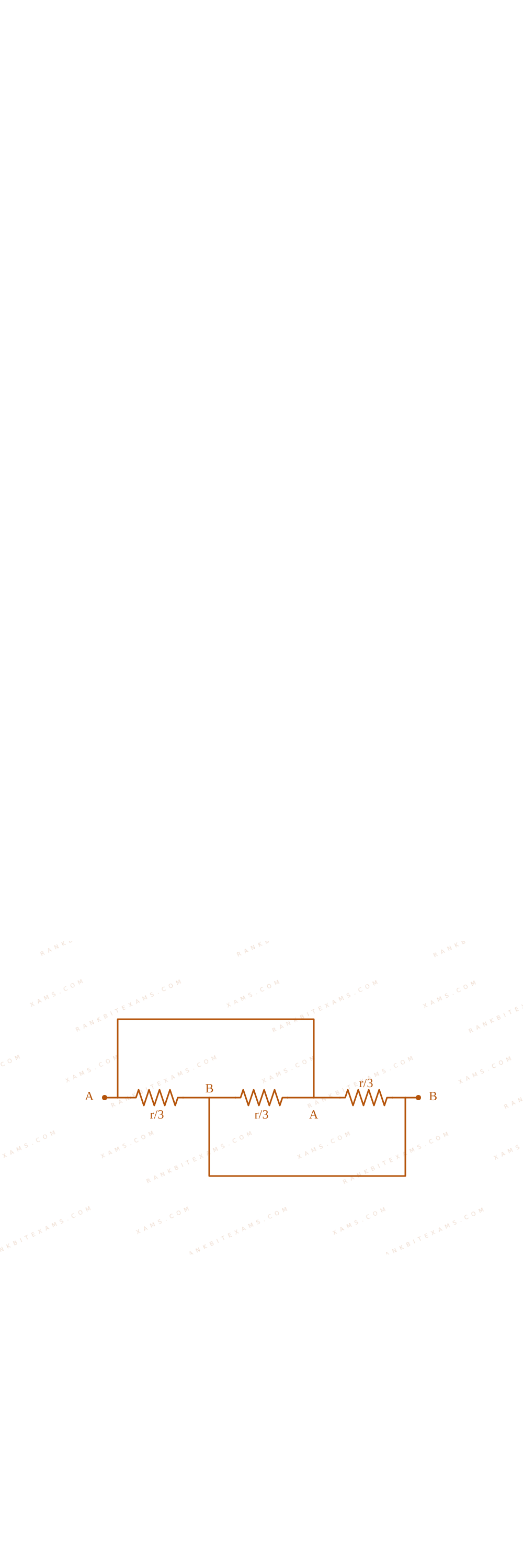
Label the circuit nodes carefully to see how the elements are connected across terminal zones:

Node potential labelling steps for Q14
A complex looking resistive mesh whose node potentials reveal a simple symmetrical pattern.

Node potential labelling steps for Q14
A complex looking resistive mesh whose node potentials reveal a simple symmetrical pattern.

Tracing parallel loops reveals all inner subsets share identical path boundaries.

Req = r/33 = r9
Step 1: Final Expression

The overall simplified system network value equals r9, matching option (3).

Pattern Recognition

Short-circuit tracking lines allow collapsing complex meshes into basic parallel branches. If all nodes connect symmetrically, apply simple division: R/N.

Chapter Mix

Class 12 Physics: Current Electricity

Reference Study Guides

More Current Electricity Previous-Year Questions — Page 10

Q39 jee_main_2024_31_jan_evening Meter Bridge
The resistance per centimeter of a meter bridge wire is r, with X Ω resistance in left gap. Balancing length from left end is at 40 cm with 25 Ω resistance in right gap. Now the wire is replaced by another wire of 2r resistance per centimeter. The new balancing length for same settings will be at
  • A. 20 cm
  • B. 10 cm
  • C. 80 cm
  • D. 40 cm

Solution

Related Formula
RleftRwire-left = RrightRwire-right
Core Logic

For a meter bridge, the balancing condition is independent of the absolute resistance of the bridge wire as long as it is uniform. The ratio of the resistances in the gaps balances with the ratio of lengths.
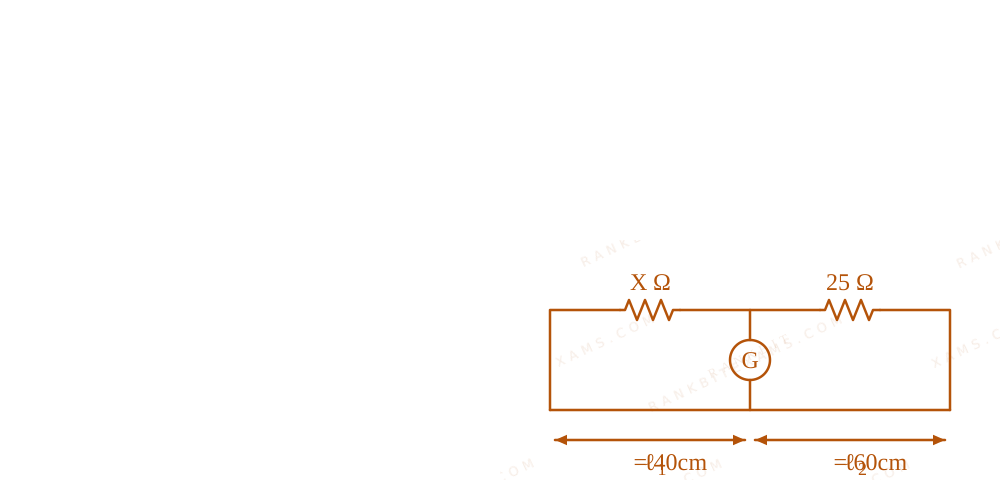
Meter Bridge diagram for Q39 - JEE Main 2024 Evening

Step 1: First Condition
(X)/(r ₁) = (25)/(r (100 - ₁))

Given ₁ = 40 cm:

(X)/(r × 40) = (25)/(r × 60) (X)/(40) = (25)/(60)
Step 2: Second Condition

When replaced by a wire of 2r per cm, the new lengths ₂ will satisfy:

(X)/(2r ₂) = (25)/(2r (100 - ₂))

Notice that the 2r terms cancel out entirely from both sides, leaving:

(X)/( ₂) = (25)/(100 - ₂)
Step 3: Conclusion

Since the ratio X/25 remains identical, the balancing length ratio / (100- ) also remains identical. Therefore, ₂ = ₁ = 40 cm.

Pattern Recognition

Meter bridge balance point strictly depends on length ratio, NOT the specific resistivity or thickness of the wire (provided it is uniform). If external resistors don't change, the balance point never changes.

Chapter Mix

Class 12 Physics: Current Electricity
Q43 jee_main_2024_31_jan_evening Power Dissipation
By what percentage will the illumination of the lamp decrease if the current drops by 20%?
  • A. 46%
  • B. 26%
  • C. 36%
  • D. 56%

Solution

Related Formula

Power (Illumination) is proportional to the square of the current for a constant resistance: P = I² R

Core Logic

Initial power: P₁ = I₁² R

If current drops by 20%, the new current is:

I₂ = I₁ - 0.2 I₁ = 0.8 I₁

New power:

P₂ = (0.8 I₁)² R = 0.64 I₁² R = 0.64 P₁
Step 1: Calculate Percentage Change
Δ P % = (P₂ - P₁)/(P₁) × 100% Δ P % = (0.64 P₁ - P₁)/(P₁) × 100% Δ P % = (0.64 - 1) × 100% = -36%
Step 2: Final Statement

The negative sign indicates a decrease. The illumination drops by 36%.

Pattern Recognition

For squared relations y = x², if x changes by a factor k (0.8), y changes by a factor k² (0.64). 1 - 0.64 = 36%. This bypasses algebraic limits usually done for small changes (like 2Δ x / x) since 20% is too large for approximation.

Chapter Mix

Class 12 Physics: Current Electricity
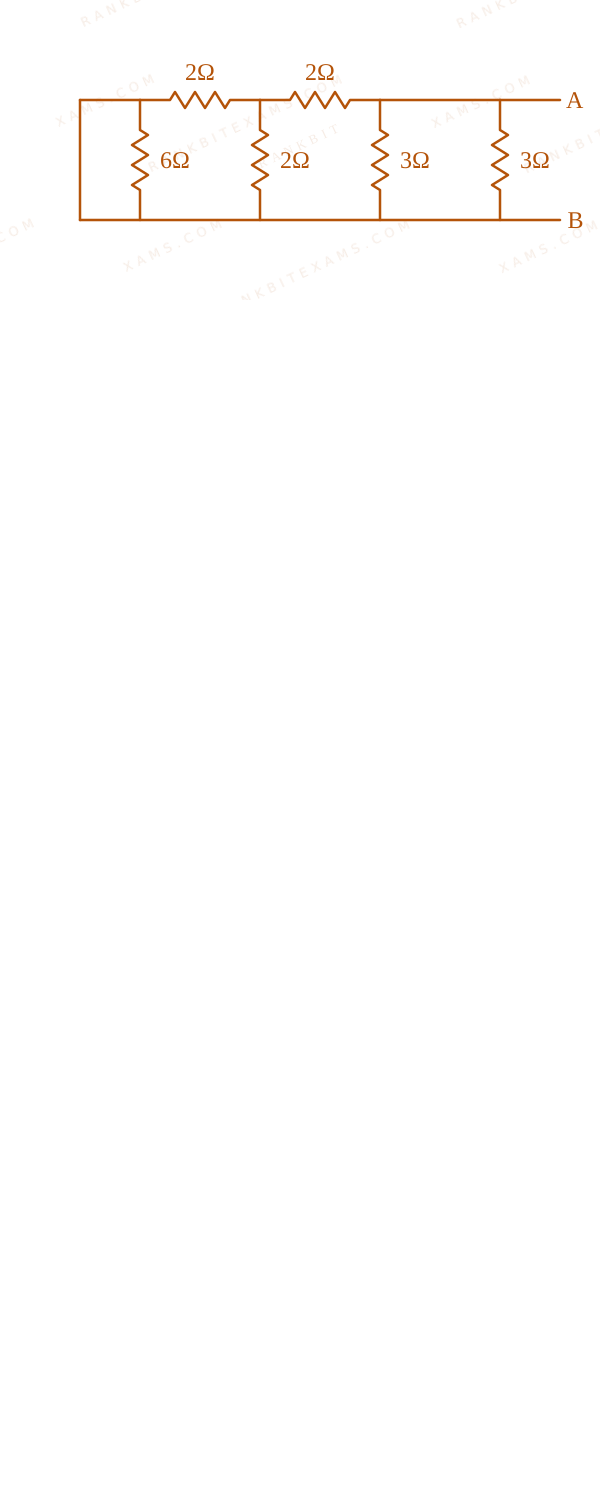
Q51 jee_main_2024_31_jan_evening Power in DC Circuits
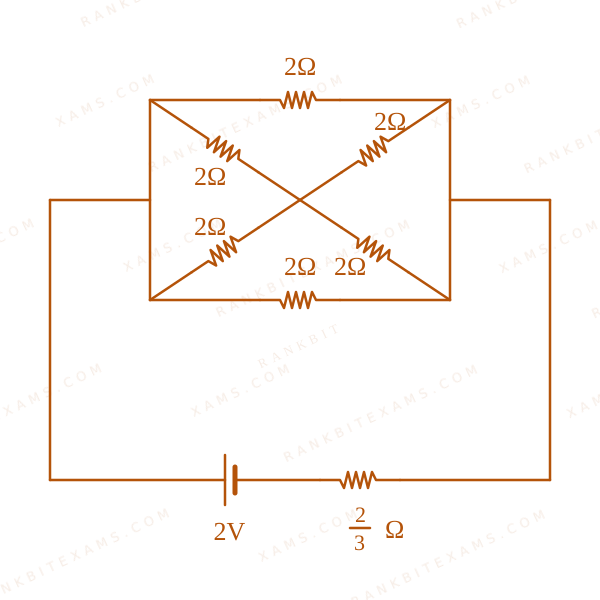
In the following circuit, the battery has an emf of 2 V and an internal resistance of (2)/(3) Ω. The power consumption in the entire circuit is ______ W.
Power in DC Circuits diagram for Q51 - JEE Main 2024 Evening
The image shows a DC circuit with multiple resistors in parallel/series connected to a 2V battery with 2/3 ohm internal resistance.
Numerical Answer. Answer: 3 to 3

Solution

Related Formula
P = V²Req
Core Logic

To find total power, collapse the entire external circuit and battery internal resistance into a single equivalent resistance Req across the battery's ideal terminals.

Step 1: Equivalent Resistance Calculation

Analyzing the diagram: The circuit simplifies to an equivalent resistance Req combining the parallel/series elements along with the internal resistance r = 2/3 Ω. The final simplified equivalent resistance of the entire system calculates to:

Req = (4)/(3) Ω
Step 2: Calculate Power
P = V²Req P = (2²)/(4/3) P = (4)/(4/3) = 3 W
Pattern Recognition

Whenever "entire circuit" power is asked, include the battery's internal resistance inside Req so you can use P = E² / Rtotal directly.

Chapter Mix

Class 12 Physics: Current Electricity
Q jee_main_2024_31_jan_morning Resistor Circuits
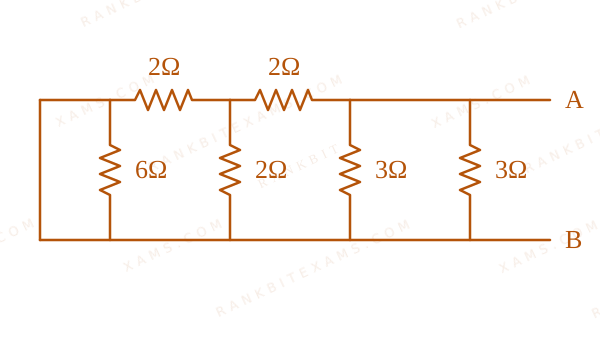
Equivalent resistance of the following network is ________ Ω
Resistor Circuits diagram for Q53 - JEE Main 2024 Morning
A complex resistor bridge network connecting nodes A and B with multiple branches.
Numerical Answer. Answer: 1 to 1

Solution

Related Formula
Rparallel = (1)/(Σ (1)/(Rᵢ))
Core Logic

Resistor Circuits diagram for Q53 - JEE Main 2024 Morning
A complex resistor bridge network connecting nodes A and B with multiple branches.

By carefully identifying the nodes, we can see that a 6 Ω resistor in the middle branch is short-circuited by a direct zero-resistance wire path across it.

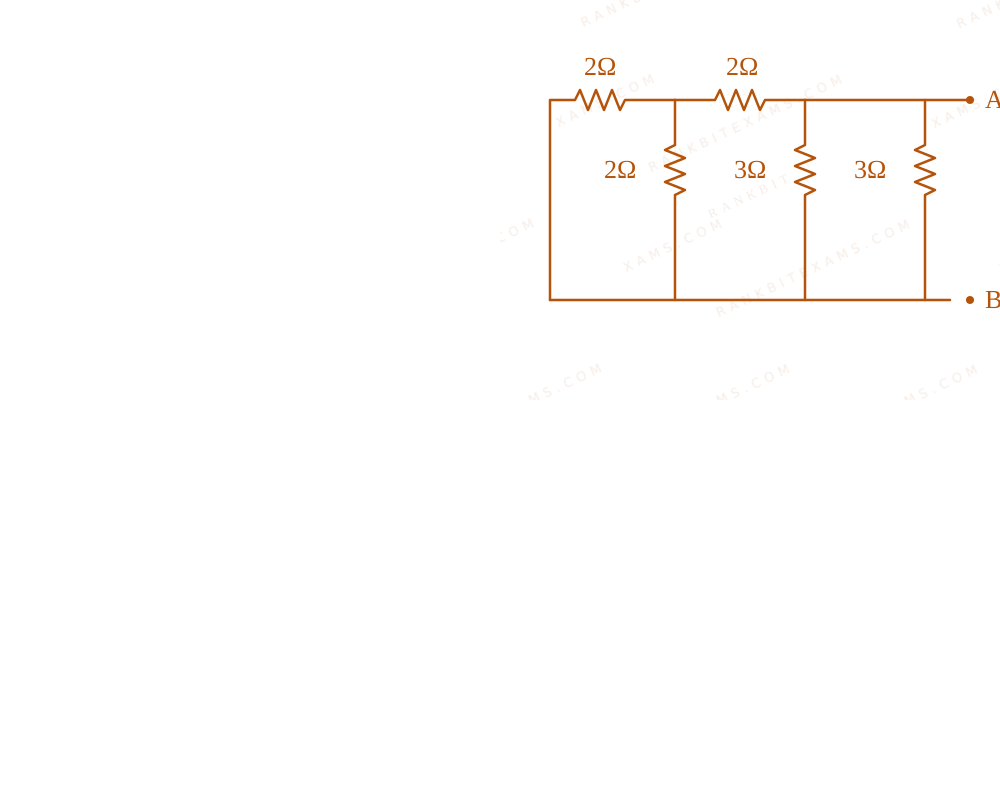
Resistor Circuits diagram for Q53 - JEE Main 2024 Morning
A complex resistor bridge network connecting nodes A and B with multiple branches.

Removing the short-circuited 6 Ω resistor simplifies the circuit into three identical branches connected directly between the terminals A and B.

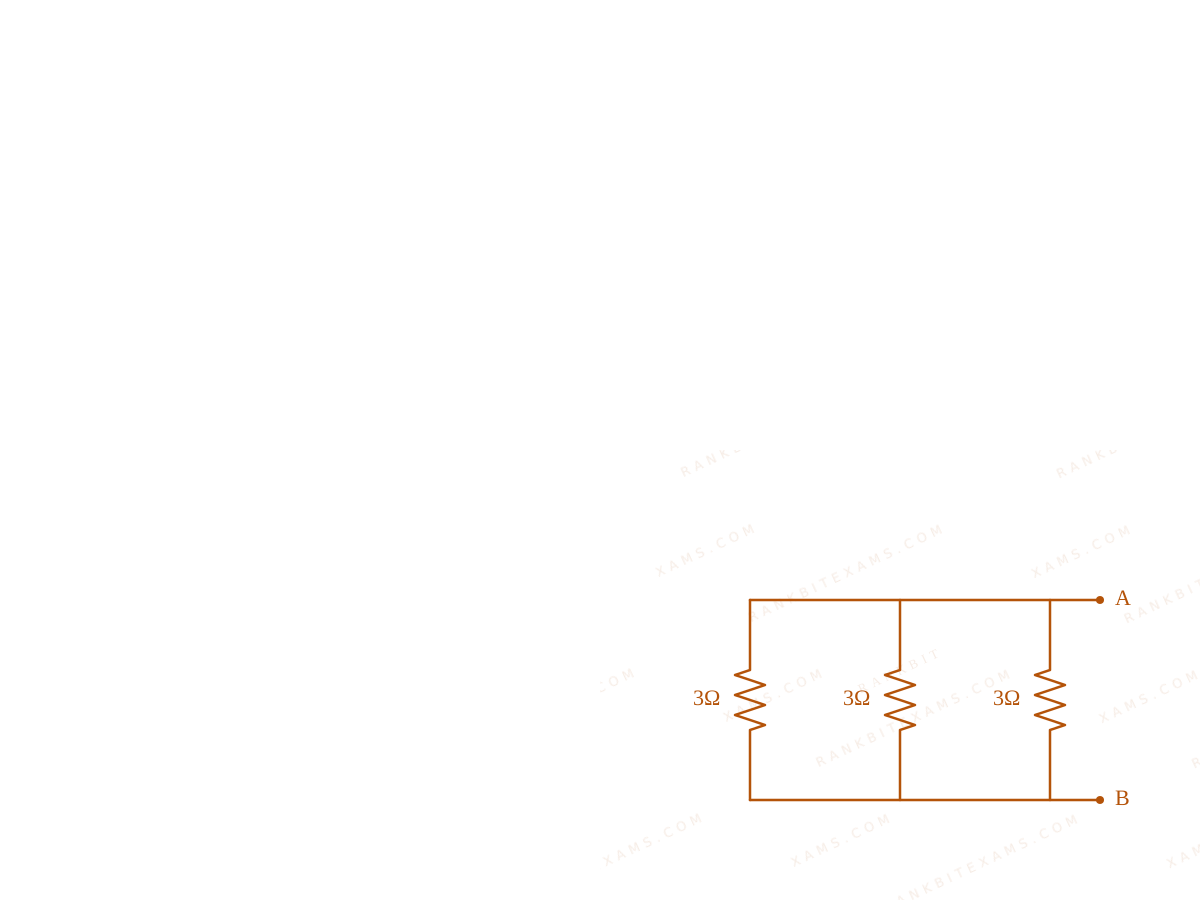
Resistor Circuits diagram for Q53 - JEE Main 2024 Morning
A complex resistor bridge network connecting nodes A and B with multiple branches.

Step 2: Equivalent Calculation

The simplified circuit consists of three identical 3 Ω resistors in parallel.

Req = 3 × (1)/(3) = 1 Ω
Pattern Recognition

Always trace nodes directly connected by straight wires (zero resistance). Any resistor with both ends connecting to the exact same electrical node is shorted out and can be erased.

Chapter Mix

Class 12 Physics: Current Electricity
Q48 jee_main_2024_31_jan_morning Temperature Dependence Of Resistance
Two conductors have the same resistances at 0°C but their temperature coefficients of resistance are α₁ and α₂. The respective temperature coefficients for their series and parallel combinations are :
  • A. α₁ + α₂, (α₁ + α₂)/(2)
  • B. (α₁ + α₂)/(2), (α₁ + α₂)/(2)
  • C. α₁ + α₂, (α₁α₂)/(α₁ + α₂)
  • D. (α₁ + α₂)/(2), α₁ + α₂

Solution

Related Formula
RT = R₀(1 + α Δ T)
Step 1: Series Combination

Let base resistance at 0^° C be R. For series:

Req = R₁ + R₂ (2R)[1 + αeq,s Δ T] = R(1 + α₁ Δ T) + R(1 + α₂ Δ T) 2 + 2αeq,s Δ T = 2 + (α₁ + α₂)Δ T αeq,s = (α₁ + α₂)/(2)
Step 2: Parallel Combination

For parallel at 0^° C, Req,0 = R/2.

Req,p = (R₁ R₂)/(R₁ + R₂) (R)/(2) [1 + αeq,p Δ T] = (R² (1 + α₁ Δ T)(1 + α₂ Δ T))/(R(2 + (α₁ + α₂)Δ T)) (1)/(2) (1 + αeq,p Δ T) = (1 + (α₁ + α₂)Δ T)/(2(1 + (α₁ + α₂)/(2)Δ T))

Using binomial expansion for small Δ T:

1 + αeq,p Δ T ≈ [1 + (α₁ + α₂)Δ T] [ 1 - (α₁ + α₂)/(2)Δ T ] 1 + αeq,p Δ T ≈ 1 + (α₁ + α₂)Δ T - (α₁ + α₂)/(2)Δ T αeq,p Δ T = (α₁ + α₂)/(2)Δ T αeq,p = (α₁ + α₂)/(2)
Pattern Recognition

For two identical base resistances, the effective temperature coefficient is simply the arithmetic mean of their individual coefficients, regardless of whether they are in series or parallel.

Chapter Mix

Class 12 Physics: Current Electricity
More Current Electricity Questions — jee_main_2025_28_jan_morning

Practice all Current Electricity previous-year questions →

Rankbit System
JEE Physics: Waves (+15.5%) | Electrostatics: Concentric Shells (-29.7%) | Modern Physics: Photoelectric Clones (+34.2%) | Mathematics: Definite Integrals (+18.1%) | Chemistry: Coordination Splitting (-11.4%) | JEE Physics: Waves (+15.5%) | Electrostatics: Concentric Shells (-29.7%) | Modern Physics: Photoelectric Clones (+34.2%) | Mathematics: Definite Integrals (+18.1%) | Chemistry: Coordination Splitting (-11.4%)
